Titanic, Treaty and Savita2012 CE
In 2012, Ireland pursued recovery under EU–IMF bailout conditions while households faced austerity, unemployment and renewed emigration. Voters approved the Fiscal Compact, reinforcing permanent budgetary discipline, and endorsed the Children’s Referendum, though it had not commenced by year’s end. The Government introduced the household charge, employment activation measures, constitutional convention and Gaeltacht legislation. Savita Halappanavar’s death during miscarriage complications intensified demands for abortion-law clarity and healthcare accountability. Dublin hosted the Eucharistic Congress amid diminished Church authority, while Katie Taylor’s Olympic gold lifted morale. In Northern Ireland, Titanic Belfast opened, McGuinness met the Queen, and flag protests exposed enduring identity tensions.
Dateline
In 2012 Ireland was still living through the long aftershock of the banking collapse, but it was no longer simply a country in acute financial rescue. The Fine Gael–Labour coalition led by Enda Kenny sought to show that the State could meet the terms of its EU–IMF assistance programme, regain credibility abroad and make institutions more durable at home. For households, however, recovery remained largely an official promise. Unemployment was exceptionally high, emigration had again become an ordinary fact of family life, and austerity was felt in taxes, public services and insecure work. The year’s defining public arguments therefore concerned not only money, but sovereignty, constitutional rights, national memory and the moral authority of major institutions.
A Vote in the Bailout Era
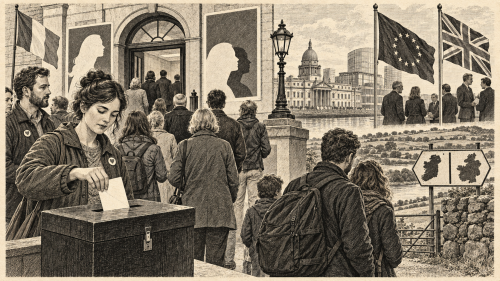
The central political event in the Republic was the referendum of 31 May on the European Fiscal Compact, formally the Treaty on Stability, Coordination and Governance in the Economic and Monetary Union. Ireland was the only state to put this particular treaty to a popular vote. Its opponents argued that it would entrench austerity and place further limits on democratic economic choice; its supporters maintained that ratification was necessary to demonstrate financial reliability and preserve access to future euro-area assistance. The campaign made the external constraints on Irish policymaking unusually visible. The State’s fiscal decisions were being judged not merely in Leinster House but by European institutions, the International Monetary Fund and lenders in international markets.
Voters endorsed the amendment by 955,091 votes to 629,088: 60.3 per cent to 39.7 per cent on a turnout of 50.6 per cent. The result authorised the State to ratify the treaty; it did not settle the argument over its social costs. The Compact’s rules on balanced budgets, structural deficits and public debt fitted the wider discipline already demanded under Ireland’s rescue programme. Its passage nevertheless gave the Government a conspicuous electoral mandate at a moment when it hoped to negotiate more favourable treatment of the heavy bank-related burden assumed by the State.
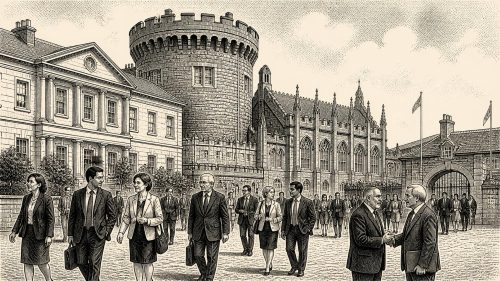
The referendum belonged to a wider programme of fiscal reconstruction. The European Commission assessed implementation of the adjustment programme as strong, while warning that domestic demand remained weak even though exports had helped return the economy to modest growth. In December the Fiscal Responsibility Act came into force, placing fiscal rules in statute and establishing the Irish Fiscal Advisory Council as an independent body to assess compliance and official forecasts. These measures reflected an important change in the machinery of government: after the crisis, budgetary restraint was being recast as a permanent institutional obligation rather than an emergency expedient.
The economic settlement was experienced very differently outside official reports. A €100 household charge became payable by residential-property owners from January, as an interim levy before a value-based property tax. It proved deeply unpopular, especially among people who believed they had already borne the costs of rescuing banks and whose homes had lost much of their market value. The levy was modest beside the wider retrenchment, but it was tangible: a direct annual demand on householders and a symbol of the State’s search for new revenue.
Departure, Work and Everyday Pressure
Statistics published during 2012 made the human scale of the downturn plain. For the year ending in April, the Central Statistics Office estimated 87,100 emigrants and net outward migration of 34,400. Irish nationals accounted for 46,500 of those leaving. At the same time, natural increase meant that the population still rose slightly, to about 4.59 million. This combination is revealing: Ireland was not simply emptying, but many communities were losing working-age relatives, friends and neighbours even as births continued and immigration had not ceased altogether. The regional experience was uneven, with the Mid-East still growing while the Border region recorded the largest estimated decline.
By the third quarter, the seasonally adjusted unemployment rate stood at 14.8 per cent. The Government responded with activation and employment schemes, including the early rollout of Intreo, designed to combine income support with employment services. Its advocates presented this as a move from passive welfare provision towards individualised assistance into work. Yet the language of activation could not remove the scarcity of secure jobs, particularly in construction and locally focused businesses. Export-oriented firms and multinational investment offered signs of resilience, but this did not quickly repair the damage in towns and estates shaped by the property boom and its collapse.
There were also quieter signs that the State was reconsidering how it made policy. In July, the Dáil approved the calling of a Convention on the Constitution. Its agenda included same-sex marriage, the constitutional description of women’s role in the home, women’s participation in public life, the voting age, presidential voting rights for citizens abroad and the offence of blasphemy. The Convention first met on 1 December. In a period when emergency finance narrowed immediate choices, this was a deliberate opening towards longer-term constitutional debate and greater citizen involvement.
Children, Health and Public Trust
On 10 November, voters approved the proposed Thirty-First Amendment, commonly called the Children’s Referendum. The proposal won 615,731 votes to 445,863, though turnout was only 33.49 per cent. It affirmed children’s rights, provided a clearer constitutional basis for adoption in specified circumstances and required that the best interests of the child be paramount in designated proceedings. The vote was significant in a society still confronting the institutional failures exposed by reports into abuse and neglect. A legal challenge meant that the amendment did not take constitutional effect in 2012; that distinction matters. What happened in the year was a popular approval of the proposal, not its eventual commencement.
The most consequential personal tragedy of the year was the death of Savita Halappanavar at University Hospital Galway in the early hours of 28 October, following complications during a miscarriage. Her case became public in November and immediately prompted demands for clarity about the law governing abortion where a pregnant woman’s life was at risk, as well as questions about clinical care, communication and accountability. An Garda Síochána assisted the coroner, while the Health Service Executive initiated an investigation. Later official inquiries identified grave failings in care and in recognising deterioration, but those findings belong to 2013 and should not be projected backwards as though they were known in 2012. What can firmly be said of 2012 is that Savita’s death brought an unresolved constitutional and medical issue into urgent public view.
Faith, Language and Public Culture
From 10 to 17 June Dublin hosted the 50th International Eucharistic Congress, its theme being communion with Christ and with one another. The event recalled the enormous 1932 congress, but took place in a very different Ireland: one in which the Catholic Church remained socially important while its prestige had been badly damaged by revelations of clerical abuse and institutional wrongdoing. The Congress was therefore both an international religious gathering and an occasion for a Church in Ireland to confront, however imperfectly, questions of renewal, trust and wounded authority.
The Oireachtas also enacted the Gaeltacht Act on 25 July. It provided for Gaeltacht language-planning areas, Gaeltacht service towns and Irish-language networks, shifting emphasis towards the social conditions in which Irish could be used daily rather than treating boundaries alone as a guarantee of linguistic vitality. Its principal language-planning provisions were commenced later, in 2013, so 2012 should be understood as the year in which the legislative framework was created. Even so, the Act marked an important acknowledgement that the future of Irish depended on communities, schools, services and settlement patterns as much as on cultural symbolism.
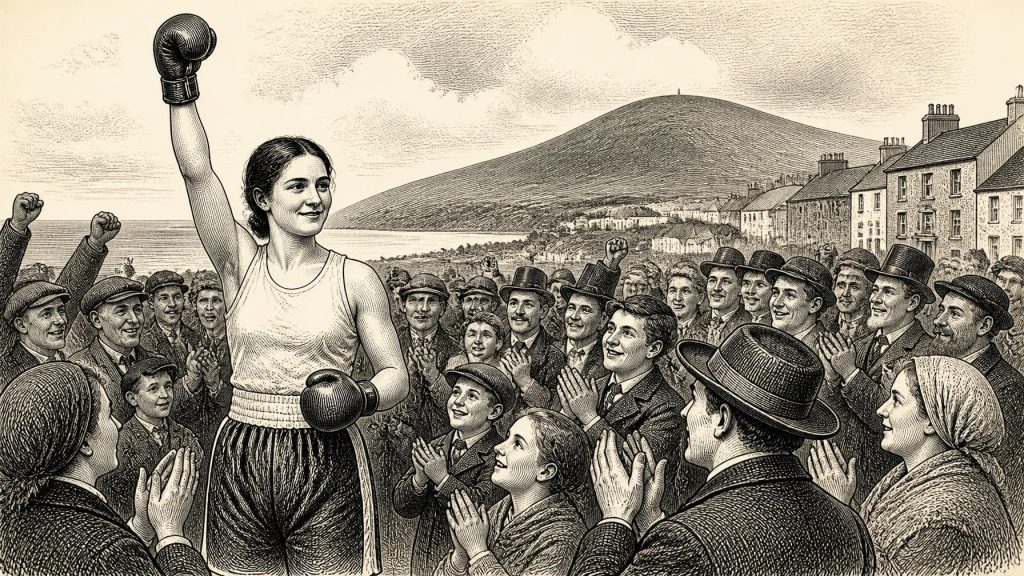
Sport supplied a rare, uncomplicated collective celebration. In August, Katie Taylor of Bray won Olympic gold in women’s lightweight boxing at London 2012, defeating Russia’s Sofya Ochigava in the final. Women’s boxing had entered the Olympic programme for the first time, and Taylor became its first champion. Her victory had an importance beyond the medal table: it rewarded a highly accomplished athlete, demonstrated the reach of women’s sport in Ireland and gave a recession-weary public a moment of shared confidence.
Belfast: Memory and Reconciliation
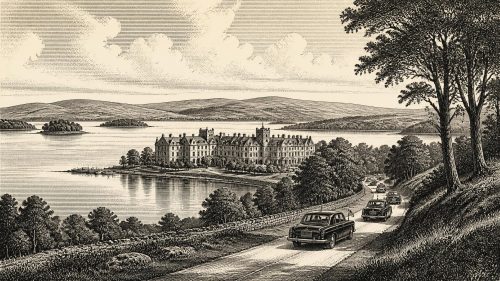
Northern Ireland’s year combined ambitious civic renewal with reminders that symbols still carried political charge. Titanic Belfast opened on 31 March beside the slipways and industrial landscape associated with Harland and Wolff, timed to the centenary of the ship’s maiden voyage and loss. The new visitor attraction used a global story to re-present Belfast’s shipbuilding past as a cultural and tourism asset. It formed part of a wider attempt to make the city’s industrial heritage economically productive rather than solely a memory of decline.
On 27 June, Deputy First Minister Martin McGuinness met and shook hands with Queen Elizabeth II at the Lyric Theatre in Belfast, in the presence of President Michael D. Higgins and First Minister Peter Robinson. For a senior Sinn Féin figure and former IRA commander to meet the British monarch was a carefully judged act of reconciliation, made possible by the peace process but not an indication that all divisions had vanished. That tension was exposed again in December when Belfast City Council adopted a designated-days policy for flying the Union flag at City Hall, a decision that helped trigger loyalist protests. Thus 2012 contained both a powerful public gesture across a historic divide and a sharp illustration of the continuing sensitivity of identity in Northern Ireland.
By the end of the year, Ireland’s condition was neither recovery nor collapse. The State had passed a major European treaty, maintained its bailout commitments and begun to build new fiscal and constitutional institutions. Yet emigration, unemployment and household charges showed how far economic repair remained from everyday security. The year’s most lasting images were strikingly different: a boxer celebrating gold, a new museum rising on Belfast’s docks, adversaries extending hands, and vigils after Savita Halappanavar’s death. Together they show a society negotiating its future under pressure, while old questions of equality, identity, faith and democratic power acquired new urgency.
Primary Sources
- Ireland and the EU: Timeline of Key Events
- Ireland Passes Fiscal Treaty Referendum by 60.3% to 39.7%
- Economic Adjustment Programme for Ireland — Winter 2011 Review
- IMF Completes Seventh Review Under the Extended Arrangement with Ireland and Approves €0.92 Billion Disbursement
- Population and Migration Estimates: April 2012
- Live Register: December 2012
- Census 2011 Preliminary Report
- Budget 2012
- Report on the Accounts of the Public Services 2012
- Fiscal Responsibility Act 2012
- Constitutional Convention: Motion
- Convention on the Constitution Final Reports: Statements
- Referendum on the Thirty-First Amendment of the Constitution (Children) Bill 2012
- Thirty-First Amendment of the Constitution (Children) Act 2012
- Death of Savita Halappanavar
- Patient Safety Investigation Report Published by Health Information and Quality Authority (Savita Halappanavar)
- 50th International Eucharistic Congress Dublin (Ireland)
- Gaeltacht Act 2012
- It’s Gold for Katie
- Britain’s Queen Elizabeth Meets Sinn Féin’s Martin McGuinness
- Minutes of the Strategic Policy and Resources and Voluntary Transition Committees
- The Duke of York Visits Titanic Belfast
- The Official Report: Titanic Centenary, 16 January 2012