

Musical Homecomings
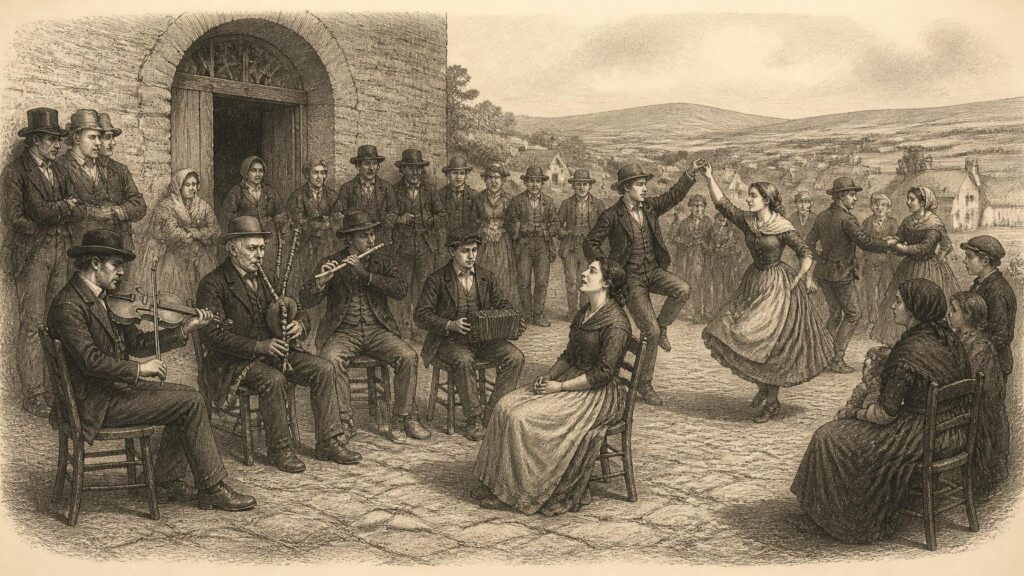
AI generated historical illustration, not a contemporary photograph.
At a Glance
Fleadh Cheoil na hÉireann is not an immemorial survival from a remote Gaelic past, though it draws deeply on older Irish musical, linguistic and festive practices. It is a documented modern creation: a competition festival conceived in 1951, in a country marked by emigration, economic uncertainty and anxiety about the standing of traditional music. From its first gathering in Mullingar, the Fleadh became one of the chief places in which Irish music was heard, judged, taught, argued over, displayed in public and carried abroad. Its history is therefore not simply the history of an annual celebration, but of cultural organisation: volunteers, branches, adjudicators, competitors, broadcasters, teachers, publicans, host towns and travelling families making a tradition visible.
Festival Inheritance
The Irish word fleadh can mean a feast or festival, while ceoil means music. In ordinary modern usage, however, “the Fleadh” commonly denotes Fleadh Cheoil na hÉireann, the All-Ireland festival associated with Comhaltas Ceoltóirí Éireann. That shorthand can obscure an important distinction. The national event sits at the summit of a wider system of county, provincial and overseas fleadhanna, and it developed from organisational precedents rather than appearing fully formed in 1951.
One crucial precedent was the feis, a competition festival closely connected with the cultural programme of the Gaelic League. From the late nineteenth century, feiseanna brought together contests, timetables, printed syllabi, adjudication, concerts, dance and Irish-language activity. The Irish Traditional Music Archive’s surviving programmes demonstrate that such events created an established machinery for putting cultural performance into public view. By the middle of the twentieth century, the format was familiar: people entered prescribed classes, performed before judges, won prizes and encountered music as both local accomplishment and national culture.
The Fleadh inherited that machinery, but its founders redirected it towards the practices of traditional musicians, singers and dancers. This mattered because traditional performance had not always fitted comfortably into formal cultural institutions. Musicians who learned by ear in kitchens, farmhouses, public houses, dances and small local circles could find that their idiom was undervalued, misunderstood or altered when brought into conventional competition settings. The new festival offered an arena in which traditional practice itself, rather than an externally imposed ideal of musical propriety, could be the central concern.
It would be mistaken, however, to portray the older feis solely as an adversary. The Fleadh was enabled by the feis tradition as much as it diverged from it. It adopted the festival’s practical techniques while creating a more specialised home for Irish traditional music. That mixture of inheritance and departure explains much of its later character. The Fleadh is at once a performance competition, a public festival, an educational setting and an assertion that musicians who had often been socially marginal could speak for a valued national culture.
Mullingar Beginnings
The immediate origins lie in early 1951. Representatives of the Dublin Pipers’ Club travelled to Mullingar to meet traditional-music enthusiasts in County Westmeath. The Pipers’ Club, associated with the preservation and promotion of the uilleann pipes, supplied experienced musicians and organisers; Mullingar supplied local allies and an existing festival environment. The proposal was not merely to establish another piping circle. Two linked ambitions emerged: the formation of an organisation capable of serving traditional musicians more widely, and a national gathering devoted to music, song and dance.
Mullingar was a practical as well as symbolic choice. The town already hosted Feis Lár na hÉireann, a Gaelic League event held around the Whit weekend. Running a new traditional-music gathering alongside it gave the organisers a calendar, a venue, local expertise and a potential audience. The arrangement was an example of cultural opportunism in the best sense: rather than waiting for extensive resources, enthusiasts used an existing occasion to make something new possible.
A meeting in Mullingar on 4 February 1951 set out the broad framework. Concerts, céilithe and competitions formed the essential structure. Contemporary reconstructions identify figures including Leo and Tom Rowsome, Arthur Connick, Paddy McElvanny, Jim Seery, Ned Gorman, Superintendent O’Sullivan, Cáit Uí Mhuineacháin and Eamon Ó Muineacháin among those associated with the initiative. Such names should not suggest a single heroic founder. The festival was collaborative from the outset, dependent on Dublin musicians, Westmeath organisers and the work of people whose contribution was often logistical rather than publicly celebrated.
The first event took place over the Whit weekend in May 1951. It was modest by later standards. Research by Méabh Ní Fhuartháin, drawing on press coverage and archival work, indicates that the advertised title was not yet the familiar Fleadh Cheoil na hÉireann but Comhdháíl is Siamsa na gCeoltóirí, convention and entertainment of the musicians. The use of “fleadh” in accounts of the event nevertheless shows that the idea was already taking shape in language as well as practice.
Early Programme
The inaugural gathering contained elements recognisable to later generations: a convention, performance, céilí and competitions. Yet its scale and programme illuminate the uncertainty of the new enterprise. There were thirteen competitive classes, with roughly 130 competitors. They included fiddle, accordion, flute, tin whistle, piano for younger entrants, war pipes, several uilleann-piping classes, a fiddle-and-pipes duet and céilí bands. Those categories were neither a complete map of Irish music nor an unchanging canon. They were the practical choices of organisers trying to establish a viable event.
The prominent place of piping reflected the ancestry of the project, while the inclusion of instruments such as fiddle, flute, accordion and whistle acknowledged the broad practical world of dance music. The presence of piano classes may seem surprising to people who imagine tradition as purely rural or anti-modern, but it is a useful corrective. Irish traditional music had long moved through changing domestic, social and commercial circumstances. The Fleadh’s earliest programme did not preserve an untouched past; it selected, arranged and publicly valued living forms of performance.
The organisers’ concern was not an absence of musicians. Ireland retained numerous players, singers and dancers. The problem, as participants described it, was a perceived decline in esteem, opportunity and organised support. Traditional musicians might be admired locally yet be absent from official stages, ignored by influential cultural circles or treated as bearers of a lesser art. The Fleadh created an occasion where their skills were not incidental entertainment but the event’s principal business.
That purpose helps explain why competition was central. A prize system attracted entrants, concentrated attention and supplied a language of recognition. At the same time, it brought an unavoidable difficulty. Traditional music is frequently learned through listening, imitation, variation and personal encounter; competition requires rules, categories and assessment. The tension between those two modes of musical life would remain part of the Fleadh’s history, sometimes productive and sometimes contentious.
Naming Institutions
The festival preceded the settled institutional name now associated with it. In October 1951 a standing committee of Cumann Ceoltóirí na hÉireann was elected at Árus Ceannt in Thomas Street, Dublin. A subsequent change produced the title Comhaltas Ceoltóirí Éireann, usually abbreviated to CCÉ. The sequence is historically significant: the Fleadh was not simply a showcase devised by an already powerful body. Festival and organisation grew together, each reinforcing the other.
Comhaltas gave continuity to the annual gathering. A festival can be exhilarating and ephemeral; an organisation can preserve records, issue rules, maintain branches, recruit volunteers, arrange classes and provide a year-round social structure. In turn, the Fleadh gave Comhaltas a public focus. It made the organisation visible, created an annual objective for local musicians and offered a ceremonial climax to work carried out in villages, towns and emigrant communities.
The Irish title also mattered. It aligned the body with a wider twentieth-century cultural confidence in the Irish language, without making the event intelligible only to fluent speakers. Traditional music had always crossed linguistic boundaries within Ireland, and the Fleadh would become a setting in which Irish, English and bilingual forms of sociability coexisted. Its language signalled cultural aspiration; its practical appeal rested on sound, dance, companionship and participation.
Accounts sometimes compress these developments into a simple origin story: a threatened music was rescued by a new organisation. The evidence supports the importance of Comhaltas, but the phrase “rescued” needs caution. Musical traditions did not cease to exist before 1951, nor did they survive through one institution alone. Families, local players, radio producers, record companies, dancers, teachers and informal sessions were all consequential. The better interpretation is that Comhaltas and the Fleadh created a durable national infrastructure at a decisive moment.
Revival Context
The early Fleadh belongs to the Ireland of the 1950s, a decade often remembered for emigration, constrained economic prospects and social conservatism. Between 1955 and 1960, more than 40,000 people left Ireland annually, chiefly for Britain, according to the estimate cited in President Michael D. Higgins’s 2022 address at the Mullingar Fleadh launch. Traditional music travelled with many of them. It could be a recreation, a skill, a social bond, a reminder of locality and an audible connection to home.
To understand the Fleadh as a “revival” does not mean accepting an uncomplicated tale of national decline followed by recovery. Revival is an interpretative term. It describes a process in which people decide that something valuable is endangered, neglected or insufficiently respected, and then build institutions to cultivate it. The perception itself has effects. By declaring traditional music worthy of promotion, organisers encouraged people to practise, perform, teach and attend. A culture becomes more secure partly because people act as though its security matters.
The choice of a provincial town also carried meaning. Traditional music was frequently imagined, sometimes romantically, as belonging most authentically to rural Ireland. Holding the Fleadh outside Dublin supported that image while making a claim for the cultural importance of small towns. Yet the event was never simply rural. Its origins joined a Dublin piping network to Mullingar organisers; its visitors travelled by road and rail; its later reach depended on broadcasting, records and overseas branches. The Fleadh was a meeting point between locality and mobility.
There is a temptation to see the 1950s only through loss. The first Fleadh instead reveals energy and confidence. It brought people together to establish new networks, give status to skilled performers and define a future for traditional arts. Its founders were responding to difficulty, but they were also making a positive public culture: one based on performance, sociability, volunteer labour and the conviction that Irish music was not a relic but a present-tense art.
Competitive Framework
The competitive structure gradually became more elaborate. In the earliest years musicians could sometimes enter directly at the national gathering, and informal encounters could lead to impromptu duets or trios. As numbers increased, that openness became impractical. County and provincial qualifying stages were developed, producing the familiar progression towards All-Ireland finals. By the later twentieth century, the national Fleadh was the culmination of months of preparation rather than a place where every hopeful performer could simply arrive and enter.
This system has several historical consequences. It spreads activity beyond the host town. A young fiddler’s road to an All-Ireland competition may begin at a branch class, continue through a county Fleadh and provincial event, and involve family travel, teachers and local fund-raising. The All-Ireland title therefore rests on a broad social base. It is the visible peak of a much larger annual network.
It also creates standards. Competitors must attend to repertoire, timing, technique, accompaniment and the requirements of a category. Adjudicators are asked to make difficult judgements about performances shaped by regional styles and personal taste. Rules can clarify expectations and protect fairness, but they can never eliminate debate. What counts as a suitable tune? How much variation is welcome? Does polish outweigh lift, individuality or local character? Such questions concern aesthetic values rather than simple measurable facts.
Some musicians have been sceptical about the very idea of adjudicating traditional performance. That scepticism deserves historical attention, not dismissal. A competition can encourage discipline and confidence, but it may also reward choices thought likely to please judges. Critics have sometimes feared uniformity, over-arrangement or an excessive concern with winning. Supporters answer that contests give young players a goal, create audiences for traditional arts and introduce musicians from different places to one another. Both positions describe real pressures within the Fleadh.
Musical Authority
The Fleadh did not invent a single “correct” Irish traditional style, despite recurring claims that competition must inevitably standardise music. Scholarly work on its early decades has found preferences and pressures rather than evidence of one fixed Comhaltas sound. The important word is plural. Irish traditional music contains regional idioms, family repertoires, instrumental differences and generations of individual interpretation. No rulebook can fully contain those variations.
Nevertheless, competitions exercise authority. They make some repertoire more visible, preserve certain categories and assign prestige to particular achievements. A winning tune selection can circulate among pupils; a celebrated céilí band can influence arrangements and instrumental balance; a successful performer can become a model for younger musicians. Authority operates not only through formal instruction but through imitation, admiration and the anticipation of an adjudicator’s ear.
The Fleadh’s contribution to musical transmission should therefore be understood as both enabling and selective. It gives a public platform to musicians who might otherwise remain known chiefly in a locality. It records names in programmes and results. It creates occasions on which instruments share a stage. But it also asks musicians to fit a category, perform within a time and accept a judgement. The tradition heard at the Fleadh is living precisely because artists continually negotiate those conditions.
Folklore about great contests often sharpens this drama. Stories of late-night musical duels, recalled performers and divided judges have become part of Fleadh memory. Such stories can preserve authentic recollections while acquiring polish in retelling. They should be treated as cultural evidence of what participants valued—stamina, mastery, rivalry and generosity—rather than accepted automatically as verbatim record. The documented history is rich enough without forcing every cherished anecdote into literal certainty.
Ennis Turning
The Fleadh moved from town to town in its first decade, and those changes enlarged its social geography. Loughrea hosted it in 1955 and Ennis in 1956. Ennis has achieved particular prominence in memories of the event because its narrow streets, strong local musical environment and remarkable céilí-band culture made the festival feel both intensely local and emphatically national. Gearóid Ó hAllmhuráin has described the 1956 gathering as a turning point in the claiming of public musical space.
That phrase is useful. Traditional music had long had places of its own, but many were domestic or informal: kitchens, crossroads, dance halls, local public houses and family gatherings. A national Fleadh altered the scale of public presence. Musicians from different counties could meet in a town centre, enter halls, draw crowds and make music audible beyond the boundaries of their home districts. The town itself became an instrument of festival culture.
Ennis also evokes céilí-band competition, including the later celebrated rivalry of the Tulla and Kilfenora bands. Such bands were not merely entertainment units. Their arrangements, rhythmic drive and personnel represented distinct local musical worlds, while competition transformed those worlds into national symbols. The Fleadh helped give céilí bands a wider audience and a history capable of travelling through radio, recordings and recollection.
The importance of Ennis should not eclipse other host towns. Each location provided facilities, volunteers, accommodation and a local cultural texture. The moving festival distributed prestige and practical benefits, but it also required adaptation. A host town had to accept crowds, noise, traffic, late sessions and the conversion of ordinary civic space into a temporary musical capital. That recurring transformation would eventually become one of the event’s defining features.
Branch Networks
Comhaltas branches were the infrastructure beneath the festival. Branches organised lessons, sessions, céilithe, concerts and local competitions. They connected novices to experienced players and converted an annual spectacle into regular practice. In historical terms, this was one of the organisation’s greatest achievements. A revival cannot endure on one national weekend alone; it needs places where people can learn tunes, make mistakes, find companions and return the following week.
Branch culture also depended upon unpaid labour. Secretaries kept records, treasurers raised money, parents drove children to competitions, teachers prepared classes, hall committees made rooms available and local organisers negotiated with councils, schools and businesses. The public image of the Fleadh is often a packed street session or a stage full of prize-winners. Its less visible history is administrative, domestic and voluntary.
That labour gave Comhaltas a breadth unusual for a musical body. It could operate locally yet connect local activity to provincial, national and international events. A branch could express the particular character of a parish or neighbourhood while using the same broad framework as branches elsewhere. This balance between local belonging and formal affiliation explains why the Fleadh became meaningful to people who never competed at the All-Ireland finals.
The network was not immune to dispute. Any large volunteer organisation must negotiate questions of representation, resources, rules and authority. The Fleadh’s survival should not be read as evidence of uninterrupted harmony. Rather, it indicates that participants repeatedly found reasons to continue despite disagreement. The capacity to absorb argument without losing the larger purpose is itself part of the institution’s history.
Learning Traditions
Education became increasingly important to the Fleadh world. The festival did not replace ear learning with classroom teaching, but it made teaching more systematic and accessible. Comhaltas classes gave many children their first regular contact with instruments, repertoire and group playing. For families without a household tradition of music, such classes could open a door that earlier generations might have found closed.
Scoil Éigse, the Comhaltas summer school held in the host town before the All-Ireland Fleadh, illustrates this development. It combines tuition, masterclasses, lectures and sessions, bringing learners into contact with established musicians. Official Comhaltas information records that hundreds of students attend annually. The school is more than an adjunct to competition: it represents the belief that a tradition thrives when knowledge is deliberately shared.
Formal teaching has occasionally aroused concern. Critics worry that notation, examinations and graded instruction may displace listening, local style and the informal social settings from which music historically grew. Those concerns are not frivolous. A tune learned from a page can be technically accurate yet lack the rhythmic ease acquired through repeated playing with others. But the opposition between oral tradition and organised teaching is too stark. Many teachers use notation as an aid while insisting that the music must ultimately be heard and played.
The Fleadh’s educational history is best understood as an expansion of access. It has helped move traditional music beyond inheritance by family or locality alone. That change has altered the social composition of performers and the routes by which they learn. It has not ended older modes of transmission; instead, contemporary musicians often combine family influence, recordings, lessons, workshops, sessions and competition preparation.
Broadcasting Audiences
Radio and television enlarged the Fleadh’s audience and helped turn regional performers into nationally recognised figures. Broadcasting could bring the sound of céilí bands, solo musicians and festival crowds into homes far from the host town. It also changed performance itself. A musician playing to dancers or a crowded hall encounters sound differently from a musician aware of microphones, recording schedules and a dispersed listening public.
RTÉ archival material preserves valuable glimpses of the event in later decades, including programmes from Listowel in 1973 and Buncrana in 1980. Such recordings do more than document tunes. They preserve accents, fashions, interview styles, street scenes and the way participants explained their own involvement. They remind historians that a festival is not reducible to official results. It is also an atmosphere: arrival, reunion, anticipation, fatigue, pride and the persistent search for the next session.
Media coverage could reinforce the Fleadh’s representative status. Once an event is shown as the national celebration of traditional music, attendance gains a public significance beyond individual participation. Yet broadcasting can simplify. Cameras favour spectacle, celebrity and clear narratives, while much of the Fleadh’s deepest work happens in lessons, committee meetings, warm-up rooms and small conversations. The historian should use media evidence carefully, valuing it while recognising its framing.
Recordings also complicate claims about preservation. They preserve particular performances, but they can make those performances influential in ways earlier musicians never experienced. A local ornament, arrangement or tune choice may circulate rapidly once recorded or broadcast. The Fleadh thus belongs to an era in which oral tradition increasingly interacted with mechanical and electronic reproduction.
Diaspora Routes
Irish migration was central to the Fleadh’s expansion. Musicians who left Ireland for Britain, North America and elsewhere carried repertoire, instruments and memories of local music-making with them. Overseas branches of Comhaltas created settings in which Irish traditional arts could be practised by emigrants, their children and people with no family connection to Ireland. The festival consequently became both national and transnational.
This was not a one-way export. Diaspora communities sent performers, ideas and expectations back towards Ireland. Overseas competitions and visiting bands showed that the tradition could flourish beyond the island. Records from Comhaltas history note overseas competition at the national Fleadh by 1960 and participation by an American céilí band. Such moments were symbolically important: they challenged any narrow assumption that authentic Irish music belonged only to people living in rural Ireland.
The term “homecoming” has frequently been used around the Fleadh, especially when it returned to Mullingar in the twenty-first century. The word is emotionally powerful but historically complex. For emigrants and descendants, a visit may feel like a return to an inherited cultural home even if they have never previously lived in Ireland. For local people, the arrival of overseas visitors demonstrates that the music is shared far beyond parish or county. The Fleadh can therefore produce belonging without requiring a single, simple definition of home.
Its international reach also raises questions of ownership. Who may play Irish traditional music? The practical history of the Fleadh gives a broad answer: people who learn, respect and participate in it have long been welcomed within its expanding networks. That does not dissolve differences of history or experience, but it shows that tradition has grown through contact as well as continuity.
Language Dance
Although music is named in the title, the Fleadh has never been only about instrumental performance. Song, dance, storytelling, Irish-language conversation and associated cultural events form part of its world. This wider scope reflects the founders’ conception of traditional culture as an interrelated field rather than a list of separate arts. A tune may be linked to a dance; a song may preserve local history; Irish speech may shape the social atmosphere in which music is introduced and discussed.
Dance is particularly important because it keeps rhythm, repertoire and communal participation connected. Céilí and set dancing create occasions where music is not merely listened to but used. The relationship has sometimes been uneasy: concert audiences may favour virtuosic display, while dancers need reliable pulse and suitable length. Yet the coexistence of stage performance and social dancing has helped prevent the Fleadh from becoming solely a recital culture.
Irish-language activity has similarly carried symbolic and practical weight. Competitions and conversation acknowledge the historic association between language and cultural revival, while the festival’s bilingual reality reflects modern Ireland. The Fleadh does not require participants to fit one linguistic identity. Instead, it offers a setting where Irish can be heard, learned and publicly valued alongside English.
These connected practices make the event difficult to classify. It is not simply a music festival in the commercial sense, nor merely a championship. It is a temporary cultural town, in which a concert, a workshop, a dance, a street session and an Irish-language exchange can all be part of the same week’s experience.
Gender Questions
The Fleadh’s public history has often been narrated through prominent male pipers, fiddlers, organisers and bandleaders. That emphasis partly reflects older patterns of public recognition and surviving documentation. It should not be allowed to obscure women’s work. Cáit Uí Mhuineacháin was among the key Mullingar figures in the first festival, while countless women have taught, organised, accompanied children, sung, danced, adjudicated and maintained the social fabric of branches.
Gendered divisions in music-making have varied by instrument, region, generation and setting. Domestic music and song were often strongly sustained by women, while some public performance spaces could be male-dominated. The Fleadh created opportunities for formal recognition, but it also reflected the assumptions of its era. A full history of the event must therefore ask not only who won prizes, but who was named in programmes, who made decisions, who had time to travel and who performed the unpaid work that enabled participation.
The growth of youth teaching has altered these patterns. Girls and boys now encounter instruments and competition through classes that may be more accessible than older informal systems. This does not mean equality is automatic, nor that all barriers have disappeared. It does mean that the social routes into traditional performance have broadened, and that women’s contribution can be more visible in professional and public roles.
Historical evidence here is uneven. Formal records often preserve office-holders and winners more readily than the everyday labour of families and volunteers. Interpretation is therefore necessary, but it should remain transparent. The available evidence supports a clear conclusion: women were integral to the Fleadh from its beginning, even where institutional memory has not always given them equal prominence.
Public Sessions
The official programme and the unofficial session coexist at every mature Fleadh. Competitions take place in halls and schools according to time, category and rule. Outside them, streets, hotel lounges, public houses and temporary venues fill with music that is unannounced, collaborative and often unjudged. For many visitors, those sessions are the heart of the festival.
This contrast should not be exaggerated into a battle between “real” and “official” tradition. The two spheres feed each other. A competitor may spend the morning preparing for an adjudicator and the evening playing freely with strangers. A teacher may be exacting in class yet encourage experimentation in a session. The festival gives people permission to move between concentration and spontaneity.
Sessions are also a form of social history. They make visible the etiquette of joining, listening, taking turns and choosing repertoire. They expose differences in experience: a confident player can enter easily; a beginner may listen at the edge until invited. They enable encounters between counties, generations and countries that no competition draw could arrange. Their informality is organised by shared conventions, however unwritten those conventions may be.
The romantic image of endless street music should be balanced with practical reality. Large crowds bring noise, licensing questions, transport pressures and concern for residents. Host towns must accommodate celebration without surrendering ordinary life entirely. The durability of the Fleadh depends partly on this negotiation between exuberant public culture and civic responsibility.
Host Economies
As attendance increased, the Fleadh became economically important to host towns. Hotels, restaurants, shops, taxis and local suppliers benefit from the arrival of visitors; councils and organisers invest in planning, traffic arrangements, stages, security and facilities. Government support for the 2023 Mullingar Fleadh explicitly recognised the event’s organisational demands and cultural importance. Such support reflects the transformation of a small 1951 gathering into a major civic undertaking.
Economic claims require care. Large attendance estimates can describe visits rather than distinct individual people, and figures are often produced for promotional or planning purposes. They should not be treated as neutral measures of cultural value. Still, there is no doubt that the Fleadh changes the commercial life of a host place for its duration. A town becomes a destination, and local businesses become part of the festival experience.
The relationship is mutually beneficial but not uncomplicated. Businesses may welcome custom while residents experience congestion and disruption. Commercial sponsorship can provide resources while raising fears that communal culture is being packaged for consumption. The Fleadh’s history contains this modern paradox: growth makes more activity possible, but scale can threaten the intimacy that people cherish.
Host towns are not passive containers. They shape the festival through their streets, halls, schools, volunteer corps and local traditions. The return to Mullingar in 2022 and 2023 was meaningful not merely because the town could accommodate a large event, but because it recalled the place where the first gathering and Comhaltas itself had taken root. In that sense, civic geography becomes historical memory.
Continuity Change
There is striking continuity between the 1951 design and the modern Fleadh. Concerts, céilithe, competitions and informal sociability remain essential. So too does the basic desire to give Irish traditional arts a public home. Yet continuity should not conceal change. The number of competitors, the range of events, the sophistication of teaching, the role of media, the international reach and the logistical scale have all altered profoundly.
Comhaltas now describes the All-Ireland Fleadh as the world’s largest annual festival of Irish music, song and dance. Its 2025 results recorded more than 5,000 competitors across over 180 competitions in Wexford, while the 2026 event is scheduled for Belfast from 2 to 9 August. These figures should be read as evidence of institutional reach rather than as proof that modern participation is inherently superior to earlier forms. The first Fleadh’s importance lies precisely in how much it achieved with comparatively few people and limited resources.
Belfast’s hosting is historically significant. It demonstrates an all-island cultural organisation operating across political borders that have often divided institutions and identities. Traditional music cannot erase conflict or settle constitutional questions, but its shared practice can create spaces of encounter. The Fleadh’s geography has long exceeded any single county or jurisdiction.
Digital communication represents another major change. Information, results, recordings and promotional material now circulate almost instantly. This makes the festival more accessible to distant audiences, while altering anticipation and memory. Earlier Fleadh stories travelled through letters, newspapers, radio and personal recollection; today they also travel through video clips, social media and livestreams. The basic human desire to gather around music remains, but the means of gathering have multiplied.
Historical Evidence
Writing Fleadh history requires distinguishing evidence from interpretation and folklore. Documentary evidence includes programmes, newspapers, minutes, organisational publications, photographs, recordings, broadcast footage, competition results and official planning documents. These can establish dates, locations, named participants, stated aims and the changing scale of events. They are indispensable, but they do not automatically explain what the Fleadh meant to those present.
Interpretation enters when historians connect those records to broader themes: revival, migration, nationalism, rural identity, education or public space. Such interpretation should be argued rather than asserted. For example, the Fleadh plainly developed during a period of mass emigration, and overseas branches plainly expanded its reach. To describe it as a cultural bridge between emigrants and Ireland is a persuasive interpretation grounded in those facts, not a measurable fact in itself.
Folklore and personal memory form a third category. Recollections of legendary sessions, miraculous weather, formidable adjudicators or contests decided at dawn are part of the Fleadh’s cultural inheritance. They can preserve emotional truths and sometimes factual detail. Yet memories change, anecdotes acquire ideal shape and different witnesses remember the same event differently. Responsible history does not despise such accounts; it reads them with care, alongside contemporary documentation.
This distinction is especially important because the Fleadh is cherished. Affection can produce an urge to make its origins older, simpler or more unanimous than the record allows. The documented story is more compelling: a twentieth-century institution, consciously made by people who knew that traditions required organisation as well as love.
Living Legacy
The Fleadh’s legacy is not confined to trophy lists or annual attendance. It lies in habits of participation. A child learns a first reel in a branch class; a family follows competitions across counties; a singer discovers an audience; a visitor hears Irish spoken in the street; a retired musician meets old companions; a local business prepares for an unfamiliar rush; a listener from abroad realises that the music is neither museum piece nor private inheritance. These small experiences accumulate into cultural continuity.
Its greatest achievement may be that it has made traditional arts socially ordinary as well as ceremonially important. Irish music can now be heard in concert halls, schools, homes, pubs, recordings and digital spaces, but the Fleadh retains a particular authority because it gathers those dispersed practices into one visible community. It demonstrates that tradition is not the opposite of change. Tradition survives by being played, taught, contested and enjoyed in changed circumstances.
There are legitimate questions for the future: how to protect local character within a vast event; how to welcome new participants without flattening regional difference; how to balance competition with hospitality; how to honour volunteer effort; and how to manage commercial success without reducing culture to spectacle. Those questions are not evidence of failure. They are the questions faced by a living institution that matters enough for people to argue about it.
From Mullingar in 1951 to an international network of musicians and audiences, Fleadh Cheoil has offered Ireland a recurring musical homecoming. It is a homecoming not because it returns to an unchanged past, but because every generation is invited to arrive, listen, learn and add its own voice to the continuing tune.
The article’s portrayal of the Fleadh as a modern institution rather than an unchanging inheritance is revealing. Its competitions created recognition, teaching networks and national visibility for musicians, yet they also required performers to meet categories, time limits and adjudicators’ expectations. This suggests that preservation and change were intertwined: the festival could strengthen local traditions while subtly influencing which repertoires, arrangements and styles gained prestige. The Fleadh’s links between provincial towns, Dublin organisers and emigrant communities further complicate any simple rural image of tradition. How should we assess the balance between competitive standardisation and its capacity to sustain diverse voices?