

Contested Fixtures
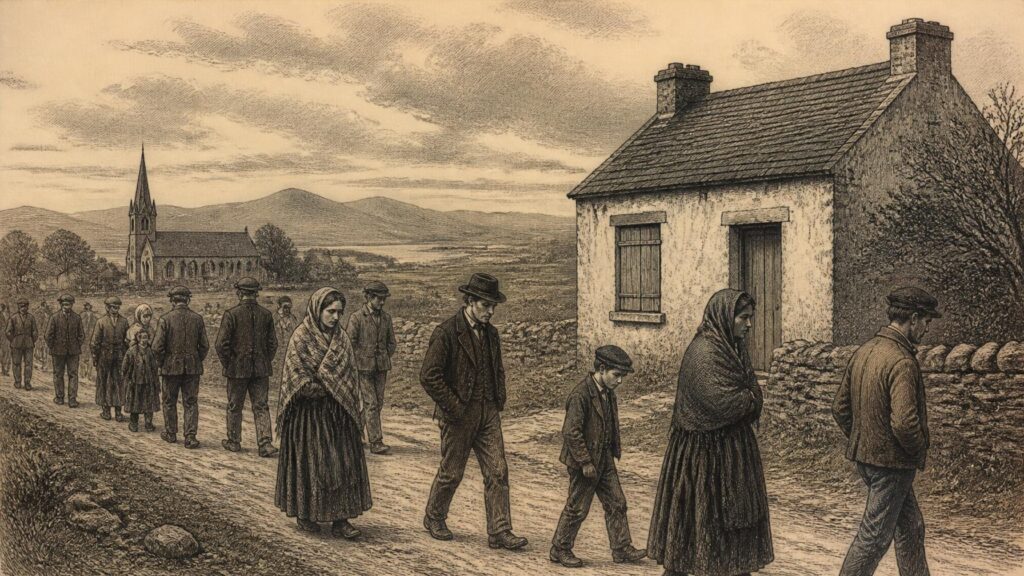
AI generated historical illustration, not a contemporary photograph.
At a Glance
Football matches between Irish and Israeli sides have never been only football matches, but neither have they been reducible to a single political meaning. From a World Cup qualifier at Lansdowne Road in 2005 to the unusually fraught Nations League fixtures of 2026, they became occasions on which Irish supporters, campaigners, players, officials and politicians argued about solidarity, occupation, racism, state responsibility and the limits of sporting autonomy. Their history belongs to Irish political culture as much as to the record of results.
Historical Setting
The phrase “Ireland Israel football protest” can suggest one discrete incident. The documentary record instead describes a sequence of encounters across more than two decades. These involved the senior men’s national side, the women’s team, the under twenty ones and, indirectly, Irish clubs and supporters. The arguments surrounding them changed with events in Israel and Palestine, with the development of organised Irish Palestinian solidarity, and with the changing structures of European football. What remained remarkably consistent was the conviction, held by many participants, that an international fixture could not be isolated from the conditions under which Palestinian athletes and civilians lived.
The subject must be approached with care. A protest against an Israeli representative team was not automatically a protest against Jewish people or against individual Israeli players. Conversely, it should not be assumed that every person who attended a match, supported the Football Association of Ireland, or opposed a boycott endorsed the policies of the Israeli state. The historical evidence records competing positions. Campaigners commonly directed their argument towards the state, the Israeli Football Association, international federations and the inclusion of clubs from settlements in occupied territory. Governing bodies generally stressed sporting rules, contractual duties, player welfare and security. Some supporters saw participation as normal sporting competition; others considered it unacceptable normalisation.
Those distinctions matter because the history has often been compressed into slogans. Ireland has a visible and durable tradition of sympathy for Palestinian self determination, but it has never produced a single unanimous Irish view. Governments, political parties, civil society organisations, football administrators and players have reached different conclusions about what that sympathy should require in practice. Football exposed those differences particularly clearly because international matches offered an unusually public stage. A stadium could be a place of national representation, commercial entertainment, official ceremony and dissent at the same time.
The roots of that political use of sport in Ireland run deeper than the Israel Palestine question. The word “boycott” itself entered international vocabulary through the Land War of 1880, when Captain Charles Cunningham Boycott, a land agent in County Mayo, was subjected to organised social and economic isolation. That episode did not concern sport, but it left Ireland with a word and a political inheritance: withdrawal of ordinary relations could become an instrument of collective pressure. Later Irish arguments over sporting isolation of apartheid South Africa, fascist regimes, Yugoslavia, Russia and Israel repeatedly drew upon that inheritance.
Political Sport
The idea that sport should stand outside politics has long been attractive to administrators. It promises a protected arena in which competitors meet as equals and audiences can enjoy a game without importing international conflict. In practice, international sport has almost never met that ideal. Flags, anthems, passports, diplomatic recognition, policing and broadcasting are political facts before a ball is kicked. The decision to exclude, include, host, travel, remain silent or protest is itself a political choice, even when described as neutral administration.
Ireland’s own sporting history gave this argument special force. The state’s relationship with sporting bodies has often been complicated by partition, overlapping jurisdictions and the distinction between the Republic of Ireland and the island wide structures maintained by some sports. Football’s representative arrangements became particularly contested in the twentieth century. That background encouraged Irish audiences to understand sport not simply as recreation but as a question of representation: who could claim to speak for a people, under which flag, and with what legitimacy?
The anti apartheid movement supplied the most important precedent for later Irish campaigners. In the late twentieth century, sporting contact with South Africa became a central moral issue internationally. Ireland’s 1981 rugby tour of South Africa, undertaken despite a global sporting boycott, generated severe controversy. The Irish government withdrew funding from the Irish Rugby Football Union and Irish sport suffered reputational consequences abroad. The episode entered public memory as an example of the difficulty of insisting that athletic institutions were insulated from a system of racial domination recognised by much of the world.
That memory was not a mechanical guide to Israel Palestine. South African apartheid and the conflict in Israel and Palestine are different histories, and the applicability of the word apartheid has been intensely contested in political and legal debate. Yet the analogy was central to activists’ language. Irish campaigners against fixtures with Israeli teams repeatedly used the phrase “Love Football, Hate Apartheid”, explicitly recalling sporting isolation of South Africa. Their purpose was not merely rhetorical. They argued that international sport could confer legitimacy, publicity and normality, and therefore that refusing it could be an act of solidarity.
Opponents of boycott made a contrasting case. They argued that teams and athletes should not be made responsible for decisions of governments, that sport can create contact across conflict, and that selective boycotts may punish players without altering state policy. Administrators also pointed to UEFA and FIFA regulations, disciplinary exposure, lost revenue and the danger of withdrawing from competitions whose structures could not readily be changed by one association. These were not trivial objections. The later Irish debate arose precisely because moral protest and institutional obligation did not lead automatically to the same answer.
Palestinian Solidarity
Irish engagement with Palestine predates football protests by many decades. It has been shaped by religious connections to the Holy Land, Irish participation in British imperial institutions, the experience of partition, political comparisons with colonial rule, and the work of churches, trade unionists, students, humanitarian organisations and campaigners. Such comparisons can illuminate feelings of identification, but they must not be treated as historical equivalence. Ireland’s struggle for independence and the Palestinian experience are distinct. When activists made the comparison, they were expressing a political interpretation rather than establishing an identical past.
Organised solidarity expanded considerably during the late twentieth century and early twenty first century. The Ireland Palestine Solidarity Campaign was established in 2001, shortly after the start of the Second Intifada. It developed a national network and made public education, demonstrations, consumer campaigns, cultural initiatives and political lobbying part of its work. The campaign’s growth coincided with the emergence of boycott, divestment and sanctions as an international Palestinian led strategy from 2005 onwards. Sport was a natural arena for this approach because its rituals were highly visible and its claims to universality could be challenged in public.
The significance of sport in such activism lay partly in accessibility. Not everybody reads parliamentary reports or attends political meetings. A football match draws people who might never otherwise encounter a campaign. The streets around a stadium offer an audience of supporters, journalists and television cameras. A flag in a stand, a leaflet handed to a spectator, a demonstration at a turnstile or a banner in a televised match can connect a distant conflict with a local event. Campaigners did not need to win an argument with every spectator to make the issue impossible to ignore.
Sport also made Palestinian restrictions on movement especially intelligible. Campaigners pointed to the obstacles faced by Palestinian players trying to leave Gaza or travel through the West Bank, the disruption of domestic sporting life, and the deaths of athletes in wider violence. They argued that a system in which one set of players could compete freely while another struggled even to travel was not politically neutral. The response from football authorities was usually to treat matches as governed by the rules of the relevant competition rather than as a venue for resolving international disputes.
This difference in perspective explains much of the later confrontation. Protesters often understood a fixture as symbolic state representation. Football associations understood it as an obligation attached to membership of UEFA or FIFA. Each side could acknowledge that sport had public consequences while disagreeing fundamentally about what those consequences required. The contest was therefore over more than whether ninety minutes should take place. It was over whether participation amounted to normal sporting contact, practical necessity, moral complicity, protestable speech, or some uncomfortable mixture of all four.
Early Encounters
The senior Republic of Ireland men’s team met Israel in the qualifying campaign for the 2006 World Cup. Their match in Tel Aviv on 26 March 2005 ended in a draw. The return match at Lansdowne Road on 4 June 2005 became the earliest major Irish football occasion clearly documented as a Palestinian solidarity protest. On the pitch, the Republic led 2–0 through Ian Harte and Robbie Keane before Israel recovered to draw 2–2. The result harmed Ireland’s qualification hopes and was remembered by many supporters primarily as a frustrating football afternoon.
Outside the match, however, the Ireland Palestine Solidarity Campaign and allied activists organised a national demonstration. Contemporary activist reporting described a march beginning near Dublin’s Central Bank and proceeding through the city. Later historical writing on Irish Palestinian solidarity estimated that as many as 1,500 people attended a demonstration connected to the fixture. Numbers stated by organisers should always be read cautiously unless independently verified, but there is no serious doubt that the event brought a substantial protest into the public orbit of an Ireland Israel match.
The 2005 mobilisation did not prevent the game. Nor did it command the attention later given to football boycotts after the outbreak of the Gaza war in 2023. Nonetheless, it established an important pattern. A fixture was used as an opportunity to explain the occupation, campaign for Palestinian rights and call for sporting isolation of Israel. The protest was neither an accidental disturbance nor simply a reaction to the scoreline. It was part of a broader strategy that understood international sport as a field of cultural and political pressure.
It is tempting to describe the 2005 match as the origin of all subsequent controversy. That would exaggerate its immediate effect. The senior game went ahead and the Irish football establishment did not adopt a boycott policy. Most reporting of the match centred on the result, the loss of a two goal lead and the campaign’s sporting consequences. Yet the demonstration showed that a constituency existed in Ireland for linking football to Palestinian solidarity. It also created a precedent that later organisations could invoke: this was not an abrupt concern invented in the 2020s but part of a longer pattern of organised protest.
The fixture’s geography mattered. Lansdowne Road was not just a stadium; it was a symbolic national venue in Dublin, close to political institutions, major media outlets and diplomatic representation. A protest in the capital could address the Irish state as well as football supporters. In this sense, the match created several audiences at once: the FAI, the Irish government, UEFA, Israeli officials, local spectators and an international media public. That multiplicity would become still more important when later debates concerned whether a match should be moved away from Dublin.
Women’s Football
The next documented strand of protest developed around women’s international football. In 2011, ahead of a Republic of Ireland women’s match against Israel, the Ireland Palestine Solidarity Campaign announced a demonstration under the slogan “Love Football, Hate Apartheid”. Its public statement framed the match within the campaign’s claim that Palestinian footballers faced exceptional restrictions and urged Irish supporters not to travel for the return fixture. It explicitly linked its appeal to the historical sporting boycott of South Africa.
The 2011 event is historically revealing for several reasons. First, it indicates that the issue was not confined to the senior men’s side or to a one off 2005 demonstration. Second, it shows how women’s football, often less fully covered by mainstream sports media, could still become a place of international political expression. Third, it highlights the campaign’s emphasis on athletes’ mobility. The argument was not simply that a state should be punished; it was that sport itself could not be separated from unequal access to travel, facilities and international competition.
Campaign literature is a source with a particular character. It records what organisers intended, believed and wished to persuade others of; it is not an independent adjudication of their claims. That does not make it historically useless. On the contrary, it is essential evidence for the language and aims of the movement. But historical writing should distinguish between a campaign’s interpretation of events and conclusions established by a court, an international body or a neutral investigator. The same rule applies to claims made by football associations and governments about legal obligations or public opinion.
Women’s fixtures also complicated the familiar claim that sporting boycotts merely target famous male professionals. The campaign framed Palestinian women players as people whose sporting participation had been restricted by the wider conflict. Whether a reader accepts the proposed remedy or not, the argument widened the field of concern. It made gender, movement, visibility and unequal sporting opportunity part of the Irish conversation. It also demonstrated that the politics of a national team could not be confined to its best attended matches.
There is a further caution. The archival trail for women’s football protests is thinner than that for high profile men’s internationals. That reflects unequal media attention rather than necessarily lesser importance. A responsible account should not invent crowd sizes, dramatic confrontations or direct effects where evidence is absent. What can be stated is that organised protest occurred, that it made a sporting boycott argument, and that it formed part of the continuity between the 2005 demonstration and later, larger campaigns.
Youth Controversy
In September 2022, the Republic of Ireland under twenty one team faced Israel in the first leg of a UEFA European Under twenty one Championship play off at Tallaght Stadium. The FAI had promoted the match as a historic opportunity for Jim Crawford’s side to reach the finals. The context outside the pitch was different. The Ireland Palestine Solidarity Campaign called a protest against Israel’s participation, while campaigners sought to make their presence visible around the ground.
Disputes over entry to the stadium became part of the story. Accounts from activists and from organisations supporting Israel alleged that Palestinian flags, leaflets, keffiyehs and certain items of clothing were restricted or confiscated. Such accounts should not be merged into a definitive narrative without access to full security records and the FAI’s internal instructions. They do, however, demonstrate that the contest had moved from the street to questions of expression within a UEFA regulated venue. Security decisions were not perceived as merely operational; participants understood them as statements about whose political speech was acceptable.
That dispute exposed a persistent tension in football governance. UEFA competitions impose obligations on host associations to maintain safety and control discriminatory or provocative conduct. Associations can face disciplinary consequences for failures of crowd management. But rules intended to prevent disorder may also be applied in ways that restrict peaceful political display. The practical difficulty is acute because there is no universally accepted line between a national flag, a humanitarian appeal, a partisan slogan, a statement of solidarity and an incitement to hostility. Stadium officials must make rapid decisions under scrutiny, and their decisions can themselves become controversial.
The youth fixture also showed the generational breadth of the issue. Protesters were not waiting for a senior international at the Aviva Stadium. A match involving younger players and a smaller crowd could still serve as a focus for solidarity. From the FAI’s perspective, the game was a major sporting occasion for a generation of Irish players. From the campaigners’ perspective, that importance made it more, not less, necessary to challenge Israel’s place in European competition. These were incompatible priorities, but both explain why the fixture acquired a significance disproportionate to an ordinary youth play off.
Israel won the first leg in Tallaght and the tie continued in Tel Aviv. The football result did not settle the political disagreement. If anything, the 2022 controversy provided a rehearsal for later events: a planned protest, arguments over stadium expression, fears of disciplinary sanctions and a disagreement about whether playing a match was an innocent sporting act. The scale was limited, but the pattern was recognisable.
Gaza War
The scale and intensity of the debate changed after the Hamas attacks of 7 October 2023 and Israel’s ensuing war in Gaza. The humanitarian catastrophe, immense civilian suffering, destruction of sporting infrastructure and international legal and diplomatic controversy made Palestine more prominent in Irish public life. Pro Palestinian demonstrations became a regular feature of the political landscape. Football supporters displayed Palestinian flags at domestic matches, while clubs and fan groups participated in fundraising and solidarity initiatives.
In this period, the older analogy with South Africa returned with greater force. Activists argued that sporting bodies had acted rapidly to exclude Russia after its full scale invasion of Ukraine in 2022, yet had not suspended Israel. They cited what they regarded as a double standard and focused especially on Israeli clubs based in settlements in occupied Palestinian territory, as well as allegations concerning the Israeli Football Association’s anti racism enforcement. Those were arguments directed at UEFA’s statutes and governance rather than only expressions of general moral outrage.
Support for a suspension was not limited to activists outside football. In November 2025, the FAI general assembly voted to submit a motion calling on UEFA to suspend Israel from European club and international competitions. Public reporting described the vote as overwhelmingly in favour. The proposal cited two alleged breaches: the organisation of clubs in occupied Palestinian territory without the consent of the Palestinian Football Association, and an alleged failure to implement or enforce an effective anti racism policy. The vote was significant because it demonstrated organised dissent from within Irish football’s own representative structure.
A request to UEFA was not the same as a suspension. UEFA retained authority over its competitions, and the motion did not itself settle the legal or factual questions it raised. That distinction is essential. It would be inaccurate to write that the FAI expelled Israel, or that UEFA accepted every allegation. What the vote established was that a substantial majority within the FAI’s assembly wished the association to seek action. It transformed what might have been treated as an external protest into an internal governance issue.
Irish football was therefore entering 2026 with a contradiction already in place. Its representative assembly had asked UEFA to suspend Israel, while its senior national team was liable to be drawn against Israel in a UEFA competition. When the 2026–27 Nations League draw paired the Republic of Ireland with Israel, Kosovo and Austria, that contradiction became immediate. It was no longer only about what UEFA should do in the abstract. It was about whether Ireland should fulfil scheduled fixtures if UEFA did not act.
Association Vote
The FAI’s position was shaped by the institutional realities of membership. National associations do not simply arrange friendlies according to their own political preferences. They enter competitions governed by regulations, commercial arrangements and disciplinary rules. Refusing to play can lead to forfeiture, financial penalties, exclusion or further sanctions. The precise consequences depend on the competition and UEFA’s decisions, but the general risk was real enough for the FAI leadership to argue that non participation could damage Irish football substantially.
For campaigners, this explanation was inadequate. They argued that sporting penalties should not outweigh the moral and legal implications of playing Israel while the Gaza war continued. Many cited previous exclusions in international sport, especially Russia’s exclusion after the invasion of Ukraine and Yugoslavia’s exclusion in the 1990s. They maintained that a governing body’s statutory obligations could not be considered in isolation from human rights responsibilities. In their view, financial and competitive costs were precisely the sort of inconvenience that boycotts were meant to impose.
The Irish government adopted a more restrained constitutional and administrative line. Ministers stated in Dáil proceedings that national governing bodies were independent organisations responsible for their sporting fixtures, and that government would not instruct the FAI to boycott the games. This was not indifference to Gaza; government representatives simultaneously expressed opposition to Israeli actions and support for efforts towards peace. But it did mean that the state declined to assume responsibility for ordering a football association to default on UEFA fixtures.
Parliamentary debate made the disagreement unusually explicit. Deputies supporting a boycott contended that Ireland had an ethical duty to act, especially given its historic opposition to apartheid and its public support for Palestinian rights. Government speakers stressed the autonomy of the FAI and the association’s right to make its own decision. The Dáil became a forum in which football administration, foreign policy and moral language met. It was an illustration of why the claim that sport and politics must never mix is descriptive fiction: they were already intertwined in the legislature.
The FAI ultimately proceeded with the fixtures. This did not mean that it had resolved the argument or secured consensus. It meant that the association judged participation to be required or prudent within UEFA’s framework. The choice carried costs of its own. It alienated campaigners, prompted protests and placed players in an uncomfortable public position. The decision also underlined an enduring feature of international sport: administrative compliance can be read by opponents as political endorsement, even where officials insist that it is not.
Stadium Protest
The campaign against the 2026 fixtures adopted the name Stop The Game. Its purpose was clear: not merely to stage a demonstration while matches went ahead, but to persuade the FAI, government and players that Ireland should refuse to play Israel. The campaign brought together Palestinian solidarity activists and figures from Irish sport, including former players and coaches. Its public interventions used open letters, press events, demonstrations, supporter mobilisation and planned stadium actions.
A friendly against Qatar at the Aviva Stadium on 28 May 2026 became an early focal point. Supporters threw tennis balls carrying Palestinian flag imagery and Stop The Game messages onto the pitch, interrupting play. The form of protest was carefully chosen. Tennis balls were conspicuous enough to halt a match but were not intended as weapons. Their use connected a mass spectator event to a boycott demand and produced the kind of images likely to circulate far beyond the stadium.
The protest also raised difficult questions. Some spectators supported it; others objected to interruption of a match they had paid to attend. The manager, Heimir Hallgrímsson, indicated respect for the right to protest while expressing concern over a boycott’s footballing consequences. The FAI’s task was complicated further because it had to consider security, crowd management and UEFA requirements. Activists, meanwhile, argued that inconvenience was central to effective protest. A demonstration that left the event entirely undisturbed might be morally expressive but politically easy to ignore.
Protest around a football ground is not a simple measure of national opinion. The number of participants is usually smaller than the full attendance and much smaller than the population. Yet it can still be historically consequential. A protest establishes that a fixture is contested; it can alter policing and hosting plans, force statements from officials and give players a public language for concerns they might otherwise have voiced privately. The 2026 actions did all of those things. They helped make the planned home fixture in Dublin a question of operational feasibility as well as principle.
In assessing this protest, it is important not to confuse the campaign’s claims with settled facts. Stop The Game and its supporters described Israel’s conduct in Gaza in the strongest terms, frequently using the word genocide. Israeli authorities and other opponents rejected such language. Historical prose can record that the term was used, that international investigations and legal proceedings formed part of the context, and that the question was contested. It should not pretend that a football article can settle matters of international criminal law. What is beyond dispute is that the language of atrocity and complicity shaped the Irish football argument.
Neutral Venues
In June 2026, the FAI announced that Ireland’s nominal home match against Israel would not take place at the Aviva Stadium. It was moved to the TSC Arena in Bačka Topola, Serbia, to be played behind closed doors. Israel’s nominal home fixture was held in Debrecen, Hungary, because Israeli home internationals had been staged at neutral venues amid security concerns since October 2023. The result was an extraordinary pair of matches in which neither side played in its ordinary home setting.
The move was interpreted in sharply different ways. The FAI described operational and security challenges. Its defenders saw an attempt to protect players, staff and spectators while meeting UEFA obligations. Critics called it a retreat from democratic protest: rather than answering the demand not to play, they argued, the association had exported the match beyond reach of Irish supporters. The decision illustrates how venue selection can become politically expressive even where it is justified in administrative terms.
Playing behind closed doors changed the meaning of home advantage. A home fixture normally gives supporters a chance to cheer, criticise, display banners and occupy a shared public space. In Bačka Topola, no ordinary Irish crowd could shape the occasion. The removal of spectators reduced the immediate risk of disruption, but it also removed the atmosphere through which national teams ordinarily represent a public. The game became a televised or reported event rather than a communal Irish gathering.
The neutralisation of venue did not neutralise politics. On the contrary, it advertised the depth of the controversy. A match relocated from Dublin to Serbia because it could not be safely or practically staged in its intended setting was already a political story. The fact that Israel also played away from home added another layer: the fixtures were shaped by a regional conflict whose effects extended through European sport, travel, policing and diplomacy. The physical displacement of the games was itself historical evidence of that reach.
There was a further paradox. Campaigners had used visibility as a strategy, seeking to bring Palestine into the stadium and onto Irish television. Moving the match reduced their access to the fixture but magnified the public explanation for the move. In this sense, protest was both excluded from the ground and made central to the story. The campaign did not obtain its principal objective, a boycott, but it influenced the conditions under which the FAI fulfilled the fixtures.
Player Dilemmas
Players occupied an especially difficult position. They were not the people who arranged the draw, adopted UEFA regulations or determined foreign policy. Yet they wore the national shirt, stood for anthems and became the faces of a decision made by others. The public naturally wanted to know whether they would play, shake hands, exchange shirts or make a gesture. This attention placed moral expectations on athletes whose careers depend on selection, contracts and team relationships.
Hallgrímsson stated that members of his squad felt uncomfortable about the matches. Players discussed the circumstances and the team’s approach to protocols. The public record also included Gavin Bazunu’s decision not to be available for the Israeli fixtures, explained in terms of his opposition to playing while atrocities were occurring. That decision was applauded by campaigners and criticised by some observers, but historically its significance lies in its personal character: an individual player publicly separated himself from the association’s decision to fulfil the fixtures.
It would be wrong to assume that all teammates shared one view, or to demand disclosure of private discussions. Collective sport depends on a degree of discretion, particularly where political disagreement might disrupt preparation. Nevertheless, the 2026 episode showed that athletes cannot always remain invisible behind an institution. When an association invokes contractual obligation and a campaign invokes conscience, players may become the point at which those claims meet. Their choices are read as moral statements even when they describe them as personal limits or professional decisions.
There is a long history of athlete activism, but there is also a long history of athletes being burdened with decisions that properly belong to states and governing bodies. Campaigners acknowledged this in different ways, often arguing that UEFA and the FAI should make the decision rather than force players into an impossible position. The same argument had been made by Irish basketball players and campaigners during disputes over fixtures involving Israel. Sport became a means of visibility, but the cost of visibility often fell most heavily on those expected to compete.
Public Memory
How will these events be remembered? The answer will depend partly on what happens beyond sport. If international football authorities alter their approach to Israel, the Irish protests may be recalled as early pressure. If no such change occurs, they may be remembered as evidence of a vigorous but unsuccessful campaign. Either way, it would be misleading to judge their significance only by whether a match was cancelled. Historical influence can appear in altered public language, changes to venue, formal votes, parliamentary debate and the formation of new alliances among supporters and athletes.
The football record will preserve scores, line ups and venues. It will note the 2–2 draw at Lansdowne Road in 2005, the youth play off at Tallaght in 2022 and the neutral venue fixtures of 2026. But that statistical record is incomplete. It cannot by itself convey why a banner, a ball thrown onto a pitch or a refusal to play carried such force. Those actions drew their meaning from a longer Irish history of boycott, anti apartheid activism and identification with peoples understood to be living under occupation or unequal power.
Folklore will inevitably grow around these incidents. Crowd figures may be enlarged, individual actions attributed to the wrong people, and claims made that “all Ireland” supported or opposed one side. Such statements should be resisted. The documented record shows significant protest, institutional disagreement and public controversy. It does not show a uniform Irish people. The phrase “Ireland” includes supporters who marched, football followers who wanted the game played, players with differing private views, administrators concerned with regulations and citizens who paid little attention to football at all.
The strongest historical conclusion is therefore a limited but important one. Football fixtures involving Ireland and Israel became recurring sites of political contest because they connected a distant conflict to an Irish public ritual. Campaigners used them to demand solidarity with Palestinians and to challenge what they saw as the normalisation of injustice. Football authorities defended competition obligations and operational responsibilities. Governments sought to separate state policy from association governance. Players were asked to carry meanings they had not created. The resulting history is not a story of sport contaminated by politics; it is a record of politics already present in sport, brought unmistakably into view.
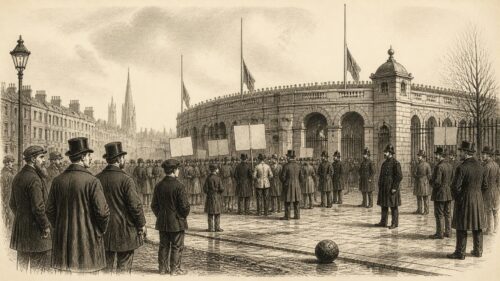

The article reveals how a fixture can be understood as a sporting obligation, a platform for solidarity, and a test of freedom of expression. Strikingly, demonstrations outside grounds have shifted towards disputes over flags, clothing and leaflets within UEFA-regulated stadiums. This suggests that decisions presented as security or crowd-management measures may acquire symbolic importance for supporters and campaigners. At the same time, the article distinguishes protest from assumptions of unanimous Irish opinion. How should football authorities balance competition rules, player welfare and stadium safety with spectators’ wish to express informed, peaceful views publicly about Palestinian sporting restrictions and international solidarity?