

Contested Fixture
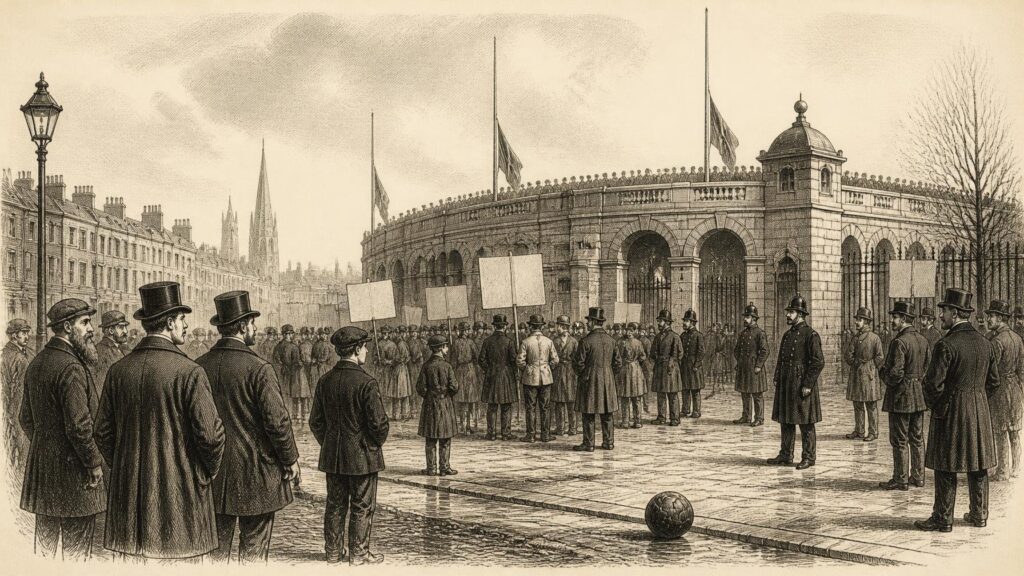
AI generated historical illustration, not a contemporary photograph.
At a Glance
In 2026, two Republic of Ireland football fixtures against Israel became far more than scheduled matches in a UEFA competition. They developed into a public argument about war, international law, sporting autonomy, security, protest and the meaning of Irish solidarity with Palestinians. The controversy did not arise because football had suddenly become political: rather, it exposed the political choices, institutional rules and historical memories that ordinarily sit beneath international sport.
The Fixture
The immediate issue was simple to state. The Republic of Ireland and Israel were drawn to meet in the 2026–27 UEFA Nations League. Yet the matches were arranged while Israel’s conduct of war in Gaza, following the Hamas-led attacks of 7 October 2023 and the ensuing Israeli military campaign, remained the subject of intense international condemnation, legal argument and humanitarian concern. For many Irish supporters, players, campaigners and public representatives, a conventional sporting encounter seemed incompatible with that context.
That conclusion was neither universal nor uncomplicated. One position held that Ireland should refuse to play: participation, critics argued, would normalise a state accused by numerous observers of grave breaches of international law. Another held that the Football Association of Ireland, as a member of UEFA, had entered competitions whose rules it was bound to honour; unilateral withdrawal could bring disciplinary and sporting consequences without changing the underlying conflict. A third view, sometimes overlapping with either of the first two, distinguished opposition to Israeli government policy from hostility to Israeli players or Jewish people. The controversy was therefore not a single dispute but a collision of moral, legal, practical and representative claims.
The FAI had already made its institutional position unusually clear. At an Extraordinary General Meeting before its Annual General Meeting in November 2025, the association’s General Assembly voted to submit a formal motion requesting that UEFA immediately suspend the Israel Football Association from UEFA competitions. The FAI said that its members had approved that request. This was not an informal expression of sentiment by individual supporters; it was an act of the governing body of football in the Republic, taken through its own membership structures.
That request did not settle the question of playing the scheduled games. The association could believe that Israel should be suspended by UEFA while also concluding that, until UEFA acted, Ireland remained obliged to fulfil fixtures. This distinction frustrated those who wanted an immediate boycott. Yet it is central to understanding the episode. The FAI’s position was not indifference to Gaza, nor was it a simple decision to treat the games as politically ordinary. It sought Israel’s exclusion at the confederation level while attempting to act within the competition framework that UEFA continued to enforce.
In June 2026 the FAI confirmed that the Ireland ‘home’ fixture would be moved overseas, to a neutral venue and behind closed doors. It cited operational challenges affecting the delivery of a match in Dublin and referred to consultation with An Garda Síochána and UEFA. The decision made the fixture exceptional even before a ball was kicked. A home international, ordinarily an event through which a national team is seen and supported in its own capital, would not be held at the Aviva Stadium. The relocation was an acknowledgment that the normal ritual of international football had broken down.
Political Context
The dispute cannot responsibly be understood without recognising the scale of the civilian catastrophe in Gaza. The conflict generated urgent arguments about ceasefires, hostages, military operations, humanitarian access, alleged war crimes, genocide and occupation. These matters were contested in political, diplomatic and legal forums, and they should not be reduced to a football argument. Nevertheless, football’s visibility gave the issue a distinctive public form. A ninety-minute match could be seen either as a minor sporting obligation or as a symbolic encounter with a state whose actions had caused profound outrage in Ireland.
The calls to exclude Israel from football were not based solely on the current war. They also concerned the long-running question of Israeli clubs based in settlements in the occupied West Bank, participating in leagues organised through the Israel Football Association. Palestinian football officials and human-rights advocates have argued that such arrangements violate territorial sporting jurisdiction and entrench an occupation considered unlawful under international law. United Nations human-rights experts have urged FIFA to address the issue, describing the presence of Israeli clubs in settlements as incompatible with international law and with football’s stated human-rights commitments.
The Israel Football Association and Israel’s supporters have rejected characterisations that present its sporting participation as illegitimate. In a sporting system intended to bring national associations together, they regard exclusion as unfair politicisation and as a collective sanction imposed on players and supporters. This argument has particular force for those who fear that criticism of Israel can slide into hostility towards Jews generally, or who believe that sport should preserve contact when diplomacy fails. A sound historical account must register these concerns without treating them as answers to every question raised by Palestinian football or by the conduct of the war.
Language itself became part of the dispute. Protesters and some politicians employed terms such as genocide, apartheid and colonialism. Others disputed the use of those words, whether as legal conclusions or political descriptions. There is an important difference between reporting that a public body or campaign used a term, and declaring the term settled fact. In Ireland’s football controversy, such distinctions mattered. The strongest arguments often rested not on rhetorical certainty but on identifiable actions: the FAI’s suspension motion, protests calling for a boycott, parliamentary speeches, the transfer of the home match, and UEFA’s continuing decision to retain Israel in its competitions.
Irish Connections
Ireland’s relationship with Israel and Palestine has never been reducible to one sentiment. Irish history includes significant Jewish communal life, a long record of Irish engagement with Zionism, and figures whose lives confound simplistic contemporary assumptions. Robert Briscoe, the Dublin businessman, Fianna Fáil politician and twice Lord Mayor of Dublin, was a committed Zionist. During the 1930s and 1940s he worked in support of Jewish migration to Palestine and maintained connections with Revisionist Zionist politics. After the establishment of Israel in 1948, he advised Menachem Begin to pursue constitutional politics rather than continuing armed struggle.
Briscoe’s career is a useful corrective to the claim that Ireland’s historical experience automatically produces one political reading of the Middle East. Irish nationalism supplied analogies and practical lessons for people with very different aims. It could inform sympathy for anti-colonial liberation, but it could also inspire admiration for Jewish national self-determination after European antisemitic persecution and the Holocaust. The meaning attached to Ireland’s past has always depended on who was making the comparison, at what moment, and for what purpose.
At the same time, pro-Palestinian feeling has developed a substantial place in Irish political and civic life. It has drawn on religious networks, trade-union activism, left-wing internationalism, Irish republican traditions, human-rights campaigning and more recent community organisations. The Irish state’s diplomatic positions have also evolved through multilateral institutions and European politics, rather than simply mirroring popular activism. Archival material from the 1970s records Irish official discussions of Palestine, including the limits that government placed on recognition of the Palestine Liberation Organisation and the wider European diplomatic setting of the period.
Irish identification with Palestinians is frequently explained through memories of colonial subordination, dispossession, famine, partition and conflict. Such comparisons can be emotionally powerful, particularly in a country whose modern national story has often been narrated through resistance to British rule. But comparison is not identity. Nineteenth-century Ireland, Mandatory Palestine, the State of Israel, the occupied Palestinian territories and contemporary Gaza are historically distinct places, governed by distinct legal, demographic and geopolitical circumstances. The value of analogy is not that it proves two histories identical. Its value, at best, is that it may encourage attention to power, displacement, civilian suffering and self-determination.
That caution is especially important where football is concerned. Sport encourages compressed narratives: a flag, anthem, shirt or fixture can appear to represent an entire people. Yet neither team could contain the political complexity of the societies attributed to it. The Republic of Ireland side represented an association based in one state on the island of Ireland, not every Irish political view. Israel’s team represented a football association and selected players, not a complete account of Israeli society, government or Jewish identity. The controversy’s intensity arose partly because many participants nevertheless understood the match as carrying those wider meanings.
Football Governance
International football is often presented as an autonomous sphere, but it has always been organised through institutions that make political decisions. FIFA determines world membership and competition structures. UEFA governs European competitions and sets conditions for its member associations. National associations select teams, administer domestic games and enter international tournaments. Governments, meanwhile, provide policing, visa systems, stadium regulation and public funding while usually claiming not to control sporting selection or competition participation.
Israel’s position in football illustrates the political geography of these institutions. The football association founded in Mandatory Palestine became a FIFA member before the establishment of the State of Israel. Israel’s national teams initially competed in Asian structures, but political opposition from other states made regional competition increasingly difficult. Israel was later admitted to UEFA. The story demonstrates that football confederations are not merely maps drawn by geography. They are negotiated communities, shaped by diplomacy, recognition, security and the willingness of associations to play one another.
That history also explains why opponents of the 2026 fixtures directed their demands towards UEFA as well as the FAI. If participation in a competition is determined collectively, they argued, then a collective institution should suspend a member association accused of violating its rules or human-rights standards. The FAI’s 2025 motion adopted precisely that approach. It asked UEFA to act against the Israel Football Association rather than merely making a moral protest on Ireland’s behalf.
UEFA’s rules, however, give powerful incentives against a national association refusing a fixture by itself. A forfeit can produce loss of points, fines and other sanctions. In a Nations League setting, consequences can affect ranking, seeding and future qualification routes. The exact sanction available in a particular case depends on regulations, circumstances and UEFA’s disciplinary process; predictions made during the Irish controversy should not be mistaken for determinations already made. Still, the possibility of punishment was real enough to shape the FAI’s reasoning and the arguments of its critics.
There is a wider difficulty. Sporting bodies regularly proclaim that politics should remain outside sport, while their own decisions make political distinctions unavoidable. Associations have been excluded, matches moved, flags banned, anthems disputed and opponents separated in draws because of war, non-recognition or security. Russia’s expulsion from much of international football after its full-scale invasion of Ukraine in 2022 formed the most frequently cited recent precedent in the Irish debate. Supporters of exclusion asked why one state could be suspended but another could not. Those resisting a direct analogy replied that international consensus, the legal setting and the decisions of governing bodies differed.
Association Vote
The FAI’s internal democracy became unusually visible during the controversy. Its 2025 General Assembly decision to seek Israel’s suspension established that the association’s membership did not wish simply to ignore the matter. The later question of whether to play the Nations League fixtures revealed a more difficult problem: how should a sporting association translate a broad ethical resolution into action when the practical costs fall upon players, staff, supporters and the future of the national team?
Campaigners argued that the logic of the suspension motion should lead to non-participation. In their view, it was contradictory to say Israel should be excluded while accepting an obligation to play it. They also argued that sanctions imposed on the FAI would be a price worth paying, particularly if refusal encouraged other associations to act. This was a strategy of visible dissent. Its purpose was not merely to avoid a match but to make sporting normality impossible in the face of Palestinian suffering.
The FAI’s own statements took a different route. It said that it was deeply conscious of the devastation endured by civilians in Gaza, that it had pursued its motion before UEFA, and that it respected the views of players, supporters, campaigners and the public. It also referred to its agreed UEFA regulations. The association’s decision was therefore framed as an attempt to hold together two commitments: opposition to Israel’s continued participation in UEFA competition and fulfilment of existing obligations until UEFA ruled otherwise.
Neither side could entirely avoid the language of responsibility. For boycott advocates, the responsible course was refusal. For the FAI, responsibility included protecting players and the association from consequences generated by a unilateral breach of competition rules. The disagreement was not between people who cared about football and people who cared about justice. It was more often a disagreement over which action gave ethical concern institutional force, and who should bear the costs of that action.
The question of player consent added another layer. International players are not simply employees in a club setting; they are public representatives who may feel personal, family, moral or professional pressures. Some may believe a fixture should not occur, others may think playing is the right course, and still others may object to being made symbols in a national dispute. Any account that treats ‘the players’ as a single political bloc is likely to oversimplify. The FAI acknowledged different views among the squad before confirming that the fixtures would be fulfilled.
Public Pressure
The debate moved rapidly beyond football’s formal structures. Irish Sport for Palestine, supporter groups, former players, politicians and activists called for Ireland not to fulfil the fixtures. Their language connected sport to broader campaigns for Palestinian rights, sanctions and accountability. Football offered a particularly resonant arena because it reached people who might not otherwise follow parliamentary proceedings, international legal cases or foreign-policy debates.
The campaign’s insistence that sport cannot be separated from politics had a strong historical basis. National teams enter stadiums under flags and anthems. International federations recognise particular associations, enforce borders of sporting jurisdiction and decide which symbols can be displayed. Governments celebrate victories as national achievements. Football can be a means of reconciliation, but it can also be an instrument of state prestige. The proposition that a match is ‘only football’ is therefore less a description than a request to disregard the political setting in which football is played.
Yet public pressure also creates risks. In periods of anger and grief, individual athletes, officials and fans can become proxies for states and governments. Criticism of Israeli state policy is legitimate political speech; antisemitism is not. Support for Palestinian civilian rights is compatible with opposition to racism in all its forms. A principled movement against injustice needs that distinction not as a public-relations device but as part of its own ethical coherence.
The same applies to Irish identity. Claims that the Irish people are uniquely qualified to understand Palestine can become self-congratulatory if they erase disagreement, Jewish Irish experience or the limits of historical comparison. Ireland’s history may help explain why Palestinian solidarity has a particular emotional and political force, but it does not give any society a monopoly on moral insight. The most durable solidarity is grounded in evidence, empathy and universal rights rather than national vanity.
State Limits
The Irish Government was placed in an uncomfortable position. Ministers faced intense pressure to support a boycott while also insisting that the FAI was an independent national governing body. In Dáil debate, the Government emphasised that it did not decide who played whom and that international sporting federations were responsible for organising their competitions. It warned that direct state interference could itself endanger Irish football through the rules designed to protect associations from government control.
This was not a claim that the State had no interest in the controversy. Government ministers and TDs expressed profound concern about Gaza, and parliament became a major forum for dispute over the fixtures. Rather, the argument was institutional: moral and diplomatic positions did not automatically create authority to order a sporting association to withdraw. The State could speak, legislate, act diplomatically, determine immigration arrangements and support international measures. It could not straightforwardly substitute itself for the FAI or UEFA without consequences.
Critics regarded that explanation as excessively narrow. They pointed to earlier moments when Irish governments had acted decisively in relation to sport, including the decision not to admit the Yugoslav national football team for a planned Euro 2000 qualifier in Dublin during the Kosovo conflict. They also invoked the anti-apartheid sports boycott, which demonstrated that sporting isolation can become a potent part of international pressure. From this perspective, institutional caution could look like avoidance of a clear moral choice.
Historical precedents can illuminate but do not mechanically decide a case. Yugoslavia in 1999, apartheid South Africa, Russia after 2022 and Israel in 2026 involved different organisations, sanctions regimes, security conditions, legal arguments and international alignments. The lesson is not that precedent commands one answer. It is that sport has repeatedly been drawn into disputes over state violence and legitimacy, notwithstanding claims that it should stand apart from politics.
Security Questions
Security was not an incidental justification for moving the Ireland home fixture abroad. A match that might attract large demonstrations, counter-demonstrations and extensive policing requires planning far beyond normal crowd management. The possibility of disorder can affect supporters, residents, stadium staff, players and police. It can also create incentives for those who wish to turn a sports event into a stage for threats or intimidation.
The FAI said that it had consulted An Garda Síochána and stakeholders before deciding to relocate the game. It referred to operational challenges, while retaining the language of respect for competing opinions. Playing behind closed doors in a neutral location removed the usual public setting but did not resolve the political disagreement. For critics, it concealed rather than addressed the core issue. For defenders, it offered a practical means of completing an obligation while reducing risks.
There is a historical irony in the neutral venue. International football normally promises the encounter of home and away: supporters travelling, local streets marked by visiting colours, and a host city displaying itself to a wider public. Neutralisation strips away much of that exchange. It suggests that the nominally ordinary fixture has become too politically charged for normal hospitality. In that sense, the decision was itself a form of political recognition, even if it was not the boycott that campaigners sought.
Legal Arguments
Legal language featured prominently in the controversy, but it was often used at different levels. The FAI’s 2025 motion referred to alleged breaches of UEFA statutes, including questions around clubs in occupied Palestinian territory and anti-racism obligations. Campaigners referred to international humanitarian law, human rights and the responsibilities of sporting bodies. Irish parliamentarians invoked the advisory opinion delivered by the International Court of Justice in July 2024 concerning Israel’s policies and practices in the occupied Palestinian territory. These were serious claims, not merely slogans.
At the same time, a historical article should avoid pretending that political debate is a substitute for adjudication. A motion tabled by an association is not a court judgment. A parliamentary speech is not an international ruling. A United Nations expert statement is authoritative evidence of expert concern, but it is distinct from a binding judicial decision. Conversely, the absence of a final sporting sanction does not mean that the concerns raised by Palestinian football or human-rights advocates are trivial. The controversy drew much of its force from this gap between ethical urgency and institutional process.
FIFA and UEFA have adopted human-rights language in their governing frameworks. Their credibility depends partly on whether that language is applied consistently, especially when politically difficult cases arise. Those seeking Israel’s suspension argued that allowing ordinary sporting relations to continue was itself a decision with consequences. Those opposed to suspension argued that disciplinary rules should not be bent to meet political pressure and that collective exclusion should meet a high threshold. The dispute was therefore also about the meaning of consistency in international governance.
For the FAI, the legal and regulatory questions had immediate practical weight. It could ask UEFA to suspend Israel, but it could not guarantee a favourable decision. It could refuse to play, but it could not assume UEFA would interpret that refusal sympathetically. It could move a home match, but only with UEFA’s approval. The association’s constrained room for manoeuvre explains its apparently paradoxical position: forceful criticism and procedural compliance existed side by side.
Historical Analogies
The anti-apartheid movement supplied the most powerful historical reference point for many boycott supporters. South Africa’s long exclusion from international sport is widely remembered as proof that sporting sanctions can delegitimise systems of racial domination and help build wider pressure for change. Ireland played an active part in anti-apartheid activism, and the country’s public culture retains a strong memory of that campaign. Invoking South Africa in 2026 was therefore a claim about both global justice and Irish political inheritance.
But analogies must be handled honestly. Apartheid South Africa was subjected to a long, developing international campaign that involved governments, sporting bodies, civil-society organisations and athletes. Its sporting isolation was part of a broader architecture of sanctions and diplomatic pressure. Applying that history to Israel involves contested legal and political descriptions, different alliances, and no comparable universal sporting consensus. To say this is not to dismiss the analogy; it is to identify why its use produced disagreement.
Another analogy connected Palestine with Ireland’s own partition. Both histories involve British imperial power, competing national claims and violent displacement. Yet the political arrangements, population movements and post-partition state histories differ sharply. Simplistic comparisons can flatten Palestinian history and sentimentalise Irish history at the same time. A more careful use of comparison asks why people perceive a family resemblance without claiming that the cases are identical.
The controversy also revived an older question in Irish public life: whether a small state’s international significance lies in caution or in principled dissent. Ireland has often used multilateral diplomacy, international law and humanitarian language to exert influence disproportionate to its size. Activists wanted football to follow that tradition. Government and football officials replied that unilateral action could weaken the institutions through which Ireland normally pursues international influence. Both positions drew, in different ways, on an Irish self-image of international responsibility.
Contested Language
Words carried exceptional weight throughout the controversy. Describing a fixture as ‘normalisation’ suggested that playing gave political legitimacy to Israeli state action. Describing a boycott as ‘politicisation’ suggested that sport was being unfairly enlisted in a conflict. Neither phrase was neutral. Each contained an argument about what sport already does.
The language of solidarity also requires care. Solidarity can mean recognition of another people’s rights and an effort to share political risk. It can also become a claim that one national history authorises speaking over those directly affected. Irish campaigners who supported Palestinian football had to navigate that boundary. The strongest forms of solidarity listened to Palestinian institutions, including the Palestinian Football Association, rather than using Palestine merely as a mirror for Irish experience.
Similarly, talk of ‘the Israeli side’ could easily obscure differences between a government, a football association, players and supporters. International sport relies upon the fact that teams stand for national associations. Political controversy arises because that representative function is real. But it is never total. The historical task is to preserve both truths: a national team is not separable from the state symbolism around it, yet no player can bear personal responsibility for every act attributed to that state.
Neutral Grounds
The choice of neutral venues and closed doors altered the visual and civic meaning of the fixtures. It diminished the opportunity for mass protest at an Irish stadium, but it also removed the celebratory public space normally attached to a home international. The result was neither a fully conventional match nor a complete refusal. It was an uneasy compromise created by a governing body seeking to fulfil competition obligations amid profound political opposition.
Compromise is sometimes presented as evidence of weakness. In this case, it can also be read as evidence that the dispute had no cost-free solution. A Dublin match would have carried security and political risks. A boycott might have exposed the FAI and team to sanctions. A neutral match reduced some risks while leaving the moral argument untouched. The controversy endured because each available action appeared, to someone, morally inadequate.
For historians, the episode is instructive because it shows how institutions cope when their normal categories fail. UEFA regulations assume fixtures will ordinarily be played. National associations assume home games will ordinarily be staged at home. Governments assume that sport can be managed at arm’s length. The Ireland–Israel dispute placed all three assumptions under strain. It revealed the extent to which international sport depends on a minimum of shared legitimacy.
Evidence Boundaries
The controversy generated a great deal of fast-moving commentary, social-media assertion and political rhetoric. Not all of it should be treated as historical evidence of equal quality. The clearest documentary record lies in formal FAI statements, parliamentary debates, UEFA material, United Nations documentation and contemporaneous reporting. These sources establish what institutions said and did, though they do not by themselves decide whether those actions were morally right.
Interpretation begins where documentation ends. It is reasonable to interpret the FAI’s suspension motion as evidence of an exceptional level of institutional concern in Irish football. It is reasonable to interpret the transfer of the home fixture as an acknowledgement that ordinary match arrangements were untenable. It is not reasonable to claim, without evidence, that every Irish football supporter held one view, that every player agreed, or that a single football result determined wider foreign policy.
Folklore and retrospective simplification will almost certainly attach themselves to the episode. Future accounts may say that Ireland unanimously refused Israel, or that the controversy was no more than a minor disturbance around two games. Neither description would be adequate. The record shows a serious and divided public debate, an association that formally sought Israel’s suspension, a government that emphasised sporting autonomy, and fixtures reshaped by political and security realities.
Historical Meaning
The Ireland–Israel football controversy belongs to the history of Irish public life because it brought distant conflict into a familiar national institution. Football was the vehicle, but the issue concerned the obligations of a small European state and its sporting bodies when faced with catastrophic civilian suffering and contested claims of international law. It revealed how quickly sporting representation can become a question of national conscience.
It also demonstrated that Irish sympathy for Palestinians is historically rooted but not historically predetermined. The island’s experiences of colonialism, partition and emigration have informed powerful political analogies. So too have the histories of Irish Jews, Irish Zionists, diplomats, soldiers, clergy, activists and anti-racist campaigners. None can be discarded if the relationship between Ireland, Israel and Palestine is to be understood in full.
The most enduring significance of the episode may lie in its refusal of easy separation. Football could not be detached from politics because the match was already embedded in institutions, flags, state identities and public grief. Politics could not simply command football because the FAI operated within a transnational regulatory system. The resulting tension was not an aberration from sport’s true nature. It was a vivid reminder that international sport has always been a field where power, identity and principle are played out in public.
Whether one believed Ireland should boycott, play, relocate or seek a UEFA-wide suspension, the controversy demanded a more serious question than who would win. It asked what representation means when a national team enters the field at a moment of moral crisis. The answer remained contested. That unresolved character is precisely why the fixture deserves a place in Ireland’s historical record.
The article foregrounds a tension between the FAI’s call for UEFA to suspend Israel and its decision to fulfil fixtures under existing rules. Relocating the home match behind closed doors recognised the exceptional circumstances without resolving whether participation itself carried political meaning. The discussion of Russia suggests that precedents depend on institutional decisions, international consensus and context, rather than simple equivalence. Irish memories of colonialism and partition deepen the debate, yet cannot settle it. What principles should UEFA and national associations use to decide when sporting obligations should yield to ethical protest, and how can those principles be applied consistently?