

Dawn Witnesses
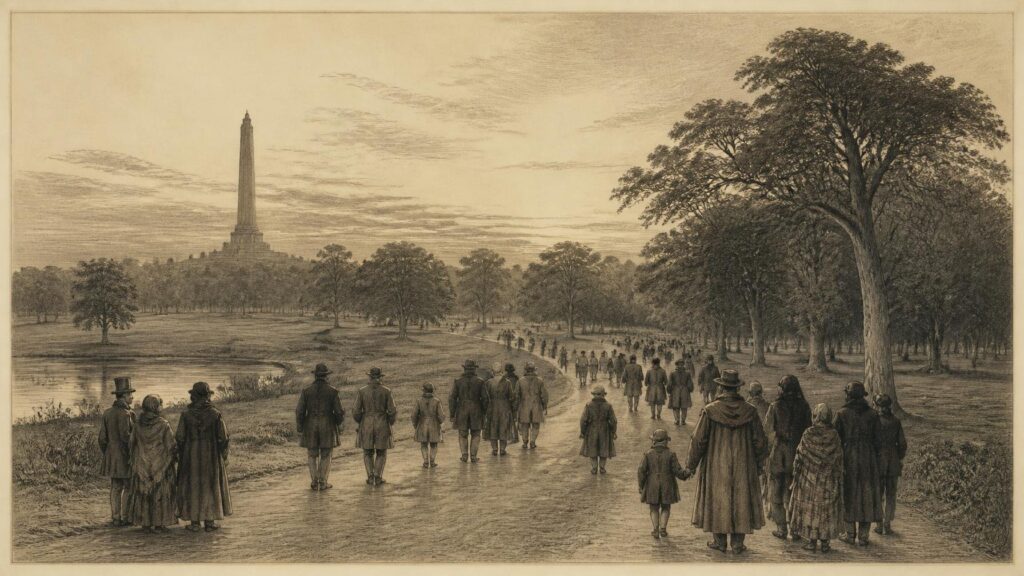
AI generated historical illustration, not a contemporary photograph.
At a Glance
Darkness Into Light is one of the most recognisable public rituals to emerge from twenty-first-century Ireland. Beginning as a pre-dawn walk in Dublin’s Phoenix Park in 2009, it brought a subject often treated in private—suicide, self-harm, bereavement and mental distress—into shared civic space. Its history is necessarily brief beside that of Irish psychiatry, but its meanings belong to a much longer story: of confinement and care, silence and speech, stigma and solidarity, voluntary action and changing ideas of citizenship.
Public Beginnings
Darkness Into Light was established by Pieta as a fundraising and awareness event in 2009. Pieta’s later account records that roughly 400 people walked a five-kilometre course in the Phoenix Park at dawn that first year. The basic form was strikingly simple: participants assembled while it was still dark, travelled together through the changing light of early morning, and finished after sunrise. Yet the form carried considerable emotional weight. The movement from darkness to daylight offered participants a language of endurance and hope which could be understood without a speech, a diagnosis or an individual disclosure.
The event arose in the Republic of Ireland during a period when public discussion of suicide and mental health was becoming more visible, though visibility should not be confused with uncomplicated openness. Suicide had long been an especially difficult subject. It involved bereavement, religious and moral traditions, fear of judgement, concern for relatives, and the practical uncertainty of how to seek assistance. Mental illness, meanwhile, had been shaped by an older inheritance of institutional care and by a public vocabulary that frequently reduced people to labels. Darkness Into Light did not create these circumstances. Its importance lies partly in making a new public response to them available.
The first walk was not a state ceremony, a church observance or a medical intervention. It was organised by a voluntary body and funded through participation and support. This matters historically. In Ireland, voluntary associations, religious organisations, charitable institutions, families and local communities have repeatedly supplied care where formal provision was incomplete, inaccessible or distrusted. Darkness Into Light belongs to that tradition, though it also reflects a more recent expectation that mental health should be discussed in the language of rights, recovery, prevention and community support.
The name itself is best treated as an organising metaphor rather than evidence of a single religious or political meaning. For some walkers, dawn may have had spiritual resonance; for others, it represented remembrance, endurance, friendship or simply the completion of a demanding early start. For people who had lost someone, it could provide a sanctioned setting in which grief was neither hidden nor required to be explained. That range of meanings is one reason why the event could travel beyond its first location.
Irish Context
To understand why an event such as Darkness Into Light found a large audience, it is necessary to place it against the history of mental health in Ireland. That history cannot be told as a smooth journey from ignorance to enlightenment. Earlier generations included compassionate relatives, committed nurses, doctors, attendants, reformers and patients who resisted or negotiated the systems surrounding them. At the same time, the record shows the immense power of institutions to define distress, remove people from their communities and organise their lives through law and administration.
Modern readers should approach historical terminology with care. Nineteenth-century statutes and asylum records used words now recognised as offensive and dehumanising. Repeating such language without explanation can reproduce its harm; avoiding it altogether can obscure the legal world in which people were classified and confined. The appropriate course is to acknowledge that the terms belonged to the record, while refusing to treat them as neutral descriptions of human beings.
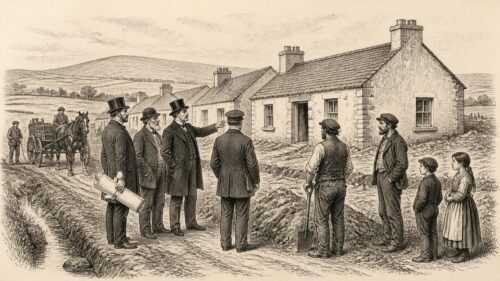
Ireland’s nineteenth-century asylum system developed within the United Kingdom of Great Britain and Ireland, before the establishment of the Irish Free State in 1922 and the later constitutional development of the Republic. Its institutions therefore cannot be understood only as a national story after independence. They were shaped by imperial legislation, local taxation, Poor Law administration, religious and philanthropic initiative, medical theory, class distinction, gender expectations and the unequal relationships between town and countryside.
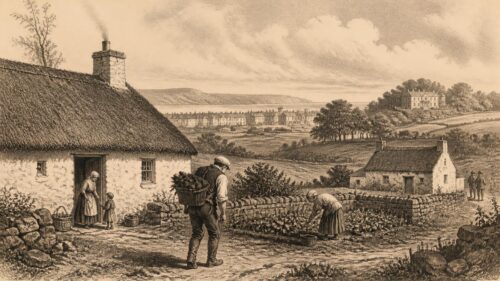
Historical research has shown that institutionalisation was not simply a medical response to illness. Poverty, age, disability, family breakdown, migration, social respectability and the shortage of other forms of support affected who entered institutions and how long they remained. This does not mean that mental distress was unreal, or that every admission was unjustified. It means that the boundary between treatment, welfare, discipline and social control was often blurred. That ambiguity is essential when interpreting the long shadow of the asylum in Irish memory.
Darkness Into Light sits at a considerable distance from that institutional world. It takes place outdoors, in public, by choice, with friends and strangers moving alongside one another. Its symbolic geography is therefore important. Where the older system was often associated with walls, wards, gates and separation, the walk is associated with roads, parks, local streets and open gathering places. This contrast is interpretative rather than a claim that one event repaired the consequences of institutional history. It nevertheless helps explain why public movement together can carry such force.
Asylum Foundations
In the late eighteenth and early nineteenth centuries, reformers across Britain and Ireland increasingly argued that people described as mentally ill required specialised accommodation. The argument could include humanitarian motives: the wish to remove people from prisons, workhouses, private confinement or neglect. It could also include ideas of supervision, order and protection of the wider public. These purposes were never entirely separate.
St Patrick’s Hospital in Dublin, founded in 1745, preceded the main public district asylum system. During the nineteenth century, public provision expanded substantially. Richmond Asylum at Grangegorman, later known as St Brendan’s, opened in 1814. District asylums were developed in many parts of Ireland. These institutions were often presented as modern alternatives to older forms of custody. Their buildings, routines and moral language reflected contemporary confidence that ordered surroundings, work, discipline, medical attention and regulated daily life might restore people to health.
That confidence needs qualification. The ideal of curative treatment coexisted with overcrowding, limited resources and long residence. An asylum could offer food, shelter and regularity unavailable elsewhere, particularly in conditions of poverty. It could also remove an individual from family, work, locality and ordinary decision-making. For some patients, admission was brief; for others, it became a defining and prolonged separation. The documentary archive is especially rich in official voices—inspectors, governors, doctors and administrators—and often poorer in the voices of those confined. Historians must therefore resist treating institutional files as transparent accounts of patients’ own experience.
The expansion of the asylum system also made mental disturbance more legible to the state. Statistics, annual reports, inspection, certification and legislation turned varied human experiences into categories that could be counted and managed. Such records are valuable evidence, but they should not be mistaken for a simple measure of how much mental illness existed in society. A rising institutional population may reflect changing law, altered admission practices, family hardship or lack of alternatives as much as a change in underlying prevalence.
This point is relevant to the history of public stigma. Once distress is chiefly encountered through an institution designed for custody, the institution can shape how the wider population imagines the people within it. The distinction between a person in crisis and a person deemed permanently dangerous may disappear. Later Irish campaigns for community care, anti-stigma work and rights-based services developed partly in response to that legacy.
Dangerous Labels
One of the most consequential developments in nineteenth-century Ireland was legislation that linked mental disorder with danger and public security. The Criminal Lunatics (Ireland) Act of 1838 became known in common usage as the ‘dangerous lunatic’ legislation. Scholarship on the subject has emphasised that the law widened routes into district asylums and helped bind public ideas of mental illness to crime, threat and removal from society.
It would be too simple to say that every person admitted under such provisions was harmless or that every official acted maliciously. Some people were in acute crisis, and families, police and local authorities faced situations for which they had few services. The deeper problem was structural. A system which allowed broad, poorly safeguarded definitions of danger could draw in people who were old, poor, infirm, disruptive, homeless or inconvenient as well as people experiencing severe psychiatric distress. Once admission was made, release could be difficult.
The language of danger had long consequences. It gave social respectability to the notion that the safest response to mental disturbance was exclusion. In popular memory, this could be reinforced by physical architecture: imposing institutions set apart from everyday life, surrounded by grounds or walls and organised around formal authority. The image was powerful even where individual staff practised care and kindness.
The Central Criminal Lunatic Asylum (Ireland) Act of 1845 illustrates the degree to which legal and psychiatric categories overlapped. The legislation provided for a central institution near Dublin for people charged with offences who were considered mentally ill. The later Central Mental Hospital at Dundrum embodied a continuing tension: were its residents to be understood principally as patients requiring treatment, as offenders requiring custody, or as people whose circumstances required both legal safeguards and specialised care? That question has never been merely historical. Modern mental-health law continues to wrestle with the relationship between capacity, risk, treatment, liberty and due process.
Darkness Into Light does not directly address forensic psychiatry or involuntary detention. Its wider cultural setting, however, includes the effort to separate mental health difficulties from stereotypes of menace or shame. A dawn walk cannot settle legal questions or replace clinical care. It can make it harder, at least for a few hours, to imagine distress solely as something hidden behind an institutional boundary.
Institutional Burdens
By the twentieth century, Ireland had acquired an exceptionally large psychiatric-hospital population relative to its size. The reasons remain contested and are not reducible to a single explanation. Historians have considered poverty, family structures, migration, rural isolation, limited welfare alternatives, administrative practice, social conservatism, changing medical classifications and the after-effects of earlier law. The point on which the evidence is clear is that psychiatric institutions occupied an unusually large place in Irish social life.
A government account drawing on the Commission of Inquiry on Mental Illness recorded that, in the year ending 31 March 1965, the average number of residents in district, branch and auxiliary mental hospitals was 17,949. It noted that the psychiatric-bed rate recorded in 1961 was very high by international comparison. The Commission also observed that many buildings dated from the nineteenth century and were products of an era in which security and custodial care had taken precedence. Such figures do not tell us how each person experienced an institution, but they convey the scale of the system.
Behind every aggregate were individual lives. Some people entered after a first acute episode and left. Others lived for years in hospitals because relatives could not provide care, because employment and housing were unavailable, because disability was misunderstood, or because there was nowhere else to go. Long stay did not necessarily prove that a person needed permanent segregation. Equally, discharge without adequate supports could transfer hardship back to families and communities. The history of deinstitutionalisation must therefore be judged not only by reduced beds but by what supports replaced them.
Institutional experience could also be shaped by gender and class. Women who defied expected domestic roles, people whose behaviour was judged sexually improper, men unable to sustain work, older people without family support, and people living in poverty could all be especially vulnerable to institutional classification. This does not mean that diagnosis was merely a disguise for social control. It means that diagnosis operated within a society that distributed power and respectability unequally.
The physical survival of former asylum buildings has made this past unusually visible. Their scale can invite easy narratives of cruelty or nostalgia. Neither is enough. Some sites contain evidence of innovation, work, craft, recreation and dedicated staff; they also represent systems in which many people lost autonomy and ordinary social belonging. A historically responsible account holds both realities together.
Reform Pressures
By the middle decades of the twentieth century, the case for reform had become unavoidable. New psychiatric medicines, changing professional ideas, economic development, international debates and criticism of institutional conditions all contributed to pressure for change. The Commission of Inquiry on Mental Illness, established in 1961 and reporting in 1966, scrutinised the condition of Irish services and questioned the suitability of many inherited institutions.
Its importance was not that it supplied a final solution. Major policy reports rarely do. Rather, it placed the structure of mental-health care under public examination and gave official recognition to problems that patients, relatives and staff had experienced in different ways. The language of the report still bore the marks of its time, but its assessment of the old custodial estate helped legitimate the case for alternatives.
Later decades saw a fall in the average resident population of psychiatric hospitals. Research on institutional confinement in Ireland identifies a substantial decline from the early 1960s and an acceleration after the 1980s. Several factors mattered: outpatient provision, changes in medication, greater use of local services and the gradual development of alternatives to long-term hospital residence. Declining numbers should not, however, be treated as an uncomplicated success measure. Community care requires housing, income, clinical access, family support, crisis provision and respect for service users’ choices. Without these, the closure of beds can create new forms of exclusion.
The word ‘reform’ is often used as though it were a single event. In practice it describes a long and uneven process. Different regions changed at different speeds. Services depended on budgets, staffing, buildings, local leadership and political priorities. Some former patients benefited from more independent lives; others encountered gaps in support. The history therefore cautions against triumphal claims about any one policy or campaign.
Nevertheless, reform altered the moral centre of debate. The question was increasingly not how to contain people judged troublesome, but how to support people to live as citizens in their own communities. That principle would later be expressed in policy through person-centred care, multidisciplinary services, recovery, social inclusion and stronger legal safeguards. Darkness Into Light emerged in a society already shaped by this shift, even though its organisers were not responsible for creating it.
Changing Laws
Law offers one way to trace the changing balance between professional authority and individual rights. Earlier legislation had concentrated heavily on certification, detention and the administration of asylums. The Mental Health Act 2001, which came into operation during the following decade, established a more modern framework for involuntary admission and created formal safeguards including review by mental-health tribunals, the Mental Health Commission and inspection arrangements.
Such legal developments should not be romanticised. Rights on paper require accessible advocacy, informed participation, trained staff and meaningful accountability. Yet the change in emphasis was significant. A person receiving mental-health care was increasingly understood not only as an object of welfare or risk management but as a rights-bearing individual entitled to safeguards when liberty was restricted.
The 2006 policy document A Vision for Change further articulated a community-based, multidisciplinary and person-centred approach. It argued for services which took account of biological, psychological and social dimensions of mental health. The formulation was important because it resisted a purely institutional or purely medical model. A person’s wellbeing could not be separated neatly from housing, relationships, employment, discrimination, trauma and participation in community life.
Its successor, Sharing the Vision, published in 2020, continued the emphasis on promotion, prevention, early intervention, access, continuity, social inclusion and accountability. These policies show that the history of Irish mental health is not solely a history of hospitals. It is also a history of ambitions: to prevent crisis, reduce isolation, involve service users, support recovery and provide help close to where people live.
The gap between policy intention and lived experience remains a historical question as well as a contemporary one. Implementation is shaped by resources and political choices. It would be unsound to describe a national strategy as proof that every person can obtain timely care. Equally, it would be wrong to dismiss policy language as empty merely because implementation is incomplete. Policy documents identify the direction in which public institutions say they should move; records of delivery reveal how far they have travelled.
Private Silences
Suicide has its own difficult history. Historical records understate as well as reveal. In the nineteenth century, social stigma, religious concern, legal consequences, uncertainties of medical certification and the pressures facing bereaved families could all influence how a death was described. Statistics should therefore be used carefully. A low recorded rate is not proof that suicide was rare in the modern sense; it may also reflect under-reporting and classification practices.
The private character of bereavement has had enduring consequences. Families may fear gossip, blame or sensational attention. They may also wish to protect the dignity of the dead. Public campaigns can challenge silence, but they must do so without converting personal loss into spectacle. The best communal observances leave room for people who want to speak and for people who do not.
Irish discussion of suicide has changed notably over recent decades. The change is visible in the growth of specialist charities, school and workplace initiatives, national prevention strategies, bereavement supports and media guidance. It is also visible in ordinary conversation: people using the language of mental health rather than moral weakness, and people acknowledging that asking for help can be difficult. Change should not be overstated. Stigma survives, particularly where masculinity, rural isolation, poverty, addiction, discrimination or fear of professional consequences affect whether people seek assistance.
Darkness Into Light is strongest when understood within this unfinished history. It does not abolish shame by naming it once a year. It provides a recurrent occasion for a community to demonstrate that the subject may be met with compassion rather than avoidance. That public demonstration can matter to participants, even though its effect will differ greatly between individuals.
Ritual Meaning
The walk’s power is not explained by fundraising alone. Fundraising is central: Pieta uses Darkness Into Light to support services connected with suicide prevention and self-harm. But events of this kind also operate as rituals. They gather people at an unusual hour, ask them to undertake a shared route, use a visible transition in the natural world and create a temporary community across ordinary social divisions.
Ritual need not mean religious ritual. Historians and anthropologists use the term more broadly for repeated actions that give form to collective feeling. A funeral procession, a civic commemoration, a sporting silence and a charity walk may all become rituals when they provide a recognised way to act together in the face of matters that are otherwise hard to articulate. Darkness Into Light offers participants a framework for grief, care and public witness without prescribing a single belief.
The pre-dawn timing is crucial. Dawn is not merely decorative. Beginning in darkness acknowledges that the event concerns experiences of loss, fear and uncertainty. Reaching daylight allows hope to be enacted physically rather than stated abstractly. This is an interpretation of the event’s form, not proof that every participant experiences it in that way. Some may walk for a person they miss; some for a friend receiving support; some for workplace solidarity; some because their local community takes part; some simply because they wish to contribute.
Its route is also significant. In an older institutional model, distress was often managed by removing a person from public view. The walk reverses that spatial logic. People occupy ordinary public places while acknowledging subjects that once carried concealment. This does not make privacy less valuable. On the contrary, it can make privacy safer by demonstrating that private suffering need not entail public disgrace.
There is a further distinction worth maintaining. A communal ritual may foster connection, but it is not therapy in itself and should not be represented as a substitute for professional treatment, crisis care or sustained support. Its historical contribution is cultural: it changes the occasions on which people may remember, speak, listen and show solidarity.
Volunteer Networks
The growth of Darkness Into Light depended on volunteer organisation. Pieta’s account of the event describes a transition from the original Phoenix Park gathering to a wider network supported by local committees, athletics expertise and, from 2013, Electric Ireland sponsorship. This growth reflects a familiar Irish pattern in which local initiative enables a national cause to take practical form.
Volunteers do more than marshal a route or distribute information. They make an event locally credible. A walk attached to a particular town, parish, school, sports club or workplace can draw on existing relationships. Such relationships may be especially important for subjects that are emotionally difficult. People sometimes participate because a neighbour asks, a team remembers a former member, a family wishes to honour someone, or a local organiser makes the event feel safe and respectful.
There are limits to the ideal of volunteerism. Reliance on unpaid labour can obscure the need for properly funded statutory services. Communities with greater resources may find fundraising easier than those with fewer. Volunteers may also carry emotional burdens when an event concerns loss and suicide. A responsible historical reading should therefore admire voluntary effort without using it as an excuse to shift public responsibility onto charitable organisations.
Corporate sponsorship presents a similar complexity. Sponsorship can provide scale, communications capacity and financial security. It can help a national event reach communities that voluntary organisers alone could not easily serve. At the same time, the partnership between a charity and a large company shapes the event’s public image. This is neither automatically beneficial nor automatically suspect; it is part of the modern history of how social causes are financed and communicated.
The event’s international expansion should likewise be understood with precision. Darkness Into Light began in Ireland and remains strongly associated with Pieta, but it has been held beyond Ireland. International participation does not erase its Irish origin. Rather, it shows how an event rooted in a particular national context can travel through migration, diaspora networks, digital communication and shared concern about mental health.
Visible Grief
Public expressions of grief have a complicated place in Irish history. There have long been communal forms of mourning, from wakes and funerals to memorial masses, anniversaries, local monuments and charitable collections. At the same time, particular kinds of death or distress could be surrounded by silence. The bereaved might receive kindness privately while feeling unable to name the cause of their loss openly.
Darkness Into Light gives visible form to a grief that is often dispersed. Participants may wear a colour, walk with relatives, carry a private memory or meet people whose experiences they do not know. The event does not require detailed personal testimony. This can be particularly important when bereavement has involved trauma, complicated family feeling or public misunderstanding. Presence itself becomes a form of acknowledgment.
There is a risk in every public memorial practice: that the pressure to appear hopeful may leave insufficient room for anger, ambivalence or despair. Grief is not a linear movement from darkness into light. Bereaved people may experience memory and pain in cycles, and no dawn ceremony can resolve that. The event’s symbolism should therefore be read as an offer of companionship, not an instruction about how mourning ought to proceed.
The distinction between memory and evidence is important here. Personal stories are indispensable for understanding why an event matters. They should not, however, be treated as statistical proof that the event prevents suicide or produces clinical recovery. Individual testimony can establish meaning; it cannot alone demonstrate population-level outcomes. Ethical public history respects both the truth of lived experience and the limits of what it can prove.
Measured Claims
The historical importance of Darkness Into Light can be stated clearly without making claims beyond the evidence. It has raised funds, gathered large numbers of participants, expanded from an Irish beginning and provided a public setting for awareness and remembrance. It has become a prominent element in the calendar of Irish mental-health advocacy. These are substantial achievements.
What cannot safely be claimed from participation figures alone is that the event has directly reduced national suicide rates, eliminated stigma or supplied adequate support to everyone in need. Suicide is influenced by complex social, economic, health and personal factors. Prevention requires many forms of action: accessible clinical services, crisis support, responsible media practice, housing and income security, substance-use supports, connection, education, research and compassionate responses after bereavement.
Fundraising events can sometimes encourage a misleadingly simple story in which awareness is assumed to solve structural problems. Awareness is valuable, but it is not the same as treatment availability. Public sympathy is valuable, but it is not the same as rights, housing or continuity of care. The most constructive way to interpret Darkness Into Light is as one part of a larger ecosystem of support and advocacy.
There is also a question of historical memory. The event’s hopeful image should not cause Ireland’s institutional past to disappear from view. Public walks, campaigns and policy reforms gain depth when they acknowledge the generations who experienced confinement, stigma, inadequate care or exclusion. Remembering that history does not diminish contemporary hope. It explains why community, dignity and voice matter so much.
Lasting Questions
Darkness Into Light has become an Irish historical subject because it records a shift in public culture. In 2009, a few hundred people gathered in Phoenix Park before sunrise. In later years, the event grew into a large and internationally recognisable movement. Its history reveals the changing place of mental health in Irish civic life: less exclusively private, less automatically associated with institutions, and more readily expressed through collective action.
The shift remains incomplete. People still encounter delays, unequal access, discrimination and fear of disclosure. Families continue to manage care under pressure. The language of recovery and inclusion is meaningful only when matched by services and material support. The history of Irish mental health warns against assuming that good intentions or changing vocabulary alone will transform lived conditions.
Yet public culture matters. It affects whether a person thinks they can speak, whether a colleague knows how to respond, whether a bereaved family feels isolated, and whether political neglect is challenged. A dawn walk cannot carry all these burdens, but it can create an annual reminder that silence is not the only available response.
Its most enduring historical significance may therefore lie in witness. Participants do not need to know one another’s stories to recognise that many people carry difficult experiences. They meet before daylight, walk a shared distance and return to ordinary life with the knowledge that private pain has a public place. In that modest but consequential act, Darkness Into Light belongs to the continuing Irish history of care, remembrance and the struggle for dignity.
Dawn Witnesses
Participants may wear a colour, walk with relatives or colleagues, carry a private memory, or join without explaining their reasons to anyone. In that respect, Darkness Into Light provides a form of witness rather than a demand for testimony. To be present in the crowd is to acknowledge that suicide, self-harm and bereavement affect a community; it does not oblige a walker to turn personal experience into a public account. This balance matters. Earlier forms of silence could isolate people, but a culture of compulsory disclosure would be no kinder. The walk allows recognition to be shared while leaving each person control over what remains unsaid.
The scale achieved by the event makes that recognition especially visible. By 2024, Pieta expected about 100,000 participants across more than 230 official walks, with events and associated fundraising extending across four continents. Such growth should not be read simply as proof that stigma has disappeared. Large participation can coexist with fear, unequal access to care and the continuing difficulty of speaking openly in particular families, workplaces or localities. It does show, however, that an issue once strongly associated with concealment can command sustained public attention. The event’s expansion from an approximately 400-person Phoenix Park walk in 2009 is therefore a change in civic practice as well as in fundraising scale.
Its public character also helps distinguish solidarity from certainty. No participant can know another person’s history, grief or need. The group does not erase those differences by moving at the same pace or arriving at the same sunrise. Rather, it makes room for a limited but significant common action: being present alongside others. This is important in a history in which people experiencing mental distress were often defined by authorities, legal categories or institutions rather than recognised as neighbours and citizens. A voluntary walk cannot undo that history, but it stages a different relationship to it. Those who take part are not gathered for confinement, inspection or certification; they assemble by choice in an open setting.
The language of hope requires care. Hope is not a guarantee that suffering will end, nor a promise that bereavement can be resolved by a single morning. For some people, dawn may bring consolation; for others, the walk may be difficult precisely because it recalls someone absent. Its value lies less in offering a universal emotional outcome than in permitting several responses to exist together. The event can hold grief, anger, affection, exhaustion and resolve alongside the more public language of encouragement. That emotional breadth is one reason ritual can be useful where ordinary speech feels insufficient.
Darkness Into Light also illustrates the limits and possibilities of charitable action in modern Ireland. Pieta’s services rely heavily on public fundraising, while national mental-health policy has committed the State to prevention, early intervention, community-based support, social inclusion and accountability. These are connected responsibilities but not interchangeable ones. Voluntary fundraising can build awareness, finance supports and mobilise communities; it cannot by itself secure the housing, clinical capacity, advocacy and continuity of care required for an equitable system. The most durable meaning of the dawn walk may therefore be its insistence that compassion must be made visible—and that visibility should be matched by practical support, public responsibility and respect for the dignity of every person.
Darkness Into Light’s journey from a pre-dawn fundraiser to a widespread ritual raises an intriguing question about what public commemoration can achieve. The article distinguishes symbolic visibility from clinical evidence, while placing the walk against Ireland’s history of institutionalisation, stigma and reform. Walking together in open spaces may counter associations of distress with isolation and confinement, yet its meanings can vary between grief, hope, spirituality and solidarity. This flexibility may be a strength, but it may also limit understanding of what support people need. How should communities balance the ritual’s inclusive symbolism with conversation about rights, care and accessible services?