

Shared Island
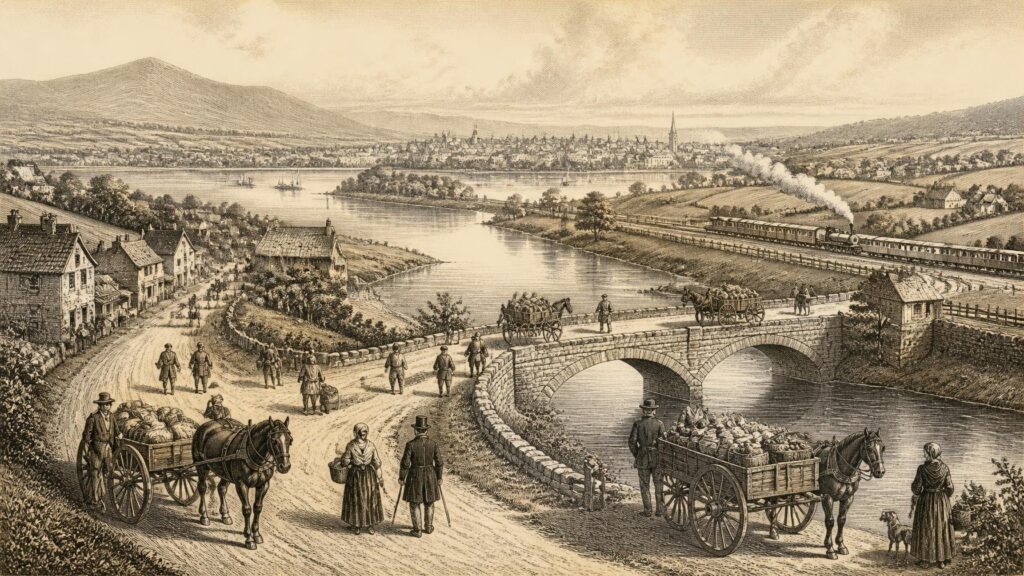
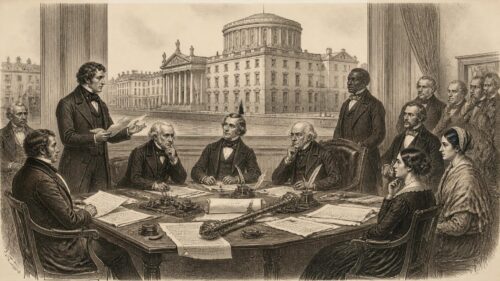
AI generated historical illustration, not a contemporary photograph.
At a Glance
North South cooperation is not a vague aspiration appended to Irish history: it is a carefully negotiated constitutional practice, developed through failure, conflict and compromise, by which two administrations on the island of Ireland address interests that neither border nor sovereignty can entirely divide. Its modern form is found in Strand Two of the Belfast/Good Friday Agreement of 10 April 1998, but its history reaches back through partition, contested constitutional schemes, cross-border economic life and the long search for a settlement acceptable to people who understood Ireland in profoundly different ways. It has never meant the same thing to everyone. For nationalists it could appear as recognition that Ireland remained an interconnected social and economic unit. For unionists it could provoke concern that administrative links might become a route towards constitutional absorption. For governments in Dublin and London it became, at different moments, a tool of crisis management, diplomacy and peace building. Its endurance has depended on resisting all three simplifications.
Border Origins
The partition of Ireland created the framework within which modern North South cooperation became necessary and controversial. The Government of Ireland Act 1920 envisaged two devolved jurisdictions, Northern Ireland and Southern Ireland, and also contained provisions for a Council of Ireland. That body might have offered a means of coordinating common concerns, but the political settlement anticipated by the Act never came into being. Southern Ireland did not develop as intended; the Irish Free State emerged from revolution and treaty in 1922, while Northern Ireland remained within the United Kingdom. The proposed Council consequently had little practical life. Its failure was an early warning that institutional design could not by itself reconcile competing claims of allegiance, sovereignty and identity.
Partition nevertheless did not divide an empty landscape. The new frontier cut across local economies, family networks, transport routes, rivers and farming districts. Towns and villages close to the line depended upon markets, roads and services extending into the other jurisdiction. The border also divided a wider island whose railways, waterways, agricultural systems and commercial habits had developed before 1921. Practical contact therefore survived even when official political relations were cool or hostile. It could take modest forms: trade, local movement, shared natural resources, professional links and the everyday improvisations of border communities. Such contact should not be romanticised. It did not dissolve political antagonism, and during periods of heightened security it could become difficult or dangerous. Yet it established the material fact on which later cooperation would rest: the border mattered greatly, but it could not make neighbouring societies unrelated.
Constitutional language made the question more fraught. The Irish state’s original constitutional claim to the national territory, and the unionist insistence upon Northern Ireland’s place in the United Kingdom, placed an all-island institution under unusual symbolic pressure. A cooperative arrangement could be judged not simply by its work but by what opponents feared it represented. In that setting, a cross-border road scheme, a shared health service or an inland-waterways body might be read as evidence of ordinary public administration, a concession to geography, or a constitutional threat. The ambiguity did not arise from misunderstanding alone. It reflected genuinely incompatible political projects and memories.
Folklore and popular memory have sometimes presented the border as either wholly artificial and ignored, or as an immovable wall separating two self-contained worlds. Neither description is adequate history. The border was a state frontier with legal, political and at times military consequences. It also crossed an island of continuing economic and human connections. The later institutions of North South cooperation did not erase that contradiction. They created procedures through which it could be managed without requiring agreement on the ultimate constitutional future.
Practical Connections
Long before the Belfast Agreement, particular subjects encouraged officials and public bodies to think beyond the frontier. Rivers and loughs do not observe constitutional jurisdictions; animal disease, environmental pollution and commercial supply chains likewise require coordination if they are to be addressed effectively. Agriculture was especially important because production, veterinary risk and rural markets often operated across the border. Transport posed a related problem. Routes which had once served an all-island network had to be administered after partition by different authorities with distinct priorities and budgets. The result was not seamless cooperation, but it did make the case for contact difficult to dismiss.
Economic interdependence was not uniform. Northern Ireland’s industrial links with Great Britain remained central, while the Republic developed its own trade patterns, fiscal system and institutions. Border counties could experience partition as economic marginalisation rather than opportunity. Still, common interests persisted at the margins of formal politics. The north-west of the island offers a clear example. Derry and Donegal were connected by geography and labour markets while separated by an international boundary. Similar problems arose in the Fermanagh–Cavan–Monaghan region, in the Newry–Dundalk corridor and around Carlingford Lough. Cross-border needs were often local and functional before they became the language of high politics.
Membership of the European Economic Community from 1973 supplied a further context. Ireland and the United Kingdom entered the same European framework on 1 January of that year. Common membership did not resolve the constitutional conflict in Northern Ireland, but it created regular governmental contact and shared regulatory settings. European funding later provided a practical resource for projects in border regions. Historians should be careful, however, not to treat European membership as a magic explanation for peace. Violence continued through the 1970s, 1980s and 1990s. What European integration did provide was a vocabulary and set of instruments for cooperation that were less starkly nationalist than an argument over sovereignty.
This practical dimension matters because later agreements did not emerge solely from abstract constitutional theory. Their advocates could point to tasks requiring sustained administrative attention: food safety, disease control, tourism, waterways, transport planning, environmental protection and business development. Such areas did not settle the question of whether Northern Ireland should remain in the United Kingdom or join a united Ireland. They offered a more limited proposition: neighbouring administrations could act together where mutual benefit and democratic authority allowed. The political difficulty lay in making that proposition acceptable to constituencies who feared that even limited action could have wider implications.
Conflict Escalation
The civil-rights crisis of the late 1960s and the conflict usually known as the Troubles transformed the atmosphere in which cross-border relations were discussed. The causes of the conflict were multiple: discrimination and unequal power within Northern Ireland; conflict over its constitutional status; competing national identities; and the actions of republican and loyalist paramilitary organisations, the British state and political parties. Violence imposed an enormous human cost. More than 3,500 people were killed during the conflict, while many more were injured, bereaved, displaced or traumatised. In such circumstances, the border was not merely an administrative boundary. It became a site of security installations, military patrols, smuggling allegations, paramilitary movement and competing accusations between governments.
Cross-border cooperation accordingly acquired a security dimension which complicated every other consideration. The Irish Government wanted a meaningful role in matters affecting the nationalist minority in Northern Ireland and repeatedly argued that the conflict could not be resolved by British policy alone. Unionists often viewed such claims with deep suspicion, believing that Dublin’s involvement challenged Northern Ireland’s constitutional position. British governments had to respond both to the escalating violence and to the evident failure of the old Stormont system, suspended in 1972. The search for a political settlement increasingly linked internal power sharing in Northern Ireland with some form of Irish governmental involvement.
It is important to distinguish between evidence and retrospective shorthand here. It is common to say that the later peace settlement simply revived earlier ideas. There is truth in that: the institutional relationship between Northern Ireland, Ireland and Britain had been debated repeatedly. But the circumstances changed markedly. The scale of violence, the development of civil-rights politics, the changing role of the Irish state, British direct rule and international attention all altered what could be proposed and how it might be received. Later negotiators learned from earlier schemes, but they did not merely retrieve an abandoned blueprint.
Failed Experiment
The Sunningdale Agreement of December 1973 was the most important early attempt to combine power sharing within Northern Ireland with structured North South relations. It followed the election of a new Northern Ireland Assembly and the formation of a power-sharing Executive involving the Ulster Unionist Party, the Social Democratic and Labour Party and the Alliance Party. At Sunningdale Park in Berkshire, the British and Irish Governments and representatives of the Northern Ireland Executive agreed the outline of a Council of Ireland. Its proposed Council of Ministers would include equal numbers from the Irish Government and Northern Ireland Executive and would act by unanimity. A Consultative Assembly would provide an advisory and reviewing role.
The Council was intended to have executive and harmonising functions in selected areas, while its detailed remit remained to be worked out. That incompleteness proved politically significant. Supporters saw an attempt to acknowledge the Irish dimension while preserving Northern Ireland’s constitutional status by consent. Critics, especially among unionists, saw an unacceptable concession to Dublin and a potential stepping stone towards Irish unity. The phrase later associated with the Belfast Agreement, that it was “Sunningdale for slow learners”, captures a political comparison, not a sufficient historical verdict. It highlights shared elements—power sharing and North South machinery—but understates differences in legitimacy, negotiation, constitutional change and public endorsement.
Sunningdale collapsed in May 1974 amid the Ulster Workers’ Council strike and intense loyalist opposition. The strike disrupted electricity, fuel and daily life and exposed the inability of the Executive and British Government to sustain the settlement. The Council of Ireland consequently never developed into a working institution. Its demise demonstrated that a settlement cannot endure without substantial consent from those expected to operate it. It also made the phrase “Council of Ireland” politically radioactive in much unionist discourse for years afterwards.
Yet Sunningdale’s collapse did not make the underlying issues disappear. It left a durable lesson for later negotiators: North South arrangements could not be isolated from internal Northern Ireland governance, nor could they be imposed as a token annex to a settlement lacking broad political ownership. Any future design would need clearer safeguards, carefully delimited powers, democratic accountability and a relationship to British-Irish structures. Above all, it would require a way for unionists to participate without accepting the nationalist premise that constitutional change was inevitable.
Diplomatic Turning
The Anglo-Irish Agreement signed at Hillsborough Castle on 15 November 1985 marked a different approach. Rather than creating a joint North South executive body, it gave the Government of Ireland a formal consultative role through the Anglo-Irish Intergovernmental Conference. British and Irish ministers would meet regularly on political, security, legal and cross-border matters affecting Northern Ireland. The agreement confirmed that there could be no change in Northern Ireland’s constitutional status without the consent of a majority of its people. It therefore combined an explicit guarantee sought by unionism with an institutional role for Dublin sought by nationalism.
Unionist reaction was overwhelmingly hostile. The major unionist parties had not been included in the final negotiation and argued that the agreement gave the Irish Government influence over Northern Ireland without the consent of its unionist majority. Large demonstrations, electoral resignations and the campaign slogan “Ulster Says No” expressed that rejection. Republican opinion was also divided and often critical: the agreement did not deliver Irish unity, and it confirmed the principle of consent. The accord did not end violence. Its immediate political reception makes clear why historians should not describe cooperation as a painless or linear process.
Its longer significance was diplomatic. It created regular, structured contact between London and Dublin at a time when public rhetoric could otherwise become accusatory. The agreement helped establish habits of official discussion and gave the Irish Government a recognised route through which to raise nationalist concerns. It also clarified that a British-Irish relationship could be part of the constitutional management of Northern Ireland without itself determining its future. The Oireachtas historical account rightly notes that the agreement’s cooperation between the two governments helped create conditions later important to the peace process, even though it did not itself bring the conflict to an end.
During the 1990s, ceasefires, party dialogue and British-Irish diplomatic engagement created an opening for a more comprehensive settlement. The Downing Street Declaration of 1993 and the ensuing negotiations mattered because they placed consent, self-determination and peaceful democratic politics at the centre of the process. The talks eventually involved parties representing sharply different positions, alongside the two governments. North South arrangements became one of the most sensitive strands. Nationalists sought meaningful institutions, while unionists required assurance that these would neither override Northern Ireland’s democratic institutions nor dilute its place in the United Kingdom without consent.
Negotiated Balance
The Belfast Agreement answered that problem through an architecture of three strands. Strand One established a devolved Assembly and power-sharing Executive in Northern Ireland. Strand Two created North South institutions. Strand Three established East West institutions, notably the British-Irish Council and the British-Irish Intergovernmental Conference. The three strands were not detachable ornaments. The agreement described the institutional and constitutional arrangements as “interlocking and interdependent”. That phrase is central to understanding North South cooperation. It was not designed as a freestanding all-island authority, nor as a concession that could be ignored after an Assembly had been created. It formed one part of a wider equilibrium.
The Belfast Agreement was signed on 10 April 1998, endorsed in referendums north and south on 22 May, and entered into force on 2 December 1999. The constitutional settlement was reinforced by changes in both jurisdictions. In Ireland, constitutional amendments accepted that a united Ireland could be brought about only by peaceful means with the consent of a majority in both jurisdictions. In the United Kingdom, the Northern Ireland Act 1998 provided the domestic legal framework for the new institutions. These changes mattered because North South cooperation was embedded in a settlement recognising both British and Irish identities and the legitimacy of differing constitutional aspirations.
Strand Two established the North South Ministerial Council, commonly abbreviated to NSMC. Its purpose was to bring together those with executive responsibilities in Northern Ireland and the Irish Government to develop consultation, cooperation and action on matters of mutual interest within the competence of the administrations. The wording was deliberately bounded. Ministers would work together, but neither side could dictate to the other. Decisions required agreement between the Northern Ireland side and the Irish Government side. Northern Ireland ministers participating in the Council remained subject to the rules of democratic authority and accountability applying within the Assembly and Executive, while Irish ministers were accountable to the Oireachtas and their own government.
This was a constitutional innovation of considerable subtlety. It acknowledged a North South dimension without establishing joint sovereignty or an all-island legislature. It made cooperation obligatory in an institutional sense—ministers were expected to participate—but consensual in decision-making. It embedded the Irish Government in a working relationship with a devolved Northern Ireland administration rather than granting it a general governing role in Northern Ireland. It also required cross-community participation in the Council’s Northern Ireland delegation, reflecting the Agreement’s wider commitment to inclusive government. The Northern Ireland Act 1998 expressly connected ministerial nominations and participation to the Agreement’s cross-community requirements.
Interpretation has always been politically contested. Some nationalists have viewed the institutions as evidence that partition no longer governs every aspect of life on the island. Some unionists have treated their limits as equally important: cooperation is between administrations, based on agreement, and does not alter Northern Ireland’s constitutional status. Both readings identify real aspects of the design. The Agreement’s achievement was not to make them identical, but to enable political representatives holding those views to undertake practical business together.
Institutional Design
The NSMC operates through several meeting formats. Plenary meetings bring together the Irish Taoiseach and relevant ministers with the Northern Ireland First Minister, deputy First Minister and relevant executive ministers. Sectoral meetings address particular policy areas. Institutional meetings consider the operation of the Council and associated bodies. Officials’ meetings prepare work and follow through on decisions. This layered structure matters because North South cooperation is not confined to ceremonial summitry. Much of its value lies in repeated ministerial and official contact over specific responsibilities.
The Agreement distinguished two ways of working. In six areas of cooperation, common policies and approaches could be agreed while implementation remained separate within each jurisdiction. These areas are agriculture; education; environment; health; tourism; and transport. The present official account of the Council identifies examples including animal and plant health, educational exchanges, water quality, cancer research, overseas tourism promotion and strategic road and rail planning. The list demonstrates the practical character intended by the negotiators. Each subject has cross-border implications but can remain within the constitutional and legal responsibilities of the respective administrations.
Alongside those six areas, the Agreement required at least six implementation bodies, operating on an all-island or cross-border basis. Their establishment was not automatic in April 1998. The final shape had to be negotiated during 1998, amid continuing disagreement over remit, accountability and symbolism. A contemporary November 1998 note preserved by the Public Record Office of Northern Ireland shows that agreement on bodies and functions was still being painstakingly assembled months after the Agreement had been signed. It is useful evidence against the comforting assumption that the referendum result made implementation inevitable. The institutions had to be built, staffed, funded and accepted.
The British and Irish Governments concluded the necessary agreement in March 1999, and parallel legislation followed. In Northern Ireland, the North South Co-operation (Implementation Bodies) Order 1999 gave legal effect to the bodies. The statutory text is revealing: it states that the bodies were to implement decisions of the NSMC on policies and actions within their functions, while emphasising that they constituted necessary public functions. They were therefore neither private voluntary projects nor independent political institutions. They were public bodies with defined remits, legal personalities and accountability arrangements in both jurisdictions.
Working Bodies
Waterways Ireland became responsible for specified inland navigable waterways, including the restoration and management of routes that connect the two jurisdictions. Its work has a visible symbolic quality—boats and waterways cross political boundaries—but its daily tasks are concrete: navigation, safety, maintenance, heritage and recreation. The body illustrates the way in which cooperation can turn shared geography into shared administration without making a constitutional claim. Its significance lies as much in routine public service as in emblematic landscape.
The Food Safety Promotion Board, publicly known as safefood, was created to promote food safety across the island. Food production and consumption chains do not stop neatly at a frontier, and public health advice is more effective when risks are understood across the relevant market and population. Its remit shows how the Agreement could institutionalise cooperation in an area where practical advantage was widely intelligible. The body does not require a common health system or common agricultural ministry. It provides a means for coordinated information, research and promotion.
The Trade and Business Development Body, operating as InterTradeIreland, was established to encourage cross-border trade and business development. Its creation recognised that small and medium-sized firms may benefit from information, networks and opportunities beyond their home jurisdiction. It also reflects a change in the language surrounding North South relations. Earlier constitutional debates often concentrated on grand political questions. InterTradeIreland placed entrepreneurship, innovation and market access within the peace settlement’s institutional landscape. That did not make economics politically neutral, but it gave cooperation a constituency among firms and workers who valued practical outcomes.
The Special EU Programmes Body, generally known as SEUPB, was established to manage particular European Union programmes with a cross-border or peace-building focus. Its existence demonstrated the importance of shared European membership to the institutional ecology created after 1998. European funding did not create the peace settlement, but it helped fund reconciliation, community development and cross-border projects. The body’s role became especially consequential after the United Kingdom’s decision to leave the European Union, when the preservation of programmes and cooperation acquired new political urgency.
The North South Language Body contains two agencies: Foras na Gaeilge, dealing with the Irish language, and the Ulster-Scots Agency, dealing with Ulster-Scots language, heritage and culture. Their pairing was constitutionally and culturally significant. The Agreement sought respect for the diversity of identities and traditions on the island; the language body did not treat cultural recognition as the preserve of one community. Its structure has not ended disputes over language policy, funding or identity. Nor was it meant to settle scholarly questions about language, dialect or tradition. Its importance lies in giving both fields a recognised cross-border institutional home.
The Foyle, Carlingford and Irish Lights Commission, commonly known through its Loughs Agency functions and related arrangements, addressed aquaculture and marine matters in shared or connected waters. Such bodies demonstrate why North South cooperation cannot be reduced to a constitutional metaphor. Fisheries, shellfish, water quality, navigation and environmental stewardship pose administrative problems requiring expertise and continuing contact. They are precisely the sort of questions that can be neglected when politics is organised only at the scale of competing national narratives.
Democratic Limits
The safeguards around the NSMC are as historically important as its achievements. The Council does not possess a general power to legislate for the island. It cannot compel a policy on either side without agreement. Its work must remain within the powers of the participating administrations. Decisions involving Northern Ireland ministers are tied to the Assembly and Executive, and the Northern Ireland Act provides for Assembly approval before a new implementation body established after the appointed day may come into operation. These limits were not technical details. They were a condition of unionist participation and a means of ensuring democratic accountability.
For the same reason, North South cooperation has been vulnerable to failure within Northern Ireland’s devolved institutions. The Agreement made the Assembly and Council mutually dependent in practice as well as principle. When devolution has been suspended or when an Executive has not been functioning, the normal ministerial side of the Council cannot operate as designed. This has produced a recurring historical pattern: useful bodies can continue aspects of their statutory work, but the political direction and ministerial relationship are constrained. Cooperation has therefore reflected the wider health of power sharing.
There were periods of suspension after the Assembly’s early years, including the prolonged suspension from October 2002 until May 2007. The institutions were restored under the St Andrews Agreement framework, but later political crises again interrupted normal operation. After the collapse of the Executive in January 2017, Northern Ireland lacked functioning devolved ministers until January 2020. A further absence followed the end of ministerial office in October 2022, after the 2022 Assembly election did not produce a restored Executive. These interruptions did not prove the North South institutions meaningless; rather, they exposed their dependence on political trust and on the willingness of parties to share power.
The Assembly and Executive were restored on 3 February 2024. The NSMC resumed with a plenary meeting at Armagh on 8 April 2024, followed by meetings in all twelve sectors during the following months. This return offered an unusually clear historical reminder of the Agreement’s interlocking design. Restoring devolution was not solely an internal Northern Ireland event. It enabled the resumption of the North South element and, in turn, renewed the wider balance of the settlement. The lesson is not that institutions automatically solve political disagreement. It is that their absence makes cooperation more difficult, less accountable and more vulnerable to symbolism.
European Context
For much of the Agreement’s first two decades, common UK and Irish membership of the European Union formed part of the background environment in which cooperation worked. It assisted cross-border projects, eased some practical barriers and allowed officials to work within overlapping legal and funding frameworks. The peace settlement itself was never an EU document; its authority rested on the British-Irish Agreement, domestic legislation and democratic endorsement. Nevertheless, the European setting helped normalise a politics in which sovereignty and cooperation were not always presented as opposites.
Brexit disturbed that environment. The United Kingdom’s withdrawal from the European Union raised immediate questions about the land border, trade, regulation, citizenship rights and the conditions in which North South cooperation could continue. The concern was not only physical infrastructure at crossing points. It was whether different legal regimes could reintroduce friction into the economic and social relationships which the Agreement had sought to make more workable. Debates over the Protocol on Ireland/Northern Ireland and later arrangements were often contentious, particularly within unionism, but the preservation of the Belfast Agreement’s Strand Two commitments remained an explicit objective.
The Irish Government’s official account of the Protocol states that its principal provisions came into effect on 1 January 2021 and that it was designed to protect the Good Friday Agreement while maintaining the conditions necessary for North South cooperation. This should not be read as proof that all political disagreement was resolved. It shows instead how deeply cooperation had become embedded in the post-1998 settlement. In earlier decades, cross-border arrangements were often proposed as a response to conflict. By the Brexit period, their protection had become a stated requirement in managing a major constitutional and economic change.
Brexit also illustrates the limits of treating cooperation as merely administrative. Rules governing goods, agriculture, public health and the movement of services can carry distributional effects and identity concerns. A practical arrangement may therefore become politically charged even where its original subject appears technical. The history of North South cooperation has repeatedly shown this pattern. Institutions work best when they are precise about their remit, transparent in their accountability and modest about what they can achieve. They become fragile when either advocates or opponents portray them as conclusive evidence that the constitutional question has already been decided.
Contested Meanings
North South cooperation has accumulated several meanings at once. It is a peace-process mechanism, because it gave institutional expression to the Irish dimension while placing it within consent and power sharing. It is a form of public administration, because it deals with waterways, food, trade, languages, marine environments and coordinated policy. It is also a cultural practice, because regular contact can make it more ordinary for ministers, civil servants, agencies and communities to work across a historically contested boundary. These meanings overlap but should not be confused.
Its achievements are often less dramatic than its constitutional importance. A meeting, a funded partnership, a common safety campaign or a joint tourism strategy may attract little public notice. Yet ordinary continuity is itself meaningful in a history where relations between the two jurisdictions were frequently defined by crisis. The enduring agencies have created institutional memory, professional expertise and networks that outlast a single ministerial term. They can make cooperative action imaginable even after political relationships have deteriorated.
There are also legitimate criticisms. The Council’s consensus rule can slow action. Its dependence on the Executive means that disputes unrelated to a particular cross-border subject can stall ministerial engagement. Bodies with narrow remits cannot solve inequalities in border areas, settle disputes over public services or overcome deeper disagreements about sovereignty. Scholars and citizens should therefore avoid both triumphalism and cynicism. It is inaccurate to call the institutions a disguised united Ireland; their legal design does not support that claim. It is equally inaccurate to dismiss them as empty symbolism; their statutory functions and continuing work demonstrate otherwise.
The current language of a “shared island” adds another layer. It can describe an aspiration towards greater connection, reconciliation and all-island investment. It is not, however, identical to the 1998 institutional settlement. The official Shared Island initiative of the Irish Government presents itself as working within the Good Friday Agreement and engaging all communities and traditions. Its programmes should be understood in that constitutional context: they may encourage cooperation and dialogue, but the status of Northern Ireland remains governed by the principle of consent. Historical clarity requires keeping policy initiatives, treaty institutions and constitutional outcomes distinct.
Enduring Lessons
The history of North South cooperation suggests several conclusions. First, geography creates practical problems that sovereignty alone cannot answer. Rivers, food chains, ecosystems, roads, markets and families make contact necessary whether political relations are cordial or not. Second, institutional forms matter. The contrast between the unrealised Council of Ireland, the collapsed Sunningdale arrangements, the Anglo-Irish Conference and the post-1998 bodies shows that legitimacy, consent, accountability and reciprocal guarantees affect whether cooperation can survive. Third, cooperation is strongest when it does not demand that participants abandon their identities or constitutional aspirations.
The Belfast Agreement did not resolve every question on the island of Ireland. It deliberately provided a framework in which constitutional change, if it comes, must follow democratic consent. Within that framework, North South cooperation offers a way to recognise shared interests without predetermining the destination. Its measured language—consultation, cooperation and action; mutual interest; agreement between the two sides—was not evasive drafting. It was the political mechanism through which adversaries could begin to act without first agreeing upon a final national story.
That mechanism remains fragile. It requires functioning devolved institutions, ministerial participation, public trust and respect for the balance struck in 1998. It is tested whenever political crises halt the Executive, whenever constitutional rhetoric obscures practical needs, and whenever new economic arrangements change the terms of cross-border life. Yet its survival through repeated interruptions is historically significant. North South cooperation has become neither an unnoticed administrative detail nor a substitute for democratic politics. It is a working expression of the proposition that Ireland’s divisions can be governed peacefully, patiently and by agreement.
The article presents North South cooperation not as a concealed constitutional destination, but as a deliberately limited mechanism for governing shared practical concerns while preserving consent. Its account of Sunningdale, Hillsborough and the Belfast Agreement suggests that institutional success depends less on administrative usefulness alone than on political ownership, safeguards and connection to power sharing and East West relations. Brexit may therefore test not merely technical arrangements but the broader equilibrium that made routine cooperation acceptable. How far can the North South Ministerial Council adapt to new economic pressures without unsettling the negotiated balance of interdependence, accountability and constitutional aspirations?