Parliamentary Ireland
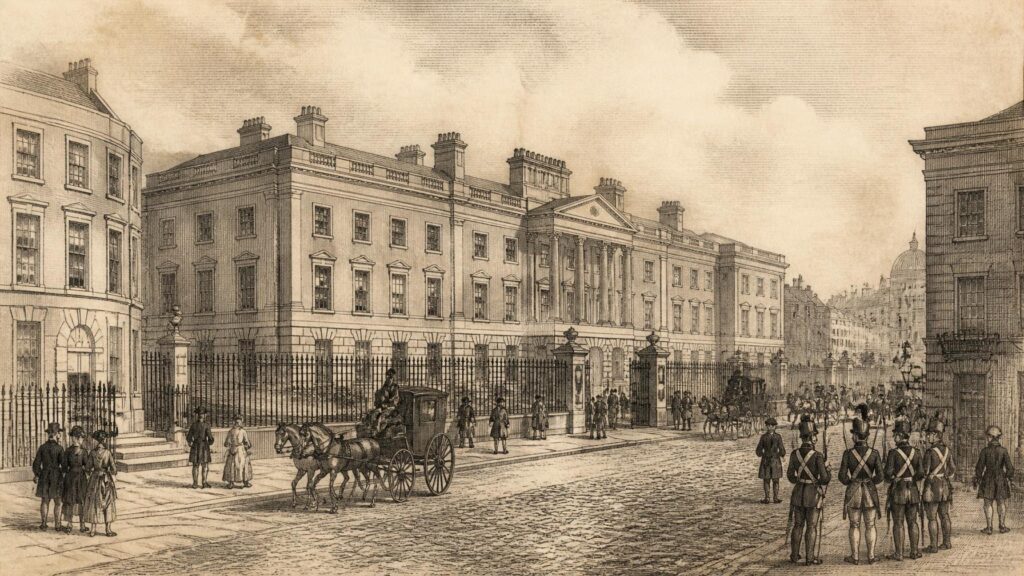
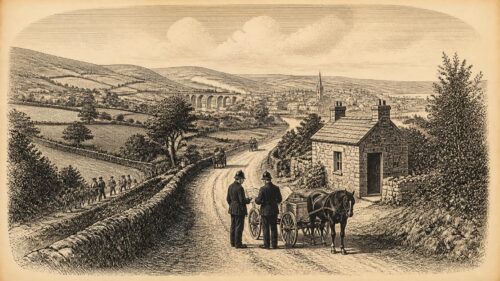
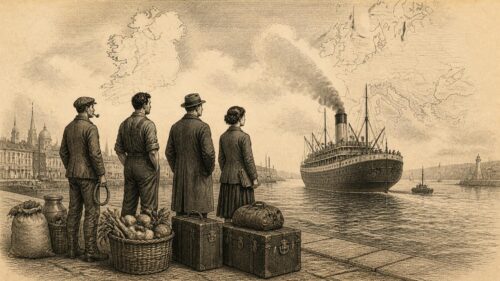
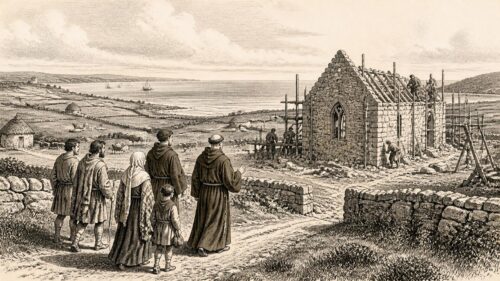
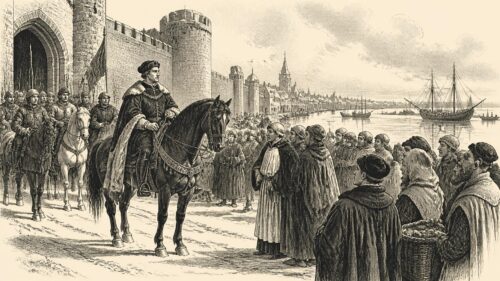
AI generated historical illustration, not a contemporary photograph.
At a Glance
Parliamentary history in Ireland is not the story of one uninterrupted national institution. It is the history of successive assemblies, claims of authority and systems of representation which operated under changing conditions of conquest, colonial rule, religious division, union, revolution, partition and constitutional democracy. From medieval gatherings within the English lordship to the contemporary Oireachtas and Northern Ireland Assembly, the word “parliament” has carried different meanings for different communities. Its buildings, rituals and laws have endured in public memory; its franchises and exclusions reveal how restricted political power often was.
Early Assemblies
Parliament in Ireland developed within the political order created after the Anglo-Norman invasion of the late twelfth century. It did not arise as a representative assembly for the whole island, nor did it replace older Gaelic systems of kingship, lordship, brehon law and regional negotiation. Rather, it grew from the institutions of the English Crown’s lordship in Ireland. Medieval parliaments brought together leading clerics, magnates, royal officials and, in time, representatives of towns and counties within areas where the Crown’s authority could be asserted. Their reach was therefore always uneven.
A tradition places the first Irish parliament at Castledermot, County Kildare, in 1264. The claim has often been repeated in commemorative writing because the meeting apparently preceded Simon de Montfort’s celebrated parliament in England by several months. Yet the evidence requires care. Medieval records are fragmentary, terminology was fluid, and historians differ over precisely which early gatherings meet later definitions of parliament. It is safer to say that assemblies exercising recognisably parliamentary functions were established in Ireland during the thirteenth century, within the English colony or lordship, than to treat one meeting as an uncomplicated national beginning.
The Parliament of Ireland was consequently not a parliament of an independent medieval Irish kingdom. Its constitutional setting was the lordship claimed by the kings of England. The institution could legislate, grant taxation, receive petitions and help give legal form to royal policy. It also supplied a venue where powerful colonial interests pursued local grievances and advantages. The surviving statutes show that parliament was as much an instrument through which officeholders and landholders protected status and property as a forum for an abstract public will.
Its membership reflected that origin. Lords spiritual and temporal sat alongside representatives of shires and boroughs, but neither the electorate nor the membership resembled a modern democratic public. Gaelic Irish communities beyond the effective reach of the lordship were frequently excluded in practice and sometimes expressly treated as outside the political community for which such laws were framed. Even within the colony, political voice was shaped by landholding, urban privilege, gender and ecclesiastical rank.
Colonial Assembly
The territorial limits of the medieval parliament changed with the fortunes of English power. During periods when the lordship contracted, particularly from the later fourteenth century, effective administration was concentrated in and around Dublin and other defended centres. The phrase “the Pale” is useful, but it should not be imagined as a permanently fixed line or as a complete description of political reality. Jurisdiction varied, local alliances mattered, and English, Anglo-Irish and Gaelic lordships interacted through conflict, marriage, trade and accommodation.
The Statutes of Kilkenny of 1366 are among the best-known enactments of the medieval Parliament of Ireland. They attempted to police boundaries between the English settlers and the Irish population, forbidding practices such as intermarriage and the adoption of Irish language, law and dress by those defined as English. Their notoriety has encouraged a simple picture of two permanently separate peoples. The statutes actually demonstrate that cultural interchange was already substantial enough to alarm sections of the colonial elite. They were prescriptive statements of anxiety and authority, not reliable proof that the rules were universally observed.
Parliamentary legislation could be ambitious, but implementation depended upon local power. A statute might proclaim royal order across Ireland while the Crown’s officials lacked the resources to enforce it beyond their immediate sphere. This gap between legal assertion and practical control is fundamental to interpreting medieval Irish parliamentary records. The statute rolls preserve intentions, bargains and claims; they do not by themselves demonstrate what people did in every locality.
Nor should the medieval institution be romanticised as an embryonic Irish democracy. The language of “Irish parliament” can be misleading if it silently imports modern assumptions of popular representation or national sovereignty. The parliament was Irish in location and in the matters it addressed, but it belonged to the constitutional machinery of the English Crown’s lordship. Nevertheless, it created precedents, records and habits of legislation that later political actors could invoke when arguing about Ireland’s constitutional distinctiveness.
Poynings Constraint
The decisive late medieval intervention was Poynings’ Law, passed in 1494–95 during the administration of Sir Edward Poynings. In broad terms, it required proposed Irish legislation and the reasons for summoning parliament to be certified to the English king and council before an Irish parliament could meet. Bills approved in England were then returned under the Great Seal for consideration in Ireland. This made parliamentary initiative far more dependent on the executive and on decision-making across the Irish Sea.
The law did not mean that Irish parliamentarians became passive or that every later session was a mere formality. Its operation was altered and managed over time; additional bills could be transmitted during a session under procedures developed in the sixteenth century. Irish politicians could still bargain over finance, patronage and particular measures, while the Dublin administration depended on local support to secure business. Yet the constitutional effect was plain: the parliament could not freely originate and amend legislation in the manner later advocates of legislative autonomy would demand.
Poynings’ Law became a potent symbol because it captured a real structural inequality. It bound legislative procedure in Ireland to a royal and privy-council process controlled principally from England. Later eighteenth-century campaigners treated its repeal as essential to a self-governing Irish legislature. Modern historians, while wary of reducing complex practice to one statute, likewise regard it as a central feature of the constitutional settlement.
The law also reminds us that parliament cannot be understood only by studying chambers and elections. Its power depended upon who set the agenda, controlled information, drafted bills, distributed offices and commanded force. In early modern Ireland, the lord deputy, the Dublin Castle administration, royal councils and metropolitan government could all shape the practical possibilities of parliamentary action before members ever assembled.
Tudor Transformation
The sixteenth century altered the scale and purpose of parliamentary government. The Tudor monarchy sought a more direct and comprehensive authority in Ireland after the Kildare rebellion of 1534. The parliament of 1536–37, sometimes called the Irish Reformation Parliament, passed legislation that attainted leading rebels, recognised royal supremacy in ecclesiastical affairs and facilitated the suppression of religious houses. These enactments were part of a broader effort to reshape church, landholding and allegiance.
It would be wrong, however, to suppose that statutory change instantly transformed religious belief or local governance throughout the island. The Reformation proceeded unevenly. The Crown’s capacity varied by region, the established church faced persistent weakness, and Catholic practice retained deep roots. Parliamentary acts proclaimed a new legal order; their social reception was another matter. The distinction is especially important where later narratives imply a swift and complete conversion imposed from Dublin.
In 1541, parliament recognised Henry VIII as King of Ireland, replacing the older title of Lord of Ireland. The change was constitutional and political. It expressed Tudor ambitions to govern the whole island through a kingdom, to draw Gaelic elites into a reformed order of allegiance and land tenure, and to place authority on a footing thought less vulnerable to competing claims. The kingdom on paper was larger than the territory securely governed in practice, but the title helped frame later administration.
Successive Tudor governments used parliament to underpin conquest, confiscation and settlement. They also broadened the geographical framework in which parliamentary representation might be organised, creating or refashioning boroughs and counties. Such measures could extend formal participation while ensuring that reliable interests received seats. Representation was not necessarily a concession to popular government; it was also a means of integrating political elites into the state.
Confessional Upheaval
The seventeenth century exposed the instability of an Irish constitutional order divided by religion, land and allegiance. The parliament summoned by James II in Dublin in 1689 is a particularly important example. With James supported in Ireland during the Williamite war, that parliament repealed Acts of Settlement, sought to reverse major land transfers and enacted measures associated with a Catholic political resurgence. Its proceedings later became a focus of fiercely partisan memory.
For contemporaries, the stakes were immediate: property, office, religion and military survival. For later Protestant writers, the 1689 parliament could be portrayed as evidence of the dangers of Catholic rule; for later nationalist writers, it could be treated as a parliament with a more socially inclusive Catholic presence than the body that followed. Neither use should erase its wartime context, its limited duration or its own exclusions. It was an assembly operating under a contested king amid civil and international conflict, not a stable prototype of modern equality.
Williamite victory produced a new political settlement. Penal legislation restricted Catholic civil and political rights, while the established Church of Ireland acquired a privileged constitutional position. Catholics were excluded from parliament, and Protestant dominance became embedded in the legislature and wider state. Presbyterians, despite their Protestant identity, also experienced legal disabilities and political marginalisation in important respects. The resulting order is conventionally called the Protestant Ascendancy, though that phrase can conceal internal rivalries among aristocrats, officeholders, borough proprietors and commercial interests.
In this period, parliament was both a site of local political activity and a pillar of minority rule. The legislature could debate taxation, trade, public works and administrative questions, but its social basis was deliberately narrow. This fact must qualify nostalgic claims that the pre-Union parliament was simply “Ireland’s parliament”. It was an Irish legislature in constitutional location, but it did not represent the population on equal terms.
Protestant Ascendancy
The eighteenth-century Parliament of Ireland sat in Dublin, first at Chichester House and later in the purpose-built Parliament House on College Green. The latter, designed initially by Edward Lovett Pearce and enlarged by later architects, became one of the great public buildings of Georgian Dublin. Its former chamber now forms part of the Bank of Ireland complex. The building’s survival has made it an unusually visible reminder of the abolished legislature, though architecture can encourage a misleading sense of institutional continuity.
The parliament was bicameral. The House of Lords comprised bishops and temporal peers; the House of Commons included county and borough members. In theory, counties and towns gave the Commons a representative character. In practice, many borough seats were controlled by patrons, while the franchise was restricted by property qualifications and religious rules. Electoral contests could be lively, expensive and sometimes genuinely competitive, but they were not democratic in the later universal sense.
The Anglican landowning class held preponderant influence. Its members were not politically uniform. Some were closely tied to Dublin Castle and British ministers; others resented executive management and sought greater legislative independence. Commercial interests pressed for freer trade. Country gentlemen guarded local privilege. Patronage, pensions and offices were used to secure support, and criticism of “corruption” became a persistent language of opposition. Yet political life cannot be reduced to bribery alone: parliamentary management operated in a world where influence, family connection and officeholding were accepted parts of governance.
The parliament’s relationship with Britain remained constitutionally subordinate. Poynings’ Law restricted the initiation of legislation. A further grievance was the British Declaratory Act of 1719, which asserted the right of the British parliament to make laws binding Ireland and confirmed the appellate jurisdiction of the House of Lords in Britain. Such claims sharpened the question that lay beneath later controversy: did Ireland possess a distinct kingdom with its own legislature, or was it subject to a supreme parliament elsewhere?
Legislative Independence
The American Revolutionary War transformed this question. Britain’s military difficulties and fear of invasion gave Irish political demands new leverage. The Irish Volunteers, formed ostensibly for defence, became a visible armed expression of Protestant political opinion. Their presence did not make parliament democratic, and their membership did not include the whole population; nevertheless, the Volunteers contributed to a climate in which constitutional reform became difficult to dismiss.
Henry Grattan emerged as the best-known parliamentary advocate of legislative independence. In 1782, amid pressure from reformers and changing calculations in London, Britain conceded important constitutional changes. The Irish parliament secured repeal of the 1719 Declaratory Act, while Poynings’ Law was modified by what became known as Yelverton’s Act, allowing a greater measure of Irish legislative initiative. In 1783 the British parliament renounced any claimed right to legislate for Ireland. These developments are commonly described as the Constitution of 1782.
That title expresses a political achievement, but it should not be overstated. The Crown, executive and patronage system remained deeply connected to Britain. Ireland and Britain shared a monarch, and the Irish executive still worked through Dublin Castle in a wider imperial framework. The settlement did not create an independent republic or sever economic and military ties. It did, however, establish a much stronger claim that legislation for Ireland belonged to the Irish parliament.
Interpretation divides at this point. Older nationalist accounts often presented 1782 as a recovered national constitution, destroyed by the Union. Unionist and revisionist accounts have stressed the vulnerability of the arrangement, the narrowness of its electorate and the persistence of British influence. Both observations matter. The constitution was neither a sham nor a fully sovereign democracy. It was a significant enlargement of legislative autonomy within a restricted Protestant political order.
Limited Electorate
The limits of that order became increasingly conspicuous. Catholics remained excluded from sitting in parliament. The Catholic Relief Act of 1793 extended the parliamentary franchise to many Catholic men who met the property qualification, but it did not permit them to become members. Women were excluded from parliamentary voting and membership. The majority of inhabitants therefore had no direct voice in the legislature, while borough patronage distorted representation even among those entitled to vote.
Reformers attacked these defects from different directions. Some wanted a wider Protestant electorate and a more independent parliament. Others, including elements within the Society of United Irishmen, came to seek parliamentary reform without religious distinction. The United Irish movement initially pursued constitutional reform but was radicalised by repression, international revolution and the refusal of the existing system to accommodate its demands. Its later programme of Irish republicanism was far removed from the cautious autonomy associated with Grattan.
Debates about Catholic emancipation, parliamentary reform and commercial policy were therefore inseparable. A parliament controlled by a Protestant elite could claim legislative independence while denying political equality to most Irish people. This contradiction weakened the moral authority of the 1782 constitution and made its legacy available to rival political traditions. Some remembered it as liberty lost; others saw it as an oligarchy unable to reform itself.
Folklore and political rhetoric have often treated the eighteenth-century parliament as either wholly glorious or wholly corrupt. The records support neither extreme. It contained able legislators, major constitutional arguments and real contests over taxation, trade and power. It was also defined by religious exclusion, patron-controlled constituencies and an executive prepared to use rewards to secure votes. Historical judgement is stronger when it accepts both realities.
Union Crisis
The rebellion of 1798, the prospect of French intervention and British fears about security brought the question of union to a crisis. The government of William Pitt the Younger concluded that a parliamentary union between Great Britain and Ireland would strengthen the state. Supporters argued that union would end constitutional friction, improve trade and make Catholic emancipation more attainable. Opponents warned that it would abolish Ireland’s legislature and diminish the country’s political standing.
An initial union proposal failed in the Irish House of Commons in 1799. The government then reorganised its campaign. Patronage, peerages, offices and compensation for disfranchised borough proprietors were deployed on a large scale. The extent and character of this activity have long made the Union a byword for political corruption. It is documented that compensation and honours played an important part in securing the necessary parliamentary support; it is less useful to imagine every vote as the product of one identical motive. Some supporters genuinely believed union necessary after rebellion and war, while many opponents defended a narrow legislature that had never represented the whole people.
Parallel Acts of Union were passed in 1800, and the union took effect on 1 January 1801. The Parliament of Ireland ceased to exist. Ireland sent 100 members to the House of Commons at Westminster. Irish peers were represented by a limited number of representative peers in the House of Lords, and Church of Ireland bishops also had a defined presence. The former Irish Parliament House was eventually sold to the Bank of Ireland.
The abolition acquired a powerful afterlife. Nineteenth-century repeal campaigners depicted the loss of parliament as the central constitutional injury inflicted on Ireland. Unionists saw it as the foundation of a united state. These were not merely arguments about an old building or a chamber of legislators. They concerned where sovereignty lay, whether Irish interests could be protected at Westminster and what political form could reconcile the island’s competing communities.
Westminster Representation
After 1801, Irish political life did not disappear; it was relocated and transformed. Westminster became the legislature for Ireland, and Irish MPs became participants in a larger parliament. The union also brought Irish questions more directly into British party politics, although distance, party discipline and the scale of the imperial legislature could make Irish representation feel remote from local concerns.
Catholic emancipation became the defining early issue. Daniel O’Connell’s election for County Clare in 1828 demonstrated the destabilising force of continued exclusion. The Roman Catholic Relief Act of 1829 permitted Catholics to sit at Westminster, although it also raised the property qualification for the Irish county franchise, reducing the electorate. O’Connell subsequently built a mass political movement for repeal of the Union, using meetings, newspapers, electoral organisation and parliamentary pressure. His “monster meetings” became emblematic of popular constitutional mobilisation, even if their numbers have sometimes been exaggerated in later retellings.
The Great Famine intensified criticism of the union and of Westminster government. Parliamentary legislation, relief policy, landlordism, eviction and emigration became matters of historical argument and moral accusation. No single institutional explanation can account for the catastrophe, which involved crop disease, poverty, social structure and administrative choices. But the experience profoundly strengthened the belief among many nationalists that Ireland’s needs were not adequately understood or answered by a parliament sitting in London.
Electoral reform gradually widened the franchise, and Irish MPs built influential parliamentary blocs. Isaac Butt’s Home Rule movement sought a devolved legislature within the United Kingdom. Charles Stewart Parnell and the Irish Parliamentary Party developed a disciplined organisation capable of using the balance of power at Westminster. Parliamentary obstruction, electoral mobilisation and local party structures made constitutional nationalism a mass force by the late nineteenth century.
Home Rule
Home Rule was not simply a demand to restore the eighteenth-century parliament. Its advocates envisaged a devolved Irish legislature while retaining an imperial parliament for matters such as defence and foreign affairs. The proposals differed over finance, representation and reserved powers, but all recognised that the old constitution could not simply be revived. The franchise had widened, Catholic political participation was established, and the political claims of unionists in Ulster had become central.
Gladstone’s first Home Rule Bill of 1886 was defeated in the House of Commons. The second, introduced in 1893, passed the Commons but was rejected by the House of Lords. The third Home Rule Bill became law as the Government of Ireland Act 1914 after the Parliament Act had curtailed the Lords’ veto. Its implementation was postponed by the First World War, while the Ulster unionist campaign against Home Rule and nationalist responses revealed the depth of constitutional division.
Home Rule debates exposed a fundamental difficulty: a parliament intended to answer nationalist demands for self-government was regarded by many unionists as a threat to their political, economic and religious security. The issue was not reducible to sectarian prejudice, although sectarianism was important. It involved differing national identities, industrial and commercial interests, connections to Britain, memories of land and religious conflict, and contrasting views of majority rule.
By 1916–18, the constitutional landscape had changed beyond recognition. The Easter Rising, the British response, the conscription crisis, the rise of Sinn Féin and the electoral collapse of the Irish Parliamentary Party shifted the basis of nationalist legitimacy. The question was no longer merely whether Westminster would devolve power to an Irish parliament, but whether an Irish assembly could claim authority independently of Westminster.
Revolutionary Dáil
The First Dáil met publicly at Dublin’s Mansion House on 21 January 1919. Its members had been elected in the general election of December 1918 as candidates pledged in large measure to Sinn Féin’s abstentionist policy: they would not take their seats at Westminster but would establish an Irish assembly. At its first sitting, the Dáil adopted a declaration of independence, issued a message to the free nations of the world and approved a democratic programme.
The Dáil claimed to be the parliament of an independent Irish republic. That claim was revolutionary rather than recognised by the British state, and the assembly operated amid the War of Independence. Many elected members were absent through imprisonment or other constraints; Unionists generally did not participate; and the body’s authority depended on a combination of electoral mandate, republican organisation and the capacity of its associated institutions to function. Its proceedings nonetheless matter greatly because they were recorded, published and embedded in an alternative administration.
The National Archives of Ireland preserves minutes, correspondence, reports and treaty materials from the First and Second Dála. Such records make it possible to see the revolutionary parliament as more than a retrospective symbol. It debated policy, authorised departments, addressed finance and sought diplomatic recognition. At the same time, its work was inseparable from armed conflict and from the competing authority of British institutions.
Using the word “parliament” for the First Dáil is therefore accurate but requires explanation. It was neither a continuation of the old Parliament of Ireland nor a body created under British constitutional law. It was a representative assembly claiming popular sovereignty on the basis of the 1918 election and republican principles. Its authority was contested then and remains interpreted differently now, particularly when the exclusion or abstention of unionist representatives is considered.
Free State
The Anglo-Irish Treaty of December 1921 divided the republican movement and led to the Civil War. Yet it also provided the framework from which the Irish Free State emerged in 1922. The Free State constitution created an Oireachtas consisting of the King and two Houses, Dáil Éireann and Seanad Éireann. It vested legislative authority in that body, while preserving constitutional links with the Commonwealth and requiring an oath which proved intensely controversial among opponents of the Treaty.
The new parliament was shaped by both inheritance and rupture. Its lower house retained the historic name Dáil Éireann; its upper house was called Seanad Éireann; and it occupied Leinster House rather than the old Parliament House on College Green. Its procedures drew upon parliamentary conventions familiar from Westminster, but its constitutional language emphasised authority derived from the people. Women possessed equal constitutional voting rights in the Free State, an important contrast with the restricted electorates of earlier Irish legislatures.
The first Seanad was deliberately designed to include voices from minority and cultural backgrounds, though its composition and powers changed over time. The Oireachtas faced the difficult tasks of stabilising a state after conflict, building administrative institutions and legislating for a society marked by division. Parliamentary government did not dissolve political disagreement; it supplied a constitutional arena in which disagreement could increasingly be managed without civil war.
In 1937, a new Constitution came into operation. It defined the national parliament as the Oireachtas, consisting of the President, Dáil Éireann and Seanad Éireann. It vested the sole and exclusive power of making laws for the State in the Oireachtas, subject to the Constitution. This was a crucial development: legislative authority was constitutionally limited, courts could assess legislation against the Constitution, and constitutional amendment generally required popular referendum.
Constitutional Renewal
The modern Oireachtas is thus not the direct legal successor of the pre-1801 Parliament of Ireland, though it stands within a much longer Irish history of assemblies and legislatures. Its authority arises from the Constitution adopted in 1937 and from the democratic institutions that preceded and followed it. Dáil deputies are elected by proportional representation through the single transferable vote, while the Seanad has a more complex composition involving vocational panels, university representation and nominees of the Taoiseach.
These arrangements reflect attempts to balance representation, scrutiny and governmental responsibility. The Dáil is the principal chamber in determining whether a government commands support; the Seanad revises legislation and can delay but generally cannot permanently block money bills or legislation approved by the Dáil. The President has defined constitutional functions in the legislative process, including the possibility in certain circumstances of referring a bill to the Supreme Court under Article 26.
Parliamentary democracy has also been shaped by practice rather than text alone: party discipline, coalition agreements, committee work, public administration, media scrutiny and the professionalisation of politics. A constitution can establish institutions, but it cannot by itself guarantee political equality, public trust or effective accountability. Those are continually contested through elections, parliamentary debate, courts, journalism and civic action.
Historical memory remains visible in Leinster House. The building was originally a ducal residence, not a parliament house, and its adaptation after independence was pragmatic. That fact is symbolically useful. The modern legislature did not simply reclaim the eighteenth-century chamber; it made a different institutional home, under a different constitutional settlement, while retaining names and ceremonial forms that linked it to earlier Irish political experience.
Northern Parliament
Partition produced a second parliamentary trajectory. The Government of Ireland Act 1920 provided for separate devolved legislatures in Northern Ireland and Southern Ireland. The Parliament of Northern Ireland was established and first sat in 1921; the Parliament of Southern Ireland did not develop into a functioning legislature, as the revolutionary and treaty processes led instead to the Irish Free State.
The Northern Ireland Parliament, commonly called Stormont after the estate where its later building stood, had a House of Commons and a Senate. It exercised devolved authority under the United Kingdom, while Westminster retained responsibility for specified matters. Unionist administrations governed continuously during its existence, and the institution became closely identified with the political dominance of the Ulster Unionist Party.
For many unionists, Stormont represented the parliamentary safeguard of Northern Ireland’s place in the United Kingdom. For many nationalists, it represented exclusion and discrimination. The historical evidence includes serious allegations and investigations concerning electoral boundaries, local-government voting arrangements, housing and employment, while the wider civil-rights movement challenged the structure of unionist rule in the 1960s. Interpretation should avoid treating every policy or every individual as identical, but it should not obscure the systemic inequalities that fuelled protest and conflict.
As violence and political crisis intensified, the United Kingdom government suspended the Northern Ireland Parliament in 1972. It was formally abolished in 1973. The end of Stormont did not end arguments about devolved government. Instead, it made clear that any durable legislature in Northern Ireland would have to address relationships between unionists and nationalists more fundamentally than the former majoritarian model had done.
Shared Legacies
The Belfast or Good Friday Agreement of 1998 established a new framework, approved in referendums north and south of the border. The Northern Ireland Assembly, first elected in 1998, differs markedly from the old Parliament of Northern Ireland. It is unicameral, elected by proportional representation, and designed around power-sharing rather than ordinary winner-takes-all government. Its arrangements for ministerial office, cross-community support and mutual consent acknowledge that parliamentary majority alone cannot settle every constitutional question in a divided society.
The Assembly has experienced periods of suspension and restoration, demonstrating both the difficulty and the necessity of shared institutions. Its history belongs alongside that of the Oireachtas, Westminster and the former Parliament of Ireland. Irish parliamentary history is not a straight line from medieval Dublin to a single modern endpoint; it is a history of overlapping jurisdictions and rival claims, now structured in part by agreement and consent.
Political language still draws upon older parliaments. “Grattan’s Parliament” may be invoked as a lost legislature; “the First Dáil” as a source of republican legitimacy; “Stormont” as both a building and a political order; “Westminster” as either a guarantor of union or a distant authority. Such invocations are meaningful, but they are selective. They can omit the exclusions of the eighteenth century, the violence of the revolutionary years, the failures of the old Stormont system or the continuing compromises required by present institutions.
The strongest historical conclusion is not that Ireland once possessed, lost and simply recovered one parliament. It is that parliamentary forms have repeatedly been used to express authority, constrain it, distribute it and contest it. Medieval statutes, eighteenth-century constitutional struggles, the Union, Westminster campaigns, revolutionary assemblies, the Oireachtas and the Northern Ireland Assembly each belong to that larger history. Their differences matter as much as their connections. Parliament in Ireland has been a language of sovereignty and a machinery of government, but also a record of who was permitted to speak, vote, legislate and belong.