

Winter Burdens
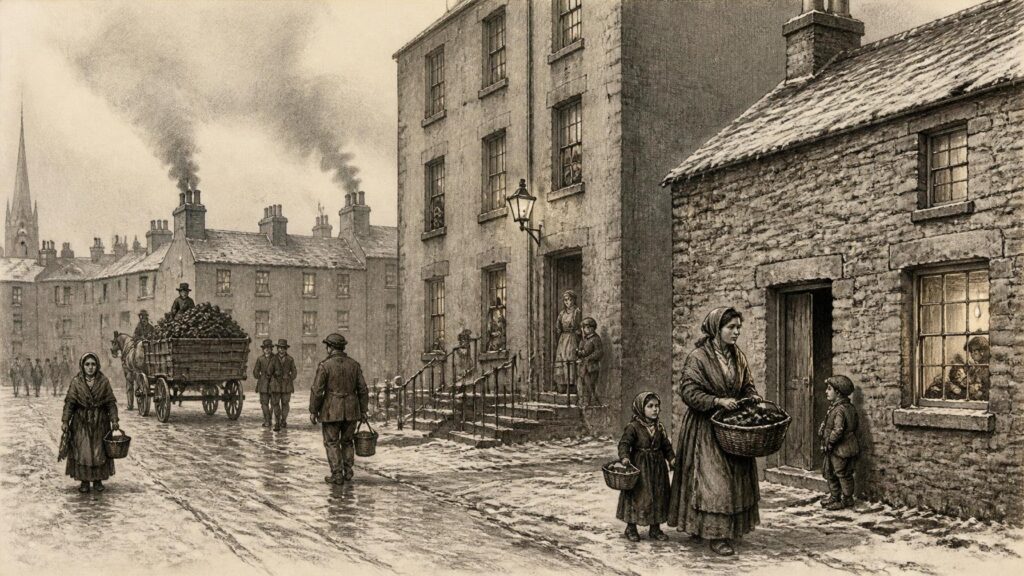
AI generated historical illustration, not a contemporary photograph.
At a Glance
For much of modern Irish history, keeping a home warm has been inseparable from questions of income, housing, health and national economic vulnerability. Fuel has never been merely a household purchase: when its price rose, it exposed the narrow margin on which many families lived, the dependence of the State on imported energy, and the difficult choice between relieving immediate hardship and addressing its structural causes.
Essential Warmth
“Fuel supports and inflation” may sound like a contemporary policy phrase, but the underlying Irish story is considerably older. In a cold and damp climate, warmth has long been a basic necessity rather than a discretionary comfort. Yet the ability to buy coal, turf, oil, electricity or gas has varied sharply with wages, employment, family size, housing condition and the price of imported energy. The history is therefore not simply one of changing benefit rates. It is also a history of poor housing, uneven development, welfare administration, international oil markets and the limits of national policy in a small, open economy.
It is important to distinguish several related ideas. Inflation is the general rise in prices over time, reducing the purchasing power of money. Fuel inflation is the increase in the price of particular energy sources: solid fuel, heating oil, electricity, gas or transport fuel. Fuel poverty, increasingly described in policy as energy poverty, refers to an inability to afford the energy services required for a safe and decent life. These concepts overlap but are not identical. A household may experience general inflation without acute difficulty heating its home; another may face energy hardship despite relatively stable fuel prices because its income is low or its dwelling wastes heat.
Irish public discussion has often used the word “fuel” as shorthand for winter heating, even though energy needs also include lighting, cooking, refrigeration and, in modern homes, the operation of appliances and communications. That language reflects an older domestic economy in which coal, turf and later oil were tangible, regularly purchased materials. A coal scuttle, a turf shed or an oil tank made the household energy budget visible in a way that a direct debit for electricity sometimes did not. The shift from hearth fuel to networked electricity and gas changed the form of payment, but not the underlying vulnerability of households with little spare income.
The documentary record shows that Irish governments have repeatedly responded to high energy costs through three broad approaches. The first is targeted income support, chiefly the National Fuel Scheme and its successor, Fuel Allowance. The second is broad intervention in prices through taxes, tax reductions or universal credits. The third is investment in homes, especially insulation, heating systems and energy efficiency. Each approach serves a different purpose. Targeted payments can direct assistance towards low-income households; universal measures can be rapid and politically visible; retrofitting can reduce energy need itself. The tension between them has shaped the history of fuel supports.
Early Hardship
Long before a distinct national fuel allowance existed, fuel appeared in accounts of poverty and relief. Interwar and wartime evidence does not suggest a settled, generous system of household heating support. Instead, it reveals a patchwork of wages, public assistance, charitable aid and occasional in-kind help. In working-class districts, fuel competed with rent, food, clothing and medical expenses. The fact that fuel and light were listed alongside rent in household budgets is revealing: they were unavoidable costs, but payment could still leave very little for food.
Research assembled in the historical material used by the Ryan Report records the harsh arithmetic of low-income Dublin households in the late 1930s and 1940s. In one small survey of unemployed families living in one-room tenements, the payment of rent, insurance, fuel and light left only a few shillings per person for food and clothes. Another account of 1945 household incomes refers to winter fuel vouchers alongside children’s allowances and charitable grants. Such evidence must be read carefully. It does not provide a complete national statistical picture, and it comes from investigations concerned with deprivation rather than energy policy alone. Nevertheless, it documents that winter fuel relief was already understood as part of the precarious economy of poor households.
There is a temptation to romanticise turf as a universal answer to Irish heating needs. Turf was indeed important, particularly in rural areas and in districts with access to bogs or established supply networks. But access was neither uniform nor costless. Cutting, drying, saving and transporting turf required land, labour, time, weather and storage. Urban households commonly depended on purchased coal or other commercial fuel. Even families with a traditional fuel supply still needed money for food, clothing, rent, candles or electricity. Folklore about the self-sufficient turf fire captures real cultural memory, but it should not be mistaken for evidence that fuel insecurity was absent.
Wartime scarcity added another layer of difficulty. Ireland’s neutral position did not insulate it from disruption to trade and supplies. Fuel conservation, alternative fuels and rationing formed part of the wider Emergency experience. However, the surviving broad narrative should not be converted into a claim that every household received equal protection. Scarcity affected households differently according to location, income and access to local resources. In the decades that followed, the expansion of electricity, the gradual improvement of homes and the development of social insurance altered domestic life, but they did not eliminate the winter pressure on those with low incomes.
Changing Fires
The fuel mix of Irish homes changed substantially after the Second World War. Coal retained a central place for many households, while turf remained important in rural and smaller-town settings. Electricity became more widely available, initially transforming lighting and domestic work before becoming a significant source of space and water heating for some consumers. Later, oil-fired central heating, bottled gas, natural gas and electric storage systems altered both comfort and exposure to price changes. A home with central heating could be warmer and healthier than a house dependent on one open fire, but it could also require a larger cash outlay at a particular moment.
This transition mattered because different fuels responded differently to market shocks and taxation. A bag of coal or briquettes could be bought in small quantities, though often at a higher unit cost than a bulk purchase. Heating oil generally required a larger delivery and therefore a larger lump sum. Electricity and gas bills arrived through suppliers and networks. For people living on weekly welfare payments, casual earnings or seasonal work, the timing of payment could be as important as the annual total. A household might technically have sufficient income over a year yet still be unable to meet a winter bill when it fell due.
Housing quality also determined how much fuel a household needed. Many older Irish dwellings were poorly insulated, prone to damp and heated only in part. This meant that a benefit intended as a contribution towards heating could buy very different amounts of comfort in different homes. A small, well-insulated dwelling with efficient heating was not comparable with a larger, draughty house occupied by an older person, a disabled person or a family with young children. The policy problem was therefore not reducible to the retail price of coal or oil. It involved the physical fabric of the home.
By the later twentieth century, policy language increasingly recognised this broader problem. The phrase “fuel poverty” became more common in debate, bringing Irish discussion into contact with British and European approaches to energy affordability. The term helped make a crucial point: a household that restricts heat in order to pay for food or rent is not simply making an ordinary consumer choice. It may be adapting to deprivation. Yet definitions remained contested. Expenditure measures, income thresholds and self-reported inability to keep adequately warm each identify somewhat different groups. Modern research has therefore cautioned against treating any one measure as a complete account of hardship.
Imported Exposure
Ireland’s exposure to imported energy gave fuel prices a national as well as domestic significance. The country possessed peat resources, and later natural gas resources, but for much of the twentieth century it depended heavily on imported oil and petroleum products. That dependence affected transport, industry, domestic heating and electricity generation. When international oil prices rose suddenly, the impact travelled through household budgets directly and through the wider economy indirectly.
The first major oil shock of 1973–75 was especially consequential. The sharp increase in oil prices came at a time when the Irish economy was deeply connected to external markets but had limited power over the price of imported fuel. Research published by the Economic and Social Research Institute on energy prices between 1973 and 1981 examined the scale of this effect on the Irish economy. A later State assessment of oil dependence estimated that the 1973–74 crisis worsened Ireland’s terms of trade by more than 3.5 per cent of gross domestic product. In plain terms, the country had to give up more resources to buy energy from abroad.
The burden did not stop at petrol pumps or oil depots. The Electricity Supply Board’s own cost structure demonstrated the extent of exposure. An Oireachtas public accounts report recorded that fuel had represented roughly one fifth of ESB costs in the 1960s and about one quarter in the early 1970s. After the oil price increases of 1973–75, the fuel share rose beyond 40 per cent. The second oil crisis of 1978–79 drove it to a peak above 49 per cent in 1980–81. These figures help explain why electricity prices became part of the wider inflationary experience. They also show that household bills were linked to infrastructure and fuel procurement decisions made far beyond the household.
The oil shocks were not the sole cause of Irish inflation. Central Bank research on Irish inflation from 1960 to 1995 characterises the years from 1973 to 1983 as a period of high and volatile inflation, partly reflecting the two oil crises but also shaped by fiscal policy and exchange-rate conditions. At the time, the Irish pound was linked to sterling. The weakness of sterling could therefore feed into domestic prices. Inflation was produced by a combination of imported costs, domestic demand, monetary arrangements and public policy. It would be misleading to present fuel as the only explanation, but equally misleading to dismiss it as a minor inconvenience.
For households, the distinction between causes mattered less than the immediate result. When energy costs rose alongside food, transport and other necessities, a fixed payment or low wage could lose value quickly. Pensioners, unemployed people, lone parents and people unable to work because of illness or disability were especially exposed. Their incomes often adjusted through annual budgets or periodic rate changes, whereas prices could rise in the intervening months. The political pressure for specific fuel assistance grew out of that mismatch between winter bills and slow-moving incomes.
Inflation Years
The inflation of the 1970s and early 1980s was remembered in Ireland not only as a sequence of percentages but as an erosion of ordinary security. Savings lost purchasing power, weekly budgets became harder to manage and industrial disputes often turned on whether pay settlements could keep pace with prices. Fuel was unusually visible because it was essential and because its price movements were linked to dramatic international events. A household could postpone some purchases; it could not indefinitely dispense with heat, cooking or travel to work.
That period also brought renewed attention to the State’s energy choices. Dependence on fuel oil for electricity generation made Ireland vulnerable, while domestic peat and coal raised questions about cost, supply and environmental consequence. The later development of natural gas, greater interconnection and a more varied generation mix changed the energy system, but none of these developments removed the underlying fact that international markets could raise the domestic cost of energy. The experience of the 1970s established an enduring lesson in Irish policy: imported energy shocks can become social-welfare questions.
There were competing answers to that problem. One was to increase general social welfare rates, on the grounds that people should decide how to spend adequate income. Another was to create or raise specific payments, on the grounds that heating was a special need with a seasonal profile. A third was to restrain energy prices, subsidise supply or reduce tax. All three responses had attractions and weaknesses. A general payment could be more flexible but might not address the extra cost of a cold winter. A fuel payment was more clearly directed at heating but could exclude people just above an eligibility threshold. Price intervention could assist many people rapidly but would also benefit those who were not in hardship.
These were not merely technical disputes. They involved different conceptions of welfare. A universalist view emphasised the social importance of affordable energy for all citizens. A targeted view sought to concentrate limited public funds on households with the least income. A structural view argued that poor insulation and inefficient heating should be tackled so that households needed less fuel in the first place. Irish policy has moved among these positions rather than settling permanently on one.
The importance of exchange rates added another complication. Before the Irish pound broke its link with sterling in 1979, changes in the value of sterling influenced Irish prices. After entry into European monetary arrangements, the mechanisms changed, but the small and open character of the economy remained. The Central Bank’s historical analysis makes clear that exchange-rate developments were a significant determinant of inflation. This helps explain why domestic welfare policy could cushion, but not abolish, the consequences of external price shocks.
National Scheme
The introduction of the National Fuel Scheme in 1988 marked a significant institutional development. According to the Department of Social Protection’s operational guidelines, the scheme was established to assist qualified households receiving specified welfare payments with the cost of heating. Its present name, Fuel Allowance, may suggest a long-standing statutory entitlement, but the Department describes it as an administrative, non-statutory scheme. That status is historically important. The payment has endured for decades, but its detailed eligibility, rate and duration have been adjusted through administrative and budgetary decisions rather than fixed permanently in primary legislation.
The scheme’s design reflected the insight that winter heating costs were both predictable and unevenly distributed. Rather than attempting to compensate every household for every energy bill, it focused on particular groups whose incomes were low or whose reliance on long-term social welfare indicated heightened risk. Over time, qualifying groups have included pensioners subject to conditions, recipients of disability-related payments, long-term jobseekers, lone parents and others. Only one allowance is generally paid per household. This household rule seeks to prevent duplication, but it also demonstrates how social policy classifies people through living arrangements as well as personal income.
The allowance was never intended to cover the whole cost of heating. The Department’s guidelines state this explicitly. It is a contribution towards normal heating expenses. That language is both modest and revealing. It recognises a public responsibility to help, while leaving households responsible for the balance. The effectiveness of the payment has therefore depended on its rate, the length of the fuel season, the price of energy and the condition of the claimant’s home. A payment that appears generous in one year can lose practical value if prices rise or if the number of payable weeks is reduced.
Oireachtas material recording the rate and duration of the National Fuel Scheme and Fuel Allowance from 1989 shows that the payment was initially modest. In 1989 it was paid from mid-October to mid-April at £5 per week. During the early 1990s, an additional smokeless-fuel element appeared in the recorded rates. From 2002, the figures were expressed in euro, reflecting Ireland’s monetary changeover. The table is useful precisely because it shows that the scheme’s history is not one of a simple annual increase. Payment periods, basic rates and supplementary elements all changed.
The appearance of a smokeless-fuel addition also points to another dimension of the story: air quality. In urban areas, particularly Dublin, concerns about smoke pollution encouraged policies favouring cleaner domestic fuels. A fuel support could therefore be asked to do more than relieve poverty. It could also influence the kind of fuel people used. This is an early example of the recurrent policy challenge of aligning social protection with environmental and public-health objectives. A payment that helps with fuel costs may support warmth, but the fuel chosen can have consequences for air pollution and carbon emissions.
Rates Debate
The history of Fuel Allowance contains repeated argument about whether specific supports or general welfare increases offer the better protection against inflation. A Dáil written answer in November 1999 provides a clear example. The responsible minister noted that the basic fuel allowance had not increased since October 1985, while also arguing that fuel price inflation between August 1985 and August 1999 had been lower than general price inflation. A review of the national and smokeless fuel schemes had concluded that the allowance should not be considered in isolation if general welfare increases adequately compensated recipients for price rises.
That argument was administratively coherent but politically contested. It assumed that general income increases reached the relevant households and were sufficient to meet competing needs. Critics could reply that money intended to meet broad living costs did not guarantee adequate warmth, especially where rent, food or debt consumed most of a household’s income. The question was not whether recipients could spend a general increase on fuel; it was whether they had enough income to do so after meeting other necessities.
By the middle of the 2000s, the official language of “fuel poverty” appeared more prominently in budgetary explanation. In the Budget 2006 social-protection speech, the minister described the issue as touching a fundamental need for warmth and shelter. The speech acknowledged a preference for improving basic welfare rates rather than dividing assistance among separate allowances, yet justified an increase in the National Fuel Scheme because it was targeted at vulnerable households and had not been raised since 2002. This episode captures the enduring compromise: general income support remained important, but a distinct winter payment was retained because need was concentrated and politically compelling.
The debate also concerned the season’s length. A weekly payment is meaningful only for the weeks in which it is made, and the weather does not always conform to an administrative calendar. Records show that the scheme’s duration has altered over time. During austerity, Budget 2012 reduced the season from 32 to 26 weeks, a change later discussed in the Comptroller and Auditor General’s reporting on welfare-payment administration. The reduction illustrated how fiscal consolidation could be felt not only through headline benefit rates but through the number of winter weeks for which assistance was available.
Rate comparisons across decades require care. A nominal increase in pounds or euro does not by itself establish that recipients were better off. The relevant questions are whether the payment rose faster or slower than energy prices, whether it was paid for more or fewer weeks, whether household energy needs changed and whether other welfare payments improved. The 1999 Dáil answer’s emphasis on the fuel-and-light component of the consumer price index was one attempt to make such a comparison. But a national index cannot capture every household’s circumstances, especially the difference between a well-insulated flat and a detached, hard-to-heat rural home.
Housing Costs
Fuel support has always been an imperfect substitute for a warm dwelling. A payment can buy fuel, but it cannot stop heat escaping through uninsulated walls, draughty windows, poorly fitted doors or inefficient boilers. Nor can it readily resolve damp, mould or the health consequences of living in a cold house. This is why the history of energy hardship must include housing policy, even when the immediate subject is welfare.
By the 2000s, official policy increasingly linked fuel poverty to insulation and heating improvements. The Budget 2006 speech referred to pilot work involving Sustainable Energy Ireland, the Combat Poverty Agency and other bodies in Cork and Donegal, directed at heating systems and insulation in selected private dwellings. The significance of this initiative was conceptual as much as practical. It recognised that winter hardship resulted from the interaction of income, prices and the energy performance of the home. The same household could require less support after an effective retrofit because it needed less energy to attain adequate warmth.
Retrofitting, however, is not a quick remedy for a sudden price shock. It requires assessment, skilled labour, capital funding and, in private rented housing, the co-operation of owners. Those barriers help explain why cash supports have remained politically necessary even when policymakers accept the case for energy efficiency. A household facing an oil bill in January cannot wait years for a programme of improvements to reach its home. Conversely, repeated cash supports without housing improvement can leave the State paying each winter for energy that inefficient buildings waste.
There is also a geographical dimension. Rural households may have greater dependence on cars, oil-fired heating, solid fuels or bulk deliveries. Urban households may be more reliant on electricity and gas networks, but they can face high rents, smaller living space and different forms of poor-quality accommodation. A national allowance must operate across these variations. Its relative adequacy will therefore differ from place to place.
Modern ESRI research emphasises that energy poverty is multidimensional. Income, energy prices and housing quality matter together; so do tenure, household composition and health. This approach is valuable historically because it guards against a simplistic narrative in which high fuel prices alone create hardship. Prices can trigger a crisis, but vulnerability often has deeper roots. An older person living alone in a poorly insulated house may need more heat and have less ability to absorb a price increase than a higher-income household living in an efficient home. Targeting based on welfare status can reach many vulnerable people, but no single administrative rule maps perfectly onto lived need.
Celtic Prosperity
The economic growth associated with the Celtic Tiger altered Ireland’s incomes, public finances and consumer expectations, but it did not erase the need for fuel supports. Rising employment and wages improved many household budgets, while property development transformed parts of the housing stock. At the same time, rapid growth placed pressure on prices and created uneven outcomes. Some people benefited greatly; others remained dependent on pensions, disability payments, low pay or insecure work. The continuing existence of the fuel scheme was a reminder that national prosperity did not distribute warmth evenly.
Fuel policy during these years also acquired new environmental significance. The movement away from smoky coal in some urban areas, the growing concern about climate change and the prospect of carbon taxation complicated traditional assumptions about cheap fuel. A policy that lowers the price of fossil fuel can relieve immediate hardship but may work against emissions-reduction goals. A policy that increases fossil-fuel prices can encourage efficiency and cleaner alternatives but may disproportionately affect low-income households unless the revenues are redistributed or protections are created.
This conflict should not be overstated as an insoluble choice between climate action and social protection. Better-insulated homes, efficient heating and reliable public transport can reduce both emissions and household exposure to volatile energy costs. Yet transitions create winners and losers in the short term. For households using oil, coal, briquettes or older heating systems, new taxes or higher energy prices can be experienced as an immediate loss. The historical importance of Fuel Allowance lies partly in its role as a mechanism through which the State has tried to soften such unequal effects.
The boom years also demonstrate why fuel hardship cannot be measured solely through the national inflation rate. Even when general inflation is moderate, certain energy prices can rise faster, and some groups can be unable to afford adequate heat. Conversely, a period of high general inflation may have less severe effects on a household whose income rises at the same time and whose home is efficient. Historical interpretation therefore needs both macroeconomic data and evidence about income, housing and social welfare.
Financial Crisis
The financial crisis and subsequent austerity brought these questions back into sharp relief. Falling employment, reduced incomes and pressure on public expenditure increased the significance of winter supports for many households. The reduction of the fuel season in Budget 2012 was emblematic. It represented a fiscal saving, but its meaning for recipients was concrete: fewer weeks of assistance during the colder part of the year. The controversy showed how apparently technical changes to duration could be as important as changes to the weekly rate.
The period also reinforced the importance of administration. The Comptroller and Auditor General recorded an error in the implementation of the 2012 duration change, through which about 60,000 jobseeker claimants received an additional week of Fuel Allowance, creating an overpayment. The episode is not simply a bureaucratic footnote. It illustrates the scale on which a long-established welfare payment operated and the practical difficulty of changing schemes that are embedded in household budgeting. For claimants, a week’s allowance may have been a small sum in public-finance terms but an important part of a tightly managed winter budget.
Austerity-era debate again revived the old question of targeting. Those defending restrictions stressed the need to control expenditure and avoid overlapping supports. Those criticising them pointed to the reality of cold homes, disability, older age and child poverty. Neither side could settle the matter by reference to a single statistic. A payment can be well targeted in the sense of reaching people on low incomes and still be inadequate in amount. It can also be comparatively generous for some households while failing to reach others in need who do not fit the qualifying categories.
The historical record suggests that Fuel Allowance became more than a marginal supplement in public understanding. It was an expected part of winter provision for many recipients, and therefore reductions attracted particular attention. Expectations matter in welfare history. Once a payment becomes regular, households may plan around it. Its withdrawal or shortening is then felt not as the loss of a bonus but as a disruption to an established means of meeting essential costs.
Energy Shock
The energy-price surge beginning in 2021 placed fuel supports at the centre of public debate once more. The causes differed from those of the 1970s, involving post-pandemic supply disruption, global demand, geopolitical instability and later the effects of Russia’s invasion of Ukraine on European energy markets. The family resemblance to earlier crises was nevertheless unmistakable: imported energy costs rose sharply, inflation accelerated and lower-income households faced the highest burden relative to their resources.
The ESRI’s 2022 study of energy poverty and deprivation documented the speed of the increase. By April 2022, compared with their 2015 levels, home-heating oil prices were reported as 86 per cent higher, electricity prices 45 per cent higher, natural gas prices 53 per cent higher and solid-fuel prices 32 per cent higher. These figures do not mean every household paid precisely the same increase, but they show why a fixed winter payment could not by itself resolve the problem. Different fuels moved differently, and households were tied to the systems already installed in their homes.
The Government responded through a mixture of targeted and broad measures. In February 2022 it announced a package including an electricity credit, a once-off Fuel Allowance payment and other cost-of-living measures. Later measures included further electricity credits, temporary changes to taxes and duties, and additional welfare payments. The policy blend reflected the urgency of the situation. Electricity credits could reach a wide range of households quickly through billing systems. Additional Fuel Allowance payments could be directed through social-protection channels to groups already recognised as vulnerable.
These measures also renewed the debate about universality. Universal electricity credits were straightforward and avoided some of the stigma or administrative delay associated with means-tested support. But they gave the same nominal help to households with very different incomes and energy needs. Targeted payments used less public money on households able to absorb higher costs, but could miss people just outside eligibility rules or those whose hardship was new and not captured by existing welfare status. The choice was not simply moral; it was administrative, fiscal and temporal.
The Department of Finance’s Budget 2023 strategy explicitly drew a lesson from the 1970s and 1980s: a State dependent on imported energy cannot permanently protect every household and business from the full national loss created by higher world prices. That statement was an economic interpretation, not an argument for doing nothing. It acknowledged that public support can cushion hardship, but it cannot make an imported fuel shock disappear. Someone ultimately bears the cost, whether consumers, taxpayers, businesses or future taxpayers through borrowing.
Policy Choices
The long history of Irish fuel support reveals the strengths and limitations of several policy tools. Fuel Allowance has the advantage of familiarity, established administration and relative targeting. It directs assistance towards groups that evidence and experience suggest are at higher risk of hardship. It is especially valuable for people who receive long-term welfare payments and must budget through winter on limited income. Its weakness is that eligibility categories cannot perfectly identify all those facing high energy costs. It also remains a contribution, not a guarantee of a warm home.
Universal price measures, such as electricity credits or reductions in fuel duties, are easier to communicate and can be delivered rapidly. They can be justified where a shock is widespread and sudden. Yet their broad reach is also their principal limitation. A household with a large income and high consumption may receive more benefit in cash terms than a low-income household that restricts its energy use. This is why recent ESRI work has argued that targeted measures may protect those experiencing energy poverty more cost-effectively than universal credits, though targeting itself requires accurate and timely information.
Tax reductions present a further difficulty. Cutting excise duty or value-added tax may reduce prices, but the benefit depends on how much fuel is purchased. It can therefore give substantial assistance to higher-consuming households and to businesses, while offering less to people who already underheat their homes because they cannot afford fuel. There can also be an environmental trade-off if lower fuel prices discourage conservation or delay the transition away from fossil fuels. These consequences do not make tax cuts inherently wrong; they mean that the measure should be understood as broad price relief rather than a precise anti-poverty instrument.
Investment in energy efficiency offers the most durable way to reduce exposure to future price shocks. Warmer homes require less energy, reduce the health risks associated with cold and damp, and can cut carbon emissions. But retrofitting demands sustained public investment and careful design. It must reach low-income owner-occupiers, social tenants and private renters, not only households with capital to contribute. It must also avoid creating burdens that people cannot navigate through complex grant systems. In historical terms, insulation and heating upgrades are the long-delayed complement to the cash payment: they address the continuing need for support rather than merely paying for it each winter.
There is no evidence that any single policy has solved the problem. The persistence of Fuel Allowance since 1988 indicates that targeted winter support fills a durable gap. The repeated use of emergency credits and tax changes during periods of sharp inflation indicates that governments also turn to broader measures when shocks become politically and socially acute. The continuing focus on retrofitting indicates recognition that neither approach changes the condition of inefficient homes quickly enough on its own.
Historical Lessons
The history of fuel supports in Ireland offers several cautious lessons. First, energy hardship is not a new phenomenon created by recent inflation. Earlier evidence of fuel vouchers, charitable help and constrained household budgets shows a much longer relationship between warmth and poverty. What changed over time were the fuels used, the form of State intervention and the scale of international market exposure.
Second, imported energy shocks repeatedly expose structural weaknesses. The oil crises of the 1970s and the energy crisis of the early 2020s differed in geopolitical setting, monetary context and household technology. Both nevertheless demonstrated that Ireland cannot determine world oil and gas prices, and that an external rise in energy costs can quickly become a domestic inflation and welfare problem. This does not mean policy is powerless; it means policy must decide how losses are shared.
Third, the National Fuel Scheme and Fuel Allowance should be understood as part of the architecture of Irish social protection rather than as an isolated concession. Their rates, duration and eligibility have reflected wider disputes about the adequacy of pensions, disability payments, unemployment support and household benefits. Parliamentary debate has repeatedly returned to the question of whether general welfare increases are enough. The survival of a separate fuel payment suggests a persistent official and public view that winter heating entails a distinctive risk.
Fourth, documented evidence supports the view that fuel hardship is shaped by income, prices and housing quality together. It does not support a simplistic claim that any one factor explains all cases. Nor does it justify romantic stories that traditional fuels made Ireland self-sufficient, or claims that universal price subsidies invariably reach those who need them most. Such assertions are interpretations or folklore unless backed by evidence about particular households, places and periods.
Finally, the most important historical lesson may be that immediate relief and structural change are not alternatives. A person in a cold home during a price shock requires timely help now. That same person may remain vulnerable next winter unless the dwelling becomes warmer, income becomes more secure or dependence on volatile fuel declines. Ireland’s history of fuel support is therefore a history of necessary but incomplete remedies: weekly allowances, seasonal payments, tax measures and emergency credits have each offered real assistance, while the deeper work of building warm, efficient and affordable homes has remained unfinished.
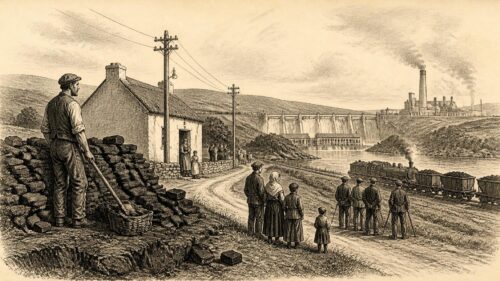
Winter Burdens shows that Irish energy hardship has repeatedly been treated as both an income problem and a housing problem. Fuel Allowance offers seasonal help to eligible households, yet its value depends on energy prices, payment timing and whether a dwelling leaks heat. The article also contrasts targeted support with universal price measures and retrofitting, each balancing speed, fairness and long-term resilience differently. This raises a question about policy priorities in a country exposed to imported-energy shocks: should Ireland place emphasis on expanding targeted winter payments, providing bill relief, or accelerating home upgrades, and what evidence should determine their balance?