

Stardust Reckoning
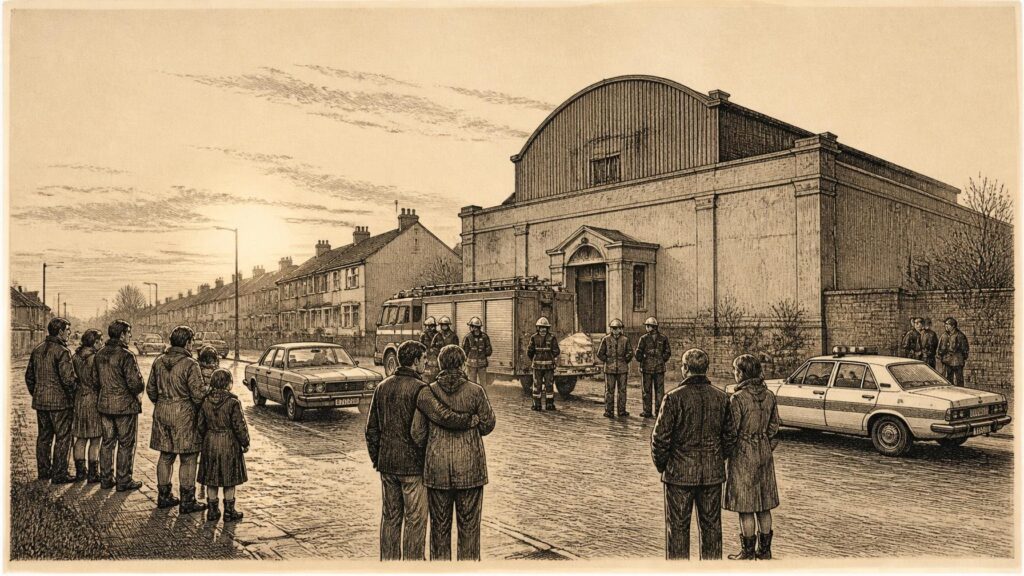
AI generated historical illustration, not a contemporary photograph.
At a Glance
In the early hours of 14 February 1981, a fire at the Stardust nightclub in Artane, north Dublin, killed forty-eight young people and injured many others. The catastrophe became more than a terrible single night: it exposed failures in public safety, burdened bereaved families with an unjust suspicion of arson, and set in motion one of the longest campaigns for truth, recognition and redress in modern Irish history. Its eventual reassessment demonstrates how official findings can shape public memory, and how persistent citizens can force the State to revisit its own record.
North Dublin
The Stardust stood on Kilmore Road in Artane, an expanding suburban district on Dublin’s north side. It occupied a familiar place in the social geography of late twentieth-century Dublin. For teenagers and young adults from Artane, Coolock, Darndale, Raheny and neighbouring districts, discos and ballrooms offered sociability, music and relative independence. A night out was often a carefully anticipated event: friends arranged to meet, chose clothes, travelled short distances together and expected to return home in the early morning. The people who went to the Stardust on the night before St Valentine’s Day in 1981 were not anonymous patrons in an abstract disaster. They were daughters, sons, siblings, neighbours, school friends and workmates.
This local character matters to the history. Disasters are sometimes narrated through buildings, regulations and official reports alone. Yet the Stardust’s meaning was formed first in homes and streets. The dead were aged between sixteen and twenty-seven. Their ages made the loss especially visible: families had watched many of them move from school into employment, apprenticeships, further education, friendships and adult relationships. Many survivors were young too. The fire therefore entered family life not as a distant public tragedy but as a rupture in a generation’s ordinary expectations.
Ireland in 1981 was a country undergoing economic strain and political uncertainty, but it was also a society in which youth culture had become more commercial and more visible. Dance venues were not marginal places. They were part of weekly life. The Stardust had originally operated as a cabaret and concert venue and later functioned as a disco. That history helps explain both the crowd gathered there and the intensity of the grief that followed. The catastrophe struck a setting associated with enjoyment, courtship and friendship, turning a commonplace social ritual into a scene of irreversible loss.
Later recollection has sometimes reduced the venue to a symbol: the Stardust as a failed building, a scandal or an inquiry. Such shorthand is understandable, but it can obscure the human setting. The disaster’s enduring force lies partly in the contrast between the normality of the evening and the devastation that followed. Families had seen young people leave dressed for a dance. Some waited for them to return. Others began searching hospitals, streets and the grounds around the nightclub. This was the beginning of a history in which private grief became a sustained public claim.
Fatal Night
Fire broke out in the Stardust during the early morning of 14 February 1981. The physical conditions became lethal with exceptional speed. Smoke, heat, darkness, disorientation and panic converged in a crowded venue. The official record, survivor testimony and later forensic discussion all establish that people faced rapidly deteriorating conditions. What remained disputed for decades was the precise origin of the fire and the extent to which the premises, fittings, exits and emergency arrangements contributed to the deaths.
The disaster killed forty-eight people. Many more were injured, some severely and permanently. Accounts preserved by RTÉ and later recollections convey a scene in which people attempted to find doors, windows and routes through dense smoke while friends tried to help friends. Outside, relatives, local residents, emergency workers, taxi drivers, Gardaí and hospital staff encountered a crisis whose scale was quickly apparent. It is important, however, to separate what is documented from the retrospective language that naturally accompanies a trauma of this kind. The documented fact is a mass fatality fire. The emotional language of chaos, horror and helplessness reflects witness experience and is indispensable to understanding the event, but it does not itself settle questions of cause or legal responsibility.
Technical investigations considered the combustible character of materials inside the club, including seating and wall coverings, alongside the course of the fire. Research undertaken for the original inquiry indicated that dangerous conditions could develop in only a few minutes. Such findings did not merely concern a single building. They raised wider questions about building control, fire precautions, inspection, emergency lighting, staff preparation and the relationship between commercial premises and public safety. In historical terms, the Stardust belongs beside other disasters that changed how a society thinks about risks in places designed for leisure.
But the immediate aftermath did not settle into a shared explanation. Instead, it opened a prolonged contest over evidence. People who had lost relatives expected an investigation that would account for the deaths and identify the conditions that made escape so difficult. They encountered processes that they believed misunderstood the fire, gave disproportionate weight to an arson hypothesis and left them with an intolerable implication: that someone among the people present might have been responsible. The next four decades were shaped by that unresolved wound.
Public Inquiry
The Government established a tribunal of inquiry under Mr Justice Ronan Keane. Its report became the principal official account of the fire for many years. It examined extensive evidence concerning the premises, the outbreak and spread of the blaze, exits, safety arrangements and the response on the night. The report is a major historical source, not because every conclusion later remained accepted, but because it records the scale of the original investigation and the framework through which the State first interpreted the event.
Its findings included grave criticism of aspects of safety at the Stardust. The report considered that the owners had shown reckless disregard for the safety of patrons in specified respects. It also addressed the fire’s cause. Crucially, the report contained a distinction that later became central. It said that the cause was not known and might never be known; it stated that there was no evidence of an accidental origin and equally no evidence that the fire had been started deliberately. Yet it also reached a further conclusion that the fire was probably caused deliberately. It was that latter conclusion which became publicly dominant and which had such damaging consequences for victims, survivors and families.
For relatives, the difference between evidence and hypothesis was not a technical nicety. The suggestion of deliberate ignition cast a shadow over the dead and those who had escaped. A finding framed as probability could migrate in public discussion into an assumption of fact. The effect was stigma. Families felt that their loved ones had not simply been lost in a disaster but placed under suspicion after death. This sense of injury was heightened because no person was prosecuted for causing the fire.
Historical interpretation must be careful here. It would be wrong to present the original tribunal as if it had made no findings of value, or to imply that all questions had been straightforward at the time. It heard complex, contradictory and traumatic evidence. Equally, later public correction makes clear that the arson conclusion was not securely grounded in evidence. The central historical point is not that hindsight makes every earlier investigator malicious or foolish. It is that institutions must distinguish scrupulously between what evidence establishes, what it may suggest and what remains unknown. When they fail to do so, the consequences can be borne for generations by people with little power to correct the record.
Damaging Stigma
The idea of deliberate fire became a social fact even though it was not proved. In ordinary conversation, newspaper reporting, public argument and official language, an allegation can acquire a life beyond the precise wording of a report. The Stardust families repeatedly described the pain of having those who died, and those who survived, associated with arson. The implication was especially cruel because the dead were so young and because bereaved parents were already coping with violent and sudden loss.
Stigma can be difficult to quantify, but it is historically real. It affects how neighbours speak, how survivors remember themselves, how institutions respond and whether grief is accorded sympathy or suspicion. In the Stardust case, it also shaped the families’ relationship with authority. Their campaign was not only for another examination of a fire; it was for the public restoration of their relatives’ good names. That demand helps explain why a simple expression of condolence could not answer the injury. The record itself had to change.
The campaign’s persistence is one of the most significant features of the story. The Stardust Victims Committee and later family-led organisations did not allow the event to recede into anniversary ritual. They gathered material, sought expert opinion, engaged lawyers, met politicians, organised protests and returned again and again to the difference between evidence and conjecture. This work was conducted while many campaigners were also raising families, working, living with illness or mourning relatives who died before they saw a resolution.
There is an understandable tendency to describe such persistence as extraordinary. It was extraordinary in duration and endurance. But it also arose from an ordinary moral impulse: parents, siblings and friends refused to accept an account that, in their view, wronged the people they had lost. Their campaigning should not be romanticised as effortless heroism. It involved exhaustion, frustration and repeated disappointment. Its historical importance lies precisely in this labour: memory was maintained not by sentiment alone, but by meetings, documents, questions, demonstrations and the decision to continue when official avenues appeared closed.
Family Campaign
Campaigning families became custodians of a counter-memory. This was not folklore in the sense of unsupported rumour. Much of their case depended on revisiting documents and demanding that official bodies assess evidence fairly. At the same time, personal memory remained essential. Families knew the character of those who had died, the circumstances in which they had gone out, and the lifelong consequences of the loss. Their testimony gave moral force to legal and technical challenges that might otherwise have remained confined to files.
Public protests were therefore acts of remembrance as well as political pressure. They insisted that the forty-eight should be named and recognised as individuals rather than treated simply as a number. This form of memorial practice is common after mass tragedy, but in the Irish context it acquired a particular resonance. The families were contesting not only forgetfulness but an official narrative that they believed had compounded their loss. To carry photographs, speak names and mark anniversaries was to reject the reduction of the dead to a disputed theory of causation.
The campaign also shows the uneven pace of Irish redress. States often respond to historic wrongs through commissions, inquiries, apologies and payments, but these mechanisms rarely arrive in a neat sequence. In the Stardust story, the initial inquiry preceded a later legal reassessment by decades. Families had to keep the issue politically present across changing governments, changing media landscapes and changing public concerns. Their work demonstrates that redress is rarely granted simply because an injustice exists. It is commonly achieved because those harmed, and their allies, make inaction harder to sustain.
Some elements of popular memory should nevertheless be handled cautiously. Communities naturally preserve stories of what people saw, heard or were told on a night of catastrophe. Those stories may contain important truths about experience, yet they cannot automatically resolve disputed forensic questions. The strength of the Stardust campaign was not that it demanded all memory be accepted without scrutiny. Its strength was that it demanded the same standards of scrutiny be applied to the arson theory that had so profoundly marked the dead and the living.
Record Corrected
A major turning point came in 2009. An independent legal examination by Paul Coffey considered the case advanced by the Stardust Victims Committee. Its conclusion, subsequently acknowledged in parliamentary debate, was that the tribunal’s assertion that the fire was probably caused deliberately was hypothetical and not established by evidence. The Government and both Houses of the Oireachtas corrected the public record by recognising that there was no evidence that the fire had been started deliberately and that its cause remained unknown.
That correction was of profound importance. It did not provide a complete account of the origin of the fire. Nor did it answer every question concerning the building, emergency arrangements or responsibility. But it removed the basis on which victims and survivors had been associated with arson. In the language of historical justice, it was a form of vindication. It acknowledged that an official conclusion with enormous social consequences had exceeded what the evidence could support.
The 2009 development also illustrates a broader lesson about archival records. Official documents are not inert. A tribunal report can appear final because it is bound, published and endowed with legal authority. Yet its interpretation may be contested when later readers identify tension between its evidential findings and its ultimate language. The correction of the Stardust record did not erase the original report or the pain caused by its reception. Rather, it changed how the State required the report to be read.
For families, however, correction was not closure. The question of how the fire began remained unresolved. The continuing campaign reflected a conviction that the legal and factual processes available to date had not fully addressed the deaths. The distinction is important. There can be a meaningful public acknowledgement of error without a complete resolution of all historical questions. Stardust redress developed through both realities: the arson stigma had been repudiated, but the wider search for a truthful account continued.
Fresh Evidence
Over subsequent years, family representatives and researchers continued to press for reconsideration. Material was submitted to public authorities, and parliamentary debates kept the issue before the Government. The process was slow. Such slowness can be read in two ways. On one hand, complex disasters require care: evidence must be examined, procedural fairness observed and the rights of living people considered. On the other, delay itself has consequences. With every year, witnesses age, relatives die and the prospect of hearing a full account becomes more fragile.
The question eventually returned to the coronial system. This was significant because an inquest has a different purpose from a tribunal or civil claim. It is concerned with how, when and where a person died. It does not operate as a general political inquiry, nor is it a criminal trial. Yet, where the original processes have left central factual questions unresolved, a properly constituted inquest can have exceptional public importance. The Stardust inquests were given an enlarged scope after legal argument, allowing detailed consideration of the circumstances in which the deaths occurred.
There was no simple transfer of authority from old inquiry to new inquest. The later process had to assess evidence in its own terms. It heard a very substantial body of testimony and expert material. The passage of time made this both remarkable and difficult. Memories can fade, records can be incomplete and a fair process cannot assume that current understanding is automatically superior to earlier investigation. But time can also permit new analysis, a more searching examination of assumptions and the accumulation of material previously overlooked or insufficiently tested.
The fact that an inquest took place more than four decades after the fire says much about the persistence of the families and about the capacity of legal institutions, however belatedly, to revisit mass tragedy. It should not be understood as proof that every claim made over the years was established. Rather, it created a formal setting in which evidence could again be heard and findings made under the direction of a coroner and jury.
Coronial Process
The Stardust inquests began hearing evidence in 2023 and became the longest inquests in Irish history. Their scale reflected the number of deaths, the complexity of the issues and the long history of contention. Hundreds of witnesses gave evidence over many days. Survivors and relatives were required to revisit events that had shaped their lives for more than forty years. The process was not merely an investigation of the past; it was an encounter between legal procedure and accumulated grief.
The inquest jury considered the starting point of the fire, the conditions within the nightclub and the barriers to escape. Its verdicts, delivered on 18 April 2024, were verdicts of unlawful killing in respect of all forty-eight people who died. The jury found that the fire began in a hot press and was caused by an electrical fault. It also made findings about factors that contributed to the deaths, including locked, chained or otherwise obstructed exits, the fire’s rapid spread, smoke, lack of visibility, emergency lighting and staff preparedness.
These findings transformed the public narrative. The 1982 tribunal’s widely remembered arson conclusion had already been corrected in 2009. The 2024 verdict went further by providing a positive finding on origin: an electrical fault in the hot press. It also located the deaths within a material environment of hazardous conditions and impeded escape. The verdict did not function as a criminal conviction of any individual. An inquest jury determines facts relating to death; it does not decide criminal liability in the way a trial jury does. That distinction must be preserved in any responsible account.
Nevertheless, the term unlawful killing carried immense moral and public weight. For families, it answered a question that had long structured their campaign: whether their relatives’ deaths were the result of an avoidable wrong rather than a mystery coloured by suspicion of those present. The courtroom response, widely reported at the time, reflected not only relief but the release of decades of unresolved strain.
Unlawful Killing
The verdict needs to be understood in its proper legal and historical sense. It did not bring back the dead, undo injuries or remove every consequence of forty-three years of grief. It did, however, authoritatively reject the social logic that had long shadowed the disaster. Those who died were not to be regarded as possible participants in a deliberate fire. The jury’s findings established a different account centred on an electrical fault, dangerous conditions and failures affecting escape.
This was especially important because public memory is often shaped less by the full texture of evidence than by a few durable phrases. For decades, “probably caused deliberately” was one such phrase. In 2024, “unlawful killing” became another. Yet their relationship is not symmetrical. The former was a hypothesis later acknowledged to lack an evidential basis; the latter was the outcome of a lengthy coroner’s court process, following the hearing of extensive evidence. The historical task is not simply to replace one slogan with another, but to understand why the correction took so long and what it required of those seeking it.
The verdict also invites reflection on institutional accountability. The findings focused attention on safety, exits and emergency preparedness. They show how deaths in a public venue can result from interconnected conditions rather than a single dramatic cause. Fire safety is often invisible when it works: unlocked exits, effective lighting, clear routes, trained staff and materials that do not accelerate danger. In catastrophe, these ordinary protections become matters of life and death.
It would be simplistic to claim that the Stardust alone transformed all Irish regulation or safety practice. Regulatory change usually arises through multiple pressures, including legislation, inspection, professional learning and other disasters. Yet the Stardust has plainly remained a reference point in Irish discussions of venue safety, public inquiry and the duties owed to people in commercial spaces. Its legacy is not only legal. It is an ethical reminder that safety provisions are promises made to strangers who enter a building in good faith.
State Apology
Five days after the inquest verdict, on 23 April 2024, Taoiseach Simon Harris delivered a formal State apology in Dáil Éireann. He apologised to the families of those killed and to survivors for the hurt done and for the protracted struggle for truth. The apology explicitly acknowledged that those present at the Stardust had been wrongly criminalised by the allegation of arson, and that the institutions of the State had failed the families.
An apology is not self-executing. Governments can express regret without changing practice, and ceremonial words can feel inadequate beside loss. Yet the Stardust apology was historically significant because it named both the original catastrophe and the secondary injury caused by the State’s treatment of families. It did not portray the wrong as an impersonal administrative mishap. It recognised that the failures of public processes had deepened trauma and isolated people who should have received support.
The setting mattered. A Dáil apology places the statement within the constitutional and democratic life of the State. It becomes part of the public record rather than a private meeting or carefully managed press release. The presence of families in the gallery reinforced the point that this was not merely a speech about the past. It was an encounter with people who had lived the consequences of official decisions.
Yet the apology’s value should be measured alongside, not instead of, material redress and continuing commemoration. For many families, vindication came through the verdict, the correction of the arson record and the recognition of individual loved ones. The apology acknowledged these achievements, but it could not substitute for them. Its strongest meaning lay in the State’s acceptance that it had not simply failed to provide answers quickly; it had added to the suffering of people already bereaved.
Material Redress
Redress has several meanings in the Stardust history. Compensation processes existed in the aftermath of the fire, but compensation did not end the dispute over truth. Money can meet immediate needs, recognise injury or provide practical assistance. It cannot determine the cause of a death, restore a reputation or answer why a family waited decades for recognition. To understand Stardust redress, therefore, it is necessary to distinguish financial provision from moral vindication, legal findings and public commemoration.
The Government later introduced further recognition measures. In 2025, the first phase of an ex gratia scheme concerned the families of those found to have been unlawfully killed. In February 2026, the Department of Justice announced a second phase for survivors injured in the fire who had received payments from the original Stardust Victims Compensation Tribunal. It provided for a tax-disregarded recognition payment of €20,000 for eligible survivors. This development reflected an official acceptance that the consequences of the fire extended beyond those who died and their immediate families.
The word “recognition” is important. Such payments are not damages awarded after a finding of civil or criminal liability. They are ex gratia measures: payments made by the State without the ordinary legal structure of fault-based compensation. Their significance lies in acknowledgement. Survivors who carried physical injury, psychological trauma or both had long occupied a difficult position in public narratives that naturally focused on the forty-eight deaths. Recognition measures make visible the wider circle of harm.
Material redress also raises difficult questions of eligibility. Any scheme must draw boundaries: which people qualify, what evidence is required, whether relatives are included and how prior payments are treated. Those boundaries can themselves cause distress. The historical lesson is not that a single scheme can perfectly measure grief. It cannot. Rather, fair redress should be designed with an awareness that bureaucracy can repeat the exclusion and disbelief that victims have already experienced. In the Stardust case, the language of recognition sought to address that danger, though the full effects of these measures will be assessed by those receiving them rather than by official announcement alone.
Living Memory
Memory of the Stardust has been kept alive through annual commemorations, memorial spaces, family testimony, documentaries, radio archives and local activism. RTÉ’s archive preserves contemporary reporting and later interviews, allowing audiences to hear the immediacy of the event as well as the long pursuit of justice. Such material is valuable, but it should be read critically. Broadcast reporting records what was known or believed at a particular moment; it does not acquire retrospective certainty merely because it is archival footage.
Memorial practice has another purpose. It restores individuality. Lists of forty-eight names can seem formal, but naming is an act of resistance to abstraction. The young people who died had tastes, ambitions, friendships and family roles. The process of collecting pen portraits and preserving photographs has allowed relatives to present them as full lives rather than solely as victims. This is not sentimentality. It is historical correction. Catastrophes can make people visible only at the point of death; memorial work returns them to the texture of life.
State commemoration at the Garden of Remembrance in June 2024 marked another stage in this process. The choice of venue connected the Stardust dead and those affected by the fire to a national site of reflection. Such symbolism must be handled with care. A national ceremony cannot absorb the particular pain of north Dublin families or replace the local meanings of Artane and surrounding communities. At its best, however, it signals that the tragedy is no longer treated as a peripheral or embarrassing episode but as part of the country’s shared history.
There is also a risk in commemorative closure. Once a State apologises and holds a ceremony, the public may assume that a difficult story has been fully resolved. For many, some forms of resolution will remain impossible. The dead cannot be restored, years of stigma cannot be un-lived, and relationships with public institutions may remain marked by distrust. The more honest interpretation is that remembrance and redress are continuing practices. They require attention not only on anniversaries but in the standards applied to public safety, inquiries and bereaved citizens.
Historical Lessons
The Stardust history offers no simple moral. It is not merely a story of institutional failure followed by eventual triumph, because the decades lost cannot be recovered. Nor is it only a story of grief, because grief was transformed into careful and organised public action. It is a history of evidence: of how conclusions are reached, how they become socially powerful, and how they can be challenged. It is also a history of class, locality and voice. Families from working communities in north Dublin had to acquire the language of reports, law and politics in order to be heard by institutions that initially seemed remote.
One lesson concerns the danger of premature certainty. When the cause of a disaster is unknown, there is pressure to produce a coherent explanation. Public bodies, journalists and communities all seek an answer. But an answer that outruns the evidence can become a second disaster, especially when it attaches blame to people who cannot defend themselves. The Stardust record demonstrates why careful uncertainty is not weakness. Saying that something is not known may be difficult, but it is more just than treating speculation as fact.
A second lesson concerns persistence. The 2024 verdict did not emerge because time automatically heals public wrongs. It emerged after generations of family members and supporters maintained pressure, assembled material and demanded another hearing. Their campaign complicates any notion that history is written only by governments or experts. Institutions have authority, but ordinary people can preserve records, expose contradictions and alter national memory.
Finally, Stardust asks what a State owes its citizens after catastrophe. It owes competent investigation, humane treatment, truthful language and material support. It owes special care not to turn uncertainty into stigma. When those duties are not met, apology and payment may be necessary, but they arrive after damage has been done. The continuing power of the Stardust story lies in this warning and in the dignity of those who refused to let forty-eight young lives be misrepresented or forgotten.

The article shows how the Stardust families’ campaign sought more than compensation: it pursued correction of a narrative that had associated victims with an unsupported arson theory. This raises an important question about redress after disaster. The 2009 parliamentary correction and inquests offered vindication and recognition, yet could not resolve the fire’s origin or undo decades of stigma. The case suggests that memory is shaped not only by legal findings, but by commemoration, activism and institutional language. How might Ireland apply the lessons of Stardust when designing responses to disasters in which evidence remains incomplete but official interpretations cause harm?