

Recorded Lives
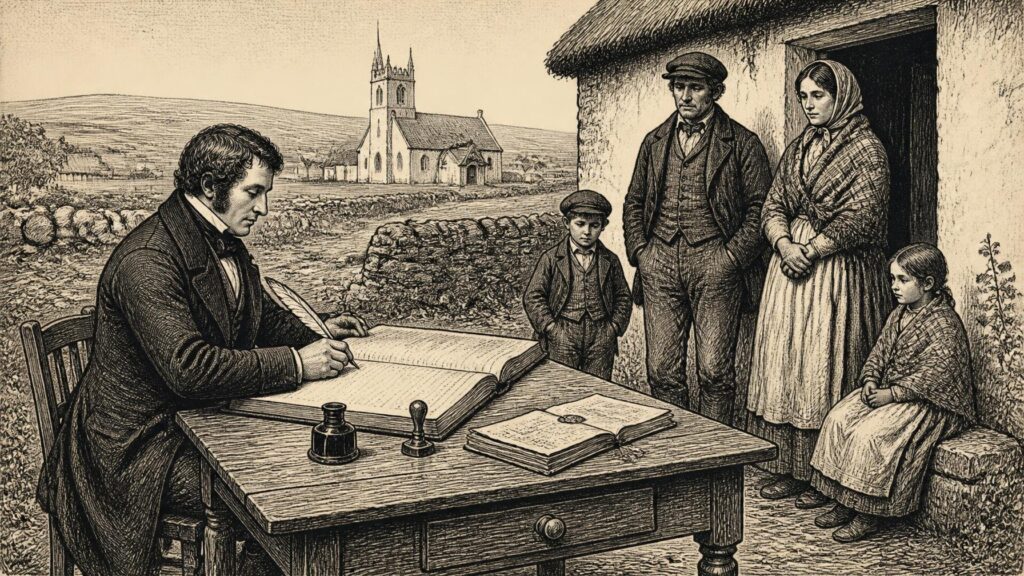
AI generated historical illustration, not a contemporary photograph.
At a Glance
Irish civil records are among the most important surviving witnesses to ordinary lives, yet they make sense only when read as historical documents rather than as a ready-made family tree. A certificate can preserve a name, occupation, address or relationship; it can also contain an error, an omission, a delayed registration or a clue shaped by the assumptions of the official who wrote it down. Their great value lies in the way they connect individual households to the larger history of Ireland.
State Origins
Genealogy is often treated as a private pursuit, concerned with descent, inheritance and the recovery of names. In Ireland, however, it is also a study of institutions. The records on which family historians depend were made for purposes other than satisfying later curiosity. Churches recorded sacraments and congregations; landlords and valuers recorded property and occupation; courts recorded legal claims; governments counted people, assessed rates, administered poor relief and registered events that bore upon status, succession and public health. Civil registration belongs to this administrative history.
The system familiar to Irish researchers emerged under the United Kingdom of Great Britain and Ireland. In April 1845, civil registration commenced for non-Roman Catholic marriages and for civil marriages conducted in register offices. This was not yet a universal record of Irish marriage. It reflected both the legal position of different denominations and the limited reach of the initial legislation. For many Roman Catholic families, whose weddings were not then within the ordinary civil system, a church register remained the principal contemporary record of marriage.
A more comprehensive change came in January 1864, when registration of births, deaths and marriages became obligatory. That date is rightly central in Irish genealogy, but it should not be misunderstood as the moment at which every birth, death and marriage was perfectly recorded. Compulsion created a framework; compliance depended upon families, clergy, registrars, informants and local knowledge. A historical record is therefore evidence that an event was reported and entered in a particular administrative setting. It is exceptionally useful evidence, but it is not identical with the event itself.
From the beginning, the system was organised through superintendent registrar districts and local registrar districts. These units did not always coincide neatly with county boundaries, parish identities or the places families themselves named. They grew from a nineteenth-century administrative landscape strongly associated with poor-law unions. Consequently, a person whose family remembered itself as belonging to one county or parish might appear in a registration district named for a nearby town, or in a district extending across a county line. The apparent mismatch is not necessarily a mistake. It may reveal the geography through which the state encountered local life.
Religious Boundaries
The uneven commencement of marriage registration is one of the first cautions required in Irish family history. Non-Roman Catholic marriages entered the civil system from 1845, while Roman Catholic marriages became part of general civil registration in 1864. A search that begins with a presumed marriage before 1864 can therefore fail for reasons that are historical rather than personal. The absence of a Roman Catholic civil entry from the 1850s is ordinarily unsurprising; it directs the researcher towards the relevant parish register, assuming one survives and can be identified.
Church records and civil records should not be treated as rivals. They arise from different authorities, serve different functions and often preserve different details. A baptism may identify sponsors, who can be kin, neighbours or patrons. A marriage register may note witnesses, residence, parish or dispensations. A civil birth entry may identify the mother’s maiden surname, the father’s occupation and a precise address. A civil death entry may name an informant, whose identity can suggest who remained close to the deceased at the end of life. The strongest reconstruction comes from comparison rather than preference.
This distinction also helps explain why religious affiliation matters without being a sufficient explanation for every gap. Church registers vary greatly in date, condition and detail. Some began early; others began later. Some contain regular entries, while others show interruptions caused by local circumstances, lost volumes or incomplete preservation. Civil registration was broader after 1864, but it too depended upon the reporting of events. A researcher should resist the tempting claim that one class of record is inherently complete while the other is inherently unreliable. Each has its own history of creation.
Names complicate the matter further. Irish people might appear under Irish-language, English-language or Latin forms of personal names; a clerk might record an abbreviated name, a familiar name or a spelling heard aloud. Surnames were not always fixed in modern fashion. Variants can arise through pronunciation, literacy, migration and clerical practice. They do not automatically prove a change of identity, nor should every similar name be joined to a desired family. Genealogy requires a chain of evidence: place, age, occupation, relatives and repeated associations must be weighed alongside names.
Register Practice
Civil registers are compelling because they capture life events at close range. A birth record may supply a date and place of birth, the child’s name, the names and occupations of parents, and the identity of the informant. A marriage entry may show residences, occupations, ages or descriptions of full age, fathers’ names and occupations, witnesses and the form of ceremony. A death entry can record the date and place of death, age, occupation or condition, cause of death and the person who supplied the information. The exact fields altered over time, and the details depend upon the form in use, but the general richness of the records is clear.
That richness creates a danger: readers can mistake a full-looking entry for an infallible statement. Ages in death registrations may be approximate. An informant may have known the deceased well, barely known them, or possessed only family hearsay. A father’s occupation can be described broadly or narrowly. An address may denote a townland, a street, an institution, a lodging house or the residence where an event happened rather than a settled family home. The handwriting and formula of registration can give an impression of certainty that the underlying information did not always possess.
Margins deserve particular attention. Later notes may refer to amendments, corrections or re-registrations. They are part of the documentary history of the entry, not decorative additions. A correction can identify an error in the original statement, while a re-registration may lead the reader to another entry containing materially fuller information. The researcher should therefore inspect the image of the register where possible, rather than rely only on a transcription or index. Indexes are finding aids. The register image is closer to the original administrative act.
The distinction between an index, a copy and a certificate is also historical as well as practical. An index helps locate an entry; a research copy reproduces the information recorded; a certified certificate is intended for legal or administrative use. For historical work, the central question is usually not which document looks most official, but whether the researcher has identified the correct person and read the record in context. A beautifully ordered certificate for the wrong Patrick Murphy remains the wrong evidence.
Delayed registration and late reporting must also be considered. Where an event occurred near the end of a year, an entry may be found in the following year. A child’s stated date of birth can differ from the registration date. In other cases, the date supplied by a relative may be inaccurate or an event may have been entered after a delay. Such discrepancies should be recorded rather than silently harmonised. A careful family history can say that two records conflict and explain which interpretation is more probable. It should not conceal uncertainty merely to produce a tidy pedigree.
Family Method
The most dependable method begins with known evidence and moves backwards one documented generation at a time. Family papers, memorial cards, letters, passports, photographs, grave inscriptions and oral recollections may provide a starting point, but they require testing. The National Archives of Ireland advises researchers to assemble core facts such as surname, locality and approximate period before entering archival collections. This is sound counsel. In a country where common surnames recur in adjacent townlands and in successive generations, a name alone is rarely enough.
Place is often the decisive factor. Irish historical geography operates at several levels: townland, parish, civil parish, poor-law union, registration district, county, electoral division and street. These categories overlap but are not interchangeable. A townland can be tiny; a registration district can encompass many townlands; a church parish may not conform to either. Before deciding that two records concern separate families, researchers should establish the relation between the places named. Before deciding that they concern one family, they should do the same.
A useful working practice is to build a small evidence table for each proposed individual. Record every appearance by date, source, stated residence, occupation, age, relatives and informant or witness. This makes patterns visible. A labourer in one document, a carter in another and a farm servant in a third may plausibly be the same man if place, spouse and associates align. Conversely, two men with identical names and occupations may be distinct if their townlands, spouses or children do not overlap. The task is identification, not the collection of attractive matches.
Women demand special care because a single person may appear under a maiden surname, married surname, widow’s description or a name shaped by local usage. Civil birth entries can be especially valuable in reconnecting a married woman with her birth identity, while marriage records may point to her father and witnesses. Yet no one item should be allowed to carry a conclusion alone. A mother named in a child’s birth registration might be the correct woman, but confirmation through marriage, census household, burial, probate, newspaper notice or repeated naming patterns strengthens the case.
Witnesses and informants can serve as the connective tissue of reconstruction. A sister may inform a death, a brother may witness a marriage, a neighbour may appear repeatedly in a cluster of entries, and a godparent in a baptism may later emerge as a marriage witness. Such connections are not proofs by themselves. Friends, employers and unrelated neighbours also appear in these roles. Nevertheless, when several records point towards the same network, they can help distinguish families who share a surname and locality.
Census Evidence
Civil registration rarely answers every question. Ireland’s surviving censuses are among the most valuable complementary sources. Systematic government censuses were taken every ten years between 1821 and 1911, but the complete public household returns that survive for the whole island are those for 1901 and 1911. They can be searched through the National Archives of Ireland, alongside surviving fragments and substitutes for earlier decades. The survival of these two full censuses gives late nineteenth- and early twentieth-century research an unusual depth.
The household form records more than a list of names. Depending on the census year, it can provide age, marital status, relationship to the head of household, occupation, religion, literacy, birthplace and language information. The 1911 return additionally asked married women about years married, children born and children living. These details can suggest marriages, identify children who died young, distinguish people with the same name and reveal households extended by grandparents, boarders, servants or kin. They are, however, snapshots taken on a particular night rather than continuous biographies.
Age must be handled cautiously in census work, just as it must in death records. People did not always know, disclose or report exact ages, and enumerators copied information into official forms. Birthplaces can be broad, local or inconsistent. A person recorded as born in County Mayo in one census and in Ireland in another may not be contradicting themselves in any meaningful sense. The question is whether the information fits the larger body of evidence. A discrepancy becomes important when it separates otherwise similar candidates, not merely because modern expectations demand numerical precision.
The census can also illuminate what civil records cannot easily show: a household’s composition, language, literacy, housing circumstances and occupational structure. A birth certificate identifies parents; a census may show the grandparents, unmarried siblings and nieces who occupied the same home. A marriage entry gives the parties’ residences at marriage; the census can establish whether they had previously lived with a parent, worked in service or migrated within Ireland. Together, these sources convert isolated life events into a social history of family and place.
Archive Loss
Any account of Irish genealogy must acknowledge absence. The destruction of the Public Record Office of Ireland at the opening of the Irish Civil War in 1922 caused a catastrophic loss of archival material. Many researchers encounter this event as a blunt explanation for missing ancestors, but it should be approached with precision. Not every Irish record was lost, not every surviving copy is complete, and not every missing item was destroyed in 1922. The historical task is to identify the fate of the particular record series required.
The loss is especially important for census research. Earlier census returns were already subject to destruction or poor survival before 1922, while 1901 and 1911 survived. This means that the apparent visibility of a family can change abruptly across the nineteenth century. A household clearly seen in 1901 may seem to vanish when the researcher looks for an 1871 return that no longer exists. The proper response is not to fill the void with a guessed household, but to seek substitutes: census search forms, valuation material, church records, estate papers, newspapers, school records, workhouse records, wills and local repositories.
Probate offers a useful example of both loss and survival. Original wills and related records suffered heavily, but calendars, copies and other associated sources can still reveal dates of death, residences, executors, occupations and kinship. Land and valuation sources likewise do not prove biological descent, but can track occupancy and property across years. A name appearing in the same house or holding after another disappears may suggest succession within a family; it may also reflect tenancy arrangements unrelated to inheritance. Interpretation must remain proportionate to the evidence.
The modern reconstruction of dispersed and damaged archives has changed the research landscape. The Virtual Record Treasury of Ireland brings together surviving copies, transcripts and parallel material held in different institutions. Such work does not restore every lost original, and digitisation cannot erase the consequences of destruction. It does, however, challenge the older fatalism that Irish research is impossible. The archive is fragmented, not empty. Good genealogy learns to work with fragments without pretending that fragments provide total certainty.
Partition Consequences
Partition introduced an essential administrative distinction into civil-record research. The historic civil registers for the whole island before 1922 belong to the earlier all-Ireland system. After 1922, civil registration for the six counties of Northern Ireland is held through the General Register Office of Northern Ireland, while records for the Irish Free State and its successor state followed the institutions of the south. A search strategy must therefore be shaped by both date and place.
This is not a minor technicality. A family that moved between Donegal and Derry, Monaghan and Tyrone, or Dublin and Belfast may require searches in more than one jurisdiction. The same is true of families whose members crossed the new border for work, marriage, military service or residence. The records should not be forced into a later national framework that did not exist at the time of an earlier event. Before 1922, the civil-registration system covered the island; afterwards, custody and access divided along new governmental lines.
Northern Irish repositories add further layers of evidence. The Public Record Office of Northern Ireland holds extensive collections useful for family and local history, including valuation revision books, maps, directories, will calendars and name-search resources. It does not itself hold the civil certificates, which are the responsibility of the General Register Office of Northern Ireland. This division of custody illustrates a broader rule: knowing which institution created or holds a record is part of knowing what the record can establish.
Emigration creates a parallel complication. A person absent from an Irish death register may not have died in Ireland at all. Civil records can establish a last known Irish residence or name a parent, but passenger records, overseas censuses, naturalisation files, military papers, foreign death certificates and cemetery records may be needed to follow the emigrant further. Family tradition often preserves the destination more readily than the departure date. It should be treated as a research lead, not as a conclusion.
Digital Access
Digital access has transformed the practical study of Irish civil records. The Irish Genealogy service provides historic indexes and register images within stated public-release periods, and the General Register Office continues to provide research access and copies beyond material available freely online. These services have made it possible to examine records from distant places and to compare entries efficiently. They have also made errors easier to propagate when a result is copied without checking the image or considering alternatives.
Online searching rewards flexible but disciplined technique. Search a narrow range of years around an estimated event. Try forename and surname variants separately. Use a place or registration district where known. Search for siblings whose names may be more distinctive than those of parents. Consider whether a marriage was registered in a neighbouring district, whether a birth was reported under a variant surname, or whether an entry was filed in the following year. Each adjustment should arise from a historical possibility, not from a desire to make a favoured answer appear.
Digitisation also raises questions of privacy and ethical use. The public availability of historic images does not make every family story suitable for casual publication. Illegitimacy, institutionalisation, poverty, illness, adoption, violence and disputed parentage may appear directly or indirectly in records. Historical writing should distinguish what a document states from what a reader infers, and should avoid turning private hardship into spectacle. The further a claim reaches beyond the document, the clearer the explanation of uncertainty should be.
Transcriptions remain valuable, but they should be checked against images whenever possible. A digital index can misread handwriting, divide or combine names unexpectedly, or reproduce an error already present in the original. The original itself may also be wrong. A good citation in private research notes should therefore record the repository or service, record type, registration district, year, volume and page or entry reference where available, together with the date on which the image was consulted. This allows later researchers, including one’s future self, to retrace the path.
Historical Cautions
Civil records are documentary evidence, not folklore; but folklore can still matter. A story that an ancestor “came from the north”, “went to America after the Famine” or “was related to a famous family” is neither established nor worthless. It is an inherited claim that may preserve a place, relationship or migration memory in altered form. The historian’s duty is to separate the claim from the proof. A tradition becomes stronger when independent records converge upon it; it remains tradition when they do not.
The same discipline applies to interpretation. It is documented that a registrar entered a particular occupation or address. It is an interpretation to say that the family was prosperous, insecure, socially mobile or estranged. Such interpretations may be reasonable when supported by repeated records and wider local context, but they should be presented as readings rather than facts. A single entry describing a man as a farmer does not reveal the size or security of his holding. A death in a workhouse does not, by itself, explain the whole course of a life.
Researchers should be equally wary of negative evidence. Failure to find a record after a sensible search is meaningful, but it is rarely final. The event may have occurred elsewhere, been recorded under a variant name, fallen outside the expected period, survived only in another series or not been registered as anticipated. Negative evidence is most useful when the search parameters are explicit. Saying that no entry was found in a named district during a stated period is more honest and more useful than declaring that no record exists.
Above all, genealogy should preserve the difference between ancestry and identity. Civil registration can help establish lines of descent, but it does not fully explain a person’s language, faith, loyalties, affections or sense of belonging. Those things are often visible only indirectly through residence, associates, letters, institutions and choices. The records matter because they make ordinary Irish lives more recoverable. Their limits matter because they remind us that no register, however carefully kept, contains the whole person.
Enduring Evidence
The history of Irish civil registration is thus more than a guide to certificates. It is a history of state formation, denominational difference, administrative geography, family strategy, archival catastrophe, partition and migration. Its records can identify a newborn child, a marriage household or the informant at a deathbed; read together, they can reveal patterns of work, mobility, kinship and loss across generations.
For the family historian, the best principle is simple: begin with what can be demonstrated, preserve the wording of the record, test every connection against time and place, and leave room for doubt. Civil registers are strongest when joined to census returns, church books, valuation sources, wills, local archives and family-held documents. That patient method does not diminish the human interest of genealogy. It gives it firmer ground, allowing the recovered lives of Irish families to be narrated with both imagination and restraint.
The article shows that civil registration can preserve both family events and the state’s view of place. A household remembered as belonging to one parish or county may appear under a different registration district because poor-law boundaries and registrar areas overlapped imperfectly. This raises an intriguing interpretative problem: apparent movement in the records may represent migration, residence, or merely the geography through which officials organised information. Comparing certificates with census returns, church registers and valuation sources can clarify patterns, although uncertainty remains. How should historians weigh administrative boundaries against family memory when deciding whether locations indicate genuine mobility or continuity?