

Contested Remembrance
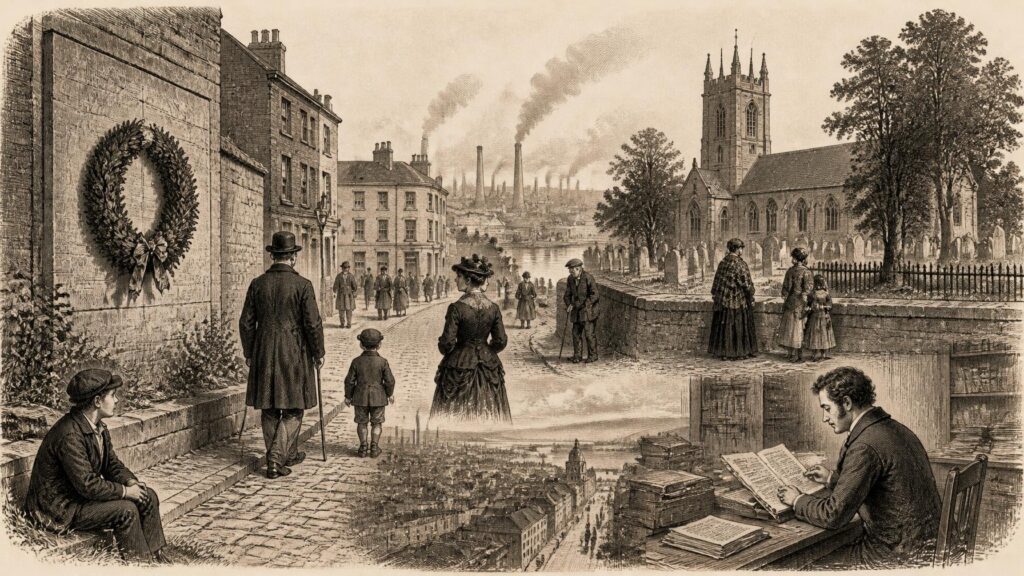
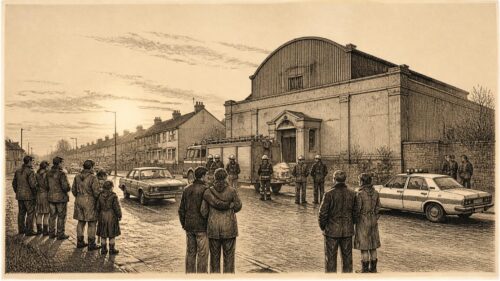
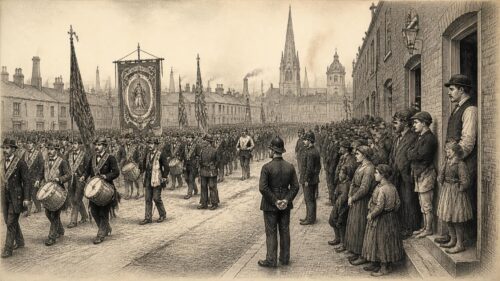
AI generated historical illustration, not a contemporary photograph.
At a Glance
Northern Ireland has a shared past, but it has never possessed a single, settled memory of that past. Its history is remembered through family stories, churchyards, marching routes, public monuments, political speeches, school lessons, murals, court files, newspapers, songs and silences. Such materials do not simply preserve what happened. They select, arrange and give meaning to events. They can sustain dignity and grief, but can also preserve division. To understand Northern Ireland memory, therefore, is not merely to ask what people recall. It is to ask who is remembered, by whom, in what setting, and for what purpose.
Memory Matters
Memory is often spoken of as if it were an individual possession: an elderly witness remembers an air raid, a former prisoner recalls a cell, a child remembers being stopped at a checkpoint. Historical memory is larger and more complicated. It is the process by which groups inherit accounts of the past that they did not personally experience. These accounts are carried through households and neighbourhoods, but also through formal institutions. A memorial committee, a museum curator, an archive cataloguer, a schoolteacher and a political party can all influence the public past. Their work need not be cynical or partisan to have consequences; selection is unavoidable. No archive can keep everything, and no exhibition can tell every story at once.
In Northern Ireland this process is unusually visible because constitutional identity has long been disputed. Many unionists understand their political tradition through attachment to the United Kingdom, the Protestant succession, the Williamite victory and participation in British military history. Many nationalists and republicans locate their identity in the wider history of Ireland, colonial dispossession, self determination and resistance to British rule. Neither description encompasses every person, and neither should be treated as a timeless essence. Yet both have shaped the languages, calendars and places through which the past is made present.
The consequence is not that facts do not matter. On the contrary, contested environments require particularly careful attention to evidence. Dates, death records, official files, photographs, contemporary reporting and testimony may establish that an event took place, identify participants or correct later embellishment. They cannot alone dictate what that event means to descendants. A historian may demonstrate that a memorial was erected in a certain year, but cannot make every visitor feel the same grief, pride or discomfort before it. Northern Ireland memory is therefore a meeting point of evidence, interpretation and emotion.
Older Inheritances
The deep background to modern remembrance lies in early modern settlement and conflict, though it would be misleading to treat the present as an automatic product of the seventeenth century. The Plantation of Ulster, following the defeat of Gaelic lords and extensive confiscations, altered patterns of landholding, religion, language and political connection. English and Scottish settlers arrived in significant numbers; older Gaelic communities endured, adapted and resisted. Later conflict, including the Williamite war, gave powerful material to competing historical traditions. The 1690 Battle of the Boyne, in particular, became a durable symbol in Protestant and unionist culture, while its public commemoration could be experienced by many Catholics and nationalists as a reminder of domination rather than a neutral historical anniversary.
Such inherited history is often compressed into moral parables. A historical episode involving changing alliances, international war, local contingencies and social conflict becomes a simple proof of loyalty, betrayal, conquest or deliverance. That compression is not unique to Ireland. It is, however, consequential where a parade route, a banner or a bonfire can activate memories accumulated across generations. The historian’s task is not to mock inherited attachment, nor to accept inherited claims untested. It is to restore complexity and distinguish between the event itself, the later tradition built around it, and the uses to which that tradition has been put.
Folklore has a place in this history, but it is not identical to documentary proof. Family tales of hidden weapons, miraculous escapes, lost farms or particular ancestors may preserve genuine fragments of experience. They may also change in repetition, attach themselves to celebrated events, or merge separate incidents into one compelling story. Folklore is historically valuable as evidence of how people have understood their past. It should not, without corroboration, be treated as decisive evidence that every narrated detail occurred exactly as remembered.
Partition Memories
The creation of Northern Ireland in 1921 placed memory at the centre of the new state’s public life. Partition did not create the island’s competing identities, but it gave them a new political framework. Northern Ireland was established with a unionist majority and a substantial nationalist minority. For many unionists, its establishment represented the safeguarding of their British citizenship and constitutional preference. For many nationalists, it represented the division of Ireland and the entrenchment of a polity in which they feared permanent exclusion. The same constitutional event thus entered collective memory as protection for one community and injury for another.
State ceremonies, war memorials and civic symbols reinforced particular versions of belonging. The experience of the First World War was also remembered unevenly. Service in British forces and commemoration of the Somme were prominent in unionist remembrance, especially in relation to the 36th Ulster Division. Nationalist and republican traditions, meanwhile, often placed greater emphasis upon the Easter Rising, the War of Independence and the anti partition struggle. These were not hermetically sealed memories: families could possess mixed allegiances, and many individuals lived beyond public labels. Nevertheless, public culture frequently made one tradition more conspicuous in a given district than another.
The decades of devolved government at Stormont, from 1921 until 1972, are recalled through sharply different lenses. Unionist accounts may stress stable administration, industrial achievement and constitutional continuity. Nationalist accounts commonly foreground discrimination in housing, electoral arrangements and employment, as well as the political marginalisation of a large minority. The documentary record is essential here. Memories of unequal treatment were not only retrospective feelings; they helped animate campaigns for reform. Yet historical explanation must retain breadth. Northern Ireland’s political crisis arose from overlapping constitutional, social, economic and cultural causes, not from a single grievance detached from all else.
Civil Rights
The civil rights movement of the 1960s brought issues of equality, representation and policing into a new public arena. Inspired in part by international currents but rooted in local complaints, campaigners demanded reforms to voting, housing allocation, local government and the use of emergency powers. Marches, counter demonstrations, television images and police responses made political disagreement visible far beyond the streets where it began. Memory of this period remains foundational because it offers rival starting points for the subsequent conflict.
For many nationalists, civil rights marches represent a democratic demand for equal citizenship met too often with obstruction and violence. For many unionists, the period is recalled alongside fears that reform campaigns were exploited by those seeking to undermine Northern Ireland altogether. Neither perspective excuses violence against civilians, nor can either account substitute for close examination of individual events. The significance of civil rights memory lies partly in this tension: the period continues to be read either as a missed opportunity for reform, a challenge to a precarious state, or both.
Historical records allow more than slogans. Contemporary newspapers, organisational papers, official correspondence, film and photographs reveal the arguments made at the time. They also reveal how language mattered. A term such as “order”, “rights”, “security” or “reform” could carry distinct implications depending upon who used it and who heard it. Later memory tends to identify a clear road towards conflict, but participants did not know the outcome in advance. Their uncertainty is one reason why contemporary evidence deserves attention alongside later recollection.
Violent Years
The conflict conventionally called the Troubles developed from the late 1960s and lasted for roughly three decades, though its beginning and ending dates vary according to the question being asked. It involved republican and loyalist paramilitary organisations, the British Army, the Royal Ulster Constabulary and other state agencies, political parties, prisoners, victims, survivors and civilians who did not choose any of these roles. Violence occurred chiefly in Northern Ireland, but also in Great Britain, the Republic of Ireland and elsewhere. More than 3,600 people were killed, while many thousands more were physically injured, bereaved, displaced or traumatised.
That scale makes generalisation hazardous. “The Troubles” can sound like a single event, yet it contained bombings, shootings, riots, disappearances, punishment attacks, imprisonment, intelligence operations, protests, negotiations and ordinary attempts to carry on with life. A person’s memory might centre on a death in the family, a military checkpoint, a workplace evacuation, a prison visit, an Orange parade, a hunger strike or the decision to leave a neighbourhood. It is possible for two people who lived a short distance apart to remember the same decade as radically different worlds.
Statistics are vital for establishing scale and patterns, but they cannot translate suffering into a simple hierarchy. The dead included people of different political and religious backgrounds, security force members, paramilitaries and civilians. Every category has its own evidential and ethical difficulties. Classification can clarify responsibility or circumstance, but it can also sound cold when used without attention to individual lives. The best historical work therefore moves between aggregate evidence and particular cases, recognising that a name, a photograph or a witness account can challenge the abstraction created by numbers.
Ordinary Lives
Public memory has often focused on dramatic episodes: Bloody Sunday, the Birmingham bombings, hunger strikes, major political agreements and the deaths of prominent figures. Those events deserve sustained scrutiny. Yet memory of the Troubles also resides in ordinary routines shaped by insecurity. People learned which streets to avoid, when shops might close, how to respond to an unexplained sound, and what questions not to ask. Children absorbed the geography of division before they necessarily understood its history. Families developed habits of caution around names, schools, accents and journeys.
Such recollections should not be romanticised as resilience alone. Adaptation to abnormal conditions can conceal the extent of harm. A person may describe a childhood as normal because the restrictions and alarms formed the background of everyday life. Only later, often when visiting an exhibition or hearing another person’s testimony, may that individual recognise how unusual those conditions were. Museums dealing with the Troubles have found that objects from domestic and routine life can provoke memories as powerfully as weapons or political posters: a schoolbag, a bus timetable, a damaged door, a security notice or a photograph of an altered street.
Gender, class and locality also shaped experience. Women frequently sustained households, visited prisoners, organised community support and led campaigns for truth or justice, while their work could be under represented in older public narratives. Working class districts bore much of the visible militarisation and much of the violence, though fear and bereavement crossed class boundaries. Rural border communities experienced the conflict differently from Belfast neighbourhoods; Derry, Armagh, Tyrone and towns along the border each possessed their own local chronology. A responsible history avoids treating Northern Ireland as a single undifferentiated place.
Prison Voices
Prisons occupy an exceptional place in the memory of the conflict. Long Kesh and the Maze, Armagh Gaol and other institutions were not merely places of confinement. They became political symbols, workplaces, sites of protest, spaces of religious observance and locations where families encountered the state. Prison experience has been remembered through competing narratives of criminality, political status, sacrifice, discipline, coercion and loss. The meaning of imprisonment cannot be decided by one vocabulary alone.
The Public Record Office of Northern Ireland’s Prisons Memory Archive illustrates the historical value of preserving different kinds of testimony. Its filmed interviews include former prisoners, prison staff, relatives, chaplains, lawyers, doctors, tutors, probation officers and maintenance workers. Such breadth matters. It does not erase conflict between accounts, but it prevents prison history from being reduced to a single representative voice. A former governor, a former prisoner and a visitor may describe the same institution with incompatible emphases while still providing useful evidence about its routines, atmosphere and human consequences.
Oral testimony is neither a lesser source nor a transparent transcript of the past. Interviewees may forget, protect others, reinterpret earlier choices or speak differently in public than they would in private. The passage of time matters. So does the relationship between interviewer and interviewee, and the knowledge that a recording may be preserved. These limitations are not reasons to discard oral history. They are reasons to read it critically, alongside records, material remains and other testimony. A contradiction may itself reveal how meaning has changed.
Material Traces
Murals, memorial gardens, painted kerbstones, flags, bonfires, peace walls and plaques are among the most conspicuous carriers of Northern Ireland memory. They are not all alike. A bereavement memorial and a political mural may serve different purposes; a temporary display may differ from a monument intended to endure for generations. Yet each alters the landscape by declaring that a particular past belongs in public view. The location is part of the message. A memorial at a roadside, outside a chapel, near a former barracks or on a housing estate speaks to a specific community and to visitors entering its space.
Murals are especially unstable historical objects. Some preserve older iconography; others change rapidly with local politics, anniversaries or negotiations. They may commemorate dead volunteers, celebrate cultural heritage, protest against injustice, mark international solidarity or promote tourism. Photographs of murals are therefore valuable but incomplete. They record appearance at a particular time, not necessarily audience response, authorship, permission, subsequent alteration or removal. Interpreting them requires local knowledge, chronology and caution against assuming that every resident agrees with a wall’s message.
Material culture can also offer openings beyond established division. The National Museums Northern Ireland collection on the Troubles includes objects, photographs, art and political ephemera, treating the conflict’s impact on daily life as well as its formal politics. Its curatorial premise is especially useful: a shared past does not automatically yield a shared memory. Museums cannot enforce agreement, but they can place different experiences in proximity, give provenance to objects and invite visitors to confront evidence that their own inherited narrative may have omitted.
Ritual Seasons
Commemoration in Northern Ireland is often calendrical. The anniversaries of the Easter Rising, the Battle of the Boyne, the Somme, Bloody Sunday, the hunger strikes and particular killings structure annual returns to the past. Parades, church services, wreath laying, speeches, banners and silence provide forms through which communities renew attachment. Ritual is not simply backward looking. It tells participants what their group values in the present and what political future it imagines.
Parading has consequently generated recurring tension. Supporters may understand a parade as a legitimate cultural expression, a commemoration, or an assertion of the right to use public roads. Opponents may understand the same procession, especially in a contested or predominantly nationalist area, as triumphalism, territorial assertion or intimidation. Historical understanding does not require that one ignore either experience. It requires acknowledgement that the route, timing, symbols, music and policing of a parade can be as meaningful as its declared purpose.
Public ritual may also encourage selective memory. A ceremony that honours courage can pass quickly over the suffering of others; an event designed to mourn one community’s dead may unintentionally imply that other losses are secondary. This is not an argument against commemoration. It is an argument for precision, empathy and openness about limits. A memorial statement is not a comprehensive history, and it should not be judged solely by that standard. But where public commemoration makes factual claims, historians and institutions have a duty to scrutinise them.
Archival Silences
Archives are central to the recovery of Northern Ireland’s past, but they are not neutral storehouses. Official records were produced for administrative, policing, military, legal or political purposes. They reflect the priorities and language of their creators. The National Archives cautions researchers that records relating to the Troubles frequently use contested terminology, while its catalogue also reflects the perspectives of successive United Kingdom governments. This does not make official files useless. It makes provenance indispensable. A security report can establish what officials believed or did; it may be less reliable as an account of how a community understood an event.
Access is another historical issue. Some files remain closed or restricted because of personal data, national security, legal obligations, preservation needs or depositor conditions. Closure can intensify suspicion, particularly where bereaved families seek answers about a death. At the same time, unrestricted disclosure can endanger privacy or revive trauma. There is no simple formula that resolves these competing claims. What matters historically is clarity about what is available, what is withheld, why it is withheld, and how those decisions shape the public story.
PRONI’s holdings demonstrate the breadth needed for a fuller record. It preserves public records and privately deposited collections, including letters, diaries, photographs, maps, organisational papers and recordings. The CAIN archive, based at Ulster University, has made a wide body of material concerning conflict, politics, victims, commemoration and society accessible to researchers and the public. Digital access has widened participation, but it has not abolished the need for archival literacy. A scanned document gains meaning only when readers ask who created it, for whom, under what conditions and with what omissions.
Witness Testimony
Victim and survivor testimony has altered the historical landscape. Earlier accounts of the Troubles frequently privileged political leaders, armed organisations and government policy. Personal testimony redirects attention towards bereavement, bodily injury, displacement, long term trauma and the administrative struggles that can follow a death. It also demonstrates that harm spread through families and communities, rather than ending with the immediate victim of an attack.
The Legacy of the Past Record at PRONI brings together reports and filmed oral histories created with people affected by the conflict. Its materials combine official sources, such as court and inquest files, with contemporary printed reporting and personal statements. This approach is important because it neither treats an official file as the final word nor leaves a personal account isolated from corroborating context. It gives readers a chance to see the difference between what institutions recorded and what families endured or later discovered.
Testimony should be received with seriousness rather than with an impossible demand for emotional neutrality. A bereaved person is entitled to speak from grief, anger or love. Historians can respect that position while still distinguishing testimony from a judicial finding or a complete reconstruction. The distinction protects rather than diminishes witnesses. It acknowledges that personal accounts provide irreplaceable knowledge of consequence and meaning, even where questions of legal responsibility remain unresolved or where documentary evidence is incomplete.
Peace Framework
The Belfast Agreement, signed on 10 April 1998 and approved in referendums the following month, did not require Northern Ireland’s people to agree on the past. Its achievement was constitutional and political rather than sentimental. It established new arrangements for power sharing, North South co operation and East West relationships, while recognising the principle of consent concerning Northern Ireland’s constitutional status. It also affirmed the right of the people of Northern Ireland to identify and be accepted as British, Irish or both, and to hold both citizenships.
That framework has profound implications for memory. It provides public recognition that identity cannot be settled by the victory of one historic narrative. A person may carry an Irish nationalist family history and a British constitutional citizenship; another may hold a strong unionist identity while sharing a neighbourhood, workplace or family connection across traditional lines. The Agreement did not dissolve antagonisms, and it did not produce a universal account of responsibility for the conflict. It did create an institutional language of parity, consent and mutual respect within which disagreement might be managed without returning to violence.
It is tempting to speak of 1998 as a clean dividing line between conflict and peace. That interpretation obscures continuities. People continued to live with injury, trauma, segregation, unresolved investigations and sharply different political loyalties. The peace settlement made new forms of conversation possible, but it did not make remembrance easy. Indeed, the relative safety of the post agreement period sometimes allowed previously suppressed questions to emerge more insistently: who authorised violence, what did the state know, how should victims be recognised, and which public stories had excluded them?
Competing Truths
Northern Ireland’s contested memory should not be described as a world in which every assertion is equally true. There are demonstrable facts about deaths, elections, agreements, prison populations, marches and official decisions. There are also interpretations that can be argued more or less convincingly from evidence. Finally, there are moral and political judgements which history can illuminate but not conclusively settle. Confusion arises when these categories are collapsed: when a community’s sincere remembrance is treated as proof of every accompanying claim, or when documentary uncertainty is used to dismiss a person’s suffering.
The word “truth” itself has several meanings. A forensic truth concerns what can be established about an event through investigation and evidence. A personal truth concerns lived experience and its consequences. A social truth concerns patterns of harm across a society. A narrative truth concerns the stories through which people organise experience. These can overlap, but they are not interchangeable. An archive may establish a date; an oral history may explain the fear of that day; a memorial may show how a community chose to carry it forward.
The responsible response is neither forced consensus nor cultivated indifference. Forced consensus can silence minorities and flatten genuine disagreement. Indifference can leave misinformation untouched and permit inherited hostility to harden. A more demanding approach accepts plural memories while testing factual claims, identifying gaps and allowing people to encounter difficult evidence. It asks not that everyone feel alike, but that no tradition claim exemption from scrutiny or deny the humanity of those outside it.
Future Histories
The future of Northern Ireland memory will depend in part on whether historical materials remain accessible, contextualised and open to revision. New testimony will emerge as witnesses age, as families decide to deposit papers and as records become available. Digital collections will make many sources easier to consult, but they will also increase the speed with which isolated documents can be circulated without context. The skills of source criticism, chronology and corroboration are therefore civic necessities, not merely academic habits.
Education has a particular role. Young people inherit names, symbols and stories before they acquire the tools to interrogate them. Good historical education need not require students to abandon family memory. It should enable them to distinguish evidence from assertion, recognise perspective, compare accounts and understand that their neighbours may have inherited a different emotional map of the same place. Encountering complexity is not a threat to identity; it is a safeguard against the ease with which identity can be manipulated.
Northern Ireland will not become historically uncomplicated. Its past contains real dispossession, courage, injustice, service, loss, endurance and political achievement. To remember honestly is not to arrange these into a comforting harmony. It is to preserve evidence, hear the wounded, question inherited certainties and resist the temptation to turn the dead into instruments for present conflict. The most durable remembrance may be one that makes room for grief without demanding uniformity, and for historical argument without abandoning the obligation to live together.
The article shows that memorials, parades and oral testimonies are not passive records: they continue to shape civic relationships by placing different experiences of conflict in public space. Its distinction between verifiable evidence and the meanings communities attach to evidence is particularly important, since agreement on facts may not create agreement on commemoration. Museums and archives can bring contrasting accounts into proximity, yet proximity may produce reflection, discomfort or renewed defensiveness. How might Northern Ireland’s cultural institutions present conflicting memories of events such as the Troubles in ways that preserve evidential rigour, recognise personal grief, and encourage engagement across identities?