

Chandra Response
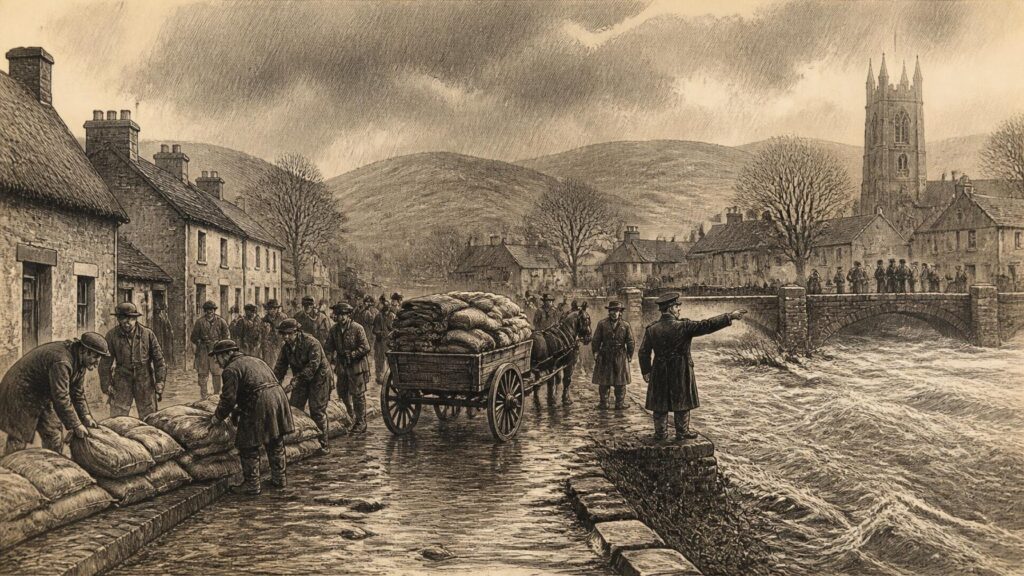
AI generated historical illustration, not a contemporary photograph.
At a Glance
Storm Chandra reached Ireland in the last days of January 2026 not as an isolated calamity but as the sharpest phase of a longer wet spell. Its rains fell upon ground already sodden, rivers already near their banks, drains already under pressure and communities already alert to an unsettled winter. The resulting floods in the South, East, Midlands and other affected districts tested a State apparatus shaped by decades of drainage policy, local-government practice, emergency planning and painful experience. The response was immediate, but its historical importance rests equally in what followed: the movement from warning to rescue, from rescue to welfare, and from relief to the unresolved work of protecting vulnerable places.
Flooded Ground
The name Storm Chandra can suggest a single day of exceptional weather. The documentary record requires a more careful description. Met Éireann’s accounts of January 2026 place the storm within a sequence of slow-moving low-pressure systems and repeated frontal rainbands. During the latter half of the month, rain crossed Ireland from the south while colder, blocking conditions farther north and east helped to maintain an unsettled pattern. This background matters because flooding is produced not simply by a measured fall of rain, but by the interaction of rainfall with antecedent ground conditions, river levels, drainage capacity, tides, land use and settlement.
By the time Chandra approached on the night of 26 January and travelled northward across the country on 27 January, many catchments were already saturated. Met Éireann had warned that rivers were approaching or exceeding bank-full conditions. Its later assessment described soils as saturated or waterlogged in many areas, with both river and surface-water levels significantly raised after a week of persistent rain. The central fact of the episode, therefore, was accumulation. Chandra added force to a hydrological system that had little remaining capacity to absorb it.
The national monthly picture gives scale without pretending that all localities suffered alike. January 2026 was wet overall, but especially wet in the South and East. Johnstown Castle in County Wexford recorded 232.7 millimetres during the month, 230 per cent of its 1991–2020 long-term average, and its wettest January since 1996. Such figures do not automatically establish the damage suffered by a particular household or townland. They do, however, document why official warnings concentrated on places in which already elevated water levels could quickly turn additional rain into inundation.
Wind was also part of the danger. Chandra was a deep low-pressure system, and Met Éireann recorded a minimum pressure of 957.7 hPa at Buoy M3 off the Cork coast on 27 January. At Malin Head, County Donegal, a gust of 70 knots, or 130 kilometres per hour, was recorded; storm-force sustained winds were reported there as well. Strong winds complicated transport, coastal safety and electricity networks, while rain created the more enduring inland emergency. It is tempting to divide a storm into separate wind and flood stories. In practice, the compound character of the event made road closures, communications, welfare provision and field operations more difficult.
Storm Approach
The warning phase illustrates the importance of public meteorology in modern Irish emergency history. On 26 January, Met Éireann explained that a low-pressure system named by the UK Met Office would bring heavy rain and strong winds from that night and through the following day. Its commentary did more than announce poor weather. It identified saturated ground, high rivers, the likelihood of local and river flooding, hazardous travel conditions, wave overtopping on exposed coasts and the greater exposure of southern and eastern counties to heavy rainfall.
That form of communication represents a long development in public protection. Earlier generations relied on observation, local knowledge, newspaper reports, railway or telegraph communication, and the visible rise of rivers. Those means could be valuable, but they were uneven and often too slow for communities downstream. By 2026, forecasting, warning systems, mobile communication and local authority channels allowed a more coordinated attempt to act before water entered buildings. Forecasting did not prevent the storm, nor did it remove uncertainty. It offered time: time to avoid journeys, move vehicles, protect premises, prepare pumps and sandbags, check on neighbours, and position staff and equipment.
The official advice was necessarily plain. People were urged to avoid flooded roads, obey closures and keep away from rivers, lakes and exposed coasts. The Coast Guard formulation, “Stay Back, Stay High, Stay Dry”, was repeated in meteorological messaging. Such phrases can appear routine in retrospect, but they respond to a recurrent and sometimes fatal pattern in flood emergencies: the underestimation of fast water, hidden hazards and the instability of road surfaces. A road that looks merely wet can conceal depth, current, broken edges, displaced debris or an undermined culvert.
Warnings also had an administrative function. They helped local authorities and emergency services anticipate demand rather than merely react to it. Weather information could be integrated with river observations, local reports, transport intelligence and electricity-network information. The historical significance of this system lies not in a claim of perfect foresight, which the evidence cannot support, but in the conversion of weather forecasts into organised preparedness. That conversion is one of the principal differences between an unavoidable natural hazard and a wholly unmanaged disaster.
Warning Systems
The response to Chandra moved through several layers of government. At national level, the National Emergency Co-ordination Group met while the storm was in progress. The Department of Housing, Local Government and Heritage, through the National Directorate for Fire and Emergency Management, had responsibility for coordinating the severe-weather emergency response. The Taoiseach’s Department stated on 27 January that national and local bodies had been liaising from the previous day, while the following day it reported a further meeting as the response and clean-up continued.
These statements show the institutional shape of the response, but they should not be mistaken for a complete operational record. Government press releases document meetings, policy decisions and public advice. They do not provide a minute-by-minute account of every rescue, road closure or property affected. Nor do they settle every local dispute about warning, access, insurance or flood protection. For historical purposes, they are best read as evidence of declared official arrangements: a national coordinating structure intended to bring departments, agencies, local authorities and humanitarian supports into contact during a widespread event.
Coordination had a practical rationale. A flood affecting several counties does not respect administrative borders. A river catchment may pass from upland to town, from one county to another, or from a tributary into a larger river system. Power outages affect communications; road closures affect welfare visits; a fire service callout may require information from a council, Gardaí, health services or voluntary bodies. The emergency therefore demanded a network rather than a single commanding institution. Local knowledge remained indispensable, but it had to be connected to national resources and policy.
The continuing risk after the storm’s central passage was recognised early. By 30 January, Met Éireann emphasised that more rain, even below conventional warning thresholds, could have serious consequences because the ground and rivers had been primed by earlier weather. This was an important correction to the common assumption that danger ends when a named storm passes. In saturated catchments, later showers and secondary rainbands may prolong high water, while roads, embankments and drainage systems can remain compromised after the heaviest rain has ceased.
Emergency Command
At the heart of any flood response are the local authorities. They are often the public bodies closest to the immediate problem: a blocked road, overwhelmed drain, stranded household, threatened bridge, impassable estate or rising river. Their work during Chandra involved monitoring, signage, closures, liaison with emergency services, deployment of staff, local communications and the beginning of clean-up once water receded. Government statements repeatedly placed local authorities alongside affected communities rather than presenting them as distant administrators.
This local role has deep roots in Irish public administration. The organisation has changed over time, but the recurring realities have not: water moves through particular landscapes; every bridge, culvert, quay, road hollow and river bend has a history; and residents often know the sequence by which their locality floods. National systems can provide forecasts, funding and strategic coordination, yet they cannot replace place-specific knowledge. The best response joins the two. It treats local observation as evidence to be considered, while retaining the wider technical information that individual communities may not possess.
Fire services were among the visibly active responders. County-level records from the aftermath described rescue work involving people trapped in vehicles and flooded homes, pumping operations, and incidents involving motorists who tried to drive through inundated roads. These are not dramatic embellishments. They show why flood response is a life-safety operation before it is a question of property damage. The same conditions that destroy furniture, stock or electrical systems can isolate people, impair ambulances, and turn an ordinary journey into an emergency.
Yet emergency command is not only about blue lights, pumps and barriers. It also concerns the creation of a shared picture of what is happening. Which roads are closed? Which communities are inaccessible? Where is electricity unavailable? Are vulnerable residents known and contacted? What further rain is expected? Are schools, health services, businesses and voluntary organisations able to function? The value of coordination is in bringing these partial facts together. Its limitations arise when local information is incomplete, events change faster than reports can be processed, or demands exceed the available people and equipment.
Local Action
The official history of a flood can be dominated by announcements and expenditure, but the lived response occurs in homes, farms, shops, community halls and roadside verges. Chandra required countless smaller acts: lifting possessions, checking elderly neighbours, clearing gullies where safe, moving vehicles, finding temporary routes, sharing information, providing hot drinks, assisting with drying and cleaning, and helping people begin the exhausting work of recovery. Such actions rarely appear in national summaries because they are difficult to count. Their absence from a spreadsheet should not be read as an absence from the event.
There is, however, a necessary distinction between documented local action and folklore. Documentary sources establish the broad fact of serious flooding, official coordination and assistance schemes. They do not validate every later recollection about the depth of water at a particular gate, the supposed failure of a particular structure, or the claim that a given storm was unprecedented in all respects. Flood memory is powerful and often valuable, especially where it preserves knowledge of recurring routes of water. But memory can merge separate storms, enlarge exceptional moments or assign simple causes to complex events.
For that reason, historians should not dismiss local testimony; they should test it. A resident’s account can be compared with rainfall records, river gauges, photographs with known dates, council minutes, emergency logs, insurance correspondence and local newspapers. Where several forms of evidence point in the same direction, a fuller account becomes possible. Where they conflict, uncertainty should remain visible. Chandra will surely acquire stories of warning, fear, ingenuity, generosity and frustration. Some will be documented over time. Others will remain important as personal memory without becoming verifiable public fact.
Community action also exposes the unevenness of flood experience. A warning may be received by many people but acted upon differently according to age, income, language, mobility, tenancy, work patterns, access to transport and prior experience. A household with upper floors, savings, insurance and family nearby does not face the same choices as a person living alone in a ground-floor flat, a small business with uninsured stock, or a farmer dependent upon access across flooded land. Emergency planning must account for this social geography as well as the physical geography of water.
Household Relief
The State’s welfare response began while the emergency was still unfolding. On 27 January, the Department of Social Protection announced the availability of the Emergency Response Payment, formerly known as the Humanitarian Assistance Scheme, for households directly affected in Wicklow, Wexford, Waterford, Dublin, Carlow, Kilkenny, Louth and Monaghan. The named counties demonstrate the geographic reach of the response; they also show that the flood was not confined to one river basin or one type of settlement.
The payment was intended to address immediate hardship. It was income-tested and directed towards essential needs, household items and structural repair for people unable to meet emergency costs. Its limits were explicit. It was not general compensation for all losses, and it did not cover damage that was insured, or reasonably expected to have been insured. This distinction is important historically. Irish disaster relief has frequently been shaped by the tension between urgent humanitarian need, private insurance, public responsibility and the practical difficulty of deciding what should be repaired by whom.
In the aftermath of a flood, the line between immediate need and longer recovery is often blurred for those affected. A family may require emergency accommodation or cleaning materials on the first day, replacement appliances during the first week, and structural works months later. Official schemes divide these stages for administrative reasons, but damaged households experience them as a continuous disruption. The historical record of Chandra should therefore not stop at the announcement of support. Announcements are beginnings, not proof that every need was met quickly or fully.
There was also a linguistic change of some significance. The older term “Humanitarian Assistance Scheme” had become “Emergency Response Payment”. The new wording emphasised immediacy and practical response rather than benevolence alone. That does not alter the hardship faced by flooded households, but it reflects a broader modern tendency to describe disaster support through administrative entitlements, eligibility and rapid intervention. Whether claimants found the system accessible is a separate question requiring later evidence from applicants, community organisations and official evaluations.
Business Recovery
Floods damage local economies as well as homes. Shops close, stock is ruined, appointments are cancelled, workers cannot travel, machinery is contaminated, and community facilities lose the ability to host sports, meetings or care services. On 28 January the Government indicated that it would seek approval to open the Emergency Humanitarian Flooding Scheme for small businesses and community, voluntary and sports organisations affected by Chandra. The Irish Red Cross was identified as administrator of that scheme for qualifying bodies unable to obtain flood insurance through no fault of their own.
The focus on uninsured or uninsurable organisations reveals a difficult feature of flood recovery. Insurance is frequently treated as the ordinary route for financial loss, but availability and affordability may decline where a property has flooded before or lies in an identified risk area. This creates a sharp public-policy problem. If state schemes simply replace insurance, they may weaken incentives or overwhelm public resources. If they do too little, viable small enterprises and valued community groups may disappear after an event they could not realistically insure against. Chandra brought that old dilemma back into public view.
Government statements cannot settle whether assistance was sufficient for every affected business. What they document is an acknowledgement that household payments alone could not meet the economic and civic effects of flooding. Small businesses and voluntary institutions often perform functions beyond their balance sheets. A local club, hall, shop, childcare setting or sports organisation can be part of the infrastructure through which recovery occurs. When such places are closed, communities lose both services and gathering points.
The recovery phase also depended upon work that remains largely invisible until it fails: waste removal, road inspections, debris clearance, electrical checks, drainage repair, bridge assessments and the reopening of safe routes. These tasks belong to the material history of the flood. Images of water in streets convey the moment of disaster; they rarely convey the days and weeks of drying, repairing, accounting, arguing with insurers and restoring ordinary routines. Yet that slow work determines whether an emergency becomes a short interruption or a long social wound.
Historic Inheritance
Storm Chandra belongs to a much longer Irish history of attempts to live with water. Rivers and wetlands have sustained fishing, agriculture, transport, biodiversity and settlement, while also imposing recurring costs through flood. Nineteenth-century drainage schemes altered many landscapes in the pursuit of agricultural improvement and land reclamation. Later arterial drainage programmes, associated particularly with the Office of Public Works, sought to improve the conveyance of water through major rivers and channels. These interventions brought benefits in some places, but they also demonstrate that flood management is never merely technical: it redistributes water, risk, land value and responsibility.
The modern response system inherited this contested terrain. Communities may expect rivers to be cleared, channels widened or defences built because earlier generations saw engineering as the principal answer to flooding. Contemporary flood-risk management operates under broader constraints. It must consider downstream consequences, environmental regulation, climate projections, the protection of habitats, planning decisions, maintenance responsibilities and the reality that no defence gives absolute security. The language of “flood relief” can imply finality; the history of Irish rivers advises caution.
Chandra also recalls the importance of repeated events in shaping public policy. A flood becomes politically significant not only because of the water level reached on one occasion, but because it arrives where people have flooded before, where schemes have been promised, where defences are incomplete, or where residents believe they have been left exposed. The April 2026 allocation of €6.6 million for interim flood-protection measures in eight local-authority areas acknowledged this wider context. The Office of Public Works noted communities including Enniscorthy, Arklow and Aughrim, some of them affected ahead of planned flood-relief works.
Interim works are historically revealing. They sit between emergency response and permanent engineering. They may reduce risk, buy time and demonstrate that a community has not been forgotten, but they are not equivalent to a completed comprehensive scheme. Their necessity can be read in two ways. It may indicate responsive government action after a serious event. It may also indicate the gap between known exposure and the slower pace of major design, consent, funding and construction processes. Both readings can be true at once.
River Politics
The politics of flooding often centre upon a deceptively simple demand: why was this place not protected? The answer is rarely simple. Flood works require evidence of risk, engineering design, environmental assessment, land access, public consultation, procurement, funding and ongoing maintenance. They may take years. Meanwhile, households living in the shadow of a river do not experience risk as a future planning category; they experience it through wet carpets, lost belongings, closed roads and the prospect of another winter.
Parliamentary debate after Chandra showed that flood response had become a national political question. Discussion addressed the role of local authorities as first responders, the need for severe-weather and flood plans, insurance, business assistance and longer-term protection. Parliamentary debate is not neutral evidence of outcomes: representatives speak for constituencies and argue for action. It is nevertheless valuable evidence of what mattered publicly, which places had become symbols of exposure, and how ministers described the limits and duties of the State.
One lesson concerns the danger of treating a named storm as the whole explanation. Chandra was the immediate trigger for many incidents, but the flooding developed in the context of cumulative rainfall and saturated ground. A historically sound account should resist both fatalism and simplistic blame. It is not enough to say that weather was unavoidable; it is also not always justified to attribute every local flood to one neglected drain, one planning decision or one agency. Each location demands evidence. Some cases may show maintenance failures, inappropriate development or inadequate protection. Others may show rainfall beyond the capacity of reasonable infrastructure. Many will involve several factors at once.
Public Memory
How Chandra will be remembered remains unsettled. Named storms have a special place in contemporary memory because the name creates a shared marker. It enables people in different counties to connect their experience to a wider event and helps institutions organise records, claims and reports. Yet the name can obscure the prolonged weather sequence that made the flooding possible. For many residents, the decisive memory may not be the wind of 27 January but the later days of standing water, the sound of pumps, the repeated rain warnings, or the moment they returned to a damaged home.
There is no reason to assume that public memory will mirror the official record. Government documents tend to record schemes, meetings, allocations and warnings. Families may remember lost photographs, a neighbour’s assistance, a child’s disrupted schooling or the first anxiety when clouds gathered the following week. Both kinds of record matter. The archive of a flood should include formal documentation, but also oral histories, local photographs, community newsletters and carefully dated personal testimony. Without them, the human texture of recovery is easily lost.
At the same time, memory must not harden too quickly into unsupported legend. Assertions that Chandra was the worst flood ever experienced in every affected locality, that nothing was done, or that a single intervention would certainly have prevented all damage require corroboration. The responsible historian can acknowledge suffering without turning it into untested certainty. The strongest account allows people’s testimony to stand in its own right while distinguishing it from measured rainfall, recorded river heights, emergency logs and formally announced expenditure.
Lasting Lessons
Storm Chandra demonstrated the value of warning, multi-agency coordination, local authority action, emergency welfare and targeted recovery funding. It also showed the limits of each. Warnings depend on people receiving, understanding and being able to act upon them. Emergency services can save life and reduce danger, but cannot remove water from every property at once. Financial assistance can relieve hardship, but may not restore uninsured losses or resolve long-standing vulnerability. Interim protection can reduce exposure, but cannot substitute indefinitely for durable solutions where those solutions are justified and feasible.
The event’s most important lesson may be temporal. Flood response begins before the rain through forecasting, maintenance, planning and preparedness. It continues during the emergency through rescue, closures, communications and mutual aid. It extends long afterwards through repairs, grants, insurance, public health, engineering and argument about what should be done next. The term “response” should therefore not be confined to the dramatic hours of a storm. It is a chain of decisions made across different timescales.
For Ireland, Chandra belongs to the continuing history of a society negotiating the power of water. The evidence supports neither a story of total institutional failure nor one of complete security. It documents a serious flood episode met by organised public action, substantial local effort and subsequent investment. It also records communities still exposed while larger protective works remained incomplete. In that tension lies the real historical meaning of the storm: not simply that water rose, but that it revealed again the unfinished relationship between rivers, weather, settlement and public responsibility.
Chandra’s aftermath highlights a difficult transition from emergency rescue to long-term adaptation. The article shows that saturated catchments, local knowledge and coordinated warnings shaped immediate safety, yet recovery exposes unequal burdens for households, businesses and community organisations, particularly where insurance is unavailable or unaffordable. It also suggests that relief schemes address urgent needs without resolving decisions about reconstruction and protecting repeatedly vulnerable towns. This raises a question about how Ireland should balance national coordination with specific experience of water, drainage and risk. What combination of evidence, investment and community participation could fairly guide flood protection and recovery after storms Chandra?