Paper Streets
At a Glance
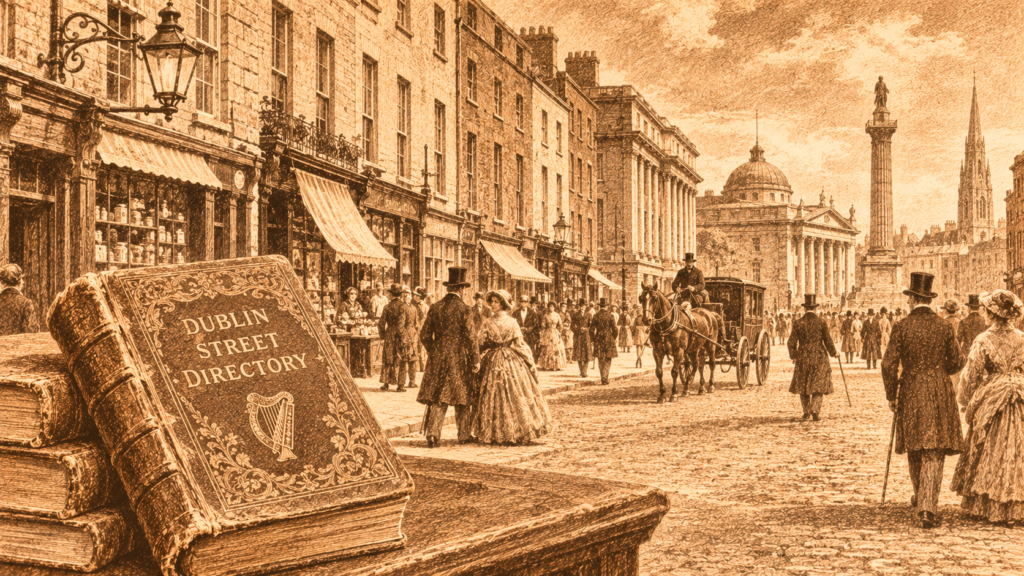
Before a street could be searched on a screen, it could be found in a printed directory: a dense, commercially produced book that attempted to make the city legible through names, numbers, occupations, institutions and addresses. In Ireland, and above all in Dublin, such volumes became among the most revealing surviving records of urban life. They do not tell the whole story of the streets they describe, but they preserve a remarkable paper geography of commerce, authority, aspiration and change.
Printed Bearings
A street directory is easily mistaken for a mere ancestor of the telephone book. That comparison is useful only up to a point. The Irish directories of the eighteenth, nineteenth and twentieth centuries were at once address books, commercial guides, civic handbooks, postal aids, almanacs and statements of social order. A reader might turn to them to find a linen draper, a surgeon, a public office, a coach departure, a parish clergyman, a market, a school, a bank, a club or a particular house. In the larger and more ambitious volumes, especially those associated with Dublin, the street itself became the organising device: one could proceed along a thoroughfare in printed sequence and see the named occupants of houses, shops, yards and offices.
The subject is firmly part of Irish history because the directory was not simply imported as an abstract publishing form. It was made and remade in response to Irish conditions: Dublin’s role as a capital city before the Union, its altered political position after 1801, the expansion of suburbs beyond old municipal limits, the importance of the postal system, the growth of professional and commercial life, and the peculiar archival losses which later made serial printed sources unusually valuable. The National Library of Ireland holds substantial runs of the principal series, while Dublin City Library and Archive describes its own collection as an almost complete succession of Dublin directories from 1751 onwards. Its statement that the earliest directory in its holdings dates from 1636 is a reminder that Dublin’s printed civic reference literature reaches back farther than the familiar Victorian volumes.
Directories must nevertheless be handled as constructed documents rather than transparent inventories. Their publishers selected material, gathered information through correspondents and compilers, used categories that reflected the assumptions of their time, and sold books largely to people who could afford or needed them. A named address records that a person, household head, firm or institution was entered in a particular publication; it does not by itself establish every resident of the building, the exact day of occupation, social status, religion or politics. Their silences are as historically important as their crowded columns.
Early Listings
The durable eighteenth-century foundation for Dublin directory publishing was Wilson’s Dublin Directory. The National Library of Ireland catalogues it as a serial initially compiled by Peter Wilson, with William Wilson acting as compiler for much of the period from 1772 to 1801. Surviving editions in the Library’s holdings include issues from 1761, 1772, 1775, 1787, 1800, 1802, 1821 and 1831. The series was annual, its imprint changed over time, and it continued in one form or another into the 1830s. Such bibliographical detail may seem remote from street history, but it matters: annual publication permits comparison, while changes in title, printer and arrangement can alter what a researcher is able to find.
Wilson’s work combined several kinds of information that a modern reader might expect to be separated into different books. The title of the 1771 directory sets out its own breadth. It promised alphabetical names, occupations and places of abode for the city’s merchants and traders, but also supplied material on baronets, cathedral chapters, parish clergy and churchwardens, former lord mayors and sheriffs, aldermen, guild officers, physicians, surgeons, barristers, solicitors, notaries and public bodies. It was preceded by an alphabetical list of streets, lanes, alleys, quays and related places in Dublin and its suburbs. This was commercial information, yet it was also a printed anatomy of civic power.
The arrangement reveals the city that the compilers considered worth knowing. Merchants and traders were made conspicuous, as were those holding civic, ecclesiastical, legal and medical office. The directory’s street list supplied orientation but did not necessarily provide the later, fuller form of house-by-house resident listing. Its Dublin was therefore a city of named professional and mercantile actors, public institutions and recognised thoroughfares. It is an invaluable picture of the urban world visible to printers and their anticipated readers; it is not a democratic census of everyone who lived or worked there.
From about 1760 Wilson’s directory was bound with Watson’s almanac and the English Registry to form the publication often called the Treble Almanack. This packaging is revealing. Urban addresses were placed beside calendars, official lists, courtly information and other practical matter. The directory did not merely answer the question ‘where is this person?’ It helped readers navigate a society organised by rank, profession, office and commercial connection. The reader of such a volume was invited to understand Dublin as an ordered network, even though the lived city was undoubtedly more crowded, mobile and unequal than its pages acknowledged.
Postal Change
Directory history also follows the development of communications. The title of Wilson’s work itself linked names, occupations and places of abode, and its later manifestations were associated with almanac publishing. The National Library records that from 1832 Wilson’s Dublin Directory was replaced by the Post Office Annual Directory. That shift was more than a change of branding. A postal directory treated streets and addresses as part of a system of movement: letters, parcels, officials, commercial correspondence and travellers all depended upon standardised names and recognisable locations.
In nineteenth-century Dublin, addresses were neither as stable nor as self-explanatory as retrospective researchers may wish. Streets could be renumbered, newly laid out, extended or differently described. Boundaries between Dublin and neighbouring townships complicated any simple notion of a fixed city. A place once treated as suburban might later become integral to metropolitan Dublin, while a directory’s geographical headings might reflect postal or administrative arrangements rather than present-day assumptions. A careful reading must therefore retain the directory’s own wording. It is risky to silently substitute modern district names or to suppose that a street designation has had one unchanging meaning.
The postal connection also explains why directories contained far more than domestic addresses. Government departments, barracks, hospitals, churches, schools, banks, legal offices and transport information mattered because an address was an operational fact. In a city where business relied heavily on correspondence and face-to-face calling, the directory was a tool for finding people and organisations as much as a record of them. Its authority came not from official perfection but from usefulness. A directory that could send a customer to the right shop or a letter to the right office had commercial value; that practical pressure encouraged regular revision.
Yet usefulness did not eliminate error. Information might be collected before printing and become outdated before a volume reached its purchaser. A business could trade under a proprietor’s name, a family name, a partnership name or a building name. A householder might be absent from an edition because of omission, recent removal, poverty, lodging arrangements or the particular rules followed by the compiler. For this reason, a directory entry should be compared, where possible, with valuation records, maps, newspapers, deeds, census material, parish records, electoral records and estate papers. The directory is often an excellent starting point; it is seldom the final proof.
Commercial Dublin
The most conspicuous advance in detailed Dublin street listing came with Pettigrew and Oulton’s Dublin Almanack and General Register of Ireland. Dublin City Library and Archive records the series from 1834 to 1847, while surviving descriptions of the publication identify its early editions as a major annual directory of the city. It joined an alphabetical list of householders, a street directory and trade or professional listings to an expansive almanac concerned with official life in Ireland.
Pettigrew and Oulton’s importance lies partly in its street-by-street form. A person can begin not with a surname but with a place, following a street and identifying the persons or firms attached to successive addresses. This reverses the normal genealogical question. Instead of asking only ‘where did this named individual live?’, the reader can ask ‘who was recorded beside this household, what businesses stood nearby, and what kinds of occupation clustered here?’ The answer can illuminate neighbourhoods, although it should never be mistaken for a complete reconstruction of the population.
The directory’s other sections widened the frame from Dublin to Ireland. It included official authorities in counties and towns, information on institutions and societies, clergy of several denominations, and entries concerning prominent local administration. Such coverage is significant because it joined the capital’s street life to the structures of the nineteenth-century Irish state and to provincial networks of status. The same book could help locate a Dublin merchant, identify county officials or note an institution’s officers. Its geography was therefore urban at its centre but national in ambition.
There is an interpretative temptation to see such books as neutral maps of the city’s social hierarchy. In fact, they helped reproduce that hierarchy. The inclusion of the gentry, officials and established professions gave them a durable printed visibility. Tradespeople who had premises were often well represented, because commercial information was central to the directory’s purpose. By contrast, servants, casual labourers, lodgers, the unemployed, inmates of institutions, many women working within households, and people living in crowded or precarious accommodation could be difficult or impossible to find. The absence of a person’s name is not evidence that the person was absent from Dublin.
This limitation is not a defect that makes the sources worthless. It is a historical fact in its own right. Directories reveal who publishers regarded as addressable and marketable: people who received callers, conducted trade, held office, managed households or represented institutions. Their selective visibility allows historians to examine the structure of recognition in urban society. A street directory is not simply a list of residents; it is a record of whom a particular print culture chose to name.
Thom Ascendant
Alexander Thom’s directory enterprise became the most enduring of the Irish series. Thom, who had come from Scotland to Ireland as a young man and was closely associated with official printing in Dublin, issued the first Irish Almanac and Official Directory in 1844. The National Library’s catalogue traces its title through several political periods: Thom’s Irish Almanac and Official Directory from 1844 to 1880; Thom’s Official Directory of the United Kingdom of Great Britain and Ireland from 1881 to 1926; Thom’s Official Directory Ireland from 1927 to 1930; and Thom’s Directory of Ireland from 1931 to 1963.
Those changing titles are historical evidence, not mere bibliographical clutter. They mark the constitutional transformation from Ireland within the United Kingdom to an independent Irish state, while also demonstrating the resilience of a commercial reference publication across political rupture. The wording on the cover cannot be treated as an uncomplicated statement of identity: it reflects the state framework, the publisher’s market and the conventions of official reference publishing. But read in sequence, the titles show how a directory carried the vocabulary of changing sovereignty into thousands of practical annual entries.
Thom’s began as a national almanac and official directory, not simply a Dublin street book. Its pages brought together national statistics, public officers, county information, legal, ecclesiastical, medical, educational, banking and postal material, as well as details of institutions and local administration. In the nineteenth century, its county sections could include information about magistrates, Poor Law Unions, petty sessions, fairs and leading landholders. Here, too, a researcher must recognise the social emphasis: state officeholders, professionals and substantial property were far easier to see than those outside official and commercial notice.
The Dublin material, however, gave Thom’s a special afterlife. A street directory was incorporated from 1852, and later editions offered a wide-ranging account of city and county. It listed inhabitants and businesses street by street, and extended into townships and suburbs including places that were not then part of Dublin city in the modern municipal sense. Rathmines, Pembroke, Kingstown and other neighbouring districts can consequently appear in ways that make Thom’s especially useful for tracing Dublin’s outward growth. The reader must still attend to the edition date and its stated geographical limits. A volume’s inclusion of an area is evidence of the publisher’s coverage, not proof that the area shared the same civic government as central Dublin.
By the later nineteenth century, Thom’s had become a very large work. Its size made it a reference library in miniature. A reader could move from national political structure to the details of a particular Dublin street, from a county fair to a professional listing, or from an institution’s officers to an urban address. This sheer abundance has encouraged historians and family researchers to describe it as a substitute for missing nineteenth-century census evidence. That phrase should be used cautiously. Thom’s cannot substitute for the household detail of a census, but it can provide a valuable serial record of named addresses, occupations, firms and institutions at dates when other sources are scarce or lost.
Mapped Expansion
The printed directory and the map were natural companions. A name in a street list becomes much more meaningful when placed against a contemporary plan showing the line of roads, canals, railways, parks, markets, docks and developing suburbs. UCD Library’s guide to historic Dublin maps records a sequence of maps accompanying Thom’s Official Directory, produced by the Ordnance Survey and published for Alexander Thom. The listed years include 1874, 1877, 1881, 1885, 1887, 1890, 1892, 1893 and 1898. These maps were made at a scale of 1:10,560 and joined the directory’s verbal geography to a surveyed visual one.
That conjunction matters. A directory can suggest social proximity: a doctor, a publican, a grocer, a solicitor and a lodging house might appear on adjacent lines. A map tests whether that proximity was straightforward or deceptive. They may have been separated by a corner, a bridge, a railway cutting, a large institutional site or a street whose numbering crossed an awkward boundary. Conversely, maps can show how seemingly peripheral addresses stood near transport routes or expanding residential districts. The strongest local history uses both sources in conversation, rather than asking either one to do the other’s work.
Maps also expose the instability of the word ‘street’. A directory may include squares, terraces, quays, roads, avenues, lanes, courts and alleys within its street sequence. These forms carried social as well as physical meanings. A grand square, a commercial quay, a modest lane and a court behind a principal street were all addresses, but their built form, access and reputation differed sharply. The directory often compresses such distinctions into uniform type. The map restores some spatial complexity, while photographs, architectural surveys, rate books and contemporary newspapers can add further evidence.
It would be wrong, however, to turn the map into an unquestioned corrective. Maps too were selected representations, produced for particular purposes, at particular dates and scales. They might omit interior occupation, flatten social difference and lag behind rapid building change. The historical task is comparative: identify what the directory calls a place, locate it on a map close in date, and then look for independent evidence of alteration. When sources disagree, disagreement may indicate renumbering, redevelopment, a change in street name, an error, or simply that the sources record different aspects of the place.
Urban Silences
The greatest value of Irish street directories may lie in the questions they make possible, but those questions require discipline. A sequence of editions can show a firm’s arrival, relocation or disappearance. It can suggest the emergence of a specialist trade, the conversion of a dwelling into business premises, or the growing commercial character of a street. A cluster of medical, legal or retail entries may point towards a district’s professional or shopping function. A changing mixture of private names and institutional entries can indicate redevelopment. These are interpretations, not automatic facts, and they should be described in that careful language.
For family history, the annual rhythm is especially attractive. A name appearing at one address for several consecutive editions and then at another can support a plausible account of movement. But annual volumes have a production cycle, and a household could have moved between the collection of information and the date printed on the title page. Names may be misspelt, abbreviated or entered under a business partner. Widows may appear under a husband’s name or a firm’s retained style. A tenant may not be named where a landlord, shopkeeper or head of household is. Good research records the exact edition and page, preserves spelling, and avoids claiming a precise move date from a single annual entry.
The directories are even less dependable as a measure of class or population. Their attention to merchants, traders, clergy, officials, landholders and recognised professions makes them rich sources for those groups. It makes them poor stand-alone evidence for the poorest Dubliners, for informal workers and for the many residents whose lives were not organised around a public business address. The problem is sharpened in a city of tenements, lodgings and frequent movement. A building may have housed far more people than the directory’s single named entry implies. To read the entry as the whole household is to mistake the publisher’s label for the social reality of the premises.
Women’s historical presence is likewise only partly visible. Some women appear clearly as proprietors, widows, educators, lodging-house keepers, retailers or members of professions and institutions. Others are concealed within household headings, family firms or conventions of marital naming. The absence of an individual woman from an alphabetical list does not demonstrate inactivity or residence elsewhere. It may reflect the organisation of property, business and print. Researchers should seek corroboration in newspapers, probate material, trade advertisements, court records, charitable records, school registers and census returns where available.
There is no need to rely on folklore to explain the authority of the directory. Its survival, serial form and dense factual content are sufficient to make it compelling. Folklore may attach stories to particular houses, streets or businesses, and those stories can be valuable evidence of later memory. They should be kept distinct from what the printed volume documents. A directory can show that a name or firm was entered at an address in a given edition. It cannot, without corroboration, prove that a celebrated visitor slept there, that a political meeting occurred in a room, or that a building had a reputation later attributed to it.
Research Method
A sound approach begins with the question being asked. If the aim is to identify an address, start with the street directory and then consult the alphabetical and trade sections. If the aim is to locate an individual, start with the name but test it against the street listing. If the aim is to understand a neighbourhood, select a run of editions at intervals, transcribe entries consistently, and map the addresses without assuming that every omission marks an empty building. The object is not simply to collect names; it is to establish patterns that can be checked.
Edition control is essential. Thom’s title changed several times, and earlier Dublin directory traditions overlapped or succeeded one another. A citation or research note should record the full title as printed, year, publisher, section, page and the form of the relevant entry. This protects against a common error: treating similarly named series as identical. It also makes later verification possible when digital search systems produce imperfect optical character recognition. Browsing a scanned page, rather than relying solely on a search result, remains important because headings, neighbouring addresses and typographical layout often contain the historical context.
Place control is equally important. Street names can be duplicated, altered or absorbed into larger roads. Dublin’s suburbs and townships have experienced administrative reorganisation, while older house numbers may not correspond neatly to modern ones. Contemporary maps, valuation sources and municipal records can help bridge these gaps. The National Library of Ireland specifically identifies directories as useful local-history resources because they may record public institutions, market days, churches and schools. Their real strength emerges when they are read alongside such other evidence.
Finally, the researcher should distinguish three levels of statement. First, there is documentary fact: a particular edition prints a particular name, trade or address. Second, there is reasonable interpretation: repeated commercial entries may indicate a street’s growing retail role. Third, there is speculation: an explanation for why a person moved or why a business vanished. The first can normally be stated directly. The second should be qualified. The third requires independent evidence or should remain an open question. This hierarchy prevents the impressive density of a directory from lending false certainty to a historical narrative.
Enduring Record
The long life of Thom’s publication illustrates the endurance of the form. The National Library’s catalogue follows it through the mid twentieth century, notes later separation into Dublin, professional and commercial volumes, and records that from 1974 the title became Thom’s Dublin & County Street Directory. What had begun in the eighteenth century as an urban reference genre continued to adapt to new administrative structures and new commercial needs. The paper directory remained useful because the basic problem endured: how to connect people, premises, institutions and streets within a changing city.
For Irish history, these books are more than aids to finding an address. They are evidence of how Dublin was imagined and administered, how commerce announced itself, how public authority named its officers, how suburbs entered metropolitan consciousness, and how print assigned varying degrees of visibility to different inhabitants. They allow us to reconstruct portions of an urban landscape that redevelopment, altered street names and archival destruction might otherwise obscure.
Yet their proper lesson is modest as well as exciting. Paper streets are not the streets themselves. They are edited, commercial and partial representations of them. Used critically, they provide a sequence of sharply dated windows onto Irish urban life. Used uncritically, they can turn a city of workers, families, institutions, poverty, movement and unrecorded lives into a tidy procession of names. The historian’s task is to preserve both truths: the extraordinary documentary richness of the directory and the human incompleteness that lies beyond its printed lines.