Irish Masonry
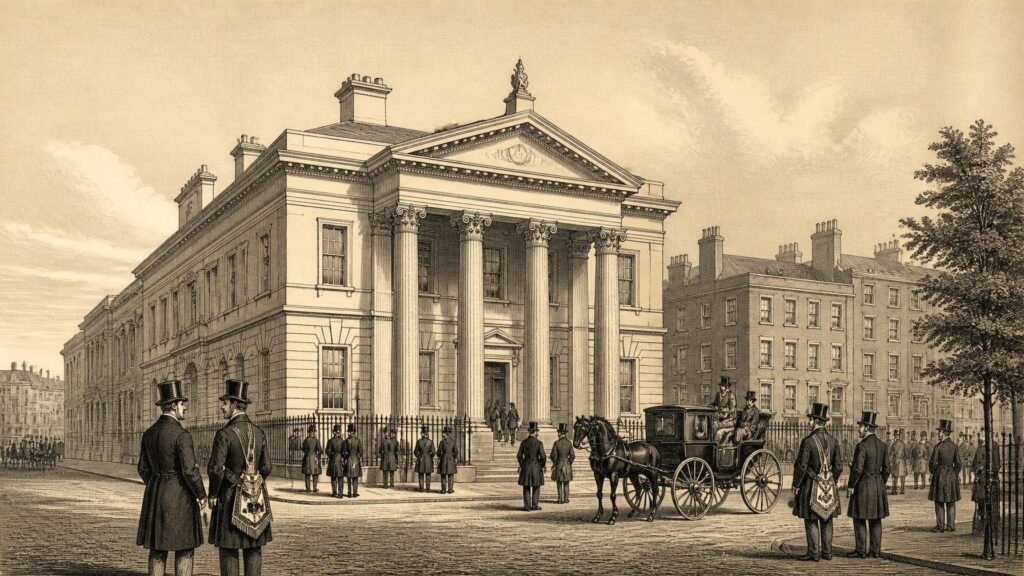
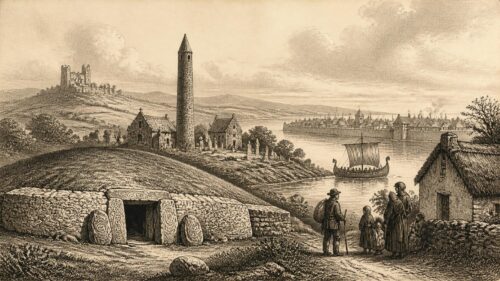
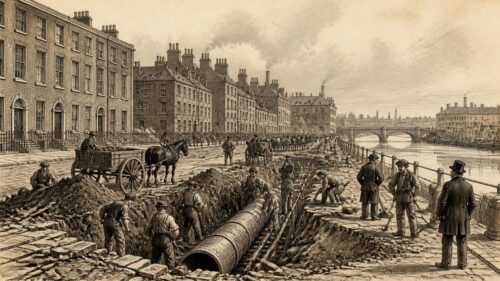
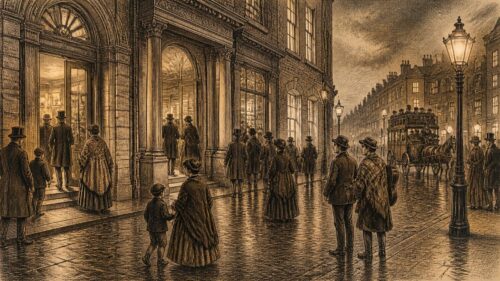
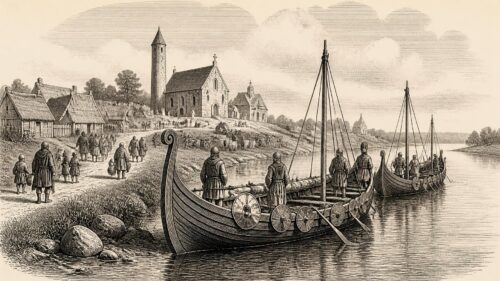
AI generated historical illustration, not a contemporary photograph.
At a Glance
Freemasonry in Ireland is neither an ancient Celtic survival nor a single hidden hand guiding national events. It is a documented, changing association whose lodges connected artisans, soldiers, merchants, landlords and professionals; whose rituals drew on biblical building imagery; and whose history has been repeatedly overlaid with legend, suspicion and political argument. From eighteenth-century Dublin to provincial towns, army regiments and overseas settlements, Irish Masonry formed part of the island’s wider social fabric. Its records illuminate networks of fellowship and charity, but also exclusions, hierarchies and the uneasy encounter between private ritual and public life.
Historical Caution
The word “Freemasonry” is often used as if it described one unchanging institution with a single origin and a unified purpose. Historical evidence gives a more complicated picture. Modern Freemasonry is usually termed “speculative”: members employ the language, tools and imagined moral lessons of stone masonry, but they are not required to be working masons. Earlier “operative” craft organisations of masons certainly existed across medieval and early modern Europe, including Ireland, yet a direct, uninterrupted institutional descent from medieval builders to every later lodge cannot be demonstrated simply by pointing to shared symbols. The square, compasses, pillars, aprons and architectural metaphors of later Masonry have encouraged precisely such claims, but symbolism is not proof of organisational continuity.
For Ireland, the archival record becomes considerably firmer in the late seventeenth and early eighteenth centuries. That is the proper starting point for a historical account. Surviving minute books, warrants, printed constitutions, newspapers, correspondence, lodge certificates, regalia and building records show an association taking recognisable form within the social world of the Protestant Ascendancy, commercial towns and imperial military service. They do not establish that Irish Freemasonry was inherited from the medieval Knights Templar, the ancient Druids, Solomon’s builders or a clandestine prehistoric priesthood. Such origin stories belong to Masonic tradition, popular mythology or later polemic rather than demonstrable Irish history.
The distinction matters because secrecy has made Masonry unusually vulnerable to speculation. Lodges have possessed private modes of recognition, ceremonies and obligations; their members have sometimes valued discretion; and outsiders have often imagined that concealment proves criminality or political conspiracy. Yet secrecy is not the same as invisibility. The Irish Masonic archive is substantial. The Grand Lodge of Ireland maintains records and collections at Freemasons’ Hall, while the National Library of Ireland, the Dictionary of Irish Architects, university repositories and historical journals preserve or describe further evidence. Much can therefore be said securely, provided that the historian keeps separate what a source records, what can reasonably be inferred, and what remains unproven.
Early Foundations
By the early eighteenth century, lodges in Ireland, England and Scotland were developing structures that claimed authority over local meetings. The Grand Lodge of Ireland identifies 24 June 1725 as the date of its first recorded communication. That is a significant documentary landmark, and the organisation was plainly functioning by then. It should not automatically be converted into a claim that no Irish lodge existed beforehand, nor into a precise moment when all Irish Masonry began. Local lodges, informal gatherings and incomplete records complicate any neat founding narrative. What the 1725 evidence securely demonstrates is that a central Irish body was meeting and exercising a recognisable form of governance.
The establishment of a grand lodge did not create a simple hierarchy imposed upon passive local members. Eighteenth-century Freemasonry was made up of individual lodges with their own officers, local sociability and practical concerns. Grand Lodge offered warrants, a framework for regulation, a means of settling disputes and a shared identity extending beyond any one town. The warrant system became especially important. A warrant was more than decorative permission: it connected a lodge to a jurisdiction, supplied legitimacy and helped make membership portable. It also created an administrative paper trail that now enables historians to trace some, though far from all, of the movement’s geographical reach.
Dublin naturally occupied an important position. It was the seat of government before the Union of 1801, a commercial and cultural centre, and a city where professional, military and aristocratic networks met. But Irish Masonry was never solely metropolitan. Lodges existed in provincial towns and rural districts, and their memberships could include shopkeepers, farmers, craftsmen, clerks, army officers and local gentlemen. The social mixture should not be romanticised. A lodge did not dissolve distinctions of wealth, religion or status merely because members met as “brothers”. Nevertheless, it created a setting in which men who might otherwise have had limited formal contact could share a meal, contribute to charity, hold office and enact a language of mutual regard.
The earliest Irish Masonic world was also shaped by the confessional settlement that followed the Williamite wars. Public authority, landholding and political influence were disproportionately Protestant, while the great majority of the population was Catholic and subject to disabilities that altered over time. It would be mistaken to regard every lodge as a straightforward arm of that settlement; membership and local practice varied greatly. Yet it would be equally mistaken to present early Masonry as socially neutral. Its records belong to a society structured by denominational inequality, and its elite officers frequently came from the ranks that benefited most visibly from the existing order.
Ritual Language
Masonic ritual provided the movement with its distinctive emotional and moral vocabulary. The principal Craft degrees—Entered Apprentice, Fellow Craft and Master Mason—used allegory, staged movement, questions and answers, symbolic objects and references to the building of Solomon’s Temple. The central lesson was not a practical instruction in architecture. It was an ethical analogy: the individual was invited to improve his conduct as a builder might shape rough material into a finished form. Charity, fidelity, self-command, benevolence, friendship and the remembrance of mortality were recurrent themes.
Such ceremonies were neither frozen nor universally identical. They changed with time, jurisdiction and the development of additional degrees. Irish practice had its own patterns, while remaining in conversation with Masonry in Britain and beyond. The Grand Lodge of Ireland’s historical material notes that Royal Arch Masonry was believed to have appeared in Ireland around 1740, with an explicit documentary reference in a Youghal procession of 1743. Later disagreements over who should regulate Royal Arch work show that ritual was also a question of authority. A Supreme Grand Royal Arch Chapter for Ireland was constituted in 1829, but its formation followed contention, not effortless institutional progress.
To contemporaries, the ceremonies could appear solemn, theatrical, mysterious or absurd, depending on their sympathies. The rituals required promises and used signs intended to identify members. Critics often concentrated upon oaths, sometimes treating them as evidence of disloyalty. Masons generally represented them as moral obligations and as safeguards for their ceremonies. Both positions tell historians something about the period: one about the internal importance of trust and controlled knowledge; the other about public anxiety over associations whose proceedings were not fully open to magistrates, clergy or political rivals.
The biblical and architectural language of Masonry also encouraged anachronism. Later Masons sometimes linked their traditions to Templar, Crusader or ancient Egyptian narratives, especially in additional orders and in the elaborate decorative schemes of nineteenth-century lodge rooms. These narratives were meaningful as inherited symbols, but they should not be read as literal institutional histories. The Grand Lodge’s own account of Irish Knight Templar Masonry is careful to acknowledge that early printed evidence is scant and that some claims are speculative. That caution is a useful model. A tradition can be historically important because people believed, repeated and enacted it, even when its proposed remote origin cannot be verified.
Warrants Abroad
The Irish Grand Lodge’s influence extended far beyond the island. Its warrants travelled with migrants, merchants and, most conspicuously, regiments in British service. The practice of issuing ambulatory or travelling warrants to military lodges enabled a lodge to move with a regiment rather than remain fixed in a town. This made Irish Masonry a mobile institution in an age of warfare and empire. A lodge chest, regalia, minute book and warrant could accompany soldiers from one garrison to another, carrying a familiar form of association across oceans and borders.
This was not an abstract globalisation. It was entangled with the military and imperial structures of the eighteenth and nineteenth centuries. Irish regiments and Irish-born soldiers served in campaigns and garrisons across the Atlantic world, the Caribbean, Europe, Africa and Asia. Masonic meetings could provide sociability in a transient military life, but they also travelled within systems of conquest, colonial administration and coerced labour. To celebrate Irish warrants as evidence of international reach without recognising those conditions would turn institutional history into pageantry.
Irish military Masonry has particular importance in the history of African American Freemasonry. Historians have connected the 1775 initiation of Prince Hall and other Black men in Boston to members of an Irish military lodge attached to the British Army. The evidence does not permit every later retelling to be treated as certain in every detail, but the relationship is a powerful reminder that Irish Masonic networks could have consequences far beyond Ireland. It also exposes the limits of any simple account of fraternity. A lodge might admit men excluded elsewhere while operating amid a society built upon racial slavery and imperial power.
Irish warrants were also sought by civilian lodges overseas. Their survival in archives and lodge traditions reveals the international reputation of the Irish Constitution, as the jurisdiction came to be known. This did not mean that a central Dublin office controlled the daily life of every distant lodge. Distance, war, changing colonial boundaries and local custom all constrained supervision. Still, the warrant created a durable constitutional affiliation, and it explains why Irish Masonry appears in the histories of communities well beyond the island.
Social Worlds
In Ireland itself, lodges were part of a crowded landscape of clubs, debating societies, friendly societies, churches, militia companies, taverns and voluntary associations. Eighteenth-century sociability frequently revolved around dinners, subscriptions, toasts, lectures, processions and charitable collections. Masonry shared some of these forms, but its graded ritual and regulated membership gave it a distinctive character. Its promise of fellowship appealed across occupational boundaries, while its ceremonies and offices gave members a stage on which to perform respectability, competence and mutual obligation.
Lodge records show neither a uniformly aristocratic nor a uniformly plebeian institution. Grand officers and prestigious Dublin lodges could contain peers, senior civil servants, clergy, lawyers and military officers. The Dukes of Leinster occupied a conspicuous place in nineteenth-century Irish Masonic leadership; Augustus Frederick FitzGerald, third Duke of Leinster, was Grand Master from 1813 until 1874. Yet provincial lodges often rested on much more modest social foundations. Tradesmen, small businessmen and farmers could be regular members and office-holders. The history is therefore best understood as socially stratified association, not as either an exclusive aristocratic cabal or a democratic workers’ organisation.
Admission, however, was controlled. A candidate normally depended upon sponsorship, scrutiny and a ballot. This fostered trust among members but could reinforce local hierarchies and personal networks. Women were excluded from the Craft lodges governed by the Irish Grand Lodge, just as they were excluded from many formal public institutions of the period. There were female Masonic charitable initiatives and later women’s Masonic organisations in Britain and Ireland, but they should not be conflated with the historically male Craft structure. “Brotherhood” was a real organising ideal and a literal boundary.
Drink, dining and conviviality were central to lodge life, as they were to many contemporary associations. This does not mean that every meeting was merely an excuse for sociable excess. Minutes, accounts and constitutions point to administrative work, charity and ritual discipline. But the social attraction of a lodge cannot be detached from shared meals, hospitality and ceremonial celebration. Nor were lodges immune from quarrels. Disputes over fees, precedence, behaviour, ritual authority and political conduct appear precisely because members took their association seriously.
Political Entanglements
Freemasonry officially professed restraint in politics and religion, an aspiration intended to preserve harmony among men who might otherwise differ sharply. In practice, lodges could not be sealed off from the crises of Irish public life. Their members voted, held office, served in militias, read newspapers and participated in other organisations. The question is not whether Masonry was “political” in a simple sense, but how its networks, habits and membership intersected with political activity outside the lodge room.
The 1790s provide the clearest example. Scholars of the United Irishmen have examined the overlap between Masonic forms of association and revolutionary organisation. Patrick Fagan’s study of Dublin lodges argues that United Irishmen and other republican groups infiltrated a considerable number of them. Jim Smyth and other historians have likewise treated Masonic connections as relevant to the radical political culture of the decade. The argument should be stated carefully. It does not prove that the Grand Lodge of Ireland directed the United Irish movement, nor that all Masons were radicals. Freemasonry supplied meeting places, personal contacts, a familiar language of fraternity and, perhaps, organisational habits that could be adapted by activists.
Those same lodges could contain loyalists, office-holders and men hostile to republicanism. The transformation of the United Irishmen into a mass revolutionary movement drew on many sources: Presbyterian reform traditions, Catholic grievances, French revolutionary influence, local agrarian conflict and the hardening of government repression. Masonic affiliation was one thread among several. A historical explanation that makes Masonry the concealed master-key of 1798 mistakes overlap for control. The evidence supports connection and appropriation, not a comprehensive secret command structure.
Freemasonry’s political ambiguity also invited conspiracy theories. In times of unrest, any oath-bound association could appear suspect. Critics imagined political designs behind symbols and private ceremonies; defenders insisted that the Craft cultivated morality and loyalty. Both responses were shaped by a wider late eighteenth-century fear of secret societies after the French Revolution. Ireland’s divisions gave such fears special intensity. Associations were judged not only by their actual conduct but by the religious and political identities observers assigned to their members.
Religious Tensions
Religion was among the most complex features of Irish Masonic history. Freemasonry required belief in a Supreme Being in forms acceptable to the jurisdiction, but it did not present itself as a church and did not substitute a specifically Masonic deity for Christian doctrine. Its use of broadly theistic language enabled members from more than one Christian denomination to meet. That feature could be attractive in a divided society. It could also provoke suspicion from clergy who saw secrecy, oaths and religiously coloured ritual as incompatible with ecclesiastical authority.
The Catholic Church’s formal opposition to Freemasonry long pre-dated the modern Irish state. Papal condemnations began in the eighteenth century and were periodically reiterated. In Ireland, however, the practical relationship between Catholics and lodges was variable. There is evidence of Catholic participation in Irish Masonry, especially before the later nineteenth century, and it is important not to project later patterns backwards unchanged. The presence of Catholics did not remove the social and political asymmetries of the era, but it does demonstrate that lodge membership could cross denominational lines in particular places and periods.
Daniel O’Connell offers an instructive case of change and tension. He had been associated with Freemasonry in his earlier life, but in correspondence and public discussion during the 1830s he said that he had renounced it after learning of ecclesiastical censure. His comments did not portray every Irish Mason as dangerous; rather, he objected especially to the taking of unnecessary oaths and to the effect he believed Masonry could have upon temperance. The episode warns against treating Catholic hostility and Catholic participation as mutually exclusive absolutes. Individual experience, pastoral pressure and political circumstance could shift attitudes.
As the nineteenth century advanced, clerical opposition and wider Catholic devotional change made Masonic membership increasingly difficult for many Catholics. The result was a stronger public association between Irish Masonry and Protestant, unionist or establishment circles, particularly in popular perception. That association had historical foundations, but it should not erase regional differences or the earlier evidence of Catholic involvement. Nor should Freemasonry be simply equated with the Orange Order. The organisations sometimes shared members and existed within overlapping Protestant social worlds, especially in Ulster, but they had different origins, structures, ritual cultures and stated purposes.
Charitable Practice
Charity was not an incidental ornament to Irish Masonry. It was one of its principal public claims and a regular feature of lodge finance. Collections for distressed members, widows, children and local causes allowed Masons to enact the moral language of brotherhood in practical form. Such assistance could be immediate and personal: help with funeral costs, illness, unemployment, travel or the family of a deceased member. It also took institutional form through schools and benevolent funds.
The Masonic Female Orphan School of Ireland and the later Masonic Boys’ School reveal both the generosity and the limits of Victorian philanthropic thinking. They offered education and support to children connected to Masonic families, while also reflecting assumptions about gender, respectability, dependence and the proper formation of future adults. Like many charitable institutions of the period, they were selective rather than universal. Their purpose was not to solve poverty across Ireland but to assist a defined community through disciplined benevolence.
Charity also helped lodges make their presence publicly respectable. A procession, church service, donation or school could counter hostile portrayals of Masonry as a selfish secret society. Yet public benevolence and private mutual aid served different functions. The former projected civic virtue; the latter strengthened obligations among members. Historians should take both seriously without assuming that charitable expenditure cancelled social exclusivity. Benevolence could coexist with restricted admission and with the inequalities of class, gender and religion that shaped nineteenth-century Ireland.
Records of relief can be especially valuable to family historians. The Grand Lodge’s archive includes membership material and researchers use it to identify relatives and trace lodge connections. Such sources must be read with care. A name on a roll confirms an affiliation, not necessarily a person’s private convictions or political commitments. Equally, the absence of a name may reflect missing records, a variant spelling, a lodge outside the available series or an unrecorded connection. Archival silence is not proof of non-membership.
Victorian Presence
The physical confidence of nineteenth-century Irish Masonry is represented most clearly by Freemasons’ Hall on Molesworth Street in Dublin. The building was erected between 1866 and 1869 to designs by Edward Holmes and was completed in August 1869. The National Inventory of Architectural Heritage records it as a nationally significant building of architectural, artistic and social interest. Its formal stone façade, portico and grand ceremonial interiors made visible an organisation that had long met in less permanent or less imposing accommodation.
The hall was more than a meeting room. It concentrated administration, ritual, hospitality, archives and display. Its architecture allowed Masonry to be both discreet and conspicuous: ceremonies could be conducted within, while the exterior announced institutional durability to a busy central Dublin street. Such a building should not be read as evidence that all Irish Masons were affluent. Rather, it indicates the resources and ambitions of a governing body and of the prosperous members able to sustain a major headquarters.
Victorian lodge culture developed further degrees, pageantry and an elaborate visual language. Regalia—aprons, collars, jewels and banners—made rank and office immediately legible. These objects are sometimes dismissed as theatrical ornament, but they were central to how members experienced hierarchy, continuity and collective memory. A jewel could identify a lodge or office; a banner could bind a local group to a wider constitutional tradition; a portrait of a Grand Master could connect present members to an imagined succession of guardians.
At the same time, Masonic respectability was challenged by changing Irish public culture. Catholic nationalism, temperance activism, clerical authority and the gradual decline of the old Ascendancy’s unquestioned dominance all altered the context in which a lodge operated. Masonic institutions persisted, but their meanings differed sharply according to whether one approached them as a member, a Protestant neighbour, a Catholic critic, a nationalist observer or an imperial official. The impressive hall on Molesworth Street was therefore not simply a monument to consensus; it was also a landmark in a city of contested identities.
Partition Effects
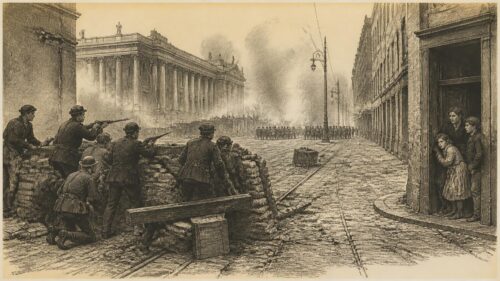
The revolutionary years from 1916 to the early 1920s tested every association with an all-Ireland structure. The Grand Lodge of Ireland retained jurisdiction across the island after partition, an institutional continuity that distinguishes it from bodies reorganised along the border. This survival did not make Masonry immune to the violence, fear and political division of the period. Members held different loyalties, and Masonic premises could be caught up in the practical consequences of conflict.
It is tempting to turn the all-island structure into evidence that Freemasonry stood outside politics. That would be too simple. Constitutional continuity may express a commitment to inherited organisational boundaries, but it does not tell us that members were politically uniform or that the lodge room dissolved surrounding antagonisms. In the new Irish Free State, Masonry’s public image was increasingly shaped by its association with Protestant and unionist minorities, whether or not that description fitted every lodge or every individual Mason.
In Northern Ireland, the relationship between Masonic and unionist social networks has attracted particular attention. There were genuine overlaps, especially among men prominent in public life, but overlap must again be distinguished from identity. A Masonic lodge was not an Orange lodge, a unionist party branch or a state institution. Treating all Protestant associational life as one coordinated structure obscures differences in membership, ritual, purpose and local practice. Conversely, refusing to acknowledge shared personnel and cultural affinities would be equally misleading.
The twentieth century also brought demographic change, urban decline in some places, emigration, new forms of leisure and a weakening of old elite networks. These developments affected lodges unevenly. Some survived through family continuity and local attachment; others merged, became dormant or reinvented their role. The documentary history of particular lodges is often richer than any broad national generalisation, which is why minute books, warrants and membership registers remain indispensable.
Public Memory
Modern public memory of Irish Freemasonry commonly oscillates between fascination and suspicion. The former is nourished by ceremonial interiors, symbols and tales of famous members; the latter by secrecy and by the indisputable fact that lodges historically connected influential men. Neither response, alone, is adequate. Influence is not proof of omnipotence. A lodge can be socially useful to its members and still be unable to dictate political outcomes. It can offer charity and fellowship while also reproducing male privilege, private patronage and denominational distance.
Claims about celebrated Irish Masons require the same caution as claims about ancient origins. Membership may be confirmed in a register, a lodge minute, a certificate, a contemporary press report or a reliable archival finding aid. It should not be accepted merely because a later list repeats it. Daniel O’Connell, Archibald Hamilton Rowan and members of the FitzGerald family are frequently connected with Irish Masonry, but each individual case has its own documentary quality and historical context. Membership alone does not explain a person’s politics, religion or character.
Folklore has a legitimate place in this story when it is labelled as folklore. Stories of hidden passages, subterranean rituals, Templar inheritances, coded national conspiracies and all-seeing Masonic control reveal the anxieties and imaginative needs of those who tell them. They can be studied as cultural evidence. They cannot replace records. The most compelling history is not diminished by abandoning sensational claims. On the contrary, the documented story of a fraternity that linked local towns to global military routes, mixed social ranks while preserving hierarchy, and endured through profound constitutional change is more revealing than legend.
Continuing Archives
The Grand Lodge of Ireland marked the three-hundredth anniversary of its first recorded communication in 2025. That anniversary is a useful prompt for historical reflection, but it should not become a triumphal tale of uninterrupted certainty. Three centuries of institutional survival have produced rich records, yet gaps remain. Early lodge papers have been lost; individual members left uneven traces; oral tradition can preserve details that cannot now be checked; and archives themselves reflect what organisations chose to retain. The historian’s task is to use this material critically rather than to demand impossible completeness.
Irish Masonic history deserves attention because it provides a lens upon association itself. It shows men creating durable communities through ritual, regulation, philanthropy and sociability. It exposes the importance of paper warrants and travelling networks in an imperial age. It demonstrates that people of differing political outlooks could share an institution without sharing a programme. It also makes visible the exclusions that structured respectable public life: women’s exclusion from the Craft, restricted entry, unequal access to influence and changing denominational boundaries.
Above all, the history resists reduction. Freemasonry in Ireland was not merely a secret society, a Protestant relic, a revolutionary nursery, an imperial network or a charitable fellowship. At different times and places, it contained elements of all these descriptions, without being exhausted by any one of them. The surviving evidence supports a history of organised fellowship shaped by Ireland’s religious divisions, political upheavals and global connections. Where evidence is incomplete, uncertainty should remain visible. That restraint is not a weakness; it is the foundation of trustworthy historical writing.
Archival Afterlives
The continuing life of Irish Masonry is not measured only by the survival of lodges. It is also preserved in the accumulated evidence that lodges and their governing bodies left behind: warrants, minute books, membership lists, account books, correspondence, certificates, portraits, jewels, aprons, banners, architectural drawings and photographs. These materials make it possible to move beyond broad assertions about secret influence and ask more limited but more productive questions. Who attended a particular lodge? Who held office? What subscriptions were collected? Which charities received assistance? When did a lodge meet, move premises, merge or cease to function? Such questions can yield a history of ordinary association as well as of prominent Grand Masters.
That evidence is extensive but uneven. A warrant may establish that a lodge received authority to meet, while telling little about its actual membership or regularity of meetings. Minutes can preserve elections, motions and disputes, but they record what officers thought should enter the formal record rather than every conversation held over dinner or after a ceremony. Membership lists can help identify a man’s lodge connection, but names may be misspelled, repeated or shared by several people. Nor does membership alone settle a person’s politics, faith or private motives. The most reliable histories therefore compare Masonic records with newspapers, census material, wills, military papers, local directories, church records and other archival sources.
This caution is especially important for family history. The Grand Lodge archive makes records available for researchers investigating relatives, including membership listings covering 1733 to 1923. A discovered name can provide a valuable lead: it may connect an ancestor to a town, profession, regiment or circle of acquaintances otherwise absent from family papers. Yet it is not a complete biography. A roll cannot reveal whether a member was active for decades or briefly initiated before disappearing from the records; nor can it show whether his experience of the lodge was chiefly charitable, social, ceremonial, professional or political. Genealogical interest can open a historical inquiry, but it cannot substitute for one.
Objects require the same disciplined reading. Regalia is often visually striking, and the museum at Freemasons’ Hall holds both historic documents and a wide range of artefacts. An apron, collar or jewel may indicate office, lodge identity, rank or participation in an additional order. It does not, by itself, unlock a hidden political programme. Its first historical value lies in what it demonstrates materially: that members invested money, skill and care in making hierarchy, memory and belonging visible within a ritual setting. Wear, inscriptions, makers’ marks and accompanying provenance can sometimes reveal still more, linking an object to an individual, a lodge or an occasion.
Freemasons’ Hall itself is a particularly rich record of institutional ambition. The building at 17–18 Molesworth Street remains in use as a Masonic hall and is recognised for architectural, artistic and social significance. Its exterior uses the formal language of a public monument, while its retained interiors accommodate several ceremonial traditions. The Grand Lodge Room, Royal Arch Chapter Room and Knights Templar Chapel express different symbolic vocabularies through classical, Egyptian and Gothic design. Their coexistence demonstrates that Irish Masonic culture was not reducible to a single visual or ritual form. It also shows how a body often described as secret could commission a highly visible and carefully ornamented headquarters in central Dublin.
Public access complicates the familiar opposition between openness and secrecy. Masonic ceremonies remain matters for members, and archives necessarily impose rules concerning preservation, privacy and access. But the museum, library and archive at Freemasons’ Hall provide a point of contact between the institution and non-members, while tours make the building itself available for inspection. This does not erase historical reasons for scepticism about closed associations. It does, however, make a more precise judgement possible. Irish Masonry has protected particular rituals and internal proceedings while also preserving, displaying and assisting research into a substantial documentary heritage.
The tercentenary commemorations of 2025 offered another occasion on which institutional memory became public. The Grand Lodge marked 300 years since its first recorded communication of 24 June 1725 with events in Dublin over 22–24 June 2025, including a service at St Patrick’s Cathedral, tours, communications and a gathering at the Royal Dublin Convention Centre. Such anniversaries are acts of commemoration rather than neutral summaries of the past. They select milestones, honour continuity and invite members to see themselves as heirs to a long tradition. Historians need not dismiss that purpose in order to distinguish it from critical scholarship. Commemoration is itself evidence of how an institution understands its own past.
That past remains most intelligible when neither celebration nor suspicion is allowed to do all the explanatory work. The Grand Lodge continues to govern lodges across the island of Ireland and in overseas provinces, maintaining an organisational form that has outlived empire, partition and major changes in Irish social life. Its survival does not prove timeless unity, still less immunity from the exclusions and tensions traced in earlier periods. Rather, it directs attention to adaptation: to records conserved, buildings maintained, charitable practices revised, memberships renewed and local traditions carried forward. Irish Masonry is therefore best approached not as an all-powerful hidden force or a harmless historical curiosity, but as a durable voluntary institution whose meanings have changed with the society around it.