Tariff Trade
At a Glance
Union Tariffs
In the 1804 Commons debate on Irish revenue acts, the central concern was not a single new tax but the arrangement of duties across import, export, excise, drawbacks, and countervailing charges. The schedule was described as serving merchant convenience and better revenue collection, while remaining limited to foreign trade in Ireland and leaving trade between Great Britain and Ireland to the Act of Union. The passage shows a fiscal system being reorganized for administration as much as for yield.
That same discussion also made clear that tariff revision could change forms without necessarily increasing total revenue. Duties were consolidated, fractions were rounded, and obsolete articles were removed from the schedule. The speaker framed these changes as practical measures for merchants and officers alike. At the same time, the debate acknowledged exceptions, including some increases on foreign manufactures and the protection of Irish consumption and production, especially where the schedule aimed to support manufacture and facilitate collection.
Mercantile Debates
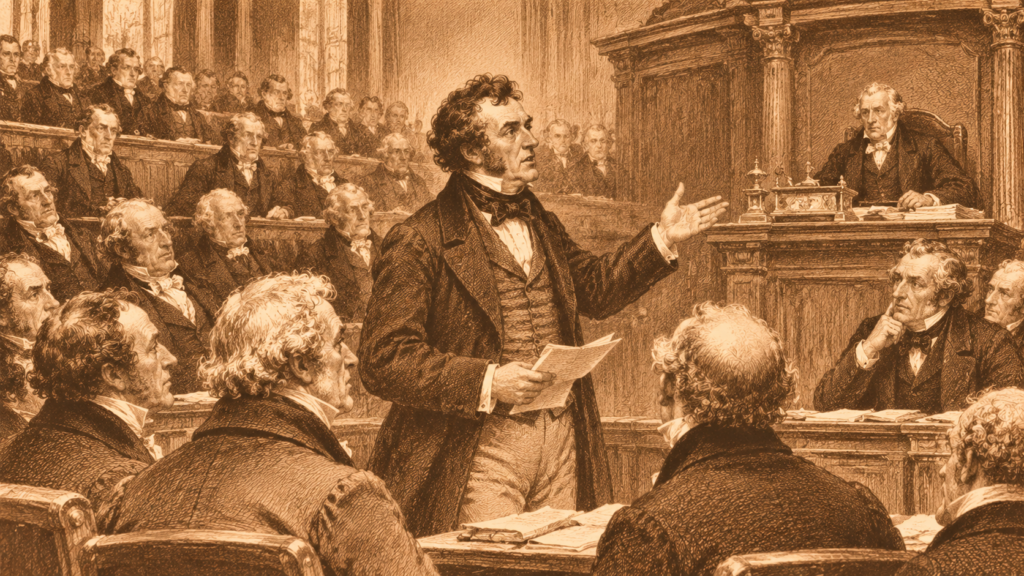
By 1820 the tariff question had become more openly political. Sir Henry Parnell moved for inquiry into the ten per cent Union duties on British manufactures imported into Ireland and Irish manufactures imported into England. He argued that continuation of the duties harmed consumers, limited demand, and treated the Union as if it were still a system of barriers. His case rested on the idea that free circulation would enlarge markets and encourage more productive investment.
Opponents and supporters of the motion did not agree on what the duties meant for Irish trade. Parnell presented the charges as a breach of Union principle and a drag on manufacturing growth, while others argued that existing industries depended on protection or that an inquiry itself would unsettle a distressed country. The exchange reveals uncertainty in interpretation: tariff policy could be read either as a shield for fragile industry or as a barrier to market expansion.
Market Access
The same 1820 debate shows a recurring Irish commercial argument: access to the larger British market mattered more than inward protection. Parnell insisted that Irish linen, butter, corn, calicos, woollens, and poplins needed freer exchange if capital was to flow into manufacture. He treated duties as a levy on Irish consumers and as a restriction on the outlet for Irish producers. This was interpretation, but it was grounded in the explicit parliamentary language of the time.
The same exchange also questioned whether protection worked where no corresponding industry existed, and whether countervailing duties still made sense after the Union. Supporters of inquiry suggested some duties might be unnecessary because certain branches were absent in Ireland; critics warned against agitation. The record therefore supports a cautious conclusion: tariff policy was being tested against actual commercial structures, but the House had not reached a settled answer on which branches deserved protection.
Constitutional Tariffs
In 1921 tariffs had become part of constitutional negotiation rather than merely fiscal administration. During discussion of the Irish settlement, the speaker said he had reluctantly accepted Ireland's right to impose tariffs on British goods, while stressing Ireland's dependence on Britain as a market, especially for agricultural produce. The account also noted a safeguard against legislation excluding British ships from coastal trade with Ireland, showing that tariff authority and transport access were being handled together.
This late-Union and post-Union perspective is important because it places tariff power inside a wider politics of dependency. The evidence does not show a complete theory of Irish trade from that debate alone, but it does show a practical judgment: Ireland's leverage lay in the distribution of markets and routes, not in a simple symmetry with Britain. Tariff powers were therefore accepted with caution, because commercial interdependence remained unequal.
Economic Conflict
By 1933, tariff administration in the Irish Free State had become a direct instrument of dispute with Britain. The Treasury's special duties powers were being used to levy duties on imports from the Free State, and the order under debate converted earlier ad valorem charges into specific duties on cattle and other animals. The stated administrative purpose was to simplify customs valuation, but the debate surrounding the order made plain that taxation and political pressure were intertwined.
The same debate shows uncertainty about revenue effects and about the broader purpose of the duties. Ministers said the conversion should not change revenue materially, while critics argued that the series of orders formed part of an economic war and that the policy was still being adjusted. Because the record is limited to parliamentary argument, the safer conclusion is that tariff form was being changed for administrative convenience even as the larger conflict over Irish trade continued.
Historical Pattern
Across these debates, the recurring pattern is clear: tariff policy in Irish trade was never only about collection at the customs house. In 1804 it was consolidation and merchant convenience; in 1820 it was protection versus access; in 1921 it was a constitutional power attached to an unequal trading relationship; and in 1933 it was an instrument of administrative simplification within a wider commercial conflict. That sequence suggests continuity in the practical importance of tariffs, even as political contexts changed.
A final caution is necessary. These parliamentary debates illuminate policy choices and contemporary reasoning, but they do not by themselves measure the full economic impact of each tariff. They show how lawmakers linked duties to revenue, protection, consumer price, and market access, yet the scale of long-term effects would need other evidence. Still, the record strongly supports the view that Irish trade was repeatedly shaped by tariff design as much as by geography or law.