Palestine Solidarity
At a Glance
Dublin Streets
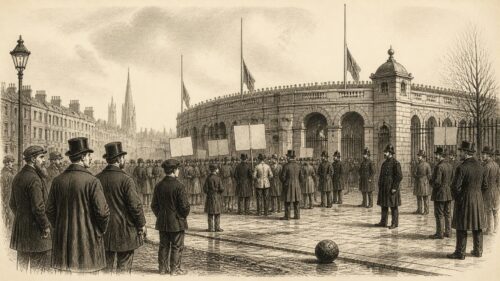
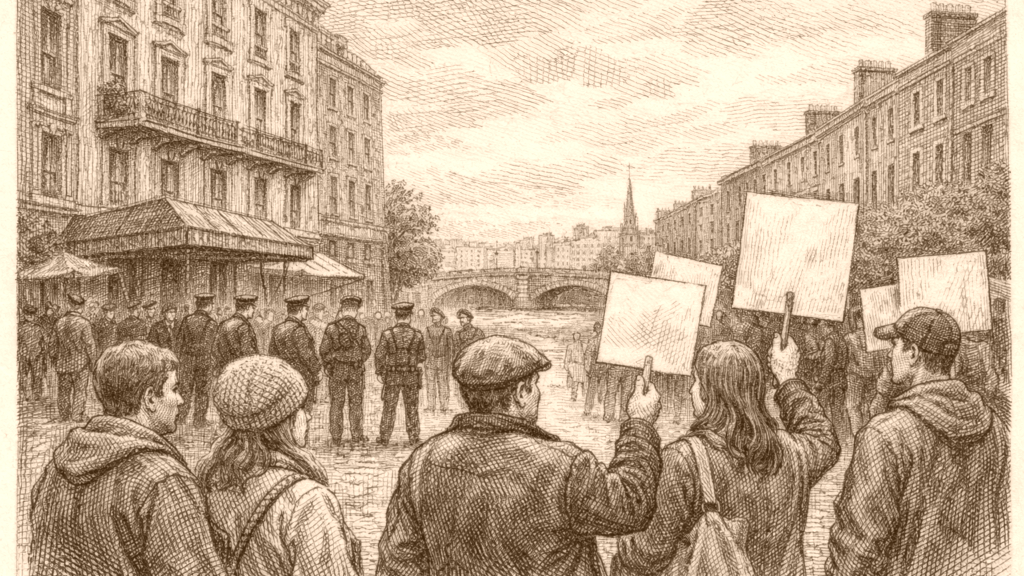
Palestine solidarity in Dublin appeared publicly through demonstrations that were small enough to be counted yet large enough to attract national attention. In April 2002 protesters gathered outside the Westin Hotel during Israeli independence celebrations, while another protest that month involved demonstrators at the Israeli Embassy and support for events in Ramallah. The reports show a movement that connected Irish streets to a wider conflict rather than remaining a purely local campaign.
These early actions were framed as expressions of solidarity rather than isolated outbursts. One report noted that protesters gathered in support of Caoimhe Butterly and sought a response from the Israeli ambassador, showing how Irish activists linked symbolic protest to specific humanitarian concerns. The evidence does not show a single unified leadership, but it does show coordinated public action aimed at creating pressure and visibility.
Public Action
By 2007 and 2008 the movement had broadened into protests aimed at the European Union and at Dublin city centre. Activists objected to what they described as occupation and sanctions, while others gathered at the GPO to protest violence in Gaza. The reporting presents the demonstrations as peaceful, suggesting that public persuasion and disciplined visibility were central to their tactics.
The language used by activists also placed moral emphasis on occupation, aid, and international responsibility. One campaigner argued that financial support and aid had stopped and that Europe treated Israel preferentially, while another said public action mattered because people should speak out before military escalation deepened. Such statements reveal a politics of urgency, but the precise internal structure of the campaign remains only partially visible in the available record.
Political Framing
The protests did not stay outside politics; they repeatedly addressed Irish government figures and diplomats. In 2002 the campaign called on politicians to boycott Israeli independence celebrations, and protesters in Dublin also asked Taoiseach Bertie Ahern to condemn the occupation of the West Bank. This suggests that solidarity work in Ireland aimed not only at sympathy for Palestinians but also at shaping Irish official language and action.
The reports also show that solidarity was framed through the language of rights, occupation, and public duty. Protesters called the situation outrageous and distressing, and one statement recalled Ireland’s own history of colonial occupation as a reason for identifying with Palestinians. That comparison is interpretive, not identical to Irish history, but it helps explain why the cause resonated with some Irish activists and observers.
Media Record
Media coverage gives much of the surviving detail about these protests, but it also shapes how the movement is remembered. The reports emphasise crowd sizes, police presence, peaceful conduct, and the specific locations of protest. Because these are journalistic accounts rather than internal campaign papers, they are strongest for public performance and weakest for the private arguments, memberships, and decision making behind the scenes.
Even in a digital age, the preservation of these traces matters. The National Library of Ireland explains that websites can disappear quickly and that its web archive preserves selected Irish sites as snapshots for the future. That preservation policy is not specific to Palestine solidarity, yet it provides an important context for how contemporary activism may survive as part of Ireland’s documentary record.
Memory Work
The movement’s later visibility suggests that Palestine solidarity became part of a broader Irish civic repertoire. By 2024 a letter to The Irish Times described a major Dublin march as probably the biggest in years on a political issue and noted support from several civil society organisations, including the Irish Congress of Trade Unions. This indicates continuity, though not necessarily organisational continuity, between early street protests and later mass mobilisation.
The same letter also observed that printed archives remain vital for future researchers, a reminder that memory is being made as events unfold. That comment is not proof of how every campaigner thought, but it does show that solidarity politics was already being imagined as history. The historical interest lies not only in protest events themselves, but also in how participants and readers expected them to be remembered.
Historical Meaning
Taken together, the record shows Palestine solidarity in Ireland as a public, peaceful, and politically pointed form of activism. It moved from hotel demonstrations and embassy protests to EU offices and citywide marches, while repeatedly invoking occupation, humanitarian concern, and Irish historical memory. What remains uncertain is the full internal life of the campaigns: their membership, strategy meetings, and relationship to wider party politics are not visible here.
The significance of this history lies in its combination of immediacy and endurance. The protests were responses to live events in Palestine, yet they also created an Irish record of solidarity that later archives, newspapers, and public memory continue to preserve. That record is incomplete, but it is enough to show a recurring pattern: Irish activists repeatedly turned local public space into a stage for international political identification.