Language Revival
At a Glance
Revival Origins
The modern revival of Irish emerged in the late nineteenth century as a cultural project tied to identity, education, and public life. University of Galway’s library history notes that the revival has been central to Irish identity since that period, while its collections bring together material on language, culture, and activism. That framing is interpretive, but it is grounded in the surviving institutional record rather than a single founding moment.
The evidence preserved by the National Library of Ireland also points to broad historical depth. Its manuscript holdings include Gaelic manuscripts from the fourteenth century to the present, and among their subjects it explicitly lists the Irish language revival movement. This does not mean the revival began in the medieval period; rather, it shows that later revivalists drew on older written traditions and that archives now connect those layers for research.
League Archive
The Conradh na Gaeilge archive is the clearest institutional witness to organised revival work. University of Galway reports that the archive contains more than 600,000 pages, covers more than a century of activity, and spans every decade from the founding of Conradh na Gaeilge in 1893 to its transfer in 2018. The record is therefore not merely symbolic; it documents campaigning, organisation, and the changing priorities of the movement over time.
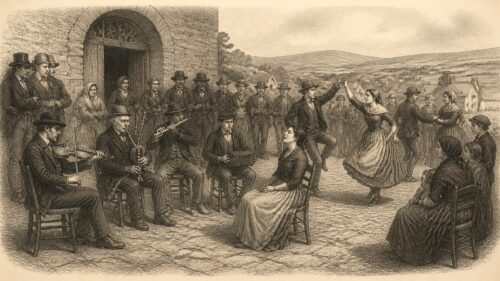
The same archive also shows how revival extended beyond language lessons into everyday social concerns. Its described holdings include material on music, sport, drama, religion, politics, and campaigns for Irish on radio and television, all-Irish schools, and language rights. Because these descriptions are institutional summaries, they should be read as a guide to the archive rather than a full inventory, but they reveal the breadth of cultural revival.
Library Custodians
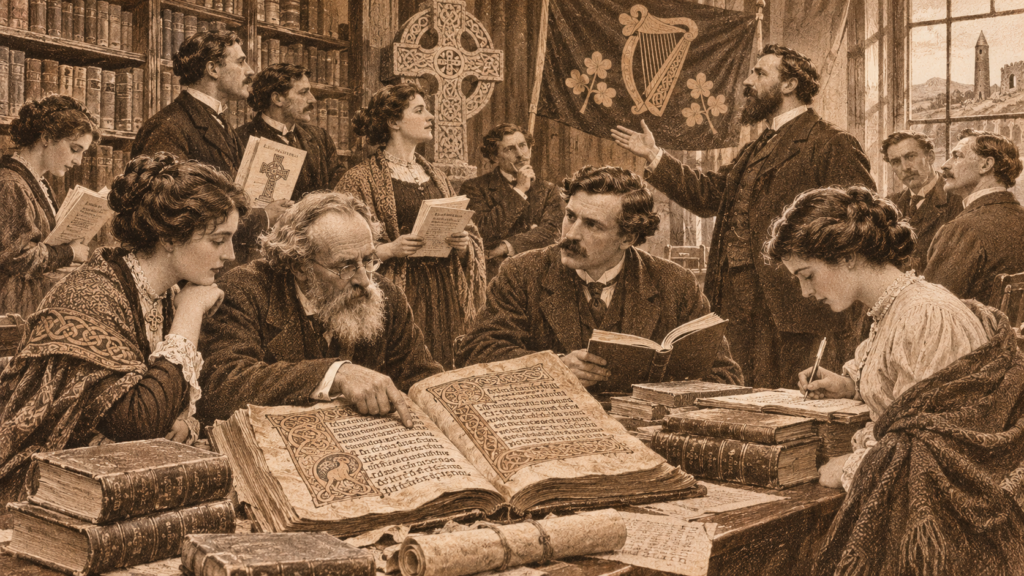
University of Galway Library presents itself as a custodian of Irish language material, stating that it has a long tradition of acquiring, preserving, and making accessible collections in and relating to Irish. It links this work to teaching, research, and community connection. That mission matters historically because revival depended not only on organisations in the streets and lecture halls, but also on institutions that kept printed and manuscript culture available for later generations.
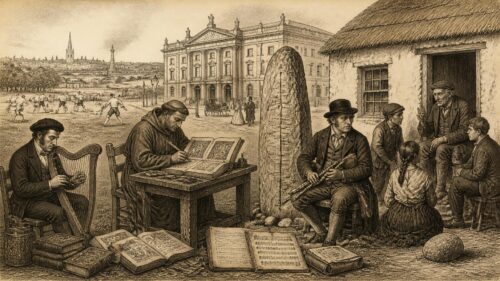
The library’s holdings also illustrate the intellectual range of revival. They include seventeenth-century Irish literary manuscripts, folk songs, prayers and poetry, an early Irish-English dictionary, and later works by modern writers. These items do not prove a single revival strategy, but they do show how literary heritage, scholarly editing, and popular culture were assembled into one research environment that now supports study of the movement’s longer roots.
Media Campaigns
The revival was also a media struggle. University of Galway’s Irish language collections include the first Irish-language newspaper published in Brooklyn, another early provincial newspaper, and material concerned with newspaper and broadcast media in Irish. The archive descriptions suggest a transnational and modernising movement, although the exact readership and influence of each publication would require separate study. What is clear is that print and broadcast forms were central to spreading the language.
Campaign material also reflects efforts to normalise Irish in public culture. The library’s collection includes a postcard campaign for more Irish-language programming on RTÉ, and the Conradh archive notes demonstrations and correspondence over television and radio use. These sources show a movement working through persuasion, protest, and publicity. They do not quantify success, but they do demonstrate how revival adapted to mass media and state institutions.
Regional Networks
The revival was not confined to Dublin or to one organisation. University of Galway’s collections refer to branches across the country, to Gaeltacht centres in Carna, Gaoth Dobhair, and An Cheathrú Rua, and to material from later activists and local organisers. This suggests a dispersed infrastructure in which central bodies, local branches, and regional language communities reinforced one another. The surviving record is uneven, but the geographical spread is unmistakable.
National Library of Ireland holdings broaden this picture by preserving material on politics, labour, theatre, women’s history, and the Irish language revival movement itself. That range indicates that revival interacted with wider social currents rather than standing apart from them. The precise balance between cultural and political motivations varied over time, and the archival record preserves that complexity better than any simple narrative of decline and recovery.
Historical Meaning
Taken together, these collections show that the Irish language and cultural revival was sustained by institutions as much as by ideas. Archives preserved the traces of campaigns, publications, performances, and local organisation; libraries made them accessible for study; and universities framed them as part of research and teaching. The historical significance lies not in a single dramatic breakthrough, but in the long accumulation of cultural work across generations.
Any account of revival must also acknowledge limits in the record. These repositories preserve what was collected, catalogued, and retained, not every voice that participated in the movement. Even so, the surviving material makes one conclusion difficult to avoid: the revival was both linguistic and cultural, and its endurance depended on continuous archival care as much as on public activism.