Rural Change
At a Glance
Rural Context
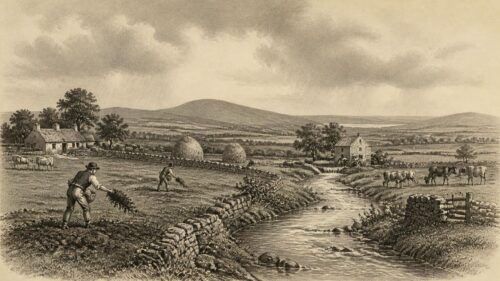
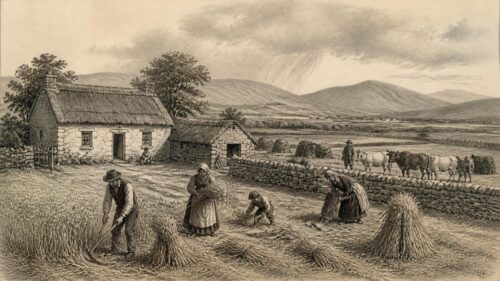
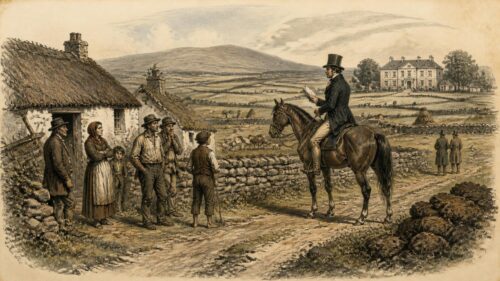
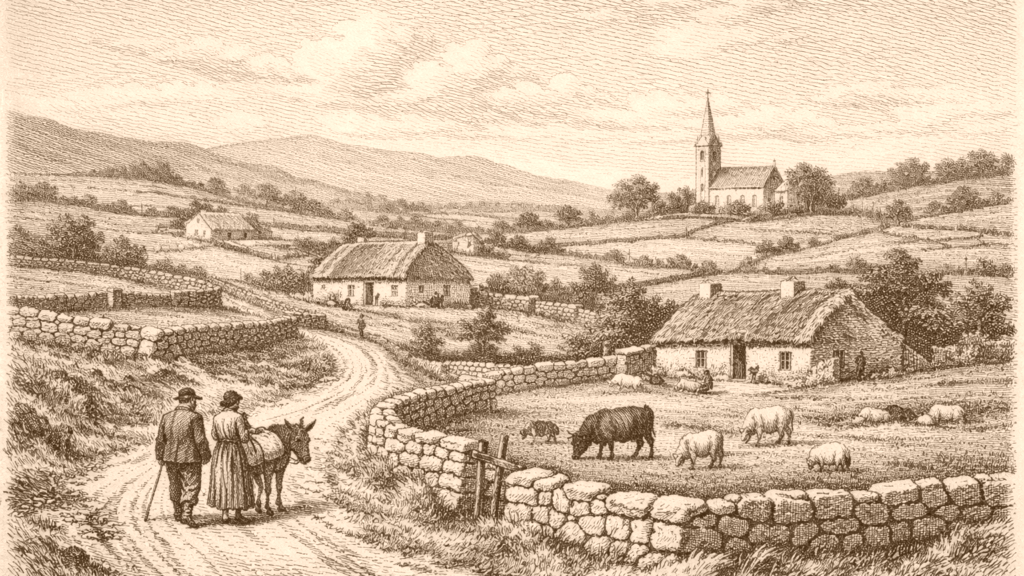
The museum material places rural Ireland in a landscape shaped by land, resources, and daily work. One exhibition says that most people lived off the land in 1850, while a small number of wealthy landowners owned it and leased it to tenants. Another adds that the fertility of land affected quality of life, and that local materials such as stone, sod, clay, straw, rushes, and reeds shaped buildings and household goods. Taken together, these passages present rural life as closely tied to land and material availability.
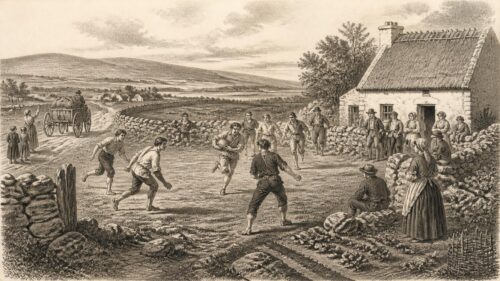
The same museum evidence also narrows the setting to a broad historical interval rather than a single event. One exhibition covers 1850 to 1950 and states that rural people participated in great political movements and saw sweeping social changes. Another says the display provides historical context through the post-Famine period, the Land War, the Land League, Home Rule agitation, and the final resolution of the land question in post-independent Ireland. The passages list these developments without detailing their internal causes.
Land Records
Archival guidance from the National Archives describes valuation records as a key source for nineteenth-century Irish property, occupiers, and local change. The valuation of Ireland is defined there as a cadastral survey for property taxes, with a valuation price established for every piece of property and local tax rates based on that valuation. The records include field books, house books, and maps. This makes the archive a practical record of landholding and occupation rather than a narrative account of rural society.
The same guide gives a sequence for the work itself. It notes that initial valuation work ran between 1830 and the mid-1860s, beginning with townland valuation and later tenement valuation. It also says the first Valuation Act passed in 1826, fieldwork began in County Londonderry in 1830, and Richard Griffith led the process from Dublin. The record thus shows an administrative survey that expanded over time and became the basis for later taxation.
Political Turn
The museum exhibition on rural Ireland links landholding directly with political change by placing the struggle for independence beside the tenant farmers’ effort to become owners of the land they worked. It identifies the immediate post-Famine period, the Land War, the Land League, and Home Rule agitation as part of the context. The wording does not explain these movements in detail, but it clearly places land ownership within the broader political chronology of the period.
A second museum page frames the same transition in more general terms. It says the question of land ownership dominated Irish political life from 1870 until the early twentieth century, when the majority of tenant farmers became owners of their small farms. The passage does not specify the legislative mechanism, but it does directly connect political life, land ownership, and the change in status from tenants to owners. That is the clearest explicit statement of political transformation in the provided material.
Local Materials
The museum description of natural environment shows how rural development can be read through everyday objects rather than only through formal politics. It states that farmers relied on local supplies of stone, sod, or clay to build houses, that walls were often covered with whitewash made from lime or seashells, and that thatched roofs used different plant materials depending on availability. The evidence shows practical adaptation to place, with construction methods varying by local resource.
The same exhibition extends that pattern to household items. It says straw was used for mattresses, baskets, stools, horse collars, and hen’s nests, and that different parts of the country produced similar objects from different materials. It also notes a bulrush raft from the River Suck used for fishing and fowling, described as the only surviving example of its type in northern Europe. These statements present rural adaptation as varied, local, and materially specific.
Historical Geography
The university module provides a broader interpretive frame for linking rural and political history, though only in course description form. It says the module charts modern Ireland from colonial expansion in the seventeenth century through the Great Famine, the War of Independence, and the creation of the Irish Free State. It also notes that the module examines historical geography through colonialism and decolonialism, focusing on both urban and rural areas. This is a syllabus statement, not a historical argument, but it shows the intended lens.
The same module outline adds that students are expected to identify agents shaping the Irish cultural landscape and assess the influence of important historical events on Irish geographies. It also includes a week sequence that moves from post-Plantation Ireland through landlord landscapes and rural Ireland to land for the people, power to the people, and early twentieth-century political and cultural landscapes. The course structure itself therefore groups rural space, land questions, and politics within one teaching sequence.
Annalistic Evidence
The Celtic Texts catalogue identifies a body of annalistic material relevant to Irish historical study. It lists the Annals of Ulster, the Annals of Tigernach, the Annals of Inisfallen, the Annals of the Four Masters, the Annals of Loch Cé, and the Annals of Connacht among historical and genealogical texts. This catalogue entry does not itself summarize rural development or political change, but it shows the range of annalistic editions available for such study.
The Tigernach page gives manuscript and editorial details rather than historical content. It names two manuscript sources, Rawlinson B 502 and Rawlinson B 488, and gives their approximate dates and contents. It also notes that the electronic edition is based on an unpublished translation and that the text includes Irish World-Chronicle material and fragmented annals. This is evidence about textual transmission and editorial framing, not a direct statement about rural development itself.