Nosegay Ireland
At a Glance
Word Meaning
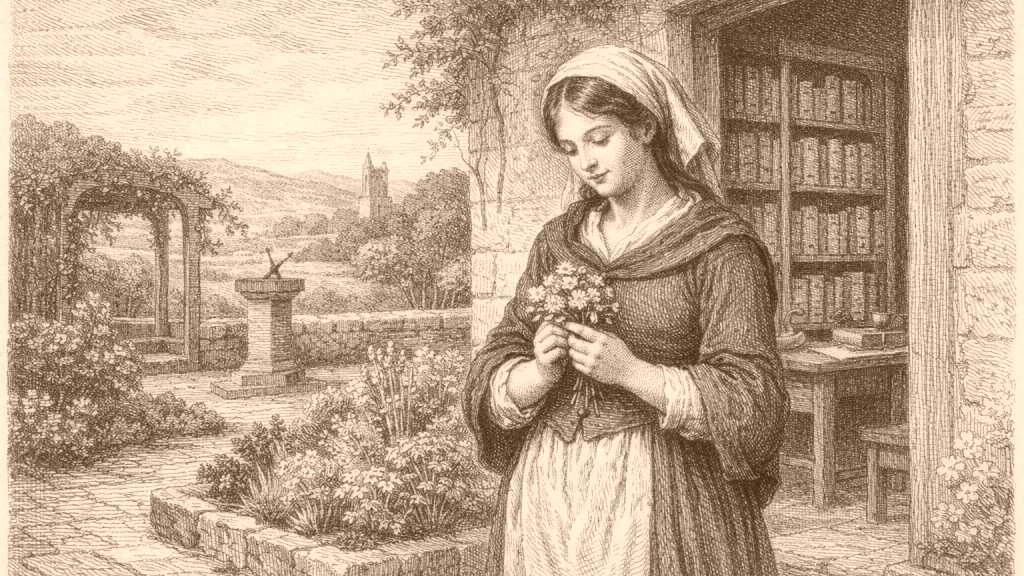
In the dictionary evidence, nosegay is defined as a small bunch of fragrant flowers or herbs, tied together and meant to be held or worn. One entry also describes it as a flower arrangement that could be given as a present. Another notes that the word is old-fashioned and was associated with carrying flowers to soften unpleasant street odors. These descriptions agree on the core sense: a compact, scented floral bundle rather than a large bouquet or general flower display.
The same dictionary material also places nosegay among related forms such as bouquet, corsage, boutonniere, and posy. That comparison is useful because it shows scale and function rather than origin: a nosegay is smaller and more personal than a bouquet, and it may be carried, pinned, or worn. The evidence does not tie the term to a single Irish custom; instead, it presents a wider English-language fashion vocabulary that Irish lexicography later had to translate or explain.
Irish Gloss
Irish-language dictionary evidence gives one of the clearest bridges into the word’s Irish history. In Foclóir Gaeilge–Béarla, triblid is glossed as a bunch of flowers, a posy, and nosegay. That is not a historical narrative in itself, but it shows how an Irish lexical item was aligned with the English term. The entry confirms that nosegay could be rendered in Irish by a word already carrying the idea of clustered flowers.
The same dictionary page does not offer an extended etymology or an Irish medieval citation, and that absence matters. It means the available evidence here is lexical rather than documentary. We can say that modern Irish dictionary practice records an Irish equivalent for nosegay, but we cannot, from these excerpts alone, trace when triblid entered use or whether it was historically common in any particular region. The evidence supports translation, not a fuller chronology.
Annalistic Flowers
The annalistic evidence does not use the word nosegay, but it does preserve floral language that helps frame the term historically. In the Annals of the Four Masters, flowers and shamrocks are said to abound in Ireland in the time of Fiacha, and the passage then turns to an image of wine found within those flowers. This is a literary account of abundance, not a definition of nosegay, yet it shows that flowers could carry symbolic weight in annalistic prose.
A second annalistic excerpt names the first king by whom the Feis Teamhrach was established and describes his building at Teamhair. That entry has no floral detail, which helps mark the limits of the comparison. The useful point is narrow: the annals include varied forms of historical and symbolic description, some with flowers and some without. From these excerpts alone, nosegay itself is absent, so any connection must remain indirect and strictly lexical.
Lexicographic Context
The Irish Texts at CELT list places the Annals of Ulster and the Annals of the Four Masters among historical, legal, and genealogical texts. That catalogue context is useful because it shows the kind of material in which floral or descriptive language appears, even when nosegay itself is not present. The list also points to editions and translations, confirming that readers encounter these annals through modern editorial mediation rather than through a single manuscript form.
The Annals of Ulster edition notes likewise show that the text exists in several manuscripts and editorial layers, with lacunae and later supplements. This matters for interpretation only in a limited way: the excerpt demonstrates that the annals are transmitted through edited text and manuscript witnesses, but it does not justify any claim about nosegay itself. For this topic, the editorial evidence mainly warns against treating a single citation as the whole historical record.
Cultural Sense
Taken together, the evidence presents nosegay as a floral object with social uses rather than a specifically Irish institution. The English dictionary entries describe it as a small bunch of fragrant flowers or herbs, often carried, worn, or given. One source adds that it was used to mask unpleasant smells, while another emphasizes its later survival in corsages and boutonnieres. These are observable shifts in usage, not proof of a unique Irish practice.
In Irish reference material, then, the most secure answer is limited: nosegay is an English word for a small fragrant bouquet, and Irish lexicography records an equivalent in triblid. The annals supply floral imagery but do not name the object. That leaves a modest historical conclusion. The word belongs to the vocabulary of flowers, scent, and display, while Irish sources mainly preserve its meaning through translation and through related imagery rather than direct narrative use.
Historical Limits
Because the surviving excerpts are dictionary and annalistic in nature, they support a restrained historical account. They show how nosegay was explained, how it was translated into Irish, and how flowers appear in annalistic prose. They do not show an Irish ceremonial object with that exact name, nor do they establish a special medieval Irish usage. The absence is specific to these excerpts, and it should not be stretched into a claim about the entire historical record.
A final comparison makes the boundaries clearer. The annalistic passages describe flowers, shamrocks, kingship, and chronology; the dictionaries define nosegay as a small floral bunch and offer Irish triblid as a counterpart. Between those two bodies of evidence lies the historical answer. No single excerpt explains all usage, but together they show a word of flowers and scent, translated into Irish lexical terms and set against the broader floral language of historical writing.