

Country Lives
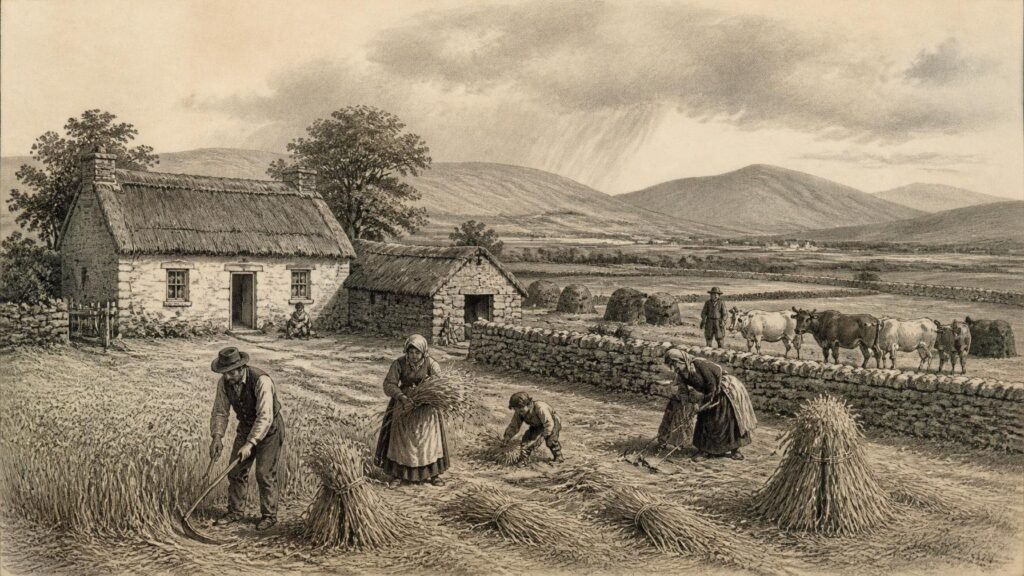
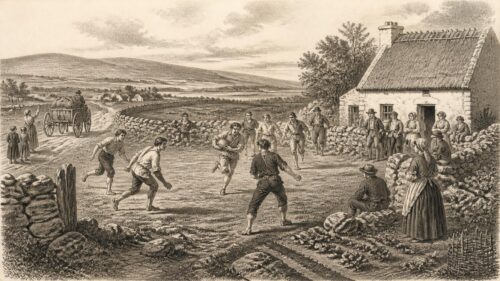
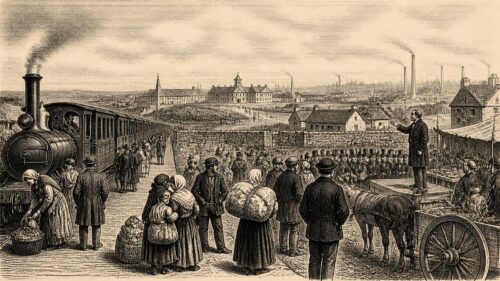
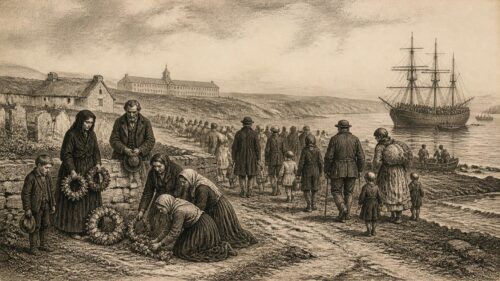
AI generated historical illustration, not a contemporary photograph.
At a Glance
Rural Ireland was neither a single place nor an unchanging inheritance. It was a succession of worked landscapes in which families, labourers, landholders, religious communities and state authorities negotiated survival, status and power. Fields, lanes, bogs, grazing lands, cabins, farmhouses and market towns preserve traces of those negotiations, but the history beneath them is more complex than the familiar image of an eternally green and contented countryside.
Landscapes Made
For much of recorded history, the greater part of Ireland’s population lived beyond its towns. That simple fact gives rural history an exceptional importance, but it should not encourage the assumption that the countryside was socially uniform. The island contained rich grain lands, wet western margins, limestone plains, mountain pastures, reclaimed bogs and coastal districts tied to fishing as well as farming. Soil, rainfall, access to markets and inherited rights of occupation mattered greatly. So did conquest, law, language and religion. A household in a prosperous lowland tillage district did not inhabit the same economic world as a cottier family on a marginal Atlantic holding, even when both depended on the potato.
Landscape itself was continually remade. Woodland clearance, grazing, drainage, stone walls, ditches, roads and later land division all left durable marks. Yet the surviving pattern should not be read straightforwardly as a map of ancient custom. A field boundary may represent long local use, an estate improvement, a post-Famine consolidation or a twentieth-century adjustment. Archaeology, maps, estate papers, tithe records and census returns therefore need to be read together. Each preserves a different part of the story, and each has its own silences.
The rural past is also inseparable from political history. Control of land was a means of securing income, influence and allegiance. Landholding was altered by medieval lordship, early modern plantation, Cromwellian confiscation, eighteenth-century estate management, nineteenth-century tenant agitation and twentieth-century redistribution. Ireland’s countryside was not a backdrop to national events. It was one of the principal places where authority was exercised, resisted and remade.
Early Foundations
The evidence for early farming is archaeological rather than documentary, and precise dates must be used carefully. Long before written Irish sources, communities cultivated crops and kept livestock. The remains of field systems, houses, monuments, animal bones, pollen deposits and tools demonstrate that farming altered the island’s environments over many centuries. Such evidence does not yield a complete picture of every household, but it establishes a basic point: rural Ireland was a created agricultural landscape, not untouched nature.
Early medieval Ireland, conventionally dated from about the fifth century onwards, was overwhelmingly rural. The archaeological record identifies enclosed farmsteads, often described as raths, alongside crannogs, fields, trackways, mills and places of craft production. Cattle held a major place in wealth, food supply and social status, but mixed husbandry was important. Sheep, pigs and cereals all formed part of local economies. Dairy production, grain processing, textile work and the preservation of food bound domestic labour closely to the seasonal cycle.
Written law tracts and later historical interpretation have often encouraged an image of cattle as the sole measure of early Irish life. That is too narrow. Livestock could express status and facilitate exchange, but grain, woodland resources, water power and skilled craftwork also mattered. Nor should the rural population be imagined as a collection of equal free farmers. Archaeological and textual evidence points to marked differences in status. Lords, tenants, dependants, unfree people and religious institutions had unequal access to land, animals and labour.
Monasteries were particularly significant rural centres. They were places of worship and learning, but they also held land, managed resources and drew people, goods and labour into wider networks. Their relationship to surrounding settlement could be cooperative, coercive or both. The distinction between religious and secular landscapes was therefore not absolute. A rural community might be organised around kinship, a local lord, an ecclesiastical institution or some combination of these forces.
Fields Power
Medieval and early modern changes in Ireland cannot be understood without recognising that land was power made visible. Lordship involved collecting dues, commanding service, controlling pasture and woodland, and defining access to productive ground. Different regions retained different customary arrangements, while English governmental influence expanded unevenly. The result was not one neat national system but a patchwork of tenures and obligations.
Seventeenth-century warfare and confiscation transformed ownership on a scale that remained politically and emotionally consequential for generations. The Civil Survey and Down Survey, undertaken in the mid seventeenth century, recorded proprietors, boundaries, land quality, use and value as part of a process of confiscation and redistribution. These records are among the most important sources for reconstructing a landscape at a moment of radical upheaval. They also reveal their official purpose: surveying was not neutral description, but an instrument of government.
After these transformations, large estates became a defining feature in many parts of Ireland. Estate management varied considerably. Some landlords invested in improvements, roads, drainage, housing or planned villages; others were absentee, indebted or dependent upon layers of agents and middlemen. The point is not to replace one caricature with another. Estate systems could contain paternalism and improvement, but their structure also placed ownership and much decision-making power in relatively few hands. Tenants often bore the risks of crop failure, price change and rent pressure.
Rural society included far more than landlords and tenants. There were labourers, cottiers, craftsmen, servants, shopkeepers, clergy, schoolteachers, fishermen and traders. Women’s work was vital but is often less visible in formal records. Food preparation, dairying, poultry keeping, spinning, child care, saving seed and managing domestic exchange were not marginal activities. They were central to household survival. The language of property and rent can obscure this labour, yet no history of the countryside is adequate without it.
Surveyed Country
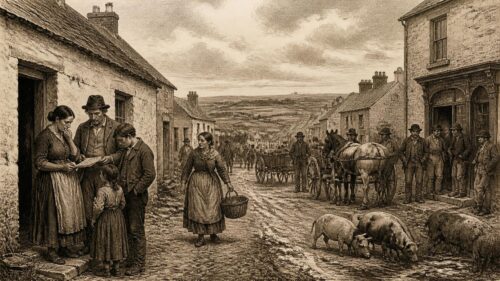
From the eighteenth century, improved surveying and record keeping made the Irish countryside increasingly legible to the state and to proprietors. Maps, valuations, estate rentals and agricultural surveys measured land as acreage, rent, quality and potential. They offer indispensable evidence, but they also turn lived places into administrative categories. A townland could be a unit on a map, a community of neighbours, a remembered homeland and a contested resource at the same time.
The Tithe Applotment Books of 1823 to 1837 are especially valuable. Compiled to assess payments towards the established Church of Ireland, they list occupiers of agricultural holdings and record the land involved. They do not enumerate every rural person, and they exclude many of the landless poor whose condition is crucial to the period. Nevertheless, they provide the first surviving national list of land occupiers and show the intensely local texture of pre-Famine rural society. Names recur within townlands and parishes, revealing settlements structured by family, occupation and access to land.
These records also illuminate inequality. A named occupier may have held a substantial farm, a few acres or only a precarious interest in land. Cottiers and labourers often appear imperfectly or not at all. The absence is itself historical evidence: official taxation and property records were designed around cultivable holdings, not around every person who depended on the rural economy. Historians must therefore resist treating records of land as records of the whole population.
Surveying altered imagination as well as administration. Ordnance mapping regularised spellings and fixed boundaries in official forms, while estate improvement often promoted straight roads, enclosed fields and consolidated farms. Such measures could increase production or ease communication, but they could also disrupt shared practices, seasonal movement and older understandings of place. The countryside was measured with greater precision, yet the meanings attached to it remained multiple.
Crowded Holdings
By the early nineteenth century, population growth placed enormous pressure on much of rural Ireland. This pressure was not identical across the island. Agricultural regions with better soils, access to markets or larger commercial farms differed from poorer districts where subdivision and small holdings were common. Nonetheless, the broad pattern was stark: many families depended on minute plots, casual labour and a food system in which the potato was exceptionally important.
The potato supported dense settlement because it could provide substantial nourishment from small areas of suitable ground. It also fitted an economy in which many poor households had limited security of tenure and little capital. Dependence on it was therefore not evidence of irrationality or laziness, as hostile contemporary commentators sometimes alleged. It was a practical response to constrained circumstances. That response was productive in ordinary years, but it carried terrible risk when disease struck the crop repeatedly.
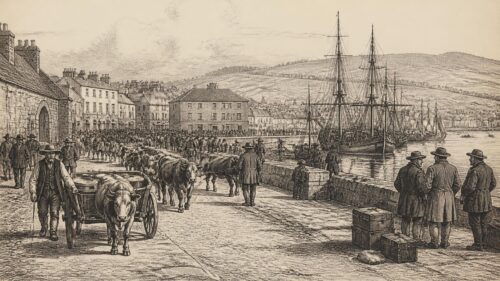
Rural poverty before the Great Famine was real, but it should not be represented as universal destitution. Some tenant farmers had viable holdings; graziers, merchants and larger farmers could prosper; rural districts supplied livestock, grain, butter and other produce to domestic and overseas markets. The critical question is distribution. Prosperity at one level could coexist with dependence and hunger at another. Food exports and local scarcity could occur simultaneously because access to food depended on income, entitlement and market power, not simply on whether food existed within a county.
Customary systems of shared labour and mutual aid helped households manage risk. Neighbours saved hay, cut turf, gathered harvests and assisted at moments of crisis. Yet community should not be romanticised. Competition over land, marriage, inheritance, grazing and employment could produce sharp division. Agrarian protest, secret societies and attacks on property emerged from particular grievances, including rents, tithes, evictions and the defence of customary expectations. Rural solidarity was real, but it was neither automatic nor all-embracing.
Famine Rupture
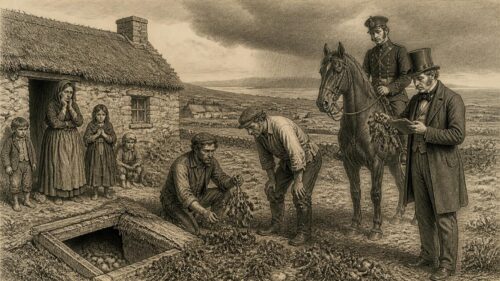
The Great Famine of 1845 to 1852 was the central rupture in nineteenth-century rural Ireland. Potato blight was the immediate ecological disaster, but the catastrophe cannot be explained by plant disease alone. It unfolded within a society marked by poverty, unequal access to land, dependence on seasonal labour, inadequate welfare provision and a political system whose relief measures changed repeatedly. The scale of mortality, disease, eviction and emigration transformed communities and families across the island.
National Archives records preserve a painful administrative trace of this crisis. The Distress Papers and Relief Commission files contain letters, reports, petitions, constabulary returns and applications for aid from famine-stricken districts. These documents show that suffering was reported, debated, classified and managed through institutions. They also show the limits of bureaucratic response. A plea for food, seed, employment or relief was never merely private correspondence; it was an attempt to make local disaster visible to an often distant authority.
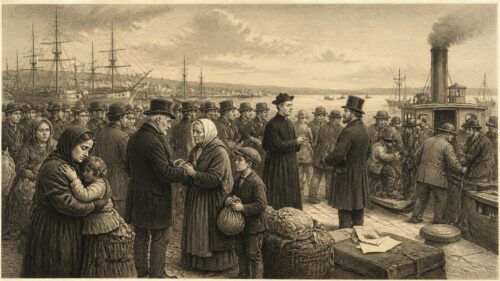
The Famine did not affect every locality in precisely the same way. Western and southern districts with high dependence on potatoes and fragile holdings were especially exposed, while differences in employment, land quality, relief administration and migration shaped local outcomes. Nevertheless, no simple regional formula captures the human experience. A household could lose members to fever, enter a workhouse, disperse through emigration or survive through a combination of charity, wage work, sale of possessions and assistance from kin.
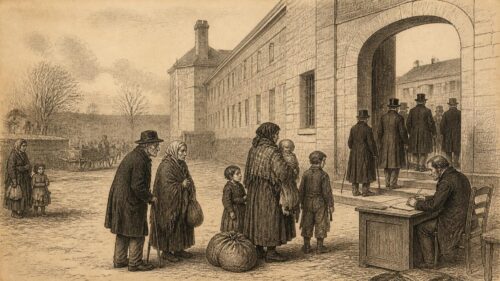
Workhouses became symbols of the crisis, but they were only one part of a larger system of relief, public works, soup kitchens, charitable action and emigration. The Irish Poor Law, introduced before the Famine, had been designed for a far smaller proportion of the population than was later driven towards it. By 1851, famine conditions had forced an immense burden upon the workhouse system. Its surviving registers and minute books make possible close local histories, yet they also record human lives through institutional categories: admission, illness, separation, discharge and death.
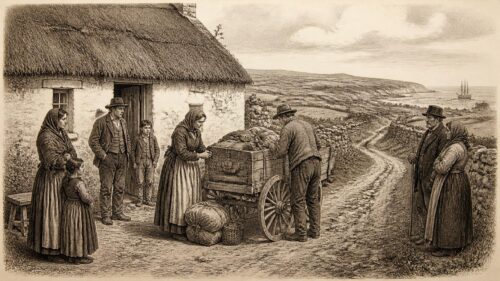
The physical landscape changed. Cabins disappeared, holdings were consolidated, and population loss altered the density of settlement. The cultural effects were equally profound. Irish-speaking communities were severely damaged; patterns of marriage and inheritance changed; migration became an enduring expectation. To describe these outcomes as inevitable modernisation would be wrong. They were shaped by a specific catastrophe and by decisions made before and during it.
Land Politics
Post-Famine rural Ireland was not simply emptying out. It was being reorganised. Smaller and less viable holdings declined in many districts, while pasture, cattle and larger farms gained relative importance. This could bring greater security to some surviving farmers, but it also reduced opportunities for agricultural labour and helped sustain emigration. The countryside became less crowded, not necessarily less unequal.
The land question became the dominant political issue of later nineteenth-century Ireland because it joined everyday insecurity to arguments about national power. Tenant demands were commonly summarised as the Three Fs: fair rent, fixity of tenure and free sale. The language was legal and political, but it spoke directly to rural fear of eviction, arbitrary rent increases and the loss of improvements made by tenants themselves.
The Land League and associated campaigns mobilised farmers and supporters through meetings, boycotts, rent struggles and electoral pressure. Violence and intimidation occurred, and it would be misleading to deny them. Yet a history confined to outrage misses the scale of organisation, public debate and constitutional action. Rural politics involved priests, journalists, women activists, local organisers, parliamentarians and tenant families as well as landlords, agents, police and courts.
A series of land acts gradually changed the balance from tenancy towards owner occupation. The Wyndham Land Act of 1903, supported by state finance, accelerated tenant purchase. The transformation was substantial, though not instantaneous and not socially simple. Ownership offered many families a new security and political standing, but it did not abolish poor land, debt, limited farm size or the problem of rural employment. The break-up of estates changed who held title; it did not make every holding equally viable.
Independent State
The creation of the Irish Free State did not end the rural question. Land redistribution continued through the Land Commission, which sought to transfer remaining estates and provide holdings, including through the rearrangement of land in congested districts. The policy expressed a powerful belief that smallholding ownership could stabilise society and repair inherited inequalities. It also reflected the political prestige of the farmer in the new state.
That prestige had limits. Rural labourers and smallholders without sufficient land did not automatically share the benefits of ownership. Housing schemes, local government and migration remained crucial. In many places, a farm could sustain one successor but not all the children of a household. The familiar pattern of delayed marriage, celibacy, migration and inheritance by a single child was not universal, but it became important in the social history of many rural areas.
The state promoted agricultural improvement, education, roads and electrification, while cooperation offered another route to rural development. Creameries and cooperative societies brought farmers into new commercial networks and altered the handling of milk, credit and local organisation. Such institutions did not erase class differences, but they demonstrate that rural life was not purely isolated or self-sufficient. Farmers were connected to towns, exporters, banks, transport systems and overseas markets.
Partition also mattered. Rural history on the island cannot be reduced to a single state narrative. Northern Ireland and the Irish Free State developed under different political administrations after 1921, though many agricultural practices, kinship networks and market connections crossed the new border. Any broad account of rural Ireland must therefore acknowledge both shared inheritances and divergent governmental frameworks.
Work Home
Material culture offers a useful correction to abstract accounts of rents and legislation. Implements, furniture, carts, churns, baskets, clothing, hearth equipment and tools show the practical demands of work and domestic life. The National Museum of Ireland’s collections at Turlough Park are especially valuable in presenting rural life as a world of labour, skill and household management rather than as scenery.
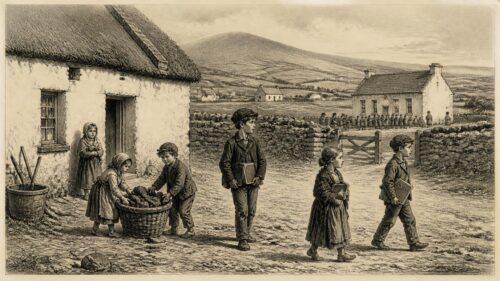
The farmhouse and cabin were workplaces as well as homes. Food was prepared and preserved; dairy produce was processed; clothing was made and repaired; children and older relatives were cared for; visitors, servants and labourers might be accommodated. The division between productive and domestic labour was often blurred. Women’s work sustained farms directly, but formal agricultural statistics and ownership records have frequently understated it.
Seasonality governed much rural activity. Sowing, planting, haymaking, turf cutting, harvest, fairs, calving and winter maintenance required different forms of labour. The horse remained indispensable for many farms until mechanisation became widespread in the twentieth century. Tractors and new machinery reduced physical drudgery and increased output per worker, but they also contributed to the decline of agricultural employment. A smaller number of people could work larger areas, changing the social life of villages and townlands.
Rural work should not be treated as exclusively agricultural. Blacksmiths, carpenters, millers, tailors, shopkeepers, teachers, carriers and seasonal migrants formed part of the countryside’s economic fabric. Many households mixed farming with wages earned elsewhere. The image of a self-contained farm family obscures these connections. Rural survival often depended upon movement: to fairs, markets, harvest work in Britain, domestic service in towns, construction sites, ships and emigrant destinations abroad.
Memory Myth
The countryside occupies a powerful place in Irish imagination. It has been represented as a repository of language, faith, tradition and national authenticity. Such representations have historical roots, particularly in cultural nationalism and in the preservation of folklore, but they must be handled critically. Rural communities did preserve rich bodies of story, song, custom and local knowledge. They were not, however, untouched survivals from an ancient past.
The National Folklore Collection records customs associated with harvest, St Brigid’s crosses, the last sheaf, animals, holy wells and seasonal observance. These records are precious evidence of what informants and collectors remembered or practised. They are not direct proof that a custom was universal, prehistoric or unchanged over centuries. Folklore commonly combines inherited motifs, local adaptation, religious practice and the circumstances of recording. A story told to a schoolchild in the 1930s is evidence of twentieth-century memory as well as of any older tradition it may contain.
Literature also challenged pastoral myth. Patrick Kavanagh’s work, particularly his unsparing vision of small-farm life, refused the idea that proximity to soil automatically produced contentment or virtue. The rural world could nurture humour, solidarity and attachment, but it could also be restrictive, sexually regulated, economically harsh and socially watchful. Historical interpretation is strongest when it allows these realities to coexist.
Memory is not therefore an obstacle to history; it is one of its subjects. Family stories of eviction, migration, a lost holding or an unusually generous neighbour may not settle factual questions on their own. Yet they show how communities gave moral meaning to land and departure. Their persistence helps explain why rural history remains emotionally charged long after the social conditions that produced particular memories have changed.
Changing Countryside
Twentieth-century change did not make rural Ireland historically irrelevant. It altered its scale, occupations and connections. Mechanisation, improved transport, education, electrification, television and later digital communications reduced some forms of isolation. At the same time, the fall in agricultural employment weakened institutions built around dense farm populations: small schools, local trades, fairs and seasonal work patterns.
Depopulation was uneven. Some areas near cities became commuter landscapes; other districts developed tourism, food production, forestry or new service employment. Coastal and upland places could experience revival alongside persistent challenges of distance and limited opportunity. The modern countryside is therefore not simply a remnant of a vanished farming society. It is a changing mixture of production, residence, heritage, recreation and environmental management.
Environmental questions now add another layer to rural history. Bog drainage, forestry, grazing regimes, hedgerow removal, river management and intensive agriculture have long consequences for biodiversity and water. Historical knowledge can clarify that present landscapes are products of human choices, but it cannot prescribe a single future. Conservation, farm income, food production and rural settlement can conflict. The past helps explain why these questions provoke strong feeling: land has always carried economic, familial and cultural claims at once.
Historical Evidence
Rural Irish history depends on combining evidence types rather than allowing one source to dominate. Archaeology can reveal settlement and production where documents are absent. Surveys and maps can show property, topography and official priorities. Tithe books, valuations and censuses permit close study of households and holdings, but they record people according to administrative purposes. Estate papers illuminate management and conflict while often preserving the voices of owners more fully than those of tenants. Folklore reveals memory and belief, but must not be mistaken for a complete census of custom.
The most responsible interpretation makes its uncertainties visible. A ruined cabin cannot by itself identify the family who lived there. A townland tradition may preserve a genuine experience while shifting dates or names. A national statistic can identify broad change but conceal local exceptions. Conversely, a vivid local story cannot automatically stand for the entire island. Rural Ireland was made from particular places, and those places require particular evidence.
What can be said with confidence is that the rural past shaped Ireland profoundly. Agricultural labour organised daily life for generations; land ownership structured political conflict; famine and emigration remade population and memory; and the countryside supplied enduring languages of belonging. The green field, the stone wall and the abandoned house are not simple symbols. They are historical records, if read with care: evidence of work, loss, adaptation and the continuing effort to make a life from land.
One compelling issue is the article’s insistence that rural landscapes are archives of competing claims rather than survivals of tradition. Field boundaries, townlands and consolidated farms can reflect customary use, estate improvement, famine loss, state surveying or later adjustment, while property records often obscure labourers and women whose work sustained households. This makes landscape evidence valuable and uncertain: visible features may preserve change as much as continuity. The article links these local transformations to emigration, political authority and national identity. How might combining maps, estate records, archaeology, oral memory and evidence of overlooked labour reshape interpretations of a community’s past?