
Biosecurity Ireland
At a Glance
Animal Health
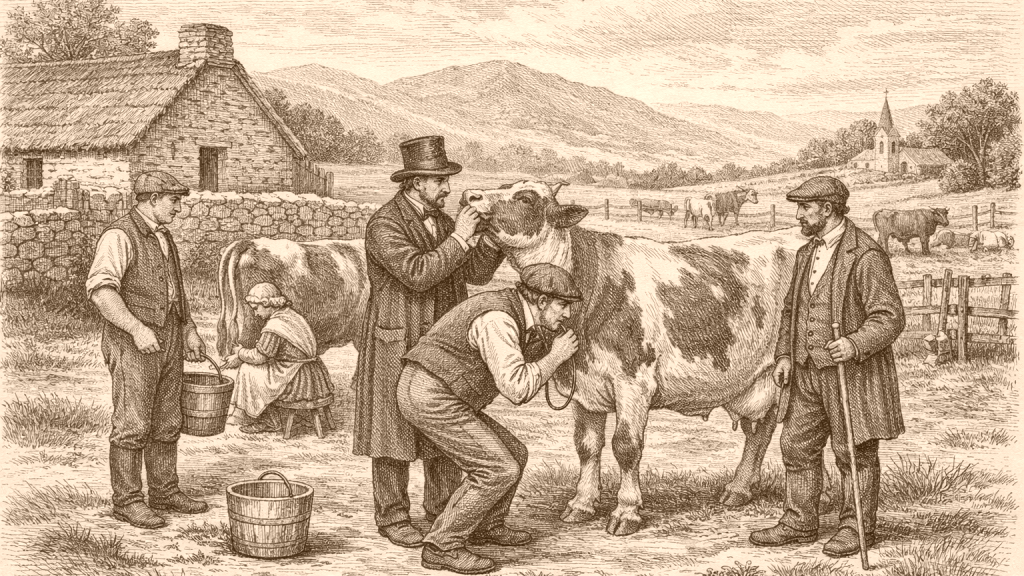
The strategy document frames animal health surveillance as part of the Irish agri-food sector rather than a narrow veterinary exercise. It says that agriculture accounted for a notable share of exports and employment in 2014, and it places livestock enterprises at the centre of that sector. The same passage connects Ireland’s favourable animal health status with a state veterinary service, a laboratory service, and an animal identification system that supports movement tracking and product traceability. [1]
The same strategy also records continuing challenges. It notes that while progress had been made against bovine tuberculosis, wildlife presence of M. bovis remained a challenge to a stated eradication aim. It also lists cattle diseases that reduce on-farm productivity, and it names antimicrobial resistance as another concern. These passages present surveillance as a response to disease pressure, but they do not provide a specific 2026 programme or outcome. [1]
Surveillance Work
The strategy defines animal health surveillance as the systemic collection, collation, analysis, interpretation, and timely dissemination of data from defined populations. It says surveillance is a key factor in improving animal health status and in maximising economic return for farmers while maintaining high animal welfare standards. That wording makes surveillance both a data process and an agricultural management tool, but the passage itself stops short of describing enforcement or market regulation. [1]
The same document also describes a crowded institutional field. It says animal health surveillance in Ireland involves farmers, private veterinarians, meat and dairy interests, government bodies, and research institutions. It identifies DAFM, Animal Health Ireland, and the Marine Institute as implementing organisations, and it says the number and diversity of stakeholders create a challenge for coordinated and effective delivery. The excerpt then notes that DAFM took a leadership role through a steering group. [1]
Farm Practice
The Teagasc SWAB project brings together scientists, industry, farmers, and veterinarians to develop solutions for animal health, welfare, and biosecurity in Irish agriculture. It says the project addressed current and emerging problems through an interdisciplinary programme and that one research strand examined the benefits of farm-level biosecurity practices. The project description therefore treats biosecurity as something to be studied alongside surveillance use and welfare behaviour rather than as a separate concern. [2]
The project page also lists practical outputs. Among them are a biosecurity scoring tool for Irish dairy farmers, an animated video for farmer engagement with animal health surveillance and diagnostic services, and a milk yield based syndromic surveillance system for Irish dairy cattle. This is direct evidence of tools aimed at farm use. The page does not explain how widely these tools were adopted, so any claim about impact would go beyond the excerpt. [2]
Dairy Tools
SWAB places dairy practice prominently in its outputs. The page includes materials on cow welfare, calf welfare, and a facilitation pack related to antimicrobial and anthelminthic resistance, alongside the biosecurity scoring tool. It also names several research outputs dealing with dairy cattle surveillance, calf welfare, and consumer perceptions. Taken together, the page shows biosecurity embedded within a wider set of animal-health and welfare tools. [2]
The project’s methods are described as participatory action research involving farmers, practicing veterinarians, industry, animal health professionals, consumers, and other actors. It says the goal was to create policy, veterinary, and extension tools that could have direct operational impact. The excerpt therefore supports a picture of biosecurity work that is collaborative and applied, but it does not document any individual farm case or a specific policy change. [2]
Regulatory Context
A departmental guidance page on pesticides and related substances shows another side of agricultural control. It says information and guidance are available on biocides, plant protection products, classification and labelling, and safety data sheets. It also states that pesticides and related substances, including biocides, are regulated by three divisions of the department working together to ensure safe agricultural practices and protection of the food consumer and the environment. [3]
This guidance page is not a biosecurity plan, but it does show an administrative setting in which agricultural safety is handled through official information and regulation. In that sense, it sits beside the surveillance and farm-level material rather than replacing it. The excerpt does not mention livestock disease, so it cannot be used to infer animal-health priorities from the page alone. [3]
Overall Picture
Across the three documents, Irish agriculture biosecurity appears as a connected set of activities: surveillance, disease monitoring, farmer engagement, and regulatory oversight. The strategy emphasises traceability, stakeholder diversity, and the need for coordination. The Teagasc project adds transdisciplinary research and practical farm tools. The departmental guidance shows that safe agricultural practice also includes product regulation. None of the passages by itself gives a complete national picture for 2026. [1] [2] [3]
The combined evidence is strongest on the existence of institutional coordination and the use of tools for farms, especially dairy farms. It is weaker on implementation detail, geographic spread, and measurable outcomes, because those matters are not directly stated in the retrieved passages. The most defensible conclusion is therefore descriptive: Irish agriculture biosecurity is represented here as a coordinated, evidence-based field centred on surveillance and applied farm practice. [1] [2]
Source References
Hover over a number to see the source. Select it to open the source.






How do the retrieved Irish agriculture documents describe surveillance and biosecurity priorities relevant to 2026 planning?