
Fuel Protests
At a Glance
Fuel Queues
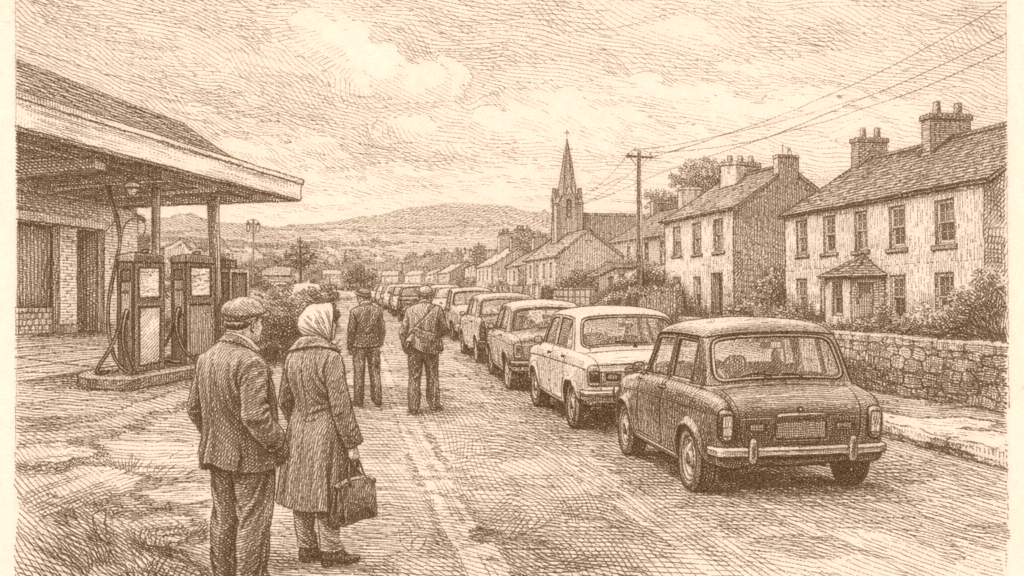
Contemporary reporting on Ireland's petrol strikes presents the most immediate face of fuel protest: long queues, rationing, and the closure of garages when deliveries stopped. One RTÉ archive item describes motorists waiting for hours, garages forced shut by lack of supply, and remaining petrol being rationed. Another archive collection refers to queues in 1973 and 1979, showing that these shortages were not isolated to a single moment but recurred in more than one crisis. [5] [7]
The same archive material also shows the visual and practical scale of the disruption. Cars are described as lining the streets bumper to bumper, with some motorists down to their last drop of petrol and pushing vehicles to the pump. The reporting does not explain who organised the strike or how long it lasted, but it does directly show scarcity, delay, and the dependence of ordinary travel on interrupted fuel supply. [5]
Oil Dependence
Oireachtas material from 1975 frames the larger context as dependence on imported oil. The committee noted the Community's objective of reducing internal consumption and referred to the danger of continued dependence on oil imported from third countries. It also recorded that the rate of growth of energy consumption should be reduced and that national circumstances would affect how such reductions worked in practice. [2]
The same report stated that Ireland could be affected more severely than other member states by proposals to reduce energy demand, because the country relied to a lesser extent on energy for some specific purposes and had less scope for cuts. That is an argument about relative constraint rather than a description of a protest, but it shows how energy security was already being discussed as a practical national issue rather than only a European one. [2]
Alternative Sources
The 1984 report on Community aid for solid fuel production traces a shift in emphasis from oil to other energy sources. It says coal had once been the major source of energy in Ireland and Western Europe, that oil displaced coal when cheap Middle Eastern supplies were available, and that the 1973-74 crisis led the Community to rethink policy and reduce dependence on imported oil. Coal and peat are presented as alternative sources that became competitive again when oil prices rose. [3]
That report also records wider responses after the oil shocks: the creation of the International Energy Agency in 1974, measures to increase indigenous energy production, attention to conservation, and renewed concern after the Iran-Iraq war. The passage does not describe street protests, but it does show official energy planning responding to insecurity of supply through diversification and restraint. [3]
Electricity Planning
The 1986 ESB report places electricity within the same longer energy-security problem. It states that the board had to cover its costs, relied on borrowings to finance expansion, and had substantial foreign-currency debt. It also notes that in the years before the first oil crisis the ESB generated most electricity from fuel oil, while shortages of electricity had not restricted national growth. The report therefore links financing, fuel choice, and supply capacity. [1]
The same report gives quantitative detail that helps explain vulnerability. It records accumulated losses, total investment, and total borrowings, and notes that two-thirds of borrowings were in foreign currency. It also says adverse currency movements increased borrowing levels. These figures do not by themselves show a protest, but they do directly document the financial pressure attached to maintaining energy supply after the oil shocks. [1]
Security Framing
By 2006, official language had settled more explicitly on security of supply. The Joint Committee on Communications, Marine and Natural Resources listed a chapter on security of energy supply and stated that Ireland had a very heavy dependence on imported fossil fuels. It also said the transport sector was the largest energy-consuming sector, was growing fastest, and depended almost totally on imported liquid fossil fuels. [4]
The report then moves from diagnosis to policy instruments. It says the Energy Miscellaneous Provisions Bill 2006 would facilitate full gas market opening, underpin the all-island energy market, allow emergency measures in a sudden market crisis, and expand the functions of the regulator. The wording is careful and administrative, but it shows that energy security was now being handled through market structure and emergency powers rather than only through fuel queues. [4]
Historical Pattern
Across these excerpts, the evidence shows a clear pattern of recurring anxiety about supply, though not a single continuous protest movement. The archive footage and reports move from queues and rationing, to oil dependence, to diversification into solid fuels and electricity planning, and finally to legal and market-based energy security. The passages do not provide a full narrative of every protest, but they do show repeated public and official responses to shortage. [2] [3] [4] [5] [7] [1]
The chronology is also uneven. The Oireachtas reports range from 1975 to 2006, while the RTÉ archive items point to petrol crises in 1973, 1979, and 1980. The annals source in the dataset is unrelated to fuel and is not used here. Within the relevant material, the record supports a comparison of immediate scarcity with later policy planning, but not a claim that every energy issue had the same cause or outcome. [5] [6] [7] [2] [3] [4] [1]
Source References
Hover over a number to see the source. Select it to open the source.

- [1] Committee Reports::Report No. 06 - Electricity Supply Board::09 December, 1986::Report
- [2] Committee Reports::Report No. 04 - Energy Policy::12 February, 1975::Report
- [3] Committee Reports::Report No. 01 - Community Aid for Solid Fuel Production::08 February, 1984::Report
- [4] Committee Reports::Report No. 07 - Review of Energy::01 June, 2006::Report
- [5] RTÉ Archives | Environment | Ireland's Petrol Strike
- [6] How Ireland dealt with the oil and energy shocks of the 1970s
- [7] RTÉ Archives | Collections | 1973 and 1979 Petrol Crises
How did Irish public fuel shortages and official energy policy discourse reflect concerns about energy security from the 1970s into the 2000s?