
Broadcasting Private
At a Glance
Legal Frame
The Wireless Telegraphy Act of 1926 set out a legal structure for broadcasting in the Irish Free State. It defined broadcasting as the transmitting, relaying, or distributing of matter by wireless telegraphy, and it included lectures, speeches, news, reports, advertisements, dramatic entertainments, and music among broadcast matter. The same act also provided for the maintenance of broadcasting stations by the Minister and for advisory arrangements. These provisions show broadcasting entering the statute book as a regulated public activity. [7]
The same act also limited possession and use of wireless apparatus unless it was authorised by licence. Its wording made unauthorised possession an offence and attached fines to contraventions. In that sense, broadcasting was not only a matter of content but also of technical permission and state control over equipment. The statute therefore placed the medium within a framework of licensing, ministerial approval, and enforceable restrictions from the outset. [7]
Radio Origins
Irish broadcasting began in Dublin with 2RN in January 1926, and the service was run by the Department of Posts and Telegraphs. A related Cork station, 2CK, followed in 1927, while both stations were described as low-powered and urban based. The first director, Seamus Clandillon, was concerned that listeners outside the towns should receive more than entertainment. He wanted programming that would also provide instruction and news for farming communities. [5] [2]
The early agricultural broadcasts show negotiations over audience, format, and usefulness. Department of Agriculture officials were uncertain about what should be broadcast, by whom, and when, and they questioned whether the station’s audience had been clearly identified. Clandillon proposed gardening and poultry-keeping first, while officials worried about reliable market prices and preferred short items rather than lengthy talks. The surviving passages present broadcasting as a practical public service shaped by administrative discussion. [5]
Television Arrival
Later accounts place the start of regular Irish television broadcasts on 31 December 1961, with Telefís Éireann described as the new television service accompanying Radio Éireann. One account says the Irish Republic became one of the last European nations to gain its own television service, while another notes that the 1960 Broadcasting Act established an independent public authority to oversee both radio and television. These passages mark television as a later addition to a pre-existing broadcast system. [3] [4]
The same television history describes the medium as a public service that had to inform, educate, and entertain while also relying on licence fees and advertising. It also records that the service arrived during a period associated with Seán Lemass and that television challenged several political, religious, and cultural institutions. The evidence here is descriptive rather than expansive: the passages state both the institutional form and the social setting, without offering a single causal explanation. [4]
Political Friction
The records also preserve episodes of tension between broadcasters and government. One account says Section 31 of the Broadcasting Authority Act 1960 allowed ministerial direction not to broadcast certain matter. It notes a 1971 directive and later a stricter 1976 directive affecting interviews and reports involving named organisations. Another history describes a 1972 dismissal of the Radio Telefís Éireann Authority after material the government considered seditious. These excerpts show formal pressure on broadcasting from the state itself. [2] [4]
The same material also records criticism from political figures. One passage says Seán Lemass regarded broadcaster criticism as hostile, while another says Charles Haughey objected to editing by Telefís Éireann when he was minister for justice. The later account adds that Ray Burke encouraged a commercial broadcasting service to challenge the public service provider. Together, these passages show that broadcasting was contested both inside and around government, though the excerpts do not explain every motive in detail. [4]
Commercial Entry
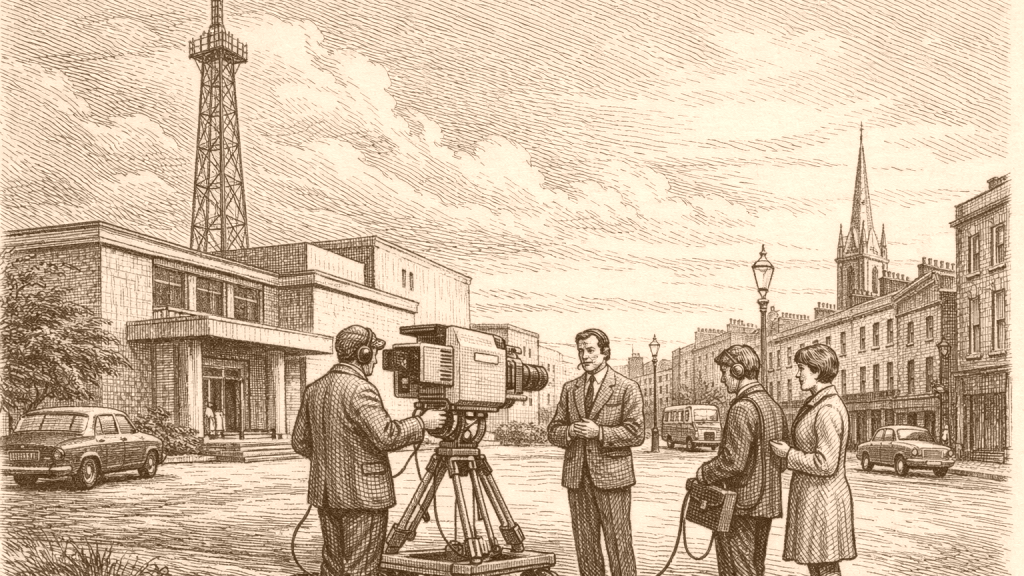
UTV provides the clearest evidence for private broadcasting in the records. It is identified as Ulster Television until 1993 and as the first commercial television broadcaster on the island of Ireland. It first went on air on 31 October 1959. The archive page also says an ongoing partnership among PRONI, Northern Ireland Screen, and ITV is preserving the archive and encouraging public engagement with it. [1]
The same archive record gives further detail about preservation. It says the UTV archive held at PRONI dates from 1959 until 1993, contains approximately 72,000 items, and includes Betacam tapes, cine film cans, and other formats such as 1 inch and U-Matic tapes. It also says complete broadcast programme tapes are preserved in the ITV archive at Leeds, while the rushes are preserved at PRONI. The passage is archival in tone and does not go beyond those material descriptions. [1]
Archive Access
The surviving institutional descriptions emphasise preservation and access. RTÉ Archives says it holds hundreds of thousands of hours of moving image and sound recordings together with photographs, manuscripts, and administrative documents. It also says that content broadcast by RTÉ becomes part of the archives, and that the archives aim to make material accessible through television, radio, and digital platforms. These statements define broadcasting not only as transmission but as an accumulating record. [6]
The UTV archive page gives a parallel account of access work in a commercial setting. It says digitisation projects have been funded by the Department for Communities and external funders including the Broadcasting Authority of Ireland and the British Film Institute. The same page notes that digitised files are preserved in PRONI’s digital repository, with first access through Northern Ireland Screen’s Digital Film Archive. In the available record, this is the clearest evidence for how private broadcasting material is being opened to users. [1]
Source References
Hover over a number to see the source. Select it to open the source.

How did Irish broadcasting move between state regulation and commercially operated television as reflected in the cited records?