
Late Late
At a Glance
First Broadcast
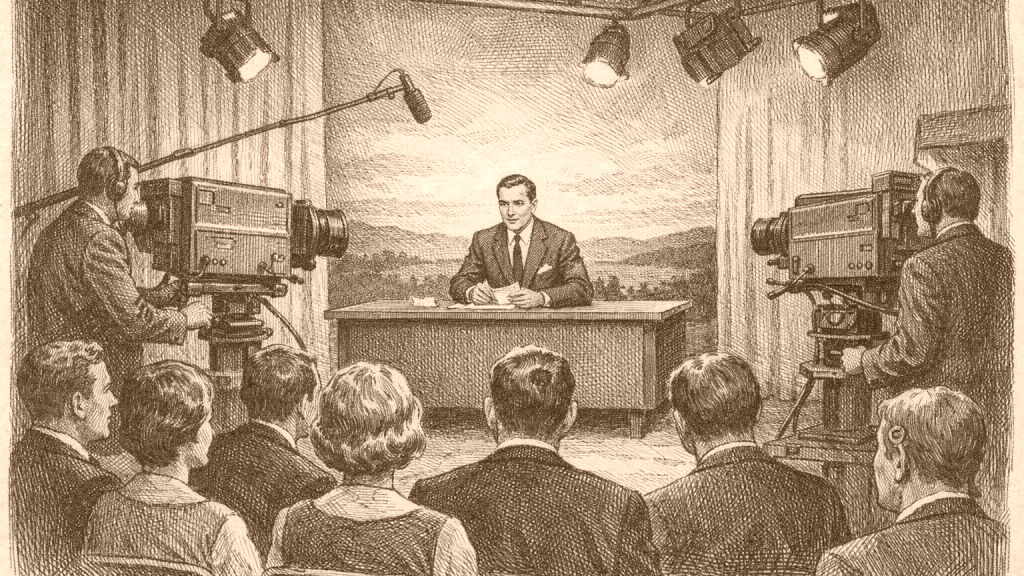
RTÉ archive material places the first broadcast of The Late Late Show on 6 July 1962 at 11.20 pm. It notes that, at the time, a live talk and entertainment programme so late in the schedule was unusual, and that the service stayed on air after midnight for the first time. The same archive item lists the opening-night guests as Count Cyril McCormack, Ken Gray, George Desmond Hodnett, and Harry Thuillier.
A later RTÉ Guide review describes the programme as informal and unrehearsed, with Gay Byrne hosting alongside a trio of regular visitors. It says the show could be seen every week in the same late slot and that the critic understood its appeal as a relaxed exchange unlike more prepared television. The review also records that the critic expected surprise in the guest list and that the format depended on live interaction.
Byrne Era
A retrospective RTÉ interview with Gay Byrne places him on the studio floor on 6 July 1962 and identifies his first guests. Byrne said the programme was live, with a studio audience that could ask questions, and that he had instructions not to research the guests in advance. Another RTÉ piece says he remained presenter for the next 37 years, making his tenure the longest recorded in the material reviewed here.
The same interview records that early viewers and critics reacted badly at first, expecting a variety show rather than the format they encountered. A later Brainstorm history also says Byrne was in the right place at the right time and describes him as central to the programme’s identity. That article links the show’s early years with Irish change, but its factual claims here are limited to Byrne’s role and the programme’s stated live, open-ended style.
Public Debate
RTÉ’s later historical summary says the programme created controversy in 1966 when rumours about a planned guest from the Playboy Club were followed by the better-known bishop and nightie incident. The same passage records that there was in fact no nightie, according to a Mrs Fox, and that some organisations called the show a dirty programme that should be abolished. This is an example of conflict recorded within the broadcast’s own remembered history.
The Brainstorm article also states that the show highlighted the church’s ban on Catholics attending Trinity in 1967, addressed Northern Ireland and contraception in the early 1970s, and later opposed sectarian violence by referring to killings from Bloody Sunday in 1972 to Enniskillen in 1987. These are presented there as examples of its content across decades, not as proof of wider causes or effects. They do, however, show the breadth of topics the article associates with it.
Changing Hosts
RTÉ archive material on the 1999 handover states that Pat Kenny was announced as the next presenter and would take up the role in September, when the programme began its 38th season. The same item says Gay Byrne was moving to a new RTÉ programme rather than disappearing from the broadcaster altogether. It also records management’s comment that Byrne could not simply be replaced, which is presented as a view within the archive report.
Another RTÉ archive report from 2009 says Pat Kenny stepped down after ten years as presenter. It notes that the final show in his run would be live from a specially constructed set in Donnybrook and that the programme still drew speculation about who would follow him. The same item says the show was then described as the world’s longest running chat show, a claim reported within the item rather than independently verified here.
Recent Era
RTÉ’s 2013 archive item on the first broadcast says Gay Byrne was succeeded by Pat Kenny in 1999, then by Ryan Tubridy, who remained host until 2023. It also identifies Patrick Kielty as the current host. These are the clearest succession markers in the material, and they show an unbroken sequence of named presenters across the programme’s later history rather than a change in title or format.
The 2024 archive note on Kenny’s departure and the 2023 Brainstorm history both show that the programme continued to attract comment and attention long after its first decades. One item says the show still had the capacity to get the nation talking after more than 40 years. The other describes it as a long-running cultural phenomenon. In these excerpts, the emphasis is on continuity of attention and host succession, not on a full programme-by-programme catalogue.
Archival Memory
RTÉ’s archive and history pages show how the broadcaster preserves the programme through broadcast notices, reviews, interviews, and later retrospective pieces. One exhibition page says RTÉ Archives holds programme files, scripts, correspondence, and interview notes, including material from The Late Late Show files. That same page indicates that the collection reaches from the earliest days of 2RN to the present, giving context for the show’s survival in the archive as well as on screen.
Seen together, these excerpts document a late-night debut in 1962, a long Byrne era, later presenter changes, and recurring public discussion. They also leave gaps: none of the retrieved passages offers a complete episode-by-episode history, and the later summaries do not list every contributor or format change. What they do show, consistently, is a programme that RTÉ itself treats as a durable part of its television history.
