
Nations Rugby
At a Glance
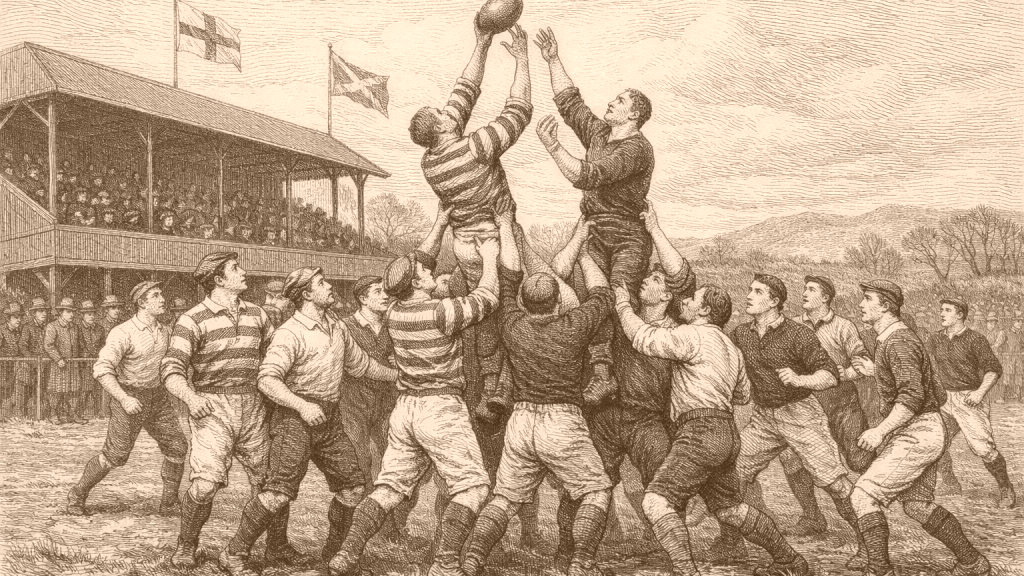
Origins Formative
Official tournament histories trace the championship to 1883, when England, Ireland, Scotland, and Wales played the inaugural Home International Championship. Another summary places the first rugby union international in 1871 and then identifies the 1883 series as the start of the older championship structure. Read together, these accounts show a progression from early international matches to a four-team annual contest that later became the basis for the modern championship. [1] [3]
The same historical summaries note early championship results without extending beyond what is stated there. England won the first series, while Ireland won in 1894, and Wales won in 1893 and again in 1908 and 1909. One source also says that those 1908 and 1909 Welsh triumphs were the first Grand Slams, because Wales defeated France in both seasons. The excerpted histories do not provide fuller detail for every intervening year. [1]
French Entry
The official chronology states that France officially joined in 1910 after having played in four tournaments up to that point. It then says the championship was referred to as the Five Nations, showing that the competition’s stated membership changed from four to five teams. One account also notes that England won the first championship of the new era, while Wales followed with the first Five Nations Grand Slam a year later. [1]
The same summary records two interruptions to the competition before the modern period. It says the tournament was suspended during World War I, then resumed in 1932 after France were ejected from the tournament in 1931, returning to the Home Nations form through 1939. Another passage says proceedings were halted again during World War II and resumed in 1947 as the Five Nations with France welcomed back into the fold. [1]
Postwar Change
The postwar section of the official history gives several direct markers of change. It says France won their first shared title in 1954 and their first outright title in 1959. It also states that by the 1970s the Five Nations had become the pre-eminent series in northern hemisphere rugby union, with matches becoming all-ticket affairs and attracting a large television audience. Those are the specific developments named in the excerpt. [1]
The same historical summary also records a specific unfinished championship in 1972, when Scotland and Wales refused to travel to Dublin to play Ireland. It then says the following season was unique for a five-way tie, with every nation having won and lost two games. These statements identify exceptional outcomes within the sequence of Five Nations championships without adding any explanation beyond the event descriptions themselves. [1]
Modern Format
The transition to the Six Nations is stated plainly in the official history. Scotland in 1999 were the last team to lift the Five Nations trophy, and Italy joined the following year, turning the championship into a six-country festival of rugby with three fixtures in each round. Another source similarly says the championship grew to include France and Italy, and describes it as having been played in one form or another for more than 138 years. [1] [3]
The same chronology gives a sequence of early modern winners and format notes. England won the first edition of the modern format and repeated the feat in 2001; France won their first championship of the professional era in 2002 with a Grand Slam. The source then notes that 2003, a Rugby World Cup year, brought additional significance before England won the Grand Slam and beat Ireland in Dublin in the final game of that championship. [1]
Recent Trends
The official history continues with later results and point-based distinctions. It says France took the Grand Slam in 2004, Wales won the Grand Slam in 2005, and Ireland repeated that away-from-home pattern four years later. It also states that from 1994 ties were broken by points difference rather than shared titles. These are the only structural and competitive changes directly noted in the excerpts. [1]
The same source records additional milestones in the middle of the decade. France retained the crown in 2007 on points difference, while Italy won their first away match against Scotland and their first two victories in a single championship after beating Wales in Rome. The following year Wales won the Grand Slam for the second time in four years, and the excerpt names Mike Phillips and Shane Williams in the description of that campaign. [1]
Contemporary Overview
A later World Rugby summary presents the championship as one of the oldest tournaments in rugby, played in one form or another for more than 138 years. It repeats that the men’s competition began as an international contest involving England, Ireland, Scotland, and Wales, and that it has grown to include France and Italy. The same source also states that a women’s edition has existed since 1996, showing a separate strand within the wider Six Nations framework. [3]
World Rugby’s tournament guides describe two different recent settings. Its 2021 guide discusses the pandemic and the men’s and women’s competitions still being played in October and November before the short turnaround into the new campaign. A separate piece looking towards Rugby World Cup 2023 describes the Six Nations as important for squad selection and as a measure of form. These are accounts from different championship seasons: the pandemic scheduling detail and the World Cup selection discussion come from separate World Rugby articles. [2] [3]
Source References
Hover over a number to see the source. Select it to open the source.




How did the Six Nations Championship expand from a Home International contest into a six-country tournament, and what changes in format are directly visible in the official historical summaries?