

Crown Contested
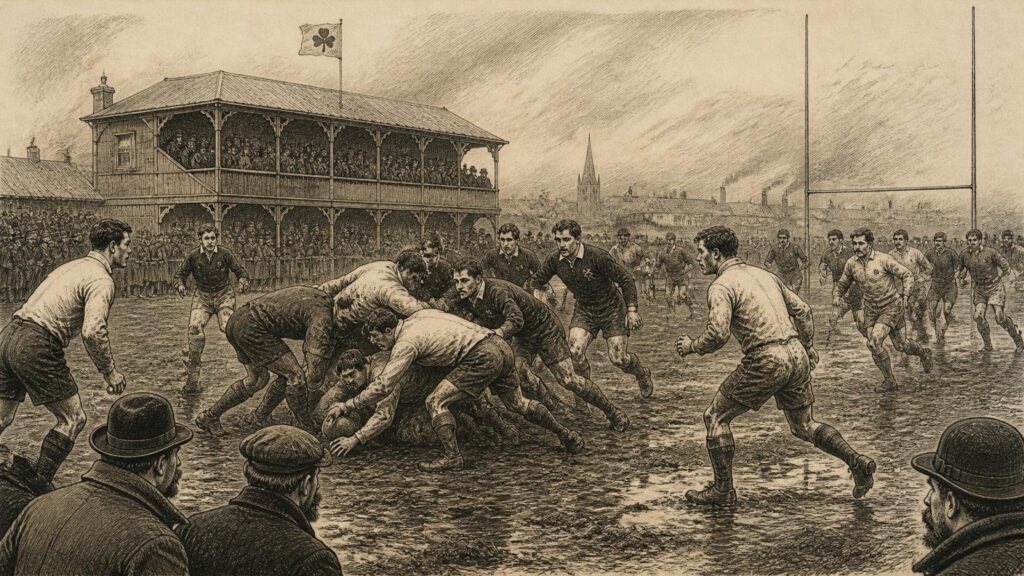
AI generated historical illustration, not a contemporary photograph.
At a Glance
The Triple Crown is one of rugby union’s most resonant honours: a prize with no fixed venue, no original cup and, for much of its history, no formal presentation. Yet its language first entered print through an Irish success in 1894. For Ireland, it has consequently been more than a sequence of victories over England, Scotland and Wales. It has been a measure of standing within the oldest international rugby neighbourhood, an all-island sporting tradition that outlasted constitutional change, and a recurring source of public memory.
Origins Defined
In rugby union, the Triple Crown is won when one of the four Home Nations—Ireland, England, Scotland or Wales—defeats each of the other three in the same annual Championship. It is contested inside the larger tournament rather than separately from it. France’s entry, and later Italy’s, enlarged the Championship, but neither side can win the Triple Crown and neither fixture counts towards it. The Crown therefore preserves the older four-nation relationship within a competition that has otherwise changed its title, membership and professional character several times.
The framework emerged from international rugby’s earliest decades. Scotland and England met in 1871 in what is conventionally recognised as the first rugby union international. Ireland first played England in 1875, while the Irish Rugby Football Union was created in 1879 through the merger of earlier Dublin-centred and Belfast-centred bodies. The inaugural Home International Championship followed in 1883, bringing England, Ireland, Scotland and Wales into a regular annual series. England completed the first clean sweep in that opening season.
It is important, however, to distinguish later terminology from contemporary language. Modern lists call England’s 1883 achievement the first Triple Crown, because it satisfied the definition subsequently attached to the honour. The phrase itself was not then the settled name of the feat. This is not a pedantic point. It reminds us that sporting traditions are often assembled retrospectively: an achievement comes first, a durable name later, and a trophy later still.
The Crown’s peculiar status follows from that history. It is neither identical to the Championship nor identical to a Grand Slam. A team may defeat the other three Home Nations but lose to France or Italy, thereby taking the Triple Crown without winning the full Championship. Conversely, France or Italy may influence the Championship table but cannot prevent a Home Nation from completing its three required victories. A Grand Slam, by contrast, requires beating every opponent in the relevant version of the Championship. The distinctions are simple in rule, but they have generated a rich hierarchy of meaning among supporters.
At its heart, the Triple Crown is a condensed record of relations among four unions which helped shape international rugby. The four sides do not represent an uncomplicated political unit. Ireland has been represented by a union organised across the island; England, Scotland and Wales each possess their own sporting institutions and distinct national cultures. The annual encounters have therefore carried association, rivalry, neighbourhood and history all at once. The Crown rewards supremacy over the closest and oldest opponents, not merely a place at the top of a points table.
Irish Beginnings
Ireland’s place in the story was established before the expression “Triple Crown” became familiar. The Irish Rugby Football Union’s own institutional history records that it governs rugby across the island of Ireland. Its formation in 1879 united the Irish Football Union, which had operated in Leinster, Munster and parts of Ulster, with the Northern Football Union of Ireland in Belfast. Provincial branches followed in Leinster, Munster and Ulster, with Connacht joining the structure later. That arrangement gave Irish rugby a geographical breadth unusual in a sport whose early elite was heavily concentrated in urban clubs, schools and universities.
The early international side was not initially strong. Ireland’s first match, against England at the Kennington Oval in February 1875, ended in defeat. Its early Championship record reflected the difficulty of building a competitive representative team against more established opponents. By the early 1890s, though, Ireland had become capable of challenging the other unions, and the 1894 campaign proved a turning point.
The history of that team should not be romanticised as a straightforward national awakening. Rugby in nineteenth-century Ireland had distinct social boundaries. It was especially associated with schools, universities, clubs and professional networks whose membership was disproportionately middle-class and Protestant. That does not make the players or their achievement less Irish, but it does mean that the public imagined by contemporary rugby coverage was narrower than the whole population of Ireland. The game’s institutions supplied a platform for international representation while also reflecting the inequalities and exclusions of the society in which they were formed.
Nor should later national meanings be automatically projected backwards. In 1894 Ireland remained within the United Kingdom of Great Britain and Ireland. International rugby nevertheless provided an arena in which an Irish team, selected and administered in Ireland, played under its own union against the other Home Nations. The distinction between political sovereignty and sporting representation is central to understanding the Crown’s Irish history. Rugby made room for an Irish collective identity without resolving the larger constitutional questions of the period.
This is one reason the event has remained historically valuable. The Irish side was neither an abstract team nor simply a proxy for a modern state. It represented a sporting organisation and a set of players drawn from the island’s provinces. Their victories could be celebrated in language of Ireland and nationhood, even when the political vocabulary surrounding those words was contested. The Triple Crown became one of the forms through which Irish rugby expressed that layered identity.
Social Boundaries
The early Home Nations game was amateur in a very particular sense. Its leading players had occupations and social connections outside rugby; travel, training and selection were fitted around work, education and club life. The amateur ideal was also entwined with class. Access to the game depended on schools, colleges, clubs, leisure and networks of patronage. Such conditions shaped who could become an international and who was likely to be represented in reports and photographs.
Contemporary newspaper language also reveals the assumptions of the period. It freely used national personifications and nicknames that now sound archaic or uncomfortable. The Irish Times report on Ireland’s concluding victory over Wales in March 1894 celebrated “triple crown honours” and treated the result as a dramatic answer to years of disappointment. It spoke of “Hibernians” and “the Shamrock” in a rhetorical register common to late Victorian sporting journalism. That language is primary evidence of how a newspaper framed the match; it is not neutral evidence of how all people in Ireland understood rugby, Ireland or nationality.
The distinction matters because later recollection can smooth away the sport’s uneven social reach. Rugby has subsequently become a more extensive game across the island, with women’s rugby, youth rugby, community clubs and professional provincial teams all contributing to a broader public. The nineteenth-century international side, however, emerged from a much more limited social world. A historical account should acknowledge both realities: rugby’s capacity to create long-lived shared institutions and the restricted character of its earliest representative culture.
There is also a temptation to treat every old match as a prelude to later political events. That risks turning players into symbols they did not choose to be. The more defensible interpretation is narrower. International rugby offered a recurring stage on which Ireland could compete as Ireland. The Crown mattered because it converted three difficult fixtures into a clear claim of superiority over neighbouring teams. It did not settle the meaning of Irishness, but it supplied a widely intelligible sporting language through which Irish success could be described.
First Triumph
Ireland’s 1894 campaign gave that language its most important early moment. Ireland beat England 7–5 at Blackheath, Scotland 5–0, and Wales 3–0 in Belfast. Scorelines from this period need to be read with care because rugby’s scoring laws differed markedly from modern practice. In 1894 a try was worth three points and a conversion two; the tactical balance of the game, and the significance attached to a goal or a dropped goal, was consequently unlike that of modern rugby.
The decisive Welsh match was played at the Ulster Cricket Club ground in Belfast. It was a close, weather-affected contest, the sort of low-scoring encounter that can look austere to a modern reader but was entirely consistent with the game’s laws, conditions and forward-dominated style. Ireland’s narrow victory completed the clean sweep. Captain Edmund Forrest’s side had done what England, Scotland and Wales had already managed in earlier seasons, but it was the Irish report that supplied the term which endured.
The Irish Times of 12 March 1894 declared that Ireland had achieved “the triple crown honours of Rugby football”. World Rugby and the World Rugby Museum both identify this as the first known newspaper reference to the idea. Absolute claims about first usages always require caution: surviving newspapers are not every newspaper, and digital searching does not replace exhaustive archival work. Yet the evidence is unusually direct. The newspaper printed the phrase immediately after Ireland’s sweep, rather than a later historian applying it retrospectively.
That gives Ireland a distinctive place in the history of the honour. England’s 1883 clean sweep remains the first achievement now classed as a Triple Crown. But Ireland’s 1894 victory is the event at which the phrase entered documented rugby journalism in its recognisable form. The name was not merely attached to Ireland after the fact; it was articulated in an Irish newspaper to celebrate an Irish team.
Ireland repeated the feat in 1899. The second Crown confirmed that 1894 was not an isolated accident, although the interval between the two achievements was short and the wider pattern remained uneven. A modern tendency to arrange sporting history as a steady march of improvement is misleading. International rugby before the First World War was subject to shifting selection, changing laws, uneven preparation and the limited resources of amateur administration. Successes could be striking without heralding permanent dominance.
Still, the 1894 and 1899 triumphs became foundational memories. They supplied an origin story with identifiable players, difficult grounds, tense finishes and newspaper language capable of being revisited by later generations. Their significance lies not only in the results but also in the creation of a vocabulary. Once “Triple Crown” existed, it allowed players, journalists and supporters to name a particular kind of Home Nations accomplishment.
Changing Championship
The competition surrounding the Crown did not remain static. France officially joined in 1910, creating the Five Nations Championship. France’s later exclusion from the tournament meant that the contest returned to four sides during the 1930s, before the Five Nations was restored after the Second World War. Italy joined in 2000 and the modern Six Nations began. These changes transformed the Championship but did not displace the Crown, because its rule remained tied to the three fixtures among Ireland, England, Scotland and Wales.
The Crown’s survival is revealing. It is sometimes dismissed as a secondary prize when compared with a Championship title or a Grand Slam. Yet its endurance across changing formats suggests something more durable than a consolation. It is an inherited honour, rooted in the original international circuit, and the four participating unions continue to treat its matches as carrying a particular emotional weight. The expansion to six teams actually sharpened the distinction: there are now more matches to play, but the old three-opponent challenge remains identifiable within the broader schedule.
The two World Wars interrupted the Championship and broke the annual rhythm on which sporting traditions depend. Such gaps matter. They remind us that the apparently continuous pageant of international rugby has been subject to wider crises. Players served, were injured or killed; clubs and grounds were affected; travel and ordinary sporting life were disrupted. The Crown was not an eternal ritual outside history. It was resumed and reimagined in the postwar world.
In Ireland, that postwar return carried additional significance. The island had been partitioned, but the IRFU continued to administer rugby on an all-island basis. UCD Archives notes that, following partition, the union retained its full thirty-two-county and four-provincial organisation. This does not mean that rugby escaped political tension or social division. It does mean that the international team and its governing body supplied one continuing institutional connection across the border at a time when many other structures were organised differently.
Postwar Revival
Ireland’s 1948 season occupies a special place because the Triple Crown came with the Championship and Grand Slam. The side defeated France, England, Scotland and Wales, ending with a 6–3 victory over Wales at Ravenhill in Belfast. Irish Rugby’s archival account describes the occasion as one in which public attention reached beyond habitual rugby followers, a plausible reflection of the relief and longing for collective occasion in the austere years after war.
The 1948 achievement was Ireland’s first Triple Crown since 1899, ending a gap of nearly five decades. Jack Kyle became the most celebrated figure of the side, though it would be misleading to reduce a fifteen-man achievement to one player. The pack, the half-backs and the tactical discipline demanded by the period were essential. What later memory has preserved is the combination of scarcity and release: a generation which had known wartime disruption saw Ireland complete the most comprehensive possible Championship campaign.
The following year brought another Triple Crown, although not another Grand Slam. Ireland lost to France but defeated England, Scotland and Wales. The contrast is useful. It demonstrates the Crown’s independence from the wider Championship. A clean sweep of the other Home Nations could remain a major success even when an overseas opponent had already denied the full unbeaten record. That possibility has helped preserve the honour’s distinctiveness in every era of the Five and Six Nations.
Postwar accounts should nevertheless resist nostalgia. The victories were real and their reception was substantial, but rugby’s public was not a single national community speaking with one voice. Ireland’s social, religious and political divisions remained profound. Ravenhill itself was in Belfast, and the side represented an all-island union in a divided island. The significance of the team lies partly in that complexity: its matches created occasions of common sporting attention without dissolving the differences beyond the touchline.
Long Interval
After 1949, Ireland waited until 1982 for another Triple Crown. The length of that interval gave the prize a special emotional charge. International rugby supporters often remember such absences more vividly than league tables: generations inherit stories of what was not won, then attach exceptional value to the moment a familiar disappointment ends.
The 1982 team, captained by Ciaran Fitzgerald and guided by coach Willie John McBride, defeated England 16–15, Scotland 21–12 and Wales 20–12. Ollie Campbell’s kicking was central to the campaign and to its subsequent memory. Ireland did not merely break the drought; it won the Championship as well. The result established 1982 as a landmark in the modern history of Irish rugby, especially for followers whose first deep experience of the international side was shaped by the long wait after 1949.
Ireland won again in 1985, defeating England, Scotland and Wales and sharing the Five Nations Championship with France. Back-to-back Crowns were evidence of a side with genuine quality rather than a single fortunate campaign. Yet they did not inaugurate an uninterrupted era of Irish dominance. The later 1980s and 1990s brought difficult seasons, while the game itself was moving towards a professional future that would alter conditioning, coaching, player development and the economics of international sport.
The history of 1982 and 1985 has often been told through heroic moments: Campbell’s boot, a late score, a packed Lansdowne Road, the authority of a captain. Such memories are legitimate parts of sporting culture, but they are not a substitute for analysis. The deeper historical point is that the Crown continued to matter even during years when Ireland was not consistently at the summit of European rugby. It provided a comprehensible measure of recovery: beat the three old rivals, and a season was given a lasting shape.
Professional Renewal
Rugby union formally embraced professionalism in 1995. Ireland’s later Triple Crowns must be understood against that transformation. The professional game required more structured player pathways, stronger provincial competition, specialist coaching, sports science and a more demanding international calendar. Ireland’s rise in the early twenty-first century was not caused by one reform alone, nor by the Crown itself, but recurring Crown successes became visible evidence that the national side could compete at the highest level.
Ireland won the Triple Crown in 2004, its first in nineteen years. The final match, a 37–16 victory over Scotland at Lansdowne Road, followed earlier wins over Wales and England. The campaign mattered enormously to supporters who had seen the 1980s achievements recede into history. It did not end in a Championship title, because France won the Grand Slam, and that fact again illustrates the Crown’s separate logic. Ireland had ruled the Home Nations portion of the contest even as France completed the wider sweep.
The team won again in 2006 and 2007 under captain Brian O’Driscoll. The 2006 achievement was especially memorable because Ireland beat England at Twickenham to complete the three victories. In 2007, a further Crown followed. These campaigns placed Irish rugby in a new relationship with its own past: the honour was no longer a rare recollection from 1985 but a standard the team expected itself to reach.
In 2009, Ireland combined the Triple Crown with a Six Nations Championship and Grand Slam, its first Grand Slam since 1948. The final 17–15 victory over Wales in Cardiff, sealed amid late pressure, became one of the defining Irish sporting occasions of the professional era. The comparison with 1948 is tempting and meaningful, but the contexts were radically different. The 2009 team played in a globalised professional sport, in a media environment of continuous coverage and before a far larger commercial audience. Continuity lay in the Crown’s old structure; change lay in almost everything surrounding it.
Further Irish Crowns in 2018, 2022, 2023, 2025 and 2026 show that the honour has remained meaningful amid sustained modern success. The 2018 campaign again formed part of a Grand Slam. The 2022 and 2023 achievements reflected a side that had become a regular contender rather than an occasional disruptor. In March 2026, Ireland completed another Crown with victory over Scotland at the Aviva Stadium. These results are sporting facts, not proof that history progresses in a straight line; other Home Nations have their own cycles of recovery and decline. They do show how thoroughly the Crown has been absorbed into Ireland’s modern rugby expectations.
Material Symbol
For most of its existence, the Triple Crown had no official physical trophy. This absence was part of its charm. It was a named honour, a line in records and a cause for celebration, but not an object raised after the decisive match. The phrase “invisible cup” became a useful description, though it should not imply that the achievement was somehow unreal. In sport, status often rests on collective recognition rather than metalwork.
There were unofficial attempts to give it form. The World Rugby Museum preserves a coal sculpture made by Durham miner Dave Merrington in the 1970s, incorporating the symbols associated with the four Home Nations. It was an imaginative local intervention rather than the competition’s official prize. Its survival is a reminder that supporters and craftspeople sometimes materialise traditions before governing bodies do.
An official trophy finally arrived in 2006, when the Championship’s sponsor commissioned a silver dish from Hamilton & Inches. Irish Rugby recorded that Brian O’Driscoll lifted it after Ireland’s win at Twickenham that year. The object changed presentation, not the underlying definition. Ireland had already won seven Crowns before there was an official plate to receive.
The late trophy has produced a small historical confusion. Viewers who see a contemporary captain holding silverware can assume that identical presentations accompanied 1894, 1948 or 1982. They did not. The material trophy is modern; the honour is Victorian in origin; and the tradition of retrospectively naming earlier clean sweeps stretches back across both eras. Keeping those layers distinct makes the story more interesting, not less.
Island Identity
The Irish dimension of the Triple Crown cannot be confined to results. The IRFU remains the governing body for rugby on the island of Ireland, and the international team continues to draw players from all four provinces. This structure has endured partition, periods of severe political conflict and changing constitutional relationships between Dublin, Belfast and London. It has given rugby a distinctive institutional place in Irish life.
That continuity should not be exaggerated into a simple tale of sport overcoming politics. Rugby has never stood outside society, and its traditions, venues, symbols and supporters have been interpreted differently by different communities. But the all-island union has provided a durable framework in which players from north and south have represented one side. When Ireland contests the Triple Crown, it does so through an institution whose territorial and provincial structure predates the state in the Republic and survived the division of the island.
This helps explain why victories in Belfast, Dublin, Cardiff, Edinburgh, London or Twickenham can carry more than ordinary sporting resonance. The Crown is not an expression of an uncomplicated “four nations” friendship, nor is it merely a relic of Victorian Britain. It is a living sporting ritual in which historical relationships are renewed, contested and celebrated. For Ireland, its meaning has been shaped by both the antiquity of the contest and the particular durability of the IRFU’s all-island organisation.
Lasting Meaning
The Triple Crown endures because it combines clarity with depth. Its rule can be explained in one sentence: defeat the other three Home Nations in the same Championship. But that sentence contains more than a century of sporting history. It reaches back to the formation of the Home Nations tournament, to Ireland’s narrow victories in 1894, to an Irish newspaper’s formative phrase, to postwar celebration, to long intervals of frustration, and to professional-era teams who inherited an old honour while playing a new game.
Documented evidence allows firm statements about results, institutions and the printed use of the term in 1894. Interpretation begins when considering what those facts meant to audiences. It is reasonable to see the Crown as a powerful expression of Irish rugby identity, but it would be unsound to claim that every person in Ireland experienced it alike. Folklore and supporter memory add colour—stories of mud, wind, packed terraces and miraculous kicks—but they should be recognised as memory unless corroborated by contemporary evidence.
That distinction does not diminish the tradition. On the contrary, it clarifies why the Crown matters. Its history is not a single uninterrupted national epic. It is a record of a sport evolving from restricted amateur circles into a professional, all-island institution; of an old four-team contest surviving expansion; and of Irish teams repeatedly finding significance in defeating their nearest rivals. The Triple Crown remains contested because the relationships that created it remain alive.
The article’s distinction between achievement, naming and trophy is revealing. England’s 1883 clean sweep is retrospectively recognised as the first Triple Crown, yet the phrase gained currency when an Irish newspaper celebrated Ireland’s 1894 victories. That sequence suggests sporting honours are not created on the pitch; their meaning develops through journalism, memory and recognition. It complicates the tendency to treat the Crown as a minor subset of the Six Nations, given its connection to relationships among the Home Nations and Ireland’s all-island union. How should supporters balance historical origin, contemporary competition and symbolic identity when valuing the Triple Crown today?