
Rivers Trust
At a Glance
Textual Record
The catalogue of Irish texts lists several annalistic works together, including the Annals of Ulster, the Annals of Tigernach, the Annals of Inisfallen, the Annals of Connacht, and the Annals of the Four Masters. It also places fragmentary and short annals beside these larger compilations. On its own, the list shows a strong concentration of historical and annalistic material, but it does not explain how any one text treats rivers, floods, or public trust in particular. [1]
The same list shows that the annalistic field is not confined to one title or one editor. It names editions of the Annals of Ulster, Annals of Inisfallen, the Four Masters, and other short or fragmentary collections, while also placing them within broader categories such as historical, legal, and genealogical texts. The observable pattern is breadth within a manuscript tradition, not a direct statement about flooding or river governance. [1]
Ulster Witness
The Annals of Ulster edition notes a text preserved in multiple manuscripts, with lacunae in specific year-ranges and supplementation from a second manuscript where possible. It describes the principal manuscript as ending imperfectly and records a fair copy with additional entries. These notes allow a reader to see where the surviving text is continuous and where it is interrupted, but they do not identify river floods as a special subject of the edition itself. [2]
The edition history also shows successive printings and translations. One version extends to 1540 in four volumes, another presents the text to 1131, and another preserves additional material from a second manuscript while distinguishing it from the principal hand. These details matter because they show how the same annalistic work is encountered through editorial mediation, even when the present record offers no specific flood entry to compare with later flood studies. [2]
Flood Chronology
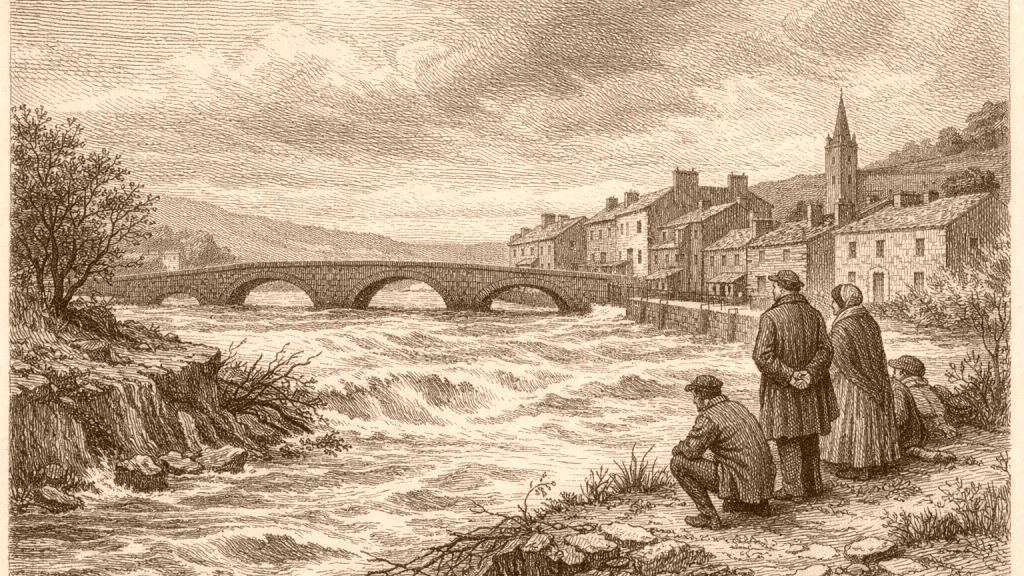
A flood chronology for Cork city covers the years 1841 to 1988 and reports 292 floods classified into six types. The study says it considers rainfall, tidal conditions, river discharge, and storm surges, and it identifies excessive rainfall as the major cause while noting the significance of high tides, especially when storm surges accompany them. This is a modern quantitative record, not an annalistic one, but it directly addresses river flooding. [3] [5]
The Cork study is also explicit about its setting in one city and about its flood vocabulary. Its metadata names storm surge and flood myth among the keywords, while the abstract situates the work within climatological background and flood chronology. The record therefore combines local flood counting with climate-related framing. What it does not provide here is a direct bridge to legal doctrine; that connection appears only when the legal sources are read alongside it. [3] [5]
Risk Narratives
A later historical analysis of flooding in Ireland says that recent floods in Dublin, Cork, and Galway generated two dominant narratives in public discourse and official responses. One presents recent floods as unprecedented and as possible evidence of climate change; the other treats floods primarily as natural events and assumes that preventing flood events is the optimal way to reduce losses. The article then states that these narratives are not supported by its historical analysis of exposure and vulnerability. [4]
The same abstract says the paper draws primarily on newspaper archives to construct a record of past flooding, and it argues that narrow quantitative risk assessment and narrow numeric instrumental records perpetuate the narratives it criticises. It also says that incorporating broader source types may illuminate more creative strategies for reducing flood losses. Those statements concern contemporary risk framing; they do not directly establish any historical legal doctrine on rivers. [4]
Trust Doctrine
Legal writing on the public trust doctrine describes it as a basis for public rights in certain natural resources. One article says the doctrine has been used historically to safeguard public rights in navigable waterways, and another says the modern doctrine requires Great Lakes states to protect sustainable future uses while constraining exploitation. These are legal descriptions of trust and access, not records of Irish flood events. [6] [7]
The public trust article on Great Lakes waterways further divides analysis into geographic scope, access rights, protected uses, and remedies for impairment. It also notes debate over compatibility with private property rights. Read beside the Irish flood chronology and the historical flood analysis, these passages show distinct kinds of concern: one legal, one climatological, and one historical. The available record supports comparison, but not a claim that any one text settles the issue of river flooding and public trust. [6] [7] [3] [4]
Comparative Reading
Taken together, the materials show three layers of evidence. First, Irish annalistic texts are listed in a broad scholarly catalogue and the Annals of Ulster survive through multiple manuscripts and editions. Second, a modern flood chronology measures flood frequency and type in one city over a defined period. Third, legal scholarship defines public trust in waterways as a doctrine of public rights, access, and protected uses. The relationship among them is comparative rather than documentary. [1] [2] [3] [6] [7]
What remains absent in these excerpts is a direct passage linking a specific Irish flood entry to a doctrine of public trust. The record instead offers adjacent forms of knowledge: annals, flood chronology, and legal theory. That omission is itself visible in the sources used here. It means any fuller argument about rivers, flooding, and trust would need additional evidence beyond these passages. [1] [2] [3] [4] [6] [7]
Source References
Hover over a number to see the source. Select it to open the source.

- [1] List of Irish Texts at CELT
- [2] The Annals of Ulster
- [3] A flood chronology for Cork city and its climatological background
- [4] Environmental knowledge and human experience: using a historical analysis of flooding in Ireland to challenge contemporary risk narratives and develop creative policy alternatives - ResearchSPAce
- [5] A Flood Chronology for Cork City and its Climatological Background - Discover Research at University College Cork
- [6] "The Public Trust in Surface Waterways and Submerged Lands of the Great" by Bertram C. Frey and Andrew Mutz
- [7] "Changing Conceptions of Property and Sovereignty in Natural Resources " by Richard J. Lazarus


How do annalistic, flood, and public trust materials together frame rivers flooding and public trust in the surviving record?