
Battle Fields
At a Glance
Named Ground
The annalistic excerpts present battlefield places as named locations within compact notices. One passage records the battle of Ard Ladhron and another the battle of Cuil Marta, while later entries attach battle names to deaths and reigns. These notices are spare: they name the place, identify the fallen, and move on. The strongest observable pattern is not narrative expansion but the repeated linking of combat to specific toponyms and named rulers (1:2,4,14,15). [1]
The same excerpt set also shows that a ruler’s reign can be followed by a list of battles attributed to him. Irial Faidh is said to have fought several battles, and Tighernmas is later associated with a long sequence of victories. The text also records other place-based changes, such as plains cleared, forts erected, and rivers erupted, but these are separate statements from the battle notices themselves. The evidence is descriptive, not explanatory (1:5-10,19-22). [1]
Clontarf Memory
The Clontarf summary gives a tightly located battlefield scene on the north shore of Dublin Bay, near modern Clontarf and the mouth of the Tolka. It identifies the opposing forces as Brian’s army and a combined enemy force, and it states that Brian won while also losing his life. The passage also names several killed leaders on both sides, including Brian’s heirs and enemy commanders (8:2-5,12-16). [3]
The same account also draws a boundary between certainty and later explanation. It says the battle was not simply Irish against Vikings and adds that casualty totals from later sources are unreliable. The text does not present Clontarf as a single-ethnic conflict; instead, it notes that Irish soldiers fought on both sides and that the result did not end Dublin’s political role immediately. Those are direct statements in the passage (8:17-22). [3]
Dublin Approach
A separate Dublin-area battlefield is described in modern prose as Battlefield, Clonliff, Co. Dublin. The site is said to lie somewhere on the northside streets near Clonliffe Road and the Tolka, but the precise location has never been established. The entry says no monument marks it and that the battle is thought to have been fought in late summer 1086, though no annalist gives an exact date (9:1-3,11-12). [4]
That same entry states that several annalistic sets record the engagement and agree that Mael Sechniall’s army was shattered. It also names some of the commanders on his side, including Mael Ciaran Ua Cathasaigh, and says both allied kings were killed. By contrast, it says the leaders of the victorious Dublin-Leinster side are not named in any surviving source. The passage therefore preserves outcome more clearly than victor identity (9:4-9). [4]
Reigning Warriors
The annals repeatedly tie battlefield descriptions to named reigns. Irial Faidh is said to have fought a cluster of battles and to have presided over place changes, while Eithrial later falls in battle of Raeire after a reign of twenty years. Conmael is described as the first king of Ireland from Munster and as having fought several battles before falling in the battle of Aenach Macha. These are plain sequencing statements (1:5-17). [1]
The same pattern appears with Tighernmas, whose second regnal year is linked to the eruption of nine lakes and whose later reign includes a long list of battles gained over the race of Emhear, others of the Irish, and foreigners. The passage does not explain these wars, but it does show how combat, place, and reign are interwoven inside the annalistic notice. The observable emphasis is on succession and listing rather than on narrative analysis (1:18-22). [1]
Marching Armies
The sixteenth-century annal excerpt shifts from ancient battlefield naming to a campaign narrative. It records Sir William Russell’s march against Fiagh in January 1595, Fiagh’s alarm, the flight of people from the castle, and Walter Reagh’s later arrival to join him. The passage then moves to nocturnal raiding near Dublin, burning, and plundering. These are concrete movements and actions, not interpretations of motive or strategy (2:2-13). [2]
Later in the same excerpt, the text names a wider rising in Ulster and several armed movements into neighboring territories. It says the O’Neills left no property in parts of the Baron of Slane’s country, and that Maguire and Mac Mahon ravaged Breifny O’Reilly and much of Cavan. It also notes the arrival of Sir John Norris with 1,800 soldiers and describes further marching by O’Donnell toward Connaught (2:14-22). [2]
Evidence Limits
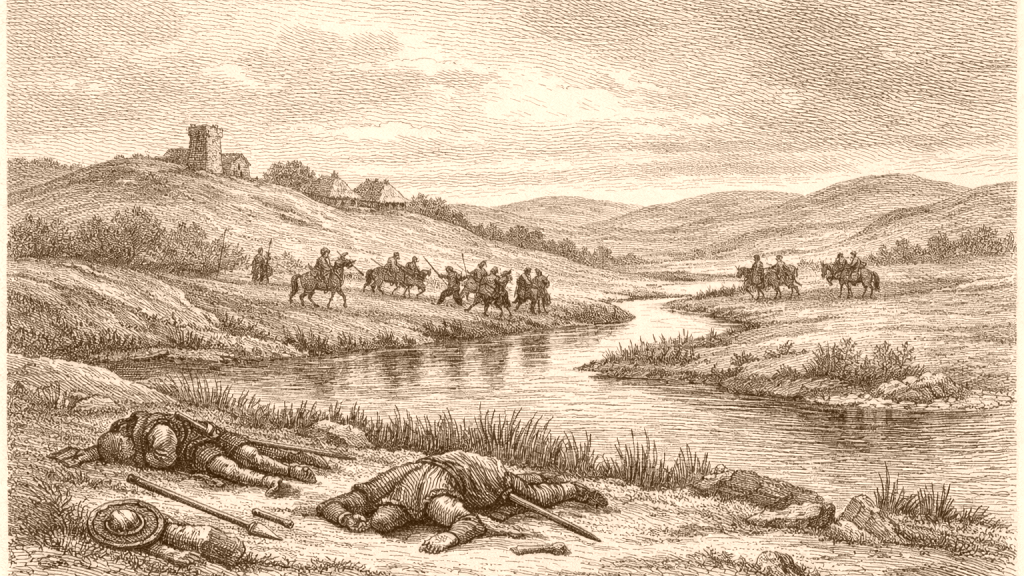
The Clonliffe battle is placed in the late summer of 1086, when an army marching on Dublin was stopped there and decisively beaten. The precise location has never been established, and the notices say no monument marks the site. One account links the action to the death of Tairdelbach Ua Briain on 14 July 1086, after which Mael Sechniall, son of Conchobor Ua Mael Sechniall and king of Tara and Meath, marched south through Leinster. The men of Dublin and Leinster met him at Clonliffe, and both allied kings were killed. [4]
The comparison also shows that one can describe what the texts state without extending them into broader claims. The annals name battles, rulers, and casualties; the Clontarf summary names armies and commanders; the Clonliff entry names only some participants and withholds others; the 1595 passage records marches and raids. Read together, they preserve battlefield traces in different densities, but they do not by themselves supply a single unified battlefield story (1:2-22; 2:2-22; 8:2-22; 9:1-12). [1] [2] [3] [4]
Source References
Hover over a number to see the source. Select it to open the source.

How do the retrieved annalistic and historical passages describe battlefield places, battle outcomes, and named participants across different Irish conflicts?