Glendalough Raids
At a Glance
Evidence Limits
The materials gathered here do not directly state that Vikings raided Glendalough in any specific year. One database describes itself as a collection of Irish annal entries on Viking activity and says it covers the years up to 902, which already limits its usefulness for a later tenth-century episode. A separate annals index presents later entries, but the relevant passages cited below concern places other than Glendalough. The safest reading is therefore cautious: these excerpts illuminate the wider setting, not a confirmed Glendalough raid.
The annal passages themselves show why restraint matters. They record captures, raids, battles, and burnings in several locations, but none of the cited lines names Glendalough. That means the excerpts support a broader picture of conflict involving foreigners and Irish rulers, not a direct statement about this particular monastery. In historical terms, absence in these excerpts is not proof that no raid happened, only that these passages do not document one. Any stronger claim would go beyond what the texts here actually say.
Glendalough Context
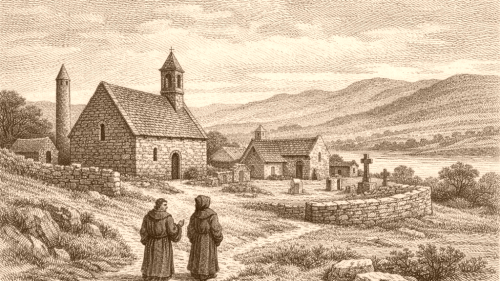
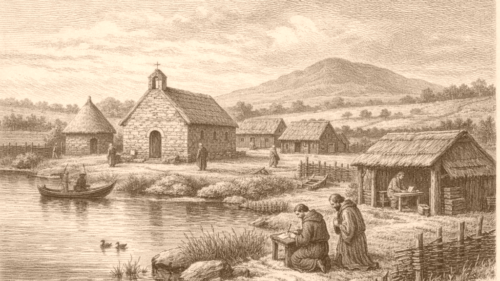
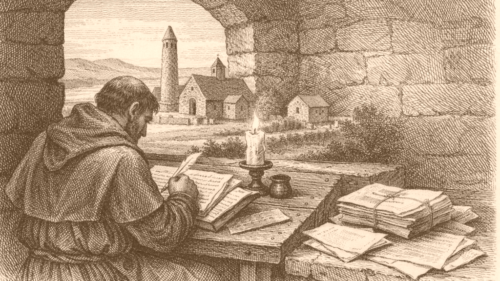
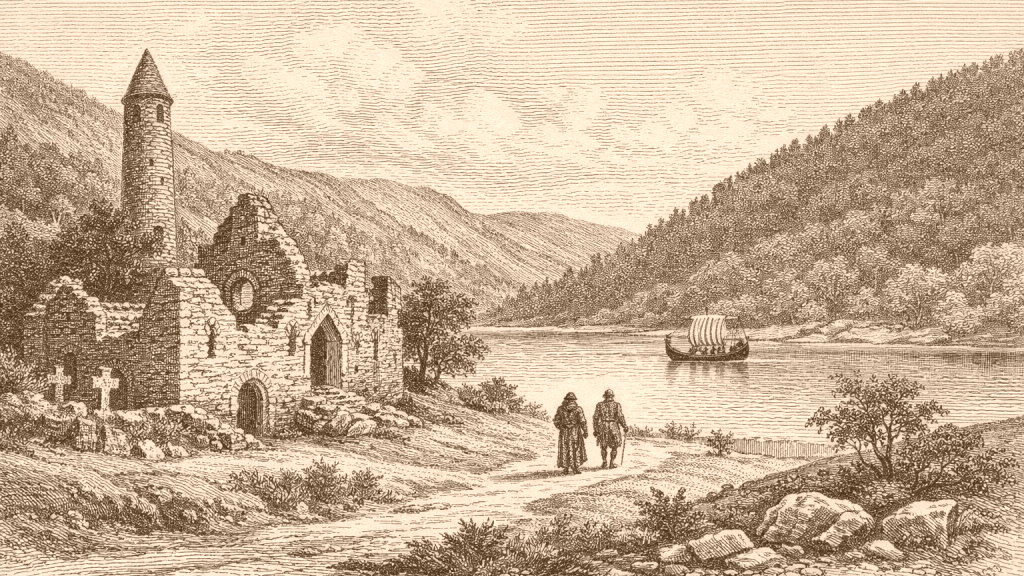
Glendalough appears in the museum material as one of Ireland’s most important monastic sites, set in a valley between two lakes in County Wicklow. The same description links the site to St Kevin, whose life is associated with prayer, solitude, and the valley landscape. This matters for the topic because a place of such importance would naturally draw attention in discussions of early medieval conflict, yet the excerpt itself is descriptive rather than narrative. It establishes setting and significance, not a raid account.
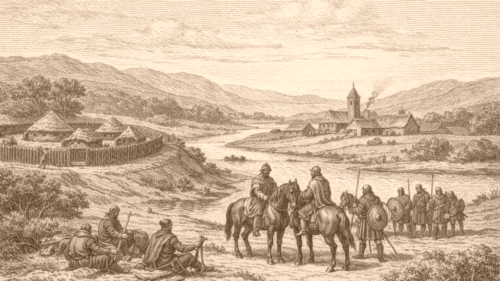
The same museum page says that major players in medieval Ireland included Vikings, bishops, abbots, and local and national kings, and that Glendalough remained a place where landscape, buildings, objects, and Christianity became intertwined. That language places Vikings within the valley’s wider medieval story, but it still does not specify a raid on the monastery. The excerpt therefore supports only a general connection between Glendalough and Viking-age Ireland, not a precise event description. The distinction is important for any careful historical account.
Annal Records
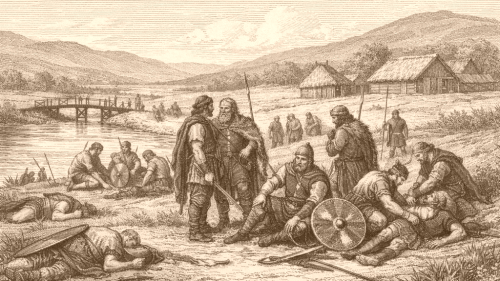
The Annals of Tigernach excerpt records several violent events in the late tenth century. It notes a foreign capture of a Leinster king, a profanation of Scattery Island in an attack on the foreigners of Limerick, and later a battle at Tara against the foreigners of Dublin. These notices demonstrate that the annal tradition cited here does record Viking and Irish conflict in detail. What they do not do in the quoted lines is identify Glendalough, so they cannot be stretched into a specific Glendalough narrative.
Other entries in the same annals continue the pattern of conflict. The text records battles at Belach Lecht and Bithland, the burning and ravaging of religious sites, and the capture of a Leinster king by the foreigners of Dublin. Because these notices are specific about places and actors, they show how an annal entry can name a site directly when the compiler wished to do so. Their silence on Glendalough in the cited passages is therefore meaningful as a documentary limit, not as a hidden reference.
Chronicle Scope
The chronicle database description explains that its purpose was to make ninth-century records of Viking activity in Ireland available to a wider audience and that it was assembled from several named annals, including the Annals of Ulster and the Annals of Tigernach. It also states that some texts were excluded because they were not annalistic in origin. This helps explain why a modern search environment may point to Viking material without automatically producing a complete or direct answer for every place-name, including Glendalough.
A separate Irish-annals search guide confirms that the Annals of Tigernach and other annals are available through searchable platforms, but it does not itself supply the historical content of any particular raid. In this set of excerpts, that matters because the search infrastructure and the historical record are different things. The guide shows where texts can be consulted; it does not by itself prove that a raid on Glendalough appears in the passages quoted here.
Museum Setting
The museum account makes clear that archaeology adds physical evidence to the story of Glendalough. It points to portable objects, chance discoveries, and planned excavations, and it mentions a tenth-century woman’s leather shoe from a bog and an eleventh-century bishop’s decorated pin. These examples do not describe Viking raids, but they do show that the site is archaeologically rich and that tenth-century material is present in the broader landscape. That strengthens interest in the period without creating evidence for a specific attack.
Taken together, the excerpts support a restrained conclusion. Glendalough was a major monastic place in a landscape where Vikings were among the actors in medieval Ireland, and the annals preserve many examples of raid and battle elsewhere. Yet the cited passages do not directly record a Viking raid on Glendalough itself. For a historical narrative based only on these materials, the most defensible statement is that the topic remains plausible in its wider context but unproven in the quoted record.
Historical Reading
The strongest historical reading of these excerpts is therefore a negative one: they do not let us reconstruct a Glendalough Viking raid in detail. Instead, they reveal how later readers may encounter the subject through a combination of site history, archaeology, and annalistic references to Viking activity in Ireland. The museum text identifies Glendalough as a major monastic site; the annals identify raids and battles elsewhere; the database notes define the scope of the record used here. Together they frame the limits of certainty.
In that sense, the evidence supports an argument about documentary method as much as about the past event itself. A careful account can say that the available excerpts show Viking-age Ireland, a significant monastic landscape at Glendalough, and a chronicle tradition that preserves conflict elsewhere. It cannot, on these texts alone, claim that Glendalough was raided in a particular year or by a particular group. The historical answer is thus partial, specific in its limits, and explicit about what remains unknown.