Tírechán
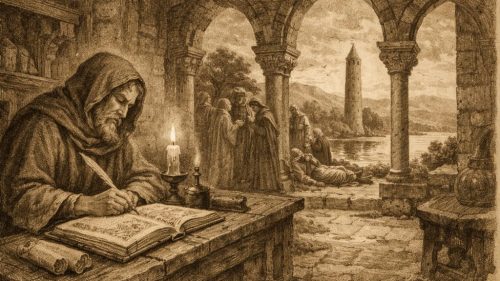
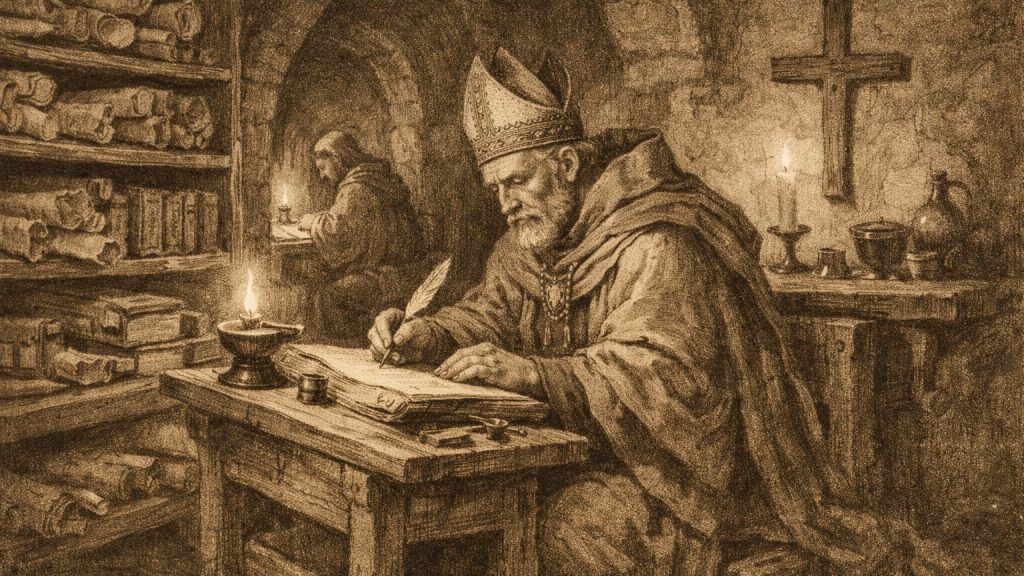
Tírechán is known from a short introductory sentence attached to the Collectanea, a Patrician text preserved in the Book of Armagh. The sentence identifies him as a bishop and says that he wrote from the words and the book of Bishop Ultán, whom he calls his fosterling and pupil. That brief notice is the firm basis for what can be said about him as a historical figure. The surviving material linked with his name is not a full biography in the modern sense, but a compilation concerned with the life and activity of Saint Patrick in Ireland.
Dateline
Tírechán is known from a short introductory sentence attached to the Collectanea, a Patrician text preserved in the Book of Armagh. The sentence identifies him as a bishop and says that he wrote from the words and the book of Bishop Ultán, whom he calls his fosterling and pupil. That brief notice is the firm basis for what can be said about him as a historical figure. The surviving material linked with his name is not a full biography in the modern sense, but a compilation concerned with the life and activity of Saint Patrick in Ireland.
Textual Witness
The Patrician material associated with Tírechán survives in manuscript copies, with the Book of Armagh the key witness named in the available sources. The modern presentation of the text on St Patrick’s Confessio gives the introductory line that attributes the work to Tírechán and situates him in relation to Ultán of Connor. The same site lists manuscript witnesses to the Patrician texts, showing that the work was copied and transmitted in later medieval manuscripts as well as in the Book of Armagh. Tírechán is therefore known above all through a textual tradition rather than through an independent narrative of his own career.
Ecclesiastical Links
The opening sentence attached to the Collectanea names Tírechán as bishop and describes him as the fosterling and pupil of Ultán. That relationship matters because it places him within a clerical setting of teaching and authority. The available text also gives the impression that he worked from oral and written material associated with Ultán. Beyond that, the sources do not provide a secure account of his ordination, his see, or his wider ecclesiastical office. The title “bishop” is the clearest designation preserved for him.
Patrician Material
The English translation of Tírechán’s text preserved on St Patrick’s Confessio presents a wide-ranging account of Patrick’s early life, travels, foundations, and companions. It includes Patrick’s captivity at seventeen, his service in Ireland, his eventual departure from druidic service, and his later movement through Gaul and Italy. It also presents episodes about Patrick’s arrival in Ireland, his first church, the baptism of Benignus, and the consecration of bishops. These are all features of Tírechán’s Patrician narrative as transmitted in the text. The sources make clear that the work is concerned with Patrick’s mission and the organisation of the early Irish church.
Chronological Claims
The text attributed to Tírechán contains chronological statements about Patrick, including a count from the Passion of Christ to Patrick’s death and a note that the latest of Patrick’s wondrous deeds occurred in the fifth year of the reign of Loíguire son of Niall. It also mentions that Patrick died 433 years after the Passion of Christ, as the text counts it. These are statements within the Patrician tradition preserved in Tírechán’s work. They are not independent modern dates for Tírechán himself, and the sources provided do not supply life dates for him. His own chronology remains unspecified in the surviving evidence.
Manuscript Context
The Confessio site’s discussion of Tírechán describes the difficulty of assigning biographical details to a person known from limited evidence and notes that the identification rests on the sentence copied into the Book of Armagh. It also places the text in the context of early medieval manuscript culture and scholarly transmission. The same site’s bibliography and manuscript listings show that interest in Tírechán belongs to the wider study of Patrician writings and their preservation. His work stands as part of the documentary tradition through which Patrick’s story was copied, interpreted, and reused.
Historical Presence
Tírechán’s historical presence is therefore that of a bishop and compiler linked to Ultán and to the Patrician tradition. The extant material shows him as someone who assembled a narrative about Patrick from inherited words and a book attributed to his teacher. The surviving testimony does not provide a fuller personal biography, but it does preserve his name, his clerical rank, and his place in the textual history of early Irish Christianity. Through that brief introduction and the work attached to it, Tírechán remains one of the named voices in early medieval Irish hagiography.
Source References
Hover over a number to see the source. Select it to open the source.