Baetán’s Assassination586 CE
The annals do not present a single uniform record for 586 CE. The Annals of Ulster, Tigernach, the Chronicon Scotorum, and the Annals of the Four Masters each print a year heading near the relevant material and then list notices that vary in wording, sequence, and level of detail. Several texts place the same kingship, deaths, and battles in adjacent years rather than in a single shared entry. This comparison keeps the records separate and reports only what each excerpt explicitly states. It also distinguishes year-headed notices from broader context, such as death notices that appear in nearby years. No omitted material is inferred.
Dateline
Year Frame
The printed year frames differ, but each text provides a way to locate notices for the period around 586 CE. In the Annals of Ulster, the relevant material appears under U586.0 and U587.0, printed as AD 585 and AD 586 respectively, and the cluster includes the killing of Baetán son of Ninnid and the note, “Or this year, the battle of Druim Meic Erca.” In Tigernach, the matching cluster appears under T586, where the same year block contains the rest of Carillan bishop of Armagh, the rest of Senach bishop of Clonard, the conversion of Constantine to lord, great snow, the slaying of Aod the Black son of Suibne Araide, and the falling asleep of Nathcomi. [1] [2]
The later compilations also print year headings for the same period. The Chronicon Scotorum gives Annal CS586 and places there the killing of Baetán son of Ninnid son of Daui son of Conall Gulban, while the Annals of the Four Masters print Annal M586, “The Age of Christ, 586,” followed by the nineteenth year of Aedh and several notices. These headings are not identical to one another, and the texts do not use the same sequence of notices. [4] [5]
Ulster Notices
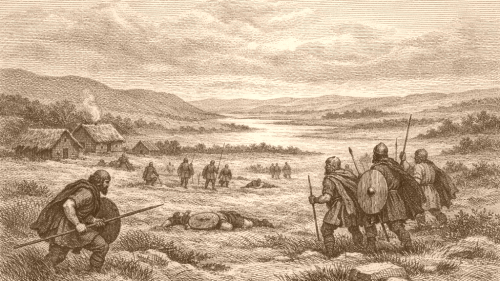
The Annals of Ulster place the first notice in the year block headed U586.0, which corresponds to AD 585, and the next in U587.0, which corresponds to AD 586. Under U586.1 they record the killing of Baetán son of Ninnid son of Daui, also identified as son of Fergus Cennfhata son of Conall of Gulbu, king of Temair, said to have reigned one year. The entry adds that Cuiméne son of Colmán Bec and Cuiméne son of Librén killed him at the instigation of Colmán at Léim ind Eich. [1]
The Ulster sequence therefore contains two different forms of notice for the same year frame: one direct killing notice and one battle notice introduced as uncertain by “Or this year.” The entry for Doaethe(?) gives a separate battle result and names Aed son of Ainmire as victor, while the prior notice names the men who killed Baetán and the place of the killing. The excerpt does not identify Druim Meic Erca beyond naming it as a possible event of that year, so no further description can be added. [1]
Tigernach Record
Tigernach places a different set of notices under Annal T586. The year block names the rest of Carillan bishop of Armagh, the rest of Senach bishop of Clonard, the conversion of Constantine to lord, great snow, the slaying of Aod the Black son of Suibne Araide, and the falling asleep of Nathcomi. The same excerpt also identifies Aod the Black as the killer of Diarmaid son of Cerball. These notices are given without any attempt in the text to merge them with the Ulster wording. [2]
Tigernach’s year block for T586 is notable for the density of entries rather than for a single battle notice alone. It includes ecclesiastical deaths, a conversion notice, a weather notice, and a killing notice. The excerpt does not explicitly label any of these as belonging to a different year, so the safest description is that they are printed together under T586. [2]
Other Versions
The Chronicon Scotorum matches the period with a shorter but related notice set. Under Annal CS586 it records the killing of Baetán son of Ninnid son of Daui son of Conall Gulban, king of Temair, and says that Cuini son of Colmán and Cumaine son of Librén son of Illadon son of Cerball killed him at the instigation of Colmán Bec at Léim ind Eich. The same sequence also gives the beginning of the reign of Aed son of Ainmire. [4]
The Annals of the Four Masters place their 586 notices under “The Age of Christ, 586.” They state that the nineteenth year of Aedh began, that St. Daigh, bishop and son of Cairell, died on 18 August, that Feidhlimidh son of Tighernach, king of Munster, died, and that the battle of Magh Ochtair was gained by Bran Dubh son of Eochaidh over the Ui Neill at the hill over Cluain Conaire, to the south. [5]
Nearby Context
Some notices close to the year 586 are printed in adjacent year blocks rather than in the 586 block itself. In the Annals of Ulster, the death of Daig son of Cairell and the battle in which Colmán Bec son of Diarmait fell appear under AD 586 and AD 587 around the same stretch of text. [1] [3]
The same caution applies to notices that are plainly year-adjacent in the other annals. In Tigernach, T586 includes the conversion of Constantine and the slaying of Aod the Black, while T587 contains a torrid and dry summer and David of Cell Muni died. In the Four Masters, the notices for 586 are followed by a separate 587 heading with the deaths of Caerlan and Seanach. [2] [5]
Year Comparison
Across the texts, the year 586 CE is represented chiefly by killings, battle notices, ecclesiastical deaths, and one conversion notice. The most repeated named figure is Baetán son of Ninnid, whose killing appears in Ulster and the Chronicon Scotorum, while Tigernach instead emphasizes related deaths and weather within the same year frame. The Four Masters add a dated death of St. Daigh and a battle at Magh Ochtair. These are directly observable differences in the printed notices, not harmonized reconstructions. [1] [2] [4] [5]
Taken together, the excerpts show that 586 CE cannot be reduced to one agreed event list. Each annal preserves its own phrasing and order, and some entries are marked with uncertainty or appear only as short notices. The safest account is therefore a comparison of what each text prints under the relevant year heading. That comparison stays within the wording of the annals and avoids adding motive, significance, or missing events that the excerpts do not state. [1] [2] [4] [5]
Source References
Hover over a number to see the source. Select it to open the source.