Manu Victory583 CE
The surviving annals preserve only a small set of notices associated with 583 CE, and they do not all arrange them in the same way. The Annals of Ulster place an AD 583 heading before a death notice, a papal notice, a battle notice, another death, and an alternative note about Brénainn. The Annals of the Four Masters give an Age of Christ 583 heading with the sixteenth year of Aedh and a death notice for Fergus. Tigernach and Chronicon Scotorum preserve nearby notices with different wording and sequence. This record is sparse, parallel, and not fully harmonised.
Dateline
Yearly Records
The Annals of Ulster keep the year heading distinct from the notices that follow it. U583.0 gives the heading, “Kalends of January sixth feria, second of the moon. AD 582,” and U583.1 then records the death of Feradach son of Daui, king of Osraige. The same annal entry continues with Pelagius, the battle of Manu won by Aedán, and the death of Fergna son of Caibléne. U583.5 adds, “Or this year, the repose of Brénainn of Cluain Ferta.” U584.0 then opens AD 583. [1]
The Annals of the Four Masters also attach a year heading to this cluster. Under M583.0 they give the Age of Christ 583 and the sixteenth year of Aedh, followed by the notice that Fearadhach, son of Duach, lord of Osraighe, was slain by his own people. In this form the year heading and the death notice stand together, and no battle is named in the cited lines for that entry. [3]
Named Dead
The Ulster notice for U583.1 names Feradach son of Daui as king of Osraige. In the Four Masters, M582.2 records Fearadhach, son of Duach, Lord of Osraighe, slain by his own people. The two texts present short death notices rather than explanatory narratives, and each places the entry within its own annal sequence. The Ulster text sets the notice before Pelagius, while the Four Masters place the death under the year heading that follows the Age of Christ 582. [1] [3]
Fergna son of Caibléne appears in the Ulster text as a separate death notice. U582.2 records his death, and U583.4 repeats the notice after the battle of Manu and before the optional remark about Brénainn. The wording gives no place, cause, or wider explanation. It is therefore safer to treat the Ulster references as concise annal entries, not as a developed narrative about the circumstances of his death. [1]
Battle Notices
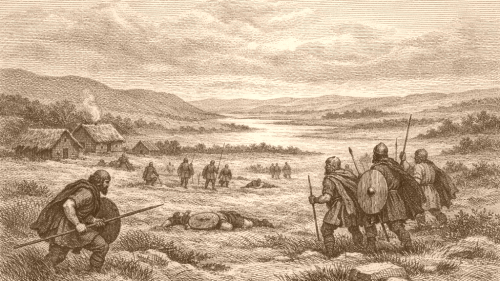
The Ulster text records the battle of Manu twice in this sequence. U582.1 says that Aedán son of Gabrán son of Domangart was victor there, and U583.3 repeats the notice more briefly: “The battle of Manu won by Aedán.” The passage does not identify the opposing force, the cause of the fighting, or any other combatants. Its emphasis is on the victory and on Aedán’s name, not on narrative detail. [1]
The Four Masters do not place a battle in M583.0–M583.2. In that entry they give the Age of Christ 583, the sixteenth year of Aedh, and the death of Fearadhach son of Duach. Their battle notices in the surrounding material occur elsewhere, including Magh Ochtair under M586 and Eadan Mor under M590. On that page, therefore, the 583 entry is limited to a year heading, a regnal count, and one death notice. [3]
Parallel Texts
Chronicon Scotorum arranges the material in a separate sequence of annal years. Under CS583 it gives the killing of Fergus Scannal, king of Mumu, and the repose of Fergus, bishop of Druim Lethglaise, who built Cell Biain. The sequence then moves on to Annal CS585, with the repose of Mac Nisi of the Ulaid, abbot of Cluain moccu Nóis, and Annal CS586, with the killing of Baetán son of Ninnid son of Daui son of Conall Gulban. The entries are brief and follow one another in the annal sequence. [4]
Tigernach also arranges these notices in a year-by-year sequence. Under T583 it records the rest of Mac Nisse, abbot of Clonmacnois, and the death of Aodh son of Suibne, king of Maonmhagh. Under T584 it gives the killing of Baedan son of Nindid son of Dua son of Conall Gulban and then says that Aod son of Ainmire took the kingship of Ireland. The order is distinct from the Ulster and Four Masters entries. [2]
Contextual Entries
These texts keep the roles of Aedh and Aedán distinct. In the Four Masters, M583.1 gives the sixteenth year of Aedh, while M583.2 records the death of Fearadhach son of Duach. Ulster U583.3 records the battle of Manu won by Aedán, and Tigernach places the death of Baedan son of Nindid in T584.1 before Aod son of Ainmire took the kingship in T584.2. The notices are separate and should not be merged into one chronology. [3] [1] [2]
The surviving record for this year also sits beside ecclesiastical and papal notices. Ulster’s AD 583 passage includes Pelagius, with the length of his pontificate, while the Four Masters’ nearby years include notices for Fergus of Druim Leathglaise and Bréanainn of Teathbha. These are listed as separate entries, and the texts do not connect them by narrative explanation in the passages preserved here. [1] [3]
Year Boundaries
For 583, the annals present parallel entries rather than a single continuous narrative. In Ulster, U583.0 is the heading for AD 582, while U584.0 opens AD 583; the Four Masters mark M583 with the Age of Christ 583 and Aedh’s sixteenth year; Tigernach has T583 and T584 as separate annal years; and Chronicon Scotorum places its notices in CS583 and the neighbouring years. The shared evidence is a sequence of short notices, not one unified account. [1] [3] [2] [4]
The record is also limited in scope. It preserves deaths, one battle notice, one papal notice, and a small number of regnal statements, but it does not offer a continuous account of events in Ireland for the year. The safest description is that the annals preserve several brief notices associated with 583, with differences in wording, sequence, and year-heading practice across the texts. [1] [3] [4] [2]
Source References
Hover over a number to see the source. Select it to open the source.