
Henry Arrival
At a Glance
Medieval Context
The Annals of Ulster place the opening notice in the year 1171, beginning with Diarmait Mac Murchadha, king of Leinster, and recording his death after the destruction of many churches and territories. The same year then moves through deaths, killings, and battles before reaching Henry’s arrival. In these entries, Ireland appears as a landscape of kingships, church houses, and armed encounters, with the annalist moving from one event to another in brief succession rather than giving a continuous narrative. [1]
A later National Archives account states that from 1171, when King Henry II invaded, Ireland came under English lordship. That same source adds that around 1200 a colonial government in Dublin was established answerable to the English government in Westminster. The wording is modern, but it directly frames the 1171 episode as the beginning of a longer relationship between Irish administration and English authority. The excerpt does not explain the process in detail, only its broad chronological outline. [4]
Royal Landing
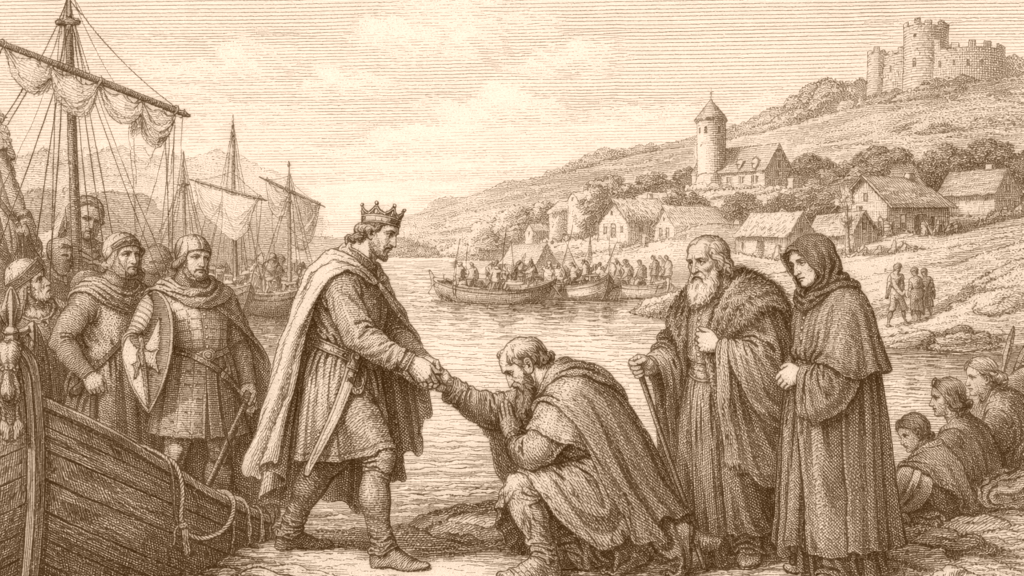
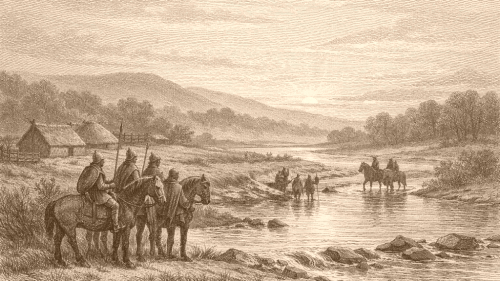
The Annals of Ulster record that Henry, son of the Empress, came into Ireland in 1171 as king of England and as duke of Normandy and Aquitaine and count of Anjou, accompanied by 240 ships. The annal also identifies this as the first advent of the Saxons into Ireland. The language is concise and emphatic, but it does not elaborate on military operations; it simply marks a major political arrival with a large fleet and a strong claim to status. [1]
The same annal continues by saying that Henry landed at Port-lairgi and received the pledges of Munster. It then states that he went to Ath-cliath and received the pledges of Leinster, the Men of Meath, the Ui-Briuin, Airgialla, and Ulidia. These are direct observations from the text: a landing place, a sequence of places, and the receipt of pledges. The excerpt does not specify the terms of those pledges or the order of all subsequent events. [1]
Other Events
The same year’s annalistic notices place Henry’s landing among other violent and political events. They mention the killing of Ascall, son of Torcall, king of Ath-cliath, and John from the Islands of Orc, as well as the death of Domnall Ua Focarta, king of the South of Eili. The record also lists a battle in which Maghnus Mac Duinnsleibhe led a great foraying force into Cuil-in-tuaisceirt, where a small number of the Cenél-Eogain overtook them and killed many men. [1]
Another notice from the same year records the defeat of Tigernan Ua Ruairc and the Men of Meath and Fern-magh by Milo de Cogan at Ath-cliath, with many deaths including a king of Machaire-Gaileng and several chiefs. Read together, these entries show that the annal compiles many distinct notices under the same year without connecting them in a single explanation. The excerpt itself presents them as adjacent records, not as a developed narrative of causation. [1]
Archive Traces
The National Archives guide to State Papers Ireland describes the records as mainly correspondence between the monarch’s secretaries of state in Whitehall and the government of Ireland in Dublin. It says these papers are the most important source for the governance of Ireland in the early modern period and that they include official and private letters between Dublin and London. The guide also notes that the papers are arranged chronologically and cover subjects such as security, finance, trade, land ownership, military matters, and ecclesiastical matters. [2]
The same guide traces the series across the Tudor, Stuart, Interregnum, and Hanoverian periods, with separate record groups for Henry VIII, Edward VI, Mary I, Elizabeth I through George III, maps, folios, cases, and entry books. It also states that the archive was reorganised in the nineteenth century from papers held by the former State Papers Office and other sources. The excerpt therefore shows not just record survival, but the administrative ordering of Irish affairs within a British archival framework. [2]
Record Loss
A separate National Archives page says the Public Record Office of Ireland was destroyed on 30 June 1922 in the opening battle of the Irish Civil War. It states that in a single afternoon the archival records of seven centuries of Irish history were lost in a fire that destroyed most of the building. This is a stark contrast with the medieval annals: the earlier text survives as a brief notice, while the later guide explains the loss of an enormous archive that once held many kinds of Irish records. [3]
That same page adds that deep connections between Britain and Ireland created rich paper trails between the two countries, and that many archives in Britain hold papers of senior politicians, administrators, and landowning families with Irish connections. It also says records that help reimagine the Irish administration are of particular interest, including official, financial, and legal documents, estate records, maps, and other papers. The passage does not list specific archives beyond these general categories, but it does define the kinds of material sought. [3]
Later Law
A Statute Law Revision Act from 1983 lists older Irish statutes that were repealed, including pre-Union Irish statutes and English statutes applied by Poynings’ Act. Among the listed items are the Statute of Merton, the Statute of Westminster the First and Second, and later Irish enactments such as the Statute of Kilkenny. This is a legal, rather than narrative, witness to the long interaction of Irish and English law. The excerpt itself gives titles and repeal dates, not their original content. [5]
Source References
Hover over a number to see the source. Select it to open the source.

How do the retrieved records portray the first recorded arrival of Henry II in Ireland and the later archival traces of British-Irish governmental relations?