Brian Boru
The annalistic record describes him in 1013 as King of Ireland, and it shows him acting with Maelseachlainn, son of Domhnall, King of Teamhair, in military campaigning towards Ath-cliath. Later tradition and commemoration would remember him as the man hailed by the church of Armagh as the “Emperor of the Irish”. The surviving annals do not narrate Brian’s early life in detail, but they do preserve his ancestry and his political standing at the height of his career. In the account of 1013, he is named directly as Brian, son of Ceinneidigh, son of Lorcan, and as King of Ireland.
Dateline
The annalistic record describes him in 1013 as King of Ireland, and it shows him acting with Maelseachlainn, son of Domhnall, King of Teamhair, in military campaigning towards Ath-cliath. Later tradition and commemoration would remember him as the man hailed by the church of Armagh as the “Emperor of the Irish”.
Rise Power
The surviving annals do not narrate Brian’s early life in detail, but they do preserve his ancestry and his political standing at the height of his career. In the account of 1013, he is named directly as Brian, son of Ceinneidigh, son of Lorcan, and as King of Ireland. The annals also record his son Donnchadh leading an army to the south of Ireland and taking hostages from Domhnall, evidence that Brian’s family was engaged in warfare and power-broking alongside him.
The sources also show that Brian’s status was recognised in later medieval memory. Trinity College Dublin’s exhibition on Brian Boru refers to him as “Emperor of the Irish”, a title associated with the honour paid by the church of Armagh after his death. This title belongs to commemorative tradition rather than a contemporary constitutional office, yet it demonstrates the esteem in which he was held by some later writers and institutions.
Munster Kingship
Brian’s political world included conflict with the foreigners and with Irish rivals, and the annals emphasise the scale of the military pressures around him. In the year before Clontarf, an army led by Brian and Maelseachlainn encountered a force that the record calls the foreigners of the west of Europe, who came with ten hundred men in coats of mail. The same source also records later fighting between Brian’s sons Donnchadh and Tadhg, with Donnchadh defeated. These entries make clear that the political and military world in which Brian ruled remained active among his descendants as well as his opponents.
He appears in direct relation to kingship at Tara, with Maelseachlainn named as King of Teamhair, and in relation to Dublin, where Ath-cliath served as the site of a major confrontation.
Clontarf Battle
The Annals of Ulster and related annalistic tradition give a vivid account of the battle of Cluain Tarbh, fought on the Friday before Easter. The record says that a “spirited, fierce, violent, vengeful, and furious battle” was fought there, and that Brian, son of Ceinneidigh, monarch of Ireland, died in it, “in the eighty-eighth year of his age”. His son Murchadh, described as heir apparent to the sovereignty of Ireland, also fell. The same account lists several other deaths on Brian’s side, including Conaing, son of Donncuan, son of Brian’s brother, and Toirdhealbhach, son of Murchadh, son of Brian.
The battle account also identifies the death of Brian’s killer in the wider carnage: Brodar, chief of the Danes of Denmark, “was the person that slew Brian”. The annal then turns from the deaths of the leading combatants to the rout of the opposing forces, before naming many other slain men from Leinster and the foreign host. This gives the battle its place as one of the most dramatic episodes in Brian’s recorded career and in medieval Irish historiography.
Burial Memory
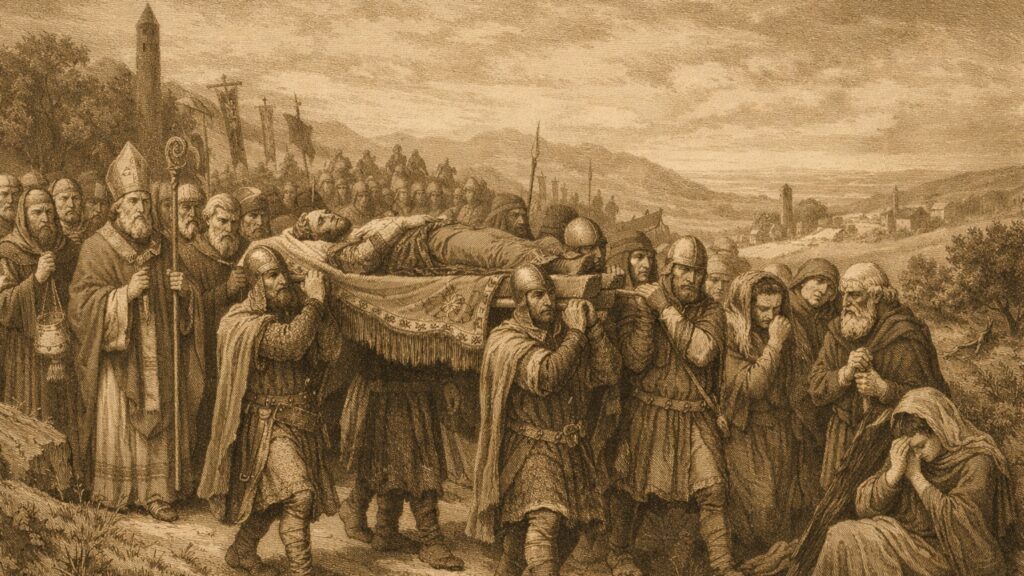
The aftermath of Brian’s death is described with ceremonial detail. Maelmuire, son of Eochaidh, successor of Patrick, went with senior clerics and relics to Sord-Choluim-Chille. There they took Brian’s body, together with the body of Murchadh, and the heads of Conaing and Mothla. The clergy waked the bodies “with great honour and veneration” and buried them at Ard-Macha in a new tomb. Trinity College Dublin’s exhibition adds that Brian’s body and the remains of other fallen leaders were taken first to Swords and then to Armagh, where they were buried after an extended wake.
This burial account shows how Brian was remembered in ecclesiastical settings as well as in royal and military ones. The sources also note that the Brian Boru harp now associated with his name is not securely linked to him; Trinity College Dublin states that it is the oldest surviving Irish harp but that its early history is uncertain and that it has incorrectly become associated with Brian Boru.
Source References
Hover over a number to see the source. Select it to open the source.