
Traveller Mental Health
At a Glance
Community Voices
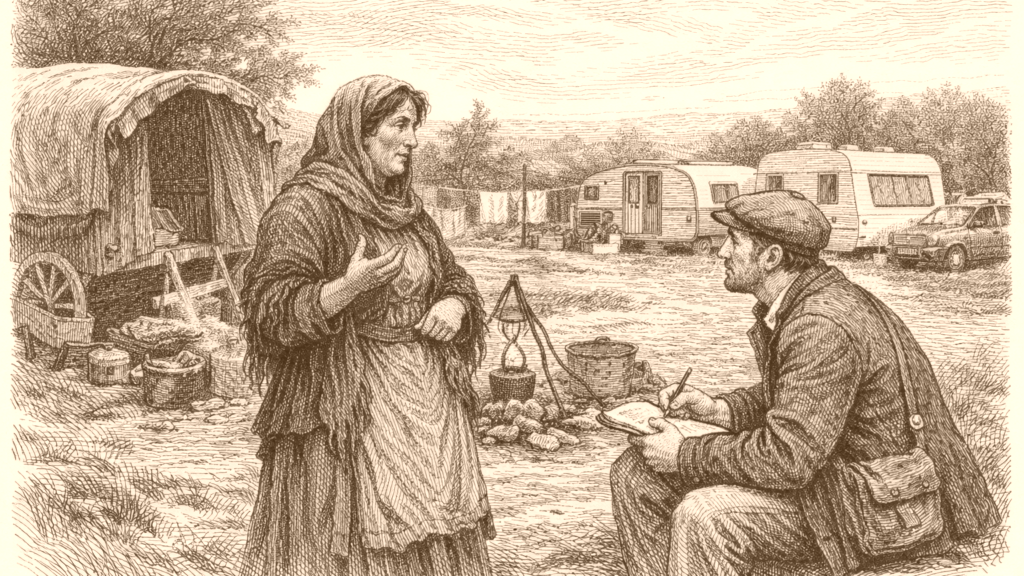
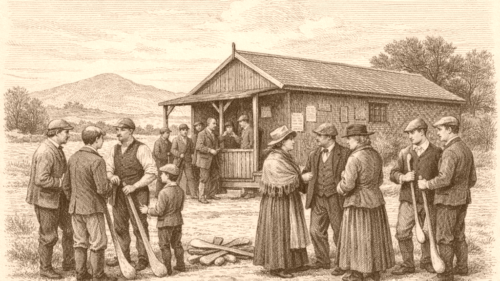
The record opens with lived testimony. In a 2001 oral history, Josie Riley says she was born in Ireland, travelled around the country with family groups, and had no schooling. She also says that later she was living on a traveller site provided by Hackney Council. The interview preserves details of movement, family life, and the transition from travel to site-based living without interpreting those details for her. This is direct voice from a Traveller life history, not a summary of a wider population. [3]
The same interview also records her account of schooling, or the lack of it, and of changing expectations over time. She says she could not write her name and that teachers later came to collect children for school. The excerpted description shows the interview was structured around childhood travel, upbringing, and schooling. On its own, this material does not diagnose illness, but it does show how education and mobility are remembered as part of a Traveller life course, and why such testimony matters to mental health history as context. [3]
Mental Distress
Later research describes mental distress among Travellers in stark terms. A 2016 report states that one in eight Travellers experienced frequent mental distress and that the suicide rate in the community was six times the general population rate. It also says current services were inadequate and that turmoil could begin at age 12. These are quantitative and descriptive claims from the report summary, and they were repeated in journalism about the launch. Together they point to a severe, early-emerging burden of distress. [4]
More recent scholarship continues the same pattern of elevated risk. A 2023 study of Traveller men states that suicide rates are seven times higher than among non-Traveller men. Its abstract links distress to racism, social exclusion, discrimination, inadequate accommodation, unemployment, and lower educational attainment, while also noting barriers to support seeking. The study is built from interviews with thirteen men aged 19 to 50. Its findings are specific to that group, but they align with the broader reports that identify high distress and structural obstacles. [6]
Barriers Overview
Discrimination appears in several of the records as a central barrier. The 2016 reporting says participants described persistent discrimination as a core part of their experience. The 2023 study likewise names prejudice, discrimination, and racism among the determinants of mental health difficulties. These sources do not use identical language, but they converge on discrimination as a repeated feature of lived experience. The evidence is descriptive rather than causal proof, yet the pattern across the two accounts is clear. [4] [6]
Fear and distrust also shape access to help. An Irish Times report from 2023 says fear of child removal by Tusla, stigma within the community, and distrust in health services contribute to reluctance to seek support. It adds that participants felt judged and misunderstood, and that no helpline then offered culturally specific Traveller support. These are reported findings from focus groups and a commissioned report, not universal claims about every Traveller household. They nonetheless show a practical barrier beyond individual willingness alone. [7]
Support System
The records also point to support structures, though often as partial or developing ones. The 2016 report says the HSE planned to increase the capacity of small primary health teams staffed part-time by Travellers, so that they could help people find support in mainstream services. The 2023 report says a Traveller mental health working group had been formed and that funding had been secured to expand suicide prevention, postvention, and Traveller counselling services. These are institutional responses rather than completed solutions. [4] [7]
At the level of individual coping, the 2024 doctoral thesis says participants rely on cultural identity, manage stigma and inequality, and find pathways to help. It also says mental health is understood within the context of Traveller culture and that culturally sensitive provision is needed. The thesis is based on interviews with fifteen members of the Traveller community, and its findings are grounded in that limited group. Even so, it shows support seeking as shaped by culture, not by symptoms alone. [5]
Archives Overview
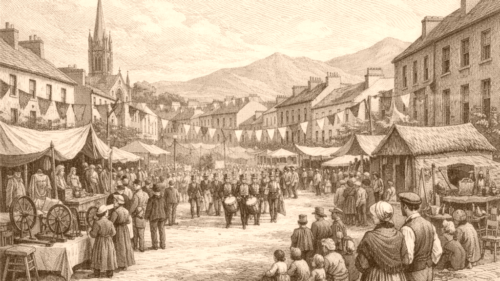
Archival work has also become part of this story. The University of Galway describes the Mincéirs Archives as a growing collection focused on Irish Travellers from the 1960s onward, on the impacts of social and economic change, and on the dawn of the Traveller rights movement. It says the archive includes material on human rights, education, employment, accommodation, music, folklore, and photographs. The project began in 2021, but the description itself emphasizes accumulation and access rather than a closed body of material. [1]
A 2024 National Museum of Ireland release similarly presents the Mincéiri Archives as a growing collection of stories about Irish Traveller culture, past and present. It says the website is the first peer-led collection of lived experiences told by Traveller elders themselves and that the project aims to affirm Traveller history as national history. It also stresses community leadership and accessibility. Read together, these archives do not replace clinical studies; they widen the record by preserving voices, memory, and self-representation. [2]
Historical Overview
Across these records, the observable pattern is a history made from testimony, health research, and community archiving. The oral history preserves travel, education, and site living; the clinical and journalistic sources record high distress, suicide risk, discrimination, and barriers to help; the archives preserve Traveller-led accounts and cultural memory. None of the excerpts provides a single comprehensive explanation, and the evidence should not be stretched beyond what it says. [3] [4] [5] [6] [1] [2]
The strongest comparison between the records is that distress and documentation advance together. Earlier testimony shows how Traveller life was lived and remembered; later studies identify specific harms and service gaps; newer archives seek to preserve community voice and make it accessible. That sequence is historical evidence, not proof of causation. Still, it suggests a move from scattered personal recollection and service critique toward more structured, Traveller-led recording of experience. The result is a richer but still incomplete public record. [3] [4] [5] [6] [2] [1]
Source References
Hover over a number to see the source. Select it to open the source.

- [1] Mincéirs Archives - University of Galway
- [2] 29 April 2024: The Mincéiri Archives A growing collection of stories that celebrates Irish Travell | National Museum of Ireland
- [3] Oral History Interview - Josie Riley | Hackney Museum
- [4] Traveller suicide rate must be addressed - report
- [5] A Grounded Theory Study of how members of the Irish Traveller community attend to their mental health needs - DORAS
- [6] Using an Intersectional Approach to Explore the Lived Mental Health Experiences of Traveller Men Affected by Suicide in Ireland - PMC
- [7] Racism and ‘toxic shame’ contribute to high rates of despair in Travellers, study finds – The Irish Times
How do recent Irish and Irish-diaspora records describe mental health distress, support seeking, and service access among Travellers?