Gabair Liphi566 CE
The annals do not align every manuscript notice with the same modern year, so 566 must be handled through the headings and sequence in each text. In the Annals of Ulster, the battle of Gabair Liphi appears under U566, while the printed heading beneath it says AD 565. The Annals of Tigernach place a notice for John the Roman under T566, and the Annals of the Four Masters give the age-of-Christ heading 566 for Ainmire’s death. Annals of Inisfallen add a birth notice under AI566. Read together, these entries show overlapping chronological framing rather than one uniform year list.
Dateline
Dating Frames
The surviving notices around 566 are presented in different chronological frames. In the Annals of Ulster, U566.0 gives a Kalends of January notice and prints AD 565 before U566.1 and U566.2; in the Annals of Tigernach, T566.0 marks the corresponding entry with K. ui.; in the Annals of the Four Masters, M566.0 gives the Age of Christ, 566; and in the Annals of Inisfallen, AI566.1 appears under the heading Annal AI566. [1] [2] [3] [4]
These headings do not all point to the same modern year in the same way. The Ulster sequence places the battle notice under U566 but prints AD 565, while the Four Masters explicitly print the Age of Christ 566 at the start of the annual entry. The Tigernach and Inisfallen passages also preserve their own annual markers, but the excerpts themselves do not present a shared explanatory scheme for reconciling them. [1] [3] [2] [4]
Ulster Entry
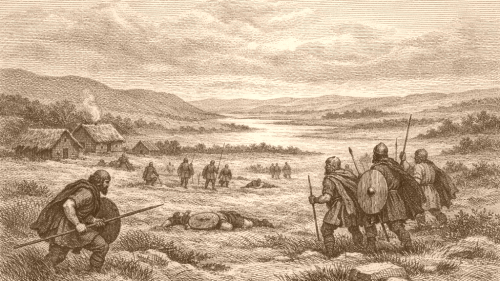
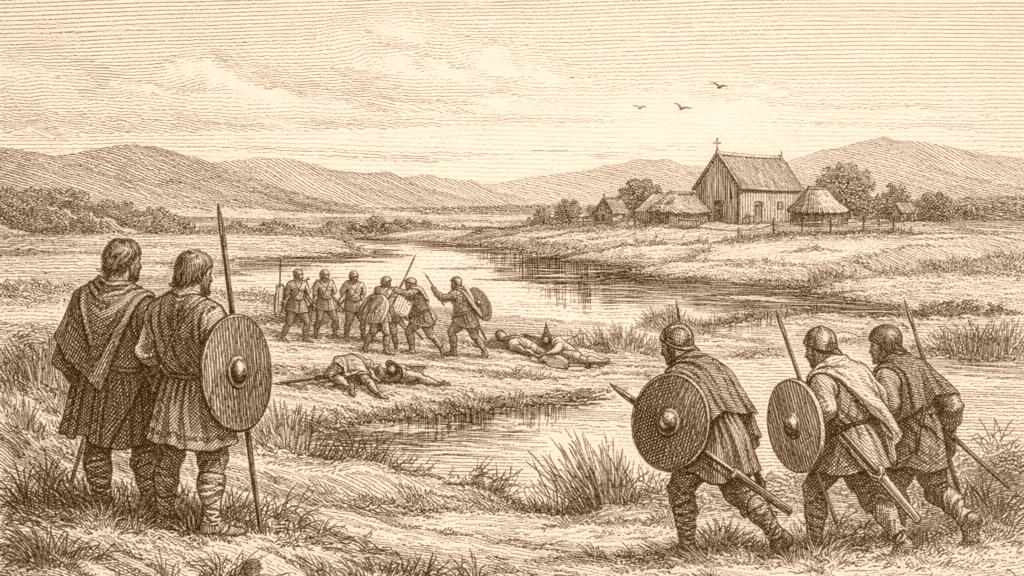
In the Annals of Ulster, the notice under U566.1 states that the battle of Gabair Liphi was fought and that Forgus and Domnall were victors. The immediately preceding line, U565.3, had already mentioned the battle of Gabair Liphi and the death of Daimíne Daim Airgit, so the text preserves the battle in more than one place within its sequence of annual notices. [1]
The same Ulster sequence also places a death notice beside the battle notice. U566.2 records the death of Domnall son of Muirchertach Mac Erca and says that Ainmire son of Sétna succeeded him. The excerpt then continues with a separate note on Justin the Younger, which shows that the annal entry combines Irish and non-Irish material in the same annual run. [1]
Tigernach Record
The Annals of Tigernach do not preserve the battle of Gabair Liphi under the 566 heading in the excerpts available here. Instead, T566.1 gives a notice about John, of Roman nation, who sat for 12 years, 11 months and 23 days, and was buried in the basilica of blessed Peter the apostle. The next annual sequence then moves forward to T567. [2]
In the Tigernach text, the notices surrounding this point also show other kinds of entry. T565.1 names the battle of Gabra Life and gives the victors, while T567.1 records the death of Deman son of Cairell, king of Ulaid, by the shepherds of Bairenn. The 566-year passage therefore sits between a battle notice in the previous annual block and a death notice in the next one, without placing Gabair Liphi itself in the excerpted Tigernach line. [2]
Masters Entry
The Four Masters give a straightforward annual heading for 566. M566.0 reads Age of Christ, 566, and M566.1 then states that after Ainmire son of Sedna had been three years in the sovereignty of Ireland, he was slain by Fearghus son of Nellin. The entry also preserves a short verse comparing Feimhin while Ainmire was king with its appearance after his fall. [3]
This Four Masters notice is not the same as the Ulster battle notice, and it gives no battle at all in the 566 excerpt. It records a killing and a succession frame around Ainmire, whereas the Ulster sequence for the same part of the chronology gives Gabair Liphi and the death of Domnall son of Muirchertach Mac Erca. The two texts should therefore be read as separate notices, not merged into one reconstructed event list. [1] [3]
Inisfallen Note
Annals of Inisfallen supply a different kind of 566 notice. AI566.1 records the birth of Lugaid son of Caelub, and the heading places it under Annal AI566. The excerpt does not attach further narrative detail to that birth, but it does show that the 566 annual block in this text includes a birth notice rather than a battle or death. [4]
The same Inisfallen passage places the 566 birth beside neighboring notices that are not part of the same year. AI565.1 records the death of Domnall son of Mac Erce in the battle of Gabair Liphi, while AI568.1 mentions a battle in Ard Tómain by Colmán Bec. The excerpt therefore shows that Gabair Liphi belongs to the surrounding chronological sequence as well as to the annual pattern, but not in a single uniform dated form. [4]
Year Focus
Taken together, the excerpts show that the evidence for 566 is mixed across the annals. The Ulster text places the battle of Gabair Liphi and the death of Domnall son of Muirchertach Mac Erca in the same annual sequence, the Four Masters record Ainmire's death under the Age of Christ 566, and Inisfallen records Lugaid's birth under AI566. Tigernach supplies a nearby chronological point with a papal notice rather than a direct battle notice for this block. [1] [3] [4] [2]
The secure conclusion is limited to what the texts explicitly say. For this year block, the annals preserve a battle, a royal death, a king's slaying, and a birth, but they do so in different books and with different annual labels. Any stronger claim about one unified Irish event for 566 would go beyond the wording of the excerpts themselves. [1] [3] [4] [2]
Comparative Reading
The comparison among the excerpts is mainly chronological and textual, not explanatory. The Ulster annal gives a battle and a death under U566 while printing AD 565; the Four Masters mark 566 directly as the Age of Christ; the Inisfallen note places a birth under AI566; and Tigernach provides a different nearby notice under T566. These are directly observable differences in presentation, not grounds for reconstructing a single hidden dating system from the excerpts alone. [1] [2] [3] [4]
The notices also show variation in content type. One text emphasizes a battle at Gabair Liphi, another a royal killing, another a birth, and another a papal chronology entry. The excerpts support a careful year-focused reading of 566 as a cluster of annal notices rather than as a single event narrative. [1] [2] [3] [4]
Source References
Hover over a number to see the source. Select it to open the source.