Detna Battle520 CE
The surviving annal excerpts for the year around 520 record a battle at Detna in Dromma Breg, the death of Buitte son of Bronach, and the birth of Colum Cille, but they also show uneven dating. One chronicle places the battle under an entry printed as AD 519, another under AD 518, while a third excerpt marks AD 520 with a papal notice instead of an Irish event. The year is therefore best read as a cluster of annal notices with explicit chronological uncertainty, not as a securely single-dated narrative.
Dateline
Annal Entries
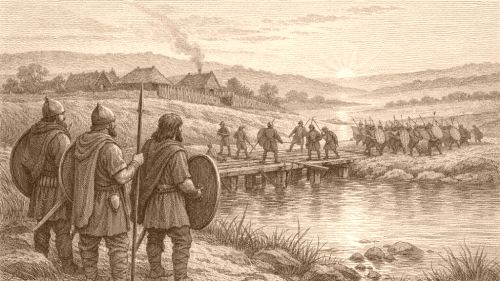
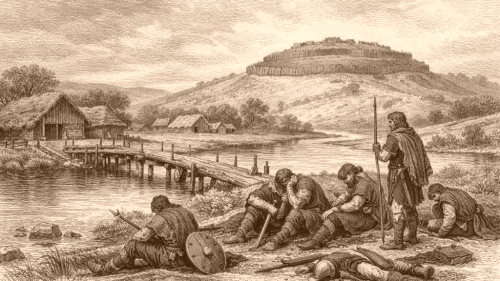
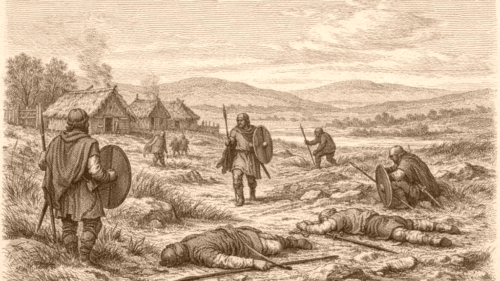
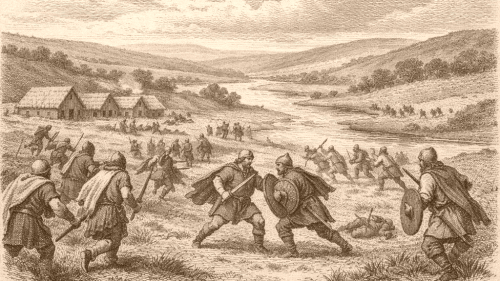
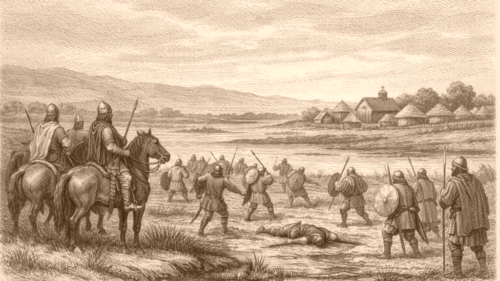
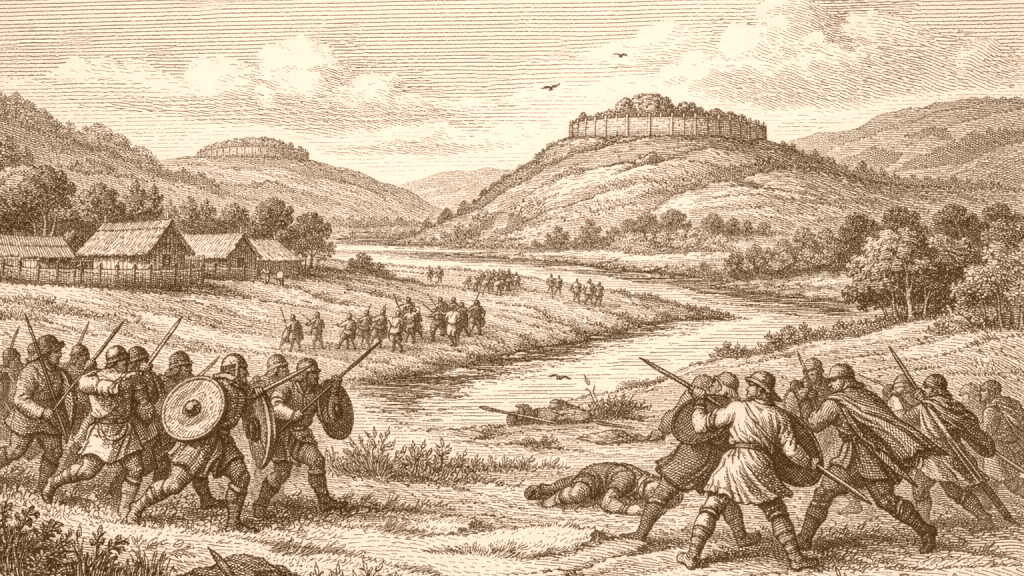
The clearest Irish notice associated with 520 is the battle of Detna in Dromma Breg. In the Ulster, Tigernach, and Chronicon Scotorum excerpts, the battle is linked with the deaths of Ardgal son of Conall son of Niall and with the victory of Muirchertach Mac Erca and Colgu or Colga of Airgiall. The same cluster of notices also records the death of Buitte son of Bronach and the birth of Colum Cille. [1] [2] [3]
The same year-cluster is not uniform across the annals. In the Ulster chronology table, the battle entry appears under U520.0 with a printed AD heading of 519, while the next heading is U521.0 with AD 520. Tigernach has the battle under T520, but its chronology table gives no explicit AD heading there. Chronicon Scotorum marks the battle under CS518 with AD 518. These differences show that the surviving excerpts preserve notices and headings, but not a single agreed year label. [1] [2] [3]
Dating Uncertainty
The evidence for 520 CE is therefore partly external to any one annal heading. Annals of Inisfallen preserves a brief notice of the death of Anastasius and the accession of Iustinus, and its later entry for the birth of Colum Cille and the death of Buitte is explicitly cross-referenced to earlier annal years. This makes the year around 520 a place where the surviving notices can be compared, but not forced into a single exact chronology. [4] [2] [1]
Wider Record
Across these excerpts, the surviving record for the year is sparse but consistent in kind: brief annal notices of a battle, a cleric's death, a saint's birth, and one external imperial death. None of the passages offers a fuller narrative for 520 itself. What they securely show is a small set of remembered events and a clearly uneven chronological framework. [1] [2] [3] [4]
Source References
Hover over a number to see the source. Select it to open the source.