Membership is completely free, giving members unlimited access to all available resources, services, features, and benefits without any restrictions or fees.
Welcome back. Sign in to continue enjoying unlimited access to all available resources, services, features, and member benefits at no cost.
The evidence requires care. Medieval Irish annals did not all reckon years in precisely the same way, and later compilations sometimes place an event a year apart from other annals. The Annals of Ulster enter the building of Clones castle, the raid into Tír Eógain and the destruction at Derry under 1212. The Annals of the Four Masters, compiled centuries later, place several of those same episodes under 1211, while recording a further sequence of fighting and castle-burnings under 1212. Rather than treating this as a reason to discard the evidence, it is best to see 1212 as a campaigning season extending across annalistic boundaries. The firmly attested picture is of an intensifying frontier war in Ulster, accompanied by serious disturbances in the midlands and Munster.
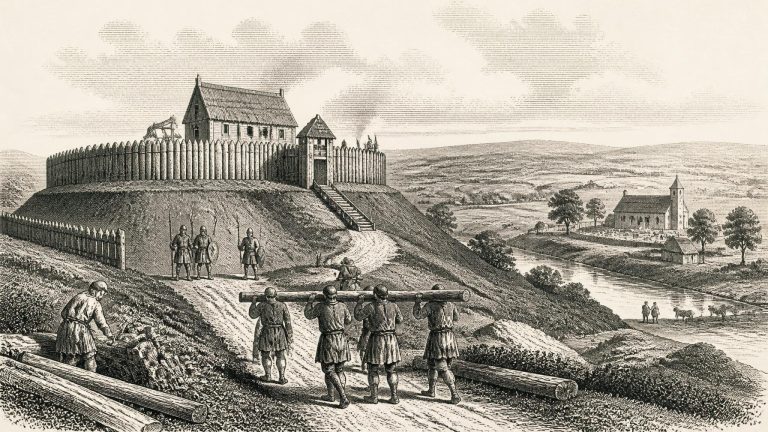
The fullest accounts of 1197 come from the northern annals. They report that John de Courcy led the “Foreigners of Ulidia” on an expedition to Eas Craibhe and built a castle at Cell Santain, usually rendered Kilsanctan. The force devastated the cantred of Ciannachta and left Roitsel Fitton with a garrison in the new stronghold. A castle was not merely a battlefield shelter. It was a durable claim upon land: a base from which troops could operate, a focus for supplies and tribute, and a threat to neighbouring communities. The entry therefore records an attempt to extend, secure and administer de Courcy’s influence rather than a passing raid alone.
The year’s most consequential event was John de Courcy’s advance into Ulaid in north-eastern Ireland. According to Gerald of Wales, whose dramatic account must be treated cautiously, de Courcy left Dublin with only twenty-two men-at-arms and about 300 other soldiers. A modern reconstruction places his arrival at Dún Dá Lethglas, now Downpatrick, around 1 February. His operation appears to have been a personal venture undertaken without clear authorisation from William fitz Aldelin, Henry II’s chief representative in Ireland.
The Ireland of 1175 was not divided simply between ‘Irish’ and ‘Norman’ camps. Gaelic kings fought one another, allied with foreign settlers and changed sides according to local interests. Anglo-Norman leaders were likewise divided by rivalry and dependence upon their followers. Strongbow possessed Leinster under Henry II, but his military position relied heavily on experienced commanders such as Raymond le Gros and on cooperation with Irish rulers including Domnall Mac Gilla Pátraic of Osraige. Henry, meanwhile, sought to prevent any magnate from becoming independent while avoiding the expense of personally reconquering Ireland.
Ireland had no single monarch exercising uniform government. Tairdelbach Ua Conchobair, king of Connacht, remained one of its strongest rulers, but Muirchertach Mac Lochlainn of Cenél nÉogain had emerged as a formidable northern claimant to the high-kingship. Provincial kings, lesser dynasties, Hiberno-Norse towns and major churches retained their own interests. Authority depended upon alliances, hostages, tribute and repeated military expeditions rather than permanent control. Agreements could be confirmed before clergy and relics, yet political necessity might soon overturn them.
The crisis in Munster began within the ruling Uí Briain dynasty. The Annals of the Four Masters record that Tadc son of Diarmait Ua Briain turned against his kinsman Tairdelbach Ua Briain, deposed him and entered the protection, or ‘house’, of Tairdelbach Ua Conchobair. Mac Carthaigh’s Book preserves a more complicated southern account, involving a further revolt by Muirchertach, Tairdelbach Ua Briain’s own son, and his capture through treachery. Although the precise sequence is difficult to reconstruct, the sources agree that internal divisions left Ua Briain authority dangerously weakened.
More than a quarter-century had passed since Brian Bóruma’s death at Clontarf, and eighteen years since the death of Máel Sechnaill mac Domnaill, the last ruler whose authority had extended widely from the traditional kingship of Tara. Brian’s son Donnchad mac Briain remained king of Munster and the principal representative of Dál gCais power. He possessed considerable military and political weight, but Ireland in 1040 was not a centralised kingdom. Provincial and regional rulers governed through personal followings, tribute, hostages, ecclesiastical connections and negotiated submission. Their authority could expand rapidly after victory and contract just as quickly after defeat.
The events firmly assigned to 1034 come principally from the Annals of Ulster, Annals of Inisfallen, Annals of Tigernach and the later Annals of the Four Masters. These chronicles sometimes disagree over titles, circumstances and even the identities of participants. Their notices are also highly selective. Kings, abbots, scholars, relics and military expeditions appear; ordinary births, marriages, harvests and local exchanges generally do not. A responsible account must therefore distinguish the year’s recorded events from the broader conditions under which most people lived.