James Mangan
James Clarence Mangan was an Irish poet commonly called James Clarence Mangan. He was born at No. 3 Fishamble Street, Dublin, on 1 May 1803. His father, James Mangan, was a native of Shanagolden, County Limerick, and the family had commenced business in Dublin in 1801. His mother is named as Catherine Smith of Fishamble Street. He was educated at a school in Saul’s Court, Dublin, where he learned Latin, Spanish, French, and Italian under Father Graham, described in the record as an erudite scholar. He then had to work to support the family.
Dateline
Early Life
James Clarence Mangan was an Irish poet commonly called James Clarence Mangan. He was born at No. 3 Fishamble Street, Dublin, on 1 May 1803. His father, James Mangan, was a native of Shanagolden, County Limerick, and the family had commenced business in Dublin in 1801. His mother is named as Catherine Smith of Fishamble Street.
Education History
He was educated at a school in Saul’s Court, Dublin, where he learned Latin, Spanish, French, and Italian under Father Graham, described in the record as an erudite scholar. He then had to work to support the family. For seven years he toiled in a scrivener’s office and for three years in an attorney’s office.
Writing Career
Mangan contributed verse to Dublin almanacs as early as 1822. In 1831 he became a member of the Comet Club and wrote for its journal under the signature Clarence. He also wrote for the Dublin University Magazine from 1834, where much of his work concerned German poetry and translations. The same account says he issued pieces presented as renderings from Turkish, Persian, Arabic, and Coptic, and that he depended on prose translations by Eugene O’Curry and John O’Daly for Irish material.
Later Years
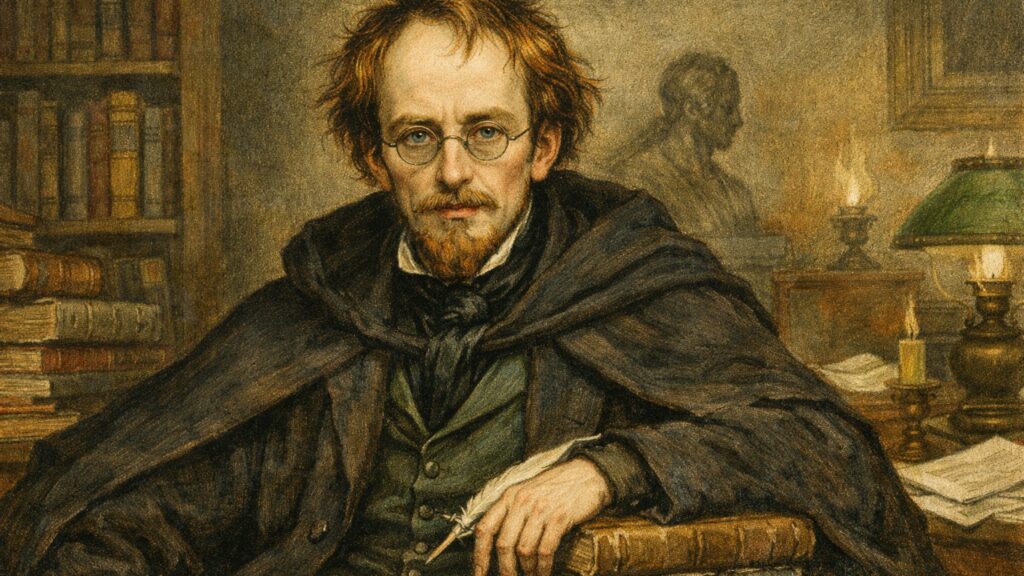
About 1839 he became acquainted with Charles Gavan Duffy and sent humorous pieces to the Belfast Vindicator as The Man in the Cloak. He wrote more regularly for the Nation after 1845, and in 1848 he became a contributor to Mitchel’s United Irishman. His friends tried in vain to induce him to take Father Mathew’s pledge. He was removed to St. Vincent’s Hospital in May 1848, later entered Richmond Surgical Hospital after an accident, caught cholera during the Dublin epidemic of 1849, and died in the Meath Hospital on 20 June 1849. The record also notes that he was unmarried.
Source References
Hover over a number to see the source. Select it to open the source.