

Related Archive: Derryvree’s Sedge Marsh

Derryvree’s Hidden Sedge Marsh

Derryvree’s Hidden Sedge Marsh

Archived: 19 September 2026

Abstract

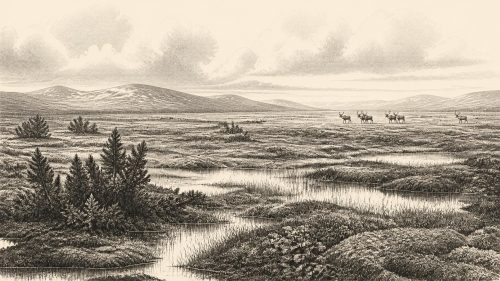
About 31,216 BCE, Ireland lay within Marine Isotope Stage 3, a variable cold interval rather than a precisely dated historical moment. At Derryvree near Maguiresbridge, freshwater sediments preserved beneath later tills record treeless, waterlogged tundra of sedges, mosses, herbs and shallow pools. Castlepook Cave’s broad contemporary fauna included mammoth, reindeer, giant deer, hyaena, wolves and cold-adapted small mammals, though deposits accumulated over time. A marked reindeer femur may indicate human carcass processing around 33,000 years ago, but cannot prove settlement or sustained occupation. Dynamic glaciation, uncertain routes and regional environmental variation defined conditions there for much of this remote period.


Read Article

Derryvree’s Sedge Marsh

Derryvree’s Sedge Marsh

Archived: 10 September 2026

Abstract

Labelled 31,833 BCE, this period cannot be dated precisely in Ireland and is best understood as a Late Pleistocene interval within Marine Isotope Stage 3. Sediments at Derryvree and Greenagho show that parts of Ireland remained ice-free, supporting open tundra, sedge marshes and seasonal freshwater habitats before later glaciation. Castlepook Cave preserves remains of reindeer, mammoth and other cold-adapted fauna, although they do not represent a single community. A possible stone-tool cut on a reindeer bone suggests brief human activity, but no secure settlement evidence exists. Subsequent ice-sheet expansion reshaped Ireland, preserving Derryvree as a rare pre-glacial environmental record survival.

Read Article

