
Archived: 26 September 2026
Abstract
In 1218, Ireland remained a patchwork of competing royal, Anglo-Norman, Gaelic and ecclesiastical powers. Under Henry III’s regency, William Marshal’s Leinster interests shaped lordship government, including regulation of shipping. His land dispute with Ailbe, bishop of Ferns, exposed conflict between royal procedure, papal intervention and Irish clerical rights. Annals recorded northern killings, a failed Meath raid into Connacht and burning at Athlone, demonstrating frontier insecurity. Deaths and successions confirmed resilient local kingships. The consecration of Boyle Abbey, church administrators’ careers, pilgrimage, and losses among poets and scholars also reveal religious patronage, learning and communal institutions amid persistent nationwide political contestation.
Read Article

Archived: 26 September 2026
Abstract
In 1216, Ireland remained divided between Gaelic lordships, the Anglo-Norman Lordship and wider Plantagenet rule. King John’s final orders concerning Walter de Lacy’s estates illustrated royal administration and cross-channel aristocratic ties. After John died, the child Henry III inherited the Lordship, governed through councillors, William Marshal and Dublin justiciar Geoffrey de Marisco. Castle-building and Robert Travers’s disputed appointment at Killaloe exposed coercive colonial expansion. Church affairs linked Ireland closely to Rome through vacancies, papal interventions and diocesan reform. Gaelic rulers maintained authority, including Cathal Crobhdearg’s Ballintubber foundation, while annals recorded killings and legal scholarship, revealing overlapping jurisdictions, allegiances and cultures.
Read Article

Archived: 26 September 2026
Abstract
1179 Ireland remained politically fragmented despite Henry II’s overlordship, Ruaidrí Ua Conchobair’s western influence, and expanding lordships under Hugh de Lacy and John de Courcy. Laurence O’Toole attended the Third Lateran Council, became papal legate, secured Dublin’s privileges, and convened Clonfert synod to advance church reform against lay control. Henry reprimanded de Lacy following Irish complaints, but settlement continued. In the north, a relic-sworn peace at Ardstraw ended in treacherous killings and devastation. Fires damaged Armagh and several church centres. Annals recorded famine, warfare and destructive snow, exposing vulnerable rural communities amid religious reform, diplomatic engagement, and enduring political instability.
Read Article

Archived: 26 September 2026
Abstract
In 1166, Muirchertach Mac Lochlainn’s breach of a guaranteed settlement in Ulaid, including the blinding of King Eochaid, destroyed his authority. Abandoned by allies, he was defeated and killed. Ruaidrí Ua Conchobair of Connacht exploited the collapse, securing submissions, hostages and tribute from Dublin and regional rulers, while distributing wealth and arbitrating disputes. Diarmait Mac Murchada, deprived of Mac Lochlainn’s support and opposed within Leinster, was expelled after coalition campaigns destroyed his Ferns residence. He sought Henry II’s permission to recruit overseas, creating conditions for later Anglo-Norman intervention. Fires, church affairs, rural burdens, towns and royal patronage also marked 1166.
Read Article

Archived: 26 September 2026
Abstract
In 1111 Ireland remained divided among competing rulers, notably Muirchertach Ua Briain in the south and Domnall Ua Lochlainn in the north, while Tairdelbach Ua Conchobair extended Connacht’s influence. Raids, hostage-taking, dynastic conflict and attacks on churches, including Clonmacnoise, demonstrated political instability. The Synod of Ráith Bressail, attended by leading clerics and royal patrons, promoted ecclesiastical discipline and a territorial diocesan framework under Armagh and Cashel, though implementation was uneven. A Meath synod also negotiated church boundaries. Ulaid’s conflict with Cenél nÉogain, harsh winter conditions, and fires at several settlements further affected society, trade and rural livelihoods across Ireland broadly.
Read Article

Archived: 26 September 2026
Abstract
In 1028, Ireland remained politically fragmented after Brian Bórama and Máel Sechnaill, with power contested through raids, killings, hostages and cattle wealth. Cenél nEógain plundered Tír Conaill, while the Conaille killed regional rulers. Sitriuc Silkbeard, Hiberno-Norse king of Dublin, and Flannacán of Brega made a prestigious pilgrimage to Rome, signalling wider Christian connections and developments associated with Dublin’s cathedral. Severe Lent snow disrupted people and livestock. Ecclesiastical deaths, Duleek’s plundering, and Slane’s collapsed oratory reveal churches’ institutional importance and vulnerability. Conflicting annals record violent regional succession, especially Connacht’s Brian Ua Conchobair, portraying a literate, agrarian, martial society linked to Europe.
Read Article

Archived: 26 September 2026
Abstract
In 1014, Ireland’s layered kingship faced conflict over Brian Boru’s overlordship of Dublin and Leinster. On Good Friday, 23 April, Brian’s coalition, including Máel Sechnaill, defeated Leinster, Dublin and overseas Scandinavian forces at Clontarf. The costly victory killed Brian, his son Murchad, grandson Tairdelbach, Máel Mórda of Leinster and Sigurðr of Orkney, but neither destroyed Dublin nor expelled Scandinavians. Armagh’s elaborate burial rites strengthened Brian’s Christian royal memory. Subsequent Munster rivalries, provincial raids and deaths exposed continuing instability after the battle. Máel Sechnaill resumed central political importance, while Dublin remained a vital Hiberno-Norse trading centre within the Irish Sea world.
Read Article

Archived: 26 September 2026
Abstract
In 1010 Brian Bóruma reinforced his contested supremacy by leading Munster forces north to Armagh and securing hostages from the northern Uí Néill, Ulaid and wider Leth Cuinn. The campaign demonstrated that overlordship required repeated negotiation, military display and guarantees. Connacht’s king Cathal mac Conchobair died penitently, while lesser rulers, an Ailech heir and other political figures also died or were killed. Church losses included Brian’s brother Marcán, senior cleric of Munster, Clonmacnoise bishop Conaing, and scholar-king Máel Suthain ua Cerbaill. An abbot suffered blinding. Annals also recorded a hot summer and fruitful autumn, underscoring rural resources sustaining political power.
Read Article

Archived: 26 September 2026
Abstract
In 1002 Brian Bórama transformed Irish politics by bringing an army to Athlone and taking hostages from Connacht and Mide, publicly demonstrating Máel Sechnaill mac Domnaill’s submission. Annals differ slightly in dating and emphasis, but confirm the event. Brian’s earlier successes over Leinster and Dublin enabled wider mobilisation, including Norse-Gaelic allies. Yet his subsequent northern expedition to Dundalk failed to secure hostages from Áed of Ailech and Eochaid of Ulaid, ending in truce. Raids, captives and ecclesiastical deaths reveal regional conflict. Coastal towns, trade and church institutions underpinned power. Brian emerged as leading king, but his island-wide overlordship remained incomplete.
Read Article

Archived: 10 September 2026
Abstract
Castlepook Cave near Doneraile, County Cork, preserves a mixed Late Pleistocene animal archive spanning roughly 45,700–19,950 years BP. A directly dated reindeer femur, about 33,000 years old, bears a fresh-bone incision possibly made by a stone tool, offering tentative evidence of human butchery before the Last Glacial Maximum. Disturbed deposits and inadequate early excavation records mean it cannot prove settlement, permanent population or a specific culture. Its fauna, including mammoth, reindeer, giant deer and hyaena, indicates a cold, varied landscape. Any visitors were probably mobile hunter-gatherers. Castlepook expands Ireland’s possible human past while underscoring the need for securely stratified evidence.
Read Article

Archived: 10 September 2026
Abstract
Circa 31,838 BCE, Ireland lay within the variable, cold conditions of Marine Isotope Stage 3, before the Last Glacial Maximum. Castlepook Cave in County Cork preserves remains of mammoth, reindeer, hyaena, bear, wolf, Arctic fox, hare and lemmings, indicating open habitats supporting predators and grazing animals. Cave deposits reflect complex carnivore and natural processes. A marked reindeer femur may indicate human butchery, but lacks secure context and remains unproven. Derryvree, County Fermanagh, records ice-free tundra wetlands between glacial advances. Lower seas altered coasts, though Ireland remained separated from Britain. The evidence reveals changing landscapes, not permanent human settlement or society.
Read Article

Archived: 10 September 2026
Abstract
About 31,843 BCE, Ireland lay within the climatically unstable Late Pleistocene, before the last British–Irish Ice Sheet reached its maximum. Freshwater sediments at Derryvree, County Fermanagh, dated broadly to this period, preserve evidence of ice-free wet tundra, mosses, sedges and herbaceous vegetation between glacial advances. Cave records and faunal collections indicate fluctuating milder phases and varied mammals, including reindeer, mammoth and hyaena, although deposits cannot reconstruct single communities. Possible cut marks on a Castlepook reindeer bone suggest a human visit, not settlement. Subsequent ice expansion destroyed or buried much evidence, leaving fragmentary environmental archives rather than a documented human society.
Read Article
Archived: 10 September 2026
Abstract
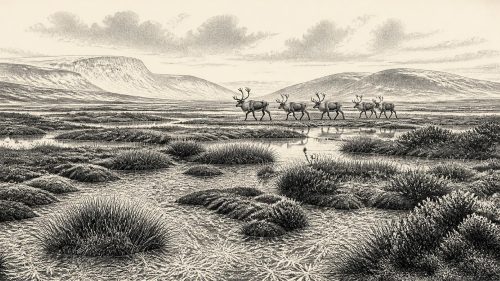
The modern label 31,846 BCE denotes a broad MIS 3 Ice Age interval, not a datable Irish event. At Derryvree, County Fermanagh, buried organic silts, pollen, plants and insects record cold, treeless tundra wetlands, indicating that parts of Ireland supported freshwater habitats before major ice-sheet expansion. Castlepook Cave, County Cork, preserves disturbed but important remains of reindeer, mammoth, bears, wolves, lemmings and other fauna, though species were not necessarily contemporaneous. A cut-marked reindeer femur may indicate Upper Palaeolithic butchery around 31,000 BCE, yet cannot prove settlement. No secure tools, hearths, dwellings or human remains exist. Possible human presence remains unconfirmed.
Read Article
Archived: 9 September 2026
Abstract
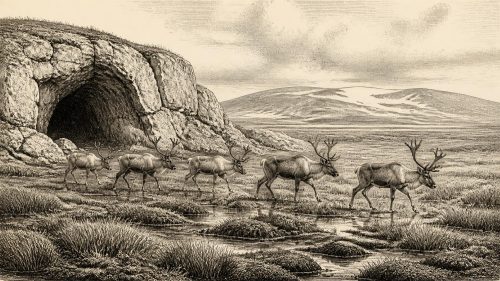
Around 31,859 BCE, Ireland lay within the climatically unstable Marine Isotope Stage 3 of the last Ice Age, although conditions and ice extent varied regionally. Freshwater deposits at Derryvree, County Fermanagh, preserve evidence of cold, open, wet tundra-like terrain, while other deposits remain fragmentary and difficult to date. Castlepook Cave, County Cork, yielded reindeer, mammoth, giant deer, bear and hyaena remains, demonstrating intermittent animal use of southern Ireland. Re-dating has complicated their chronology. A marked reindeer femur may indicate human butchery about 33,000 years ago, but lacks excavation context. No established Palaeolithic settlement, tools, hearths or social history is known.
Read Article
Archived: 9 September 2026
Abstract
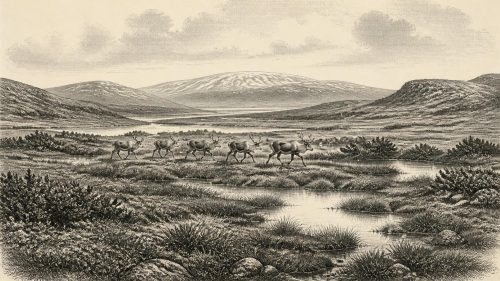
Around 31,878 BCE, Ireland lay within the unstable cold conditions of Marine Isotope Stage 3, before the Last Glacial Maximum. Derryvree, County Fermanagh, preserves freshwater sediments indicating an ice-free, treeless wet-tundra landscape of sedges, grasses, mosses and juniper. Castlepook Cave, County Cork, yielded late Pleistocene fauna including reindeer, mammoth, giant deer, horse, bear, wolf, arctic fox and hyaena. These sites demonstrate surviving habitats and grazing land before major ice-sheet expansion. Possible butchered bones raise, but do not prove, human presence. No secure evidence supports settlement, farming, communities or specific events. Dating ranges, disturbed deposits and later glaciation require cautious interpretation.
Read Article

Archived: 9 September 2026
Abstract
Around 31,880 BCE, Ireland was a cold, changing landscape on the north-western fringe of Upper Palaeolithic Europe, approaching but preceding the Last Glacial Maximum. Calendar precision is impossible; evidence consists chiefly of cave remains, sediments and glacial landforms. Castlepook Cave, north County Cork, contains Ireland’s richest pre-maximum vertebrate assemblage, including reindeer, mammoth, giant deer, bears and hyenas, indicating habitats able to sustain Ice Age fauna over millennia. Ice was advancing unevenly, though the extent of ice-free ground remains uncertain. A possibly cut-marked reindeer femur suggests a human visit, but lacks secure context. No evidence proves Palaeolithic settlement, society or continuity.
Read Article

Archived: 9 September 2026
Abstract
Around 31,897 BCE, a modern label corresponding approximately to 33,800 calibrated years before present, Ireland lay within the variable later Pleistocene, before the Last Glacial Maximum. Castlepook Cave near Doneraile, County Cork, preserves Ireland’s richest long-term faunal archive, containing mammoth, giant deer, reindeer, bears, hyaenas and other animals. These remains show intermittent habitats for substantial mammals, but cave processes and early excavation complicate interpretation. A possibly cut-marked reindeer bone may indicate very early human activity, yet remains unconfirmed. No secure contemporary settlements, tools, hearths or human remains exist. Ice reshaped landscapes, leaving cave deposits as fragmentary records of environmental change.
Read Article

Archived: 9 September 2026
Abstract
Around 31,906 BCE, Ireland has no annual historical record; the date represents a broad Late Pleistocene, Marine Isotope Stage 3 horizon. Derryvree, County Fermanagh, preserves organic silts between tills, showing locally ice-free, treeless tundra-like wetlands supporting plants, insects and freshwater pools. Castlepook Cave, County Cork, contains accumulated remains of mammoth, reindeer, giant deer, hyaena and other cold-adapted mammals, although their dates and associations vary. A possibly cut-marked reindeer bone may indicate an early human visit, not settlement. No political, cultural or economic history is demonstrable. As the British-Irish Ice Sheet expanded, glaciers later erased much evidence, leaving rare ecological archives.
Read Article

Archived: 9 September 2026
Abstract
Labelled 31,913 BCE, this period cannot be treated as an observable calendar year, but lies within late Marine Isotope Stage 3, before the Last Glacial Maximum. Ireland was a cold, unstable mosaic of open vegetation, with advancing yet regionally variable ice. Castlepook Cave, County Cork, preserves crucial fossil evidence, including reindeer, mammoth, giant deer and predators, accumulated across different episodes. A reindeer femur reportedly bearing a stone-tool cut mark may indicate early human butchery, but remains unconfirmed and cannot prove settlement. Secure evidence places humans in Ireland only during the terminal Pleistocene. The era chiefly represents ecological change preceding glaciation.
Read Article

Archived: 9 September 2026
Abstract
31,929 BCE is a modern label for a Late Pleistocene phase, not a recoverable Irish year. During Marine Isotope Stage 3, Ireland experienced cold, unstable conditions before the Last Glacial Maximum, with fluctuating ice margins, sea levels and landscapes. Organic silts at Derryvree, County Fermanagh, dated broadly to 36,900–31,700 cal BP, indicate locally ice-free intervals and treeless wet vegetation. Cave deposits, including Castlepook, show cold-stage mammals occurred during the wider period, though not necessarily then. No securely dated human evidence exists. Later glaciation erased much evidence; surviving sediments, landforms and fauna provide an incomplete environmental record of developing Irish glaciation.
Read Article

Archived: 9 September 2026
Abstract
Around 31,932 BCE, Ireland lay in a cold, unstable pre-Last Glacial Maximum environment as the British–Irish Ice Sheet expanded. Precise annual dating is impossible; evidence derives from radiocarbon-dated cave fauna and reconstructions. Castlepook Cave, County Cork, preserved remains including mammoth, reindeer, giant deer, bear, wolf, Arctic fox, lemmings and hyaena, indicating intermittently habitable open terrain. A reindeer bone may bear stone-tool marks and date to about 33,000 years ago, suggesting a possible human visit. However, disturbed old collections and uncertain context prevent proof of occupation. Later glaciation erased much evidence, while modern re-dating and excavation continue refining Ireland's Palaeolithic record.
Read Article

Archived: 9 September 2026
Abstract
About 31,937 BCE, Ireland was a cold, open and environmentally unstable landscape in the later Last Glacial Period, approaching maximum glaciation. Lower sea levels altered coastlines and may have eased animal movement from Britain and Europe. Castlepook Cave, County Cork, preserves remains of reindeer, mammoth, giant deer, predators and other fauna, though deposits span different times. A reindeer bone reportedly bearing stone-tool butchery marks may indicate human passage around 33,000 years ago, but cannot prove permanent occupation. Later ice erosion and inundation destroyed evidence. No society, culture, trade or institutions can be inferred; sustained settlement is documented from the Mesolithic.
Read Article

Archived: 9 September 2026
Abstract
31,938 BCE is a modern label for an imprecisely dated phase of late Marine Isotope Stage 3, not an identifiable Irish event. Ireland experienced unstable, cold conditions before maximum glaciation, with open grassland, sedges, dwarf shrubs and marked seasonality indicated by Ulster pollen and beetles. Castlepook Cave preserves a diverse fauna, including reindeer, mammoth, bear, giant deer and hyaena, showing changing animal access despite uncertain routes. A cut-marked reindeer bone may indicate Upper Palaeolithic butchery and brief human visits. However, no associated camp or tools prove settlement. The period chiefly reveals a changing Ice Age landscape and rare, precarious evidence.
Read Article
Archived: 9 September 2026
Abstract
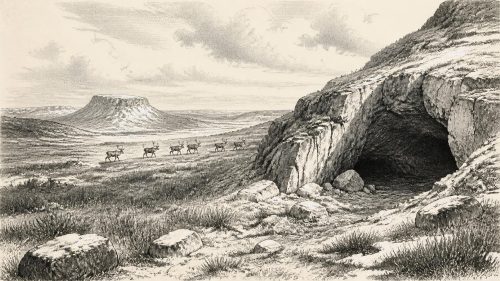
About 34,000 years before present, Ireland experienced cold, unstable Marine Isotope Stage 3 conditions as the British–Irish Ice Sheet began expanding. Deposits at Derryvree and Greenagho indicate north-central areas remained ice-free until roughly this period, although local glaciers and periglacial processes occurred. Open tundra-like habitats supported reindeer, giant deer, spotted hyaenas, bears and other fauna, evidenced especially at Castlepook Cave. A marked reindeer bone may indicate brief Upper Palaeolithic butchery, but cannot prove permanent human occupation. No settled communities or political institutions are evidenced. Changing coastlines, glaciation and disturbed deposits obscure evidence, leaving animal life and possible mobile human visits.
Read Article
Archived: 9 September 2026
Abstract
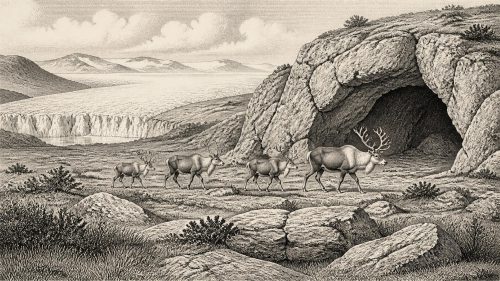
Around 31,948 BCE, Ireland lay within the climatically unstable Late Pleistocene, before the Last Glacial Maximum. Ice growth was substantial but regionally uncertain, while lower sea levels transformed coastlines without guaranteeing easy land connections. Geological landforms, offshore sediments and caves preserve fragmentary evidence of glaciation and changing fauna, including mammoth, reindeer, giant deer, bear and hyena. Later ice erosion and sea-level rise destroyed or submerged much evidence. No securely dated human artefacts, occupations or communities are known; possible transient visits remain unproven. Agriculture, villages, politics, trade and ritual belong to later periods. Ireland’s significance lies in its glacially reshaped environment.
Read Article
Archived: 9 September 2026
Abstract
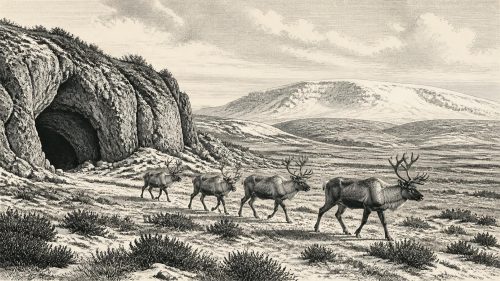
Around 31,949 BCE, Ireland lay in the climatically unstable Late Pleistocene, approaching maximum glaciation but retaining intermittently ice-free terrain in the south. Crag Cave speleothems indicate changing conditions, while lower sea levels reshaped coasts. Castlepook Cave’s mixed deposits preserve cold-adapted fauna, including reindeer, mammoth, lemmings, predators and giant deer, suggesting open steppe-tundra habitats. A possibly butchered reindeer bone dated about 33,000 years ago offers tentative evidence of human visitation, not settlement. No contemporary Irish tools, hearths, burials or communities are securely known. Environmental change, cave evidence and uncertainty therefore define this remote period, preceding later proven Upper Palaeolithic occupation there.
Read Article

Archived: 9 September 2026
Abstract
Around 31,950 BCE, Ireland lay within the Midlandian cold stage of the Late Pleistocene, before the Last Glacial Maximum. Its treeless, periglacial landscapes comprised tundra, grasses, sedges, dwarf shrubs, unstable rivers and frost-shattered ground, while lowered seas altered coastlines without necessarily providing easy land routes. Cave deposits, especially Castlepook in Cork, preserve evidence of mammoth, reindeer, giant deer, predators and Arctic-adapted mammals, though accumulated remains cannot reconstruct one ecosystem. A possibly cut-marked reindeer bone, dated near 33,000 years ago, may indicate human butchery. Yet no settlement, tools, hearths or continuous occupation are established. It represents environmental change and tentative presence.
Read Article

Archived: 8 September 2026
Abstract
Around 31,953 BCE, Ireland lay within the climatically unstable later Ice Age, approaching expanded glaciation. Evidence from Castlepook, or Mammoth, Cave in County Cork confirms a diverse Marine Isotope Stage 3 fauna, including reindeer, mammoth, giant deer, bears, wolves and Arctic species. A reindeer femur, dated about 33,000 years ago, has a possible stone-tool butchery mark, perhaps indicating Ireland's earliest human activity. However, disturbed cave deposits and lack of associated tools or habitation prevent conclusions about settlement. Ice later damaged much archaeological evidence. No local polities, warfare, art or culture can be established; human presence remains possible, fleeting and uncertain.
Read Article

Archived: 8 September 2026
Abstract
Around 31,978 BCE, Ireland lay in a cold, changing Pleistocene environment before the Last Glacial Maximum, when expanding ice later reshaped much of the island. Evidence is chiefly geological and faunal, with Castlepook Cave near Doneraile providing a significant but uncertain clue to human presence. A reindeer femur, dated roughly 33,000 years ago, bears a possible butchery mark, suggesting intermittent Upper Palaeolithic visitors rather than settlement. Cave remains reveal open tundra-steppe supporting reindeer, giant deer, predators and Arctic mammals. Poor excavation records and disturbed deposits prevent certainty. No camps, tools, hearths, political institutions or specifically Irish cultural practices are known.
Read Article

Archived: 8 September 2026
Abstract
About 31,983 BCE, Ireland lay in the later Marine Isotope Stage 3, a cold, variable period before the Last Glacial Maximum, rather than beneath uniform ice. Castlepook Cave in County Cork preserves mixed, imperfectly excavated animal remains including reindeer, mammoth, giant deer, predators and Arctic species, demonstrating an Ice-Age fauna. Revised dating places some bones in this era. Cut marks on a reindeer femur may indicate stone-tool butchery and intermittent human presence around 33,000 years ago, but prove neither settlement nor society. Subsequent glaciation and rising seas obscured evidence; sustained settlement is documented only much later, at Mesolithic Mount Sandel.
Read Article




