Cenn Con645 CE
The Annals of Inisfallen associate 645 with a battle at Cenn Con between Mael Dúin of Éoganacht Locha Léin and Áengus Liath of Áine, the death of Máel Ochtraig, king of the Déisi, and the repose of the churchman Mac na Cerda. However, comparison with other annals suggests that some entries belong earlier in the 640s. The notices nonetheless illuminate a rural society shaped by competing regional kingships, armed retinues, cattle-based wealth and uncertain successions. Churches held land and political influence while sustaining learned links with Britain and the Continent. The year demonstrates both the value and chronological limitations of early Irish annalistic evidence.
Dateline
In 645 CE, Ireland cannot be described through a single securely dated island-wide event. The most substantial notices attached to this year occur in the Annals of Inisfallen, but that chronicle’s own modern edition signals that its entries for the year are chronologically displaced when compared with the Annals of Ulster and Annals of Tigernach. It records a battle at Cenn Con, the death of a ruler of the Déisi, and the repose of a churchman called Mac na Cerda. These are important evidence for the political and ecclesiastical world in which 645 fell, but responsible history must separate the annalistic year-label from a proven calendar date. The year is therefore best understood as a moment in the unsettled middle of the seventh century: a time of small kingships, armed rivalries, expanding churches and intensely rural wealth.
An Annal Under Scrutiny
The Inisfallen entry headed 645 says that Mael Dúin son of Áed Bennán fought Áengus Liath of Áine at Cenn Con, where there was “much slaughter on both sides”. It then notes the repose of Mac na Cerda and the death of Máel Ochtraig, king of the Déisi. At first sight this looks like an unusually compact annual record: a battle, a religious death and a royal death. Yet the editor’s cross-references are decisive. The battle is linked to material placed in 640 and 643 by other annals; Mac na Cerda is similarly connected to a notice placed in 641. Thus, the Inisfallen annal preserves valuable traditions, but it does not demonstrate that all three events happened during the twelve months now called 645 CE.
This is not a minor technicality. Irish annals were compiled and copied across centuries, drawing on earlier local records and Easter tables. A missing or duplicated chronological marker could move a sequence of notices by several years. The surviving texts are not frauds, nor are they simple calendars. They are layered historical witnesses. Their terse entries often preserve names and relationships otherwise lost, while their dating systems require comparison. For 645, the safest conclusion is that Inisfallen associated these developments with its year 645, whereas the comparative evidence puts at least part of the sequence earlier in the 640s.
Fighting in Southern Munster
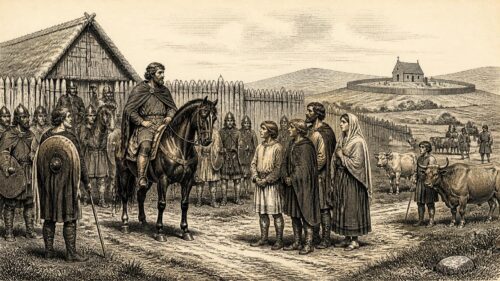
Even with that reservation, the reported clash at Cenn Con illuminates the political geography of the period. Mael Dúin belonged to the Éoganacht Locha Léin, a dynasty based in the western Munster kingdom around the lakes of Killarney. His opponent Áengus Liath was associated with Áine, the important hill and territory in what is now County Limerick. Neither man commanded a modern territorial state. Authority rested in kin-groups, client peoples, control of land and cattle, the ability to reward followers, and the capacity to make or resist military expeditions.
The annal’s phrase “much slaughter on both sides” is deliberately spare. It identifies neither the cause of the conflict nor a victor, and it gives no figure for the dead. It would be unsafe to turn it into a detailed campaign narrative. Still, it demonstrates that armed competition could be severe and localised. A battle between rulers from the south-west and the north of Munster need not have involved all Munster, much less all Ireland. It probably drew on retinues of nobles, dependants and allied groups, whose military obligations arose from lordship and kinship. The consequences were borne not only by leaders named in chronicles but also by households that supplied food, transport, labour and fighting men.
The wider setting was one of fluid succession. Munster had recently lost prominent kings, while its Éoganacht branches competed for precedence. In the north and east, the descendants of Niall dominated the political imagination but were themselves divided into rival branches. After the death of Domnall mac Áedo, normally placed in 642 or 643, Cellach and Conall Cóel are represented as exercising the kingship of Tara jointly or in close succession. Such “high-kingship” was not a national office with permanent institutions. It was a claim to superiority expressed through hostages, tribute, military success, ceremonial status and alliances. Regional rulers such as Mael Dúin and Áengus operated within that larger, contested political field.
The Déisi and the Cost of Kingship
The death of Máel Ochtraig, king of the Déisi, is the only explicitly royal obituary in Inisfallen’s 645 entry. The Déisi were a significant people of south-eastern Munster, associated especially with the area later known as County Waterford. The annal does not state whether Máel Ochtraig died peacefully, in conflict or from disease; no cause should be invented. But the record reminds us that kingship was personal as well as territorial. The death of a ruler created an immediate question of succession among a royal kindred and its allies, with implications for tribute, landholding, fosterage and military allegiance.
Early medieval political language can make these communities seem more uniform than they were. “King of the Déisi” names a position within a hierarchy, not the ruler of a bounded county. Beneath such rulers were free farming families of differing rank, client households, craftsmen, dependants and enslaved people. Law tracts and archaeology alike show a strongly graded society. A king’s household and its followers required regular renders in food, livestock and labour. Political change could therefore reach deeply into ordinary life: a new lord might alter who received cattle dues, who provided hospitality, and which kin-group could call men to an armed gathering.
Cattle, Land and Household Life
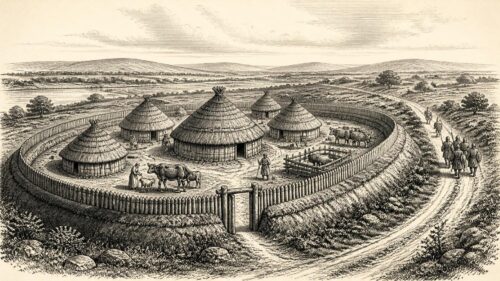
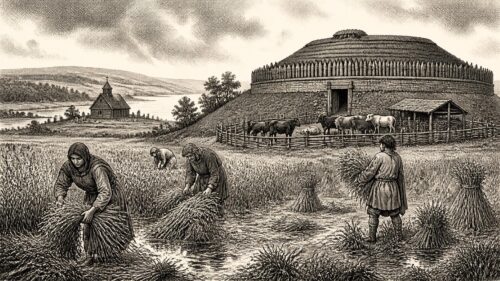
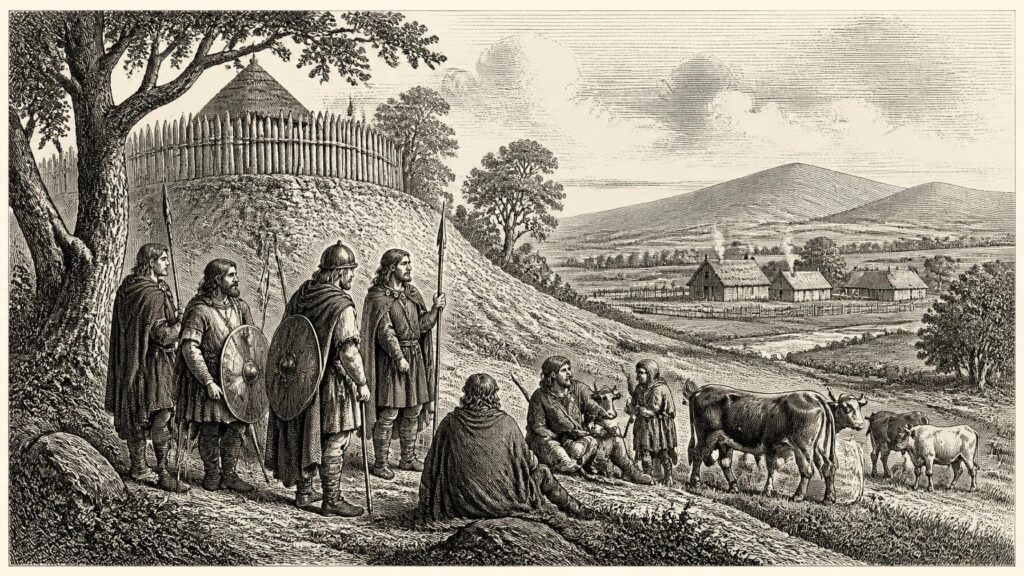
For most people connected with Ireland in or around 645, everyday life was rural. Settlement was scattered across farmsteads, enclosed raths and cashels, lake settlements, ecclesiastical precincts and seasonal grazing land, rather than concentrated in towns. Archaeology indicates a landscape of timber houses, animal enclosures, cultivated plots and routes linking local communities. Cattle were central to subsistence, status and exchange; they supplied milk, meat, hides, traction and a measure of value. Grain, notably oats and barley, was also indispensable, while pigs, sheep and goats added to household resources.
This material background helps explain why the language of cattle, food and hosting recurs in political and literary sources. The later tale Cath Cairnd Chonaill, associated with a battle conventionally dated to 649 rather than 645, makes the seizure of a foster-mother’s cattle the provocation for a conflict between Diarmait mac Áedo Sláine and Guaire of Aidne. Its speeches and miracles cannot be treated as a factual report of the earlier decade. Nevertheless, the story’s assumptions are historically revealing: cattle-raiding, fosterage, honour and hospitality were intelligible ways of representing political injury. Wealth moved through reciprocal obligations as much as through impersonal buying and selling.
There is no reliable annalistic evidence for a distinctive harvest, famine, epidemic or environmental disaster in 645 itself. It would be wrong to manufacture a weather narrative merely to fill a yearly entry. The best evidence instead supports continuity: communities managed livestock and crops within a variable Atlantic climate; travel followed rivers, roads and sea routes; and local economies were interwoven with political and religious institutions. The absence of a recorded calamity is not proof of ease, only a limit to what the sources permit us to say.
Churches as Local Powers
Mac na Cerda’s “repose” belongs to the conventional Christian language of the annals, which commonly describe the death of an ecclesiastic as rest in Christ. The notice is brief enough that his precise institutional role cannot be reconstructed from this entry alone. Yet it points to a world in which churches and monasteries were woven into local society. Ecclesiastical communities held land, received food-renders, educated clerics, preserved books and maintained links with ruling families. Their leaders could be spiritual authorities, landholders, advisers and diplomatic intermediaries at once.
By the mid-seventh century, Latin learning and Irish vernacular literacy were established features of elite religious culture. The calculation of Easter, biblical exegesis, penitential discipline and the copying of texts connected Irish clerics to Britain and the Continent. The very chronological difficulty of the annals is a reminder of this learned environment: recording years involved the Kalends, lunar cycles and Easter computation, not merely writing down memorable events. At the same time, the Church was not separate from secular politics. Saints’ cults and monasteries could reinforce royal prestige; kings could endow churches; and ecclesiastical protection could shape negotiations and warfare.
Ireland’s overseas links were also real, though no external diplomatic event can securely be assigned to 645. Irish religious travellers had long moved through western Britain and Frankish Gaul. The death of the Irish missionary Fursa at Péronne is entered by the Annals of Ulster under 649, demonstrating the continuing connections of Irish churchmen with the Frankish world only a few years after the period considered here. Such contacts carried people, manuscripts, religious ideas and reputations across the sea; they did not make Ireland politically unified.
A Carefully Bounded Year
What, then, can 645 CE responsibly contribute to Irish history? Inisfallen preserves a memorable cluster of events: conflict at Cenn Con, the death of Máel Ochtraig of the Déisi and the repose of Mac na Cerda. Its synchronisms warn that at least some belong earlier in the decade by modern reckoning. Rather than weakening the history, that uncertainty reveals how it survives. The entries expose a society of regional kings, vulnerable successions, militarised retinues, cattle-based wealth and powerful religious communities. They also show why early Irish history demands patience: a year may be historically meaningful not because every detail is fixed, but because the evidence itself explains how contemporaries and later record-keepers organised their past.
Primary Sources
- Annals of Inisfallen, Annals AI645–AI649
- The Annals of Ulster, Year U649
- The Annals of Tigernach
- Chronicon Scotorum
- The Battle of Carnn Chonaill
- The Battle of Carn Conaill
- Cath Cairnn Chonaill: Text and Translation
- Cath Cairnn Chonaill: Background Information
- Scéla Cano meic Gartnáin: Background Information
- Fragmentary Annals of Ireland, Part 2
- Imarcaigh sund ar gach saídh
- Annals of Inisfallen
- The Annals of Ulster
- Irish Texts at CELT
- List of Published Texts at CELT
- Irish Hagiography and Its Dating: A Study of the O’Donohue Group of Irish Saints’ Lives
- Agriculture, Settlement and Society in Early Medieval Ireland
- Early Medieval Ireland, AD 400–1100: The Evidence from Archaeological Excavations
- Early Medieval Rural Settlement Archaeology in Ireland and the Impact of Large Infrastructural Developments
- Early Medieval Ireland: Archaeological Excavations, 1930–2009
- Early Medieval Dwellings and Settlements in Ireland, AD 400–1100, Volume 1
- The Archaeology of Livestock and Cereal Production in Early Medieval Ireland, AD 400–1100
- Settlement Patterns and Socio-Economic Change in the Diocese of Tuam c. AD 400–1000
- Ireland in the Seventh Century: A Tour