


Related Archive: Frozen Ground

Fermanagh Tills

Fermanagh Tills

Archived: 20 September 2026

Abstract

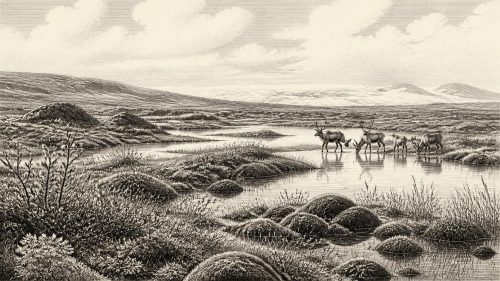
Labelled 31,096 BCE, this period cannot be reconstructed as a single Irish year, but through fragmentary environmental evidence. At Derryvree near Maguiresbridge, freshwater silts between glacial tills, radiocarbon dated broadly to 36,900–31,700 years ago, preserve tundra wetland plants and animals, indicating cold, ice-margin conditions before renewed glaciation. Ireland's ice cover was dynamic, not uniformly continuous. Castlepook Cave fossils show reindeer, mammoth and other cold-country mammals reached Ireland when lower sea levels enhanced connectivity. A marked reindeer bone may indicate an early human visit, but lacks contextual proof. No evidence establishes permanent settlement, polities, trade, or institutions; the record remains ecological.


Read Article

Intertill Organics

Intertill Organics

Archived: 14 September 2026

Abstract

31,768 BCE is a nominal modern date, not an identifiable Irish event, and belongs broadly to Late Pleistocene MIS 3. Derryvree, County Fermanagh, preserves freshwater organic sediments between glacial tills, dated broadly to 36,900–31,700 calibrated years BP. They reveal a cold, locally ice-free, treeless periglacial wetland of sedges, mosses, pools and short growing seasons, later overridden by ice. Northern sites corroborate open conditions. Castlepook Cave, County Cork, records cold-adapted fauna including mammoth, reindeer and hyaena, though not necessarily contemporaneously. A marked reindeer bone may indicate early human butchery, but lacks secure supporting context. No evidence establishes permanent settlement or institutions.

Read Article

