
Archived: 24 September 2026
Abstract
Around 30,760 BCE, Ireland lay within the fluctuating cold conditions of Marine Isotope Stage 3, with tundra-like wetlands, open grasslands and changing ice margins. Evidence from Derryvree and Castlepook Cave shows that reindeer, mammoths, giant deer, hyaenas and other cold-adapted animals inhabited parts of the island. Castlepook’s mixed bone deposits reflect animal deaths, scavenging and denning, not a proven settlement. A reindeer femur, possibly cut by a stone tool, suggests brief Upper Palaeolithic human visits or carcass processing near Doneraile. However, no securely associated tools, hearths, dwellings or burials confirm occupation. Subsequent glaciation erased or buried much earlier evidence there.
Read Article

Archived: 21 September 2026
Abstract
Ireland around 30,983 BCE cannot be reconstructed as a specific historical year, but belongs to late Marine Isotope Stage 3, a climatically unstable period preceding maximum glaciation. Derryvree sediments in Fermanagh document an ice-free tundra wetland with freshwater plants, insects and open vegetation. Castlepook Cave in Cork preserves a mixed Pleistocene fauna including reindeer, mammoth, giant deer, wolves and hyaenas, indicating severe yet productive environments. A marked reindeer femur may record stone-tool butchery and potentially Ireland’s earliest human activity. However, its complex context and lack of associated artefacts preclude claims for permanent settlement, society, culture or recorded events with certainty.
Read Article
Archived: 9 September 2026
Abstract
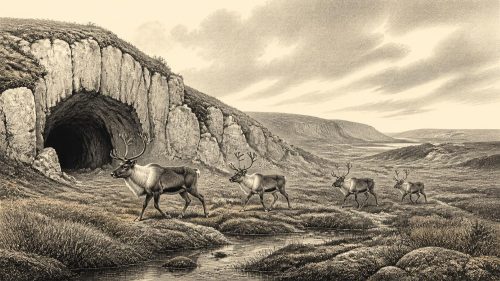
Castlepook Cave near Doneraile, County Cork, contains a reindeer femur whose deep mark may represent Ireland’s earliest evidence of human activity, perhaps from stone-tool butchery around 33,800 years ago. The date is a broad Late Pleistocene MIS 3 estimate, not a precise annual event, and bone dating records animal death rather than human handling. Excavated deposits were disturbed and include scavenger-accumulated fauna, limiting conclusions. Mammoth, reindeer, giant deer and carnivores indicate cold, open, intermittently habitable landscapes and changing access routes. The find suggests possible brief forager presence, but proves neither settlement, culture, identity nor permanent occupation in Ice Age Ireland.
Read Article





