The Doneraile Femur31,893 BCE
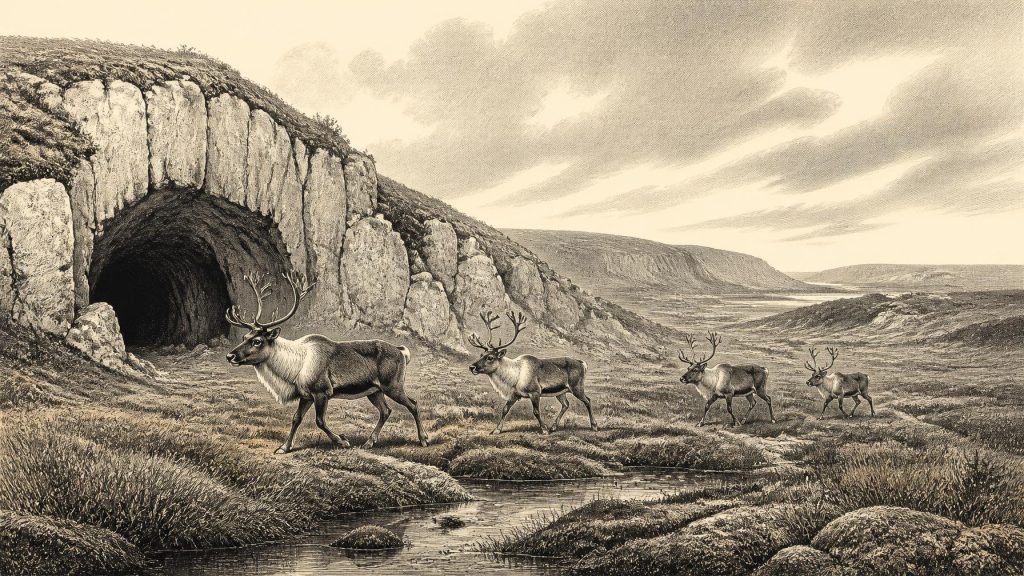
The label 31,893 BCE creates an appearance of precision that the evidence cannot sustain. No people in Ireland then used a calendar, and archaeology cannot isolate an event to this particular modern year. The responsible chronological setting is the Late Pleistocene, within Marine Isotope Stage 3 (MIS 3), a long and climatically volatile interval of the last Ice Age. In calendar terms, this notional year falls broadly around 33,800 years ago, but evidence is normally reported as radiocarbon ages and calibrated ranges rather than as a dated annual narrative.
For Ireland, the period matters because it may contain the island’s earliest claimed trace of human activity. That claim rests principally on a reindeer femur from Castlepook Cave, near Doneraile in north County Cork. The bone has been reported as bearing a deep mark interpreted as having been made by a sharp stone tool during butchery, and local heritage publications place it at about 31,000 BCE. It is a consequential find, but also a limited one. The bone is not part of a securely excavated living floor with hearths, stone tools, shelters, burials or human remains. It can support the possibility of a brief human encounter with a carcass; it cannot, by itself, prove a permanent population on the island.
A Date Range, Not an Anniversary
Radiocarbon dating does not translate automatically into a calendar year. A laboratory measures remaining carbon-14 in organic material and produces an age in radiocarbon years before present, where “present” conventionally means 1950. That result must then be calibrated against records of past atmospheric carbon-14. At this antiquity calibration produces ranges, sometimes broad or irregular ones, rather than an annual date. The internationally used IntCal20 curve extends to 55,000 calibrated years before present, but its older section necessarily combines several kinds of environmental archive and retains uncertainty.
There is a further distinction that is essential at Castlepook. A date on bone estimates when an animal died, not when a person handled it. The interpretation of a line or incision as a cut mark depends on its shape, position and microscopic character, as well as whether natural processes could have produced a similar trace. Cave deposits are especially challenging: bones can be carried in by carnivores, moved by water, disturbed by sediment collapse, mixed between layers, or recovered long ago without modern recording methods. Archaeologists must therefore separate a securely dated animal from the more ambitious proposition that people butchered it.
Castlepook’s importance has grown precisely because improved ultrafiltration methods have prompted the redating of southern Irish cave fauna. A 2020 reassessment found that some earlier dates from Castlepook were thousands of radiocarbon years too young, placing significant elements of the fauna firmly in MIS 3. This establishes that the cave’s animal record spans a far deeper past than once thought. It does not remove the difficulties created by early twentieth-century excavation, when much sediment was cleared and only a fraction of the originally reported bone collection survived in museum care.
The Cave Beneath the Limestone
Castlepook is a maze-like limestone cave system in the Awbeg Valley, north of the Blackwater in County Cork. Between 1904 and 1914, the naturalist Richard J. Ussher and his workers recovered a remarkable concentration of fossil bone there. Later study identified animals including woolly mammoth, giant deer, reindeer, brown bear, wolf, Arctic fox, lemmings and spotted hyaena. The assemblage is not a snapshot of one season, one herd or one human party. It accumulated over a great span of time and in several cave spaces. Yet it shows that southern Ireland was, during portions of MIS 3, accessible to and capable of supporting a varied cold-stage fauna.
Spotted hyaena is especially important for understanding how the deposit formed. Hyaenas commonly use caves as dens and can drag in parts of carcasses, gnaw bones and leave a confusing mixture of prey remains. Wolves and other scavengers could also move bones. Thus, even if the reindeer femur was butchered in the landscape by people, the cave may not have been the place where the animal was killed or processed. County Cork’s heritage interpretation cautiously suggests that a discarded butchered fragment could have been brought underground later by scavengers. That is a plausible reconstruction, but it remains interpretation rather than demonstrated fact.
The bone nevertheless deserves attention. A large reindeer supplied more than meat: hide, sinew, marrow and bone were valuable resources to Upper Palaeolithic hunter-gatherers elsewhere in north-west Europe. A sharp lithic edge could be used to detach flesh or work around joints. If the Castlepook mark is confirmed as anthropogenic and contemporary with the animal’s death, it would indicate a moment of practical knowledge and skilled carcass processing. It would not identify the people involved by name, language, ethnicity or archaeological culture. Calling them “the Irish” would be an anachronism; there was no Irish people, polity or tradition that can be traced from this single object.
An Open, Severe Landscape
Ireland around this point was not the green, wooded island familiar today. Environmental sequences beneath later glacial deposits in Fermanagh, including those at Derryvree, offer the closest terrestrial evidence for conditions during the broader cold-stage world. Pollen, plant macrofossils and insects indicate open, treeless vegetation: grasses, sedges, juniper, herbs and mosses around wet ground and pools. Such records cannot be transferred without qualification from Fermanagh to every part of the island or assigned to one exact year. They do, however, provide sound evidence for a landscape of tundra or muskeg-like habitats during cold intervals of MIS 3.
Insects from comparable deposits suggest harsh winters and cool summers, while the presence of Arctic-adapted mammals in southern cave assemblages reinforces the picture of exposed terrain. Low shrubs and herb-rich vegetation could support grazing animals, but it was a demanding environment, shaped by frost, wind, seasonal scarcity and unstable ground. There is no evidence for extensive forest, crop fields, livestock pasture or permanent villages. Rivers, spring-fed wetlands and sheltered limestone valleys may have offered local resources, but they were not landscapes softened by later soils, bogs and woodland.
Climate was not uniformly cold. MIS 3 contained abrupt oscillations, with comparatively milder interstadial phases interrupting severe cold. The exact extent of ice in Ireland at c. 33,800 years ago remains debated in detail, and should not be reconstructed as a simple island-wide white sheet. The later Last Glacial Maximum lay ahead: during Marine Isotope Stage 2, especially from roughly 29,000 years ago onward, the British–Irish Ice Sheet expanded over most of Ireland and adjacent shelves. At the date considered here, the best evidence supports a changing pre-maximum world in which at least some ground, particularly in southern Ireland, could intermittently sustain large mammals.
Movement Across a Different Geography
Sea level was substantially lower than today because enormous quantities of water were held in northern ice sheets. The Irish Sea basin and Celtic Sea shelf consequently had a very different shape, exposing or narrowing routes that are now submerged. But lower seas did not necessarily create one continuous, easy land bridge from Ireland to Britain or continental Europe. The timing and character of connections changed repeatedly with sea level, ice margins and local topography. Animals and any people who reached Ireland may have moved over exposed terrain during favourable phases, crossed narrow waterways, or used a combination of both. The present evidence does not decide between these possibilities.
The faunal record indicates connectivity of some kind. Mammoth, reindeer, giant deer and carnivores did not originate in isolation on an Atlantic island. Their presence implies routes into and out of Ireland during the Pleistocene, although each species had different mobility and ecological needs. Recent work on Irish cave deposits, including sedimentary ancient DNA research, is beginning to investigate those wider faunal connections. Such research may eventually clarify whether populations were short-lived visitors, recurrent migrants or locally established groups. For now, the evidence is strongest for animal movement and much weaker for human movement.
Society Beyond the Evidence
If people briefly reached north Cork, they were almost certainly mobile foragers, travelling in small groups and making decisions around weather, animal movements, shelter and fuel. That description is an inference from the wider Upper Palaeolithic world, not a direct portrait of a Castlepook community. Ireland has yielded no securely associated domestic structure, hearth, lithic assemblage, ornament, art object or burial of this age. It is therefore impossible to reconstruct family life, clothing, diet, seasonal rounds or social leadership specifically for the island.
The same restraint applies still more strongly to politics and conflict. There were no states, kingdoms, chiefs, named territories, diplomatic agreements or written laws evidenced in Ireland in 31,893 BCE. Nor can warfare be inferred from a hunted animal bone. Cooperation within a small travelling group is likely in the broad human sense, and access to game-rich ground may have mattered greatly, but evidence does not allow the mapping of social boundaries or rival groups. A cave full of bones records ecological and taphonomic history, not political history.
There is likewise no Irish evidence at this date for formal religion, monuments, ritual deposition, cave art or systems of learning. Upper Palaeolithic people elsewhere in Europe created powerful images, ornaments and technologies, but those achievements cannot simply be imported into Ireland because they would make an appealing story. The Doneraile femur offers, at most, a possible action: cutting into a reindeer carcass with a stone edge. It does not disclose the beliefs of the cutter, the words they spoke, or whether they returned.
A Fragile Earliest Trace
The economic world that can responsibly be described was one of wild resources rather than farming or trade. Reindeer and other animals were potential sources of food and raw materials; the surrounding landscape offered water, stone, wood or scrub for fuel where available, and sheltered places in which to wait out dangerous weather. There is no evidence for agriculture, animal husbandry, pottery, metalworking, exchange networks or permanent coastal settlements. Even the existence of a human group in Ireland remains less secure than the presence of the animals themselves.
That imbalance is the central fact of Ireland in this remote period. The cave fauna, environmental deposits and later glacial landforms make the Ice Age landscape increasingly intelligible. The possible cut-marked reindeer femur makes human presence a serious question rather than an impossibility. But the honest history of 31,893 BCE is not a story of a known expedition, battle or settlement. It is a history of calibrated ranges, open tundra, shifting access routes and a single contested mark on bone: enough to suggest a human threshold, not enough to claim that it had been decisively crossed.
Primary Sources
- A reconsideration of the radiocarbon dating of the Marine Isotope Stage 3 fauna from southern Ireland
- The Irish Quaternary Fauna Project
- Phylogeographic, ancient DNA, fossil and morphometric analyses reveal ancient and modern introductions of a large mammal: The complex case of red deer (Cervus elaphus) in Ireland
- First evidence of a Late Upper Palaeolithic human presence in Ireland
- New insights on the fauna of Ireland's Younger Dryas and Early Holocene from Alice & Gwendoline Cave
- 2022:564 – Castlepook Cave, Castlepook South, Cork
- Heritage Artefacts of County Cork
- Archaeological Heritage of County Cork
- Europe and the County of Cork: A Heritage Perspective
- Landscapes and environments of the last glacial-interglacial transition: a time of amazingly rapid change in Ireland
- The IntCal20 Northern Hemisphere Radiocarbon Age Calibration Curve (0–55 cal kBP)
- Recent Developments in Calibration for Archaeological and Environmental Samples
- Growth and retreat of the last British–Irish Ice Sheet, 31,000 to 15,000 years ago: the BRITICE-CHRONO reconstruction
- The deglaciation of the western sector of the Irish Ice Sheet from the inner continental shelf to its terrestrial margin
- Pattern, style and timing of British–Irish Ice Sheet retreat: Shetland and northern North Sea sector
- Response of the Irish Ice Sheet to abrupt climate change during the last deglaciation
- Ireland through geological time
- Quaternary
- An All-Ireland Quaternary map
- Investigating seasonal mobility in Irish giant deer (Megaloceros giganteus Blumenbach) using strontium isotope analysis