The Doneraile Femur Debate30983 BCE
Ireland around 30,983 BCE cannot be reconstructed as a specific historical year, but belongs to late Marine Isotope Stage 3, a climatically unstable period preceding maximum glaciation. Derryvree sediments in Fermanagh document an ice-free tundra wetland with freshwater plants, insects and open vegetation. Castlepook Cave in Cork preserves a mixed Pleistocene fauna including reindeer, mammoth, giant deer, wolves and hyaenas, indicating severe yet productive environments. A marked reindeer femur may record stone-tool butchery and potentially Ireland’s earliest human activity. However, its complex context and lack of associated artefacts preclude claims for permanent settlement, society, culture or recorded events with certainty.

Dateline
30,983 BCE is not a recoverable year in Ireland’s human story. It is a modern calendar label for a point roughly 32,900 years before AD 1950, during the Late Pleistocene and broadly within Marine Isotope Stage 3 (MIS 3). No Irish calendar, settlement sequence or historical record can distinguish this particular year from those around it. Radiocarbon measurements at this depth have substantial uncertainties and must be calibrated; they cannot be translated into an exact modern BCE anniversary. The responsible subject is therefore Ireland during a broad late-MIS-3 interval: a climatically unstable, increasingly glacial landscape represented by exceptionally fragmentary environmental and faunal evidence.
The most important conclusion is also the most limiting. Ireland was not an arena of known kingdoms, tribes, diplomacy or warfare in 30,983 BCE. There are no named communities, human burials, houses, hearths, unequivocal stone-tool scatters, fields or monuments securely dated to this horizon. There is, however, compelling evidence that parts of Ireland sustained cold-stage life before the Last Glacial Maximum, and one remarkable reindeer bone from County Cork that may preserve evidence of human butchery. Its significance is considerable; its limitations are equally important.
Dating a Changing Island
MIS 3, conventionally dated to about 57,000–29,000 years ago, was not one unbroken deep freeze. It contained abrupt swings between colder stadials and relatively milder interstadials. In Ireland, ice margins, sea level, vegetation and animal ranges responded to these changes on scales far beyond a single year or generation. The date in question falls late in that sequence, as the British–Irish Ice Sheet was expanding towards its eventual maximum. Recent ice-sheet reconstructions show that growth and maximum extent were not simultaneous everywhere: sectors advanced and retreated differently, and the available evidence cannot draw a precise island-wide ice boundary for 30,983 BCE.
Low global sea levels exposed much more of the continental shelf than exists today. Yet it is misleading to picture a simple, reliable land bridge connecting Ireland to Britain or mainland Europe. The geography of the Irish Sea was changing, while ice and cold seas presented formidable barriers. Animals demonstrably reached Ireland during parts of the Pleistocene, but the routes, frequency and seasonality of those movements remain uncertain. What can be said is that Ireland belonged to a wider north-west European ecological zone, not to an isolated world untouched by continental climatic and biological change.
Derryvree’s Buried Wetland
The clearest local environmental window relevant to this era comes from Derryvree near Maguiresbridge, County Fermanagh. There, road works exposed organic freshwater sediments lying between two tills: deposits of mud and plant material formed during an ice-free interval, then sealed beneath later glacial deposits. The original study obtained a radiocarbon determination of 30,500 +1,170/−1,030 radiocarbon years BP. That is not a date for 30,983 BCE, and calibration does not transform it into a precise historical timestamp. It nevertheless places the deposit broadly within late MIS 3 and demonstrates that open, biologically active ground existed in this part of Ireland before renewed ice cover.
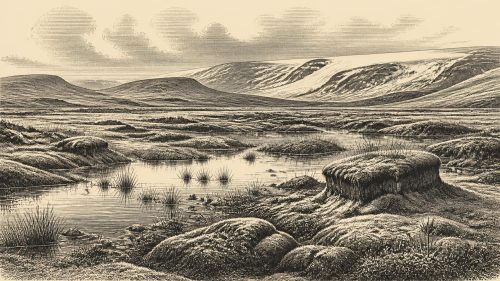
Derryvree’s contents are unusually informative. Pollen, plant macrofossils, mosses and insects record grasses, sedges, herbs, juniper and cold-adapted plants, including bogbean, mountain avens and lesser clubmoss. The assemblage supports an interpretation of open, treeless tundra or muskeg-like terrain, with wet mossy ground, plant-rich margins and shallow pools. Inference must be separated from observation: the fossils directly show organisms that lived in or near the basin; the broader image of a periglacial mosaic is a reconstruction based on their combined ecological requirements and regional comparison.
This was not necessarily a featureless desert of snow. During favourable seasons, wet hollows could support aquatic plants and invertebrates, while sedges, grasses and herbs created patches of grazing. Elsewhere, thin soils, frost disturbance, exposed gravel and strong winds probably restricted vegetation. The Derryvree record cannot show that all Ireland looked the same, nor does it tell us which animals stood beside its pools in a particular season. It does establish a landscape in which freshwater life persisted under harsh conditions, and it demonstrates why the later Irish Ice Sheet did not erase every trace of the preceding world.
Castlepook’s Animal World
For large animals, Castlepook Cave near Doneraile in north County Cork is the crucial Irish archive. Also known as Mammoth Cave, it was excavated principally in the early twentieth century, long before modern standards of stratigraphic recording. Its collections contain remains attributed to woolly mammoth, giant deer, reindeer, brown bear, wolf, Arctic fox, lemmings and spotted hyaena. The cave is Ireland’s richest known source for Pleistocene vertebrate remains, while later radiocarbon reassessment has shown that elements of its fauna belong to MIS 3.
The collection should not be mistaken for a snapshot of one day, one habitat or one food chain. Cave hyaenas and other carnivores could carry carcass parts underground; scavenging, gnawing, water movement, sediment collapse and early excavation could mix remains from different episodes. A mammoth bone demonstrates that a mammoth, or part of one, reached the cave; it does not prove a resident herd immediately outside its entrance. Similarly, the occurrence of predators does not reveal their numbers, social organisation or precise prey choices in Ireland.
Even with those cautions, the fauna is powerful evidence. Reindeer, lemmings and Arctic fox are consistent with severe, open-country conditions. Mammoth and giant deer indicate that, at intervals, enough forage existed to sustain very large herbivores. Wolves and spotted hyaenas show that carcasses were contested resources and that Ireland’s Pleistocene ecosystems included formidable carnivores. This was an ecological setting radically unlike the wooded post-glacial island familiar from later prehistory. It was dynamic, seasonal and vulnerable to rapid climatic deterioration.
A Mark on a Reindeer Bone
Castlepook’s most consequential object is a fragment of reindeer femur reported to carry a deep linear mark interpreted by zooarchaeologist Ruth Carden as a cut or chop made with a sharp stone implement while the bone was fresh. The animal bone has been presented publicly as approximately 33,000 years old. In scientific terms, its age must be expressed through its laboratory result and a calibrated range, not treated as proof that butchery occurred in the calendar year 30,983 BCE. Nor does an age for the animal automatically date the mark or identify its maker.
If the modification is confirmed as a stone-tool mark, it would be the earliest known indication of human activity in Ireland by a very large margin. It would suggest that one or more people handled a reindeer carcass during MIS 3, perhaps on a brief hunting or scavenging visit at Europe’s north-western edge. It would not demonstrate a permanent population. There is no securely associated lithic assemblage, hearth, dwelling surface, human bone, repeated processing area or cemetery from Castlepook of comparable antiquity. The specimen derives from an old, complex cave collection, precisely the sort of context in which taphonomic alternatives must be rigorously tested.
The distinction matters. A cut-marked bone can transform the chronology of human presence while still revealing almost nothing about settlement duration, group size or movement. It is possible that people reached Ireland sporadically and left little trace; it is also possible that the mark will require further qualification. Subsequent glaciation scoured much of the landscape and makes the survival of open-air sites unlikely, but destruction alone cannot be used as proof for a population for which direct archaeological evidence has not yet been found.
Society Beyond Recovery
Political affairs, conflict and diplomacy cannot responsibly be written for Ireland at this date. There were no documented polities, boundaries, leaders or treaties, and even continuous human occupation remains unproven. Later ethnic labels, Gaelic language, Celtic identity and Irish origin traditions belong to vastly later periods and have no evidential place in this Pleistocene setting. Farming, settled villages, trade in the later prehistoric sense and formal institutions are likewise unsupported.
The same restraint applies to religion, culture and learning. No securely dated Irish cave art, portable art, grave, shrine or ceremonial feature belongs to this horizon. Upper Palaeolithic groups elsewhere in Europe possessed sophisticated technical knowledge, social networks and, in some regions, rich symbolic traditions. Those comparisons show what people who might have visited Ireland were capable of; they do not establish that such objects or practices existed here. Should a small group have processed the Castlepook reindeer, its everyday economy would have involved immediate decisions about meat, marrow, hide, sinew and safe movement through a dangerous landscape. But the Irish evidence cannot tell which resources were taken, whether the animal was hunted, or how knowledge was shared.
What This Date Can Mean
Ireland around 30,983 BCE is therefore best understood as a time of cold, unstable environmental change rather than a year of recorded human events. Derryvree preserves a local wetland world of sedges, mosses, herbs and shallow freshwater; Castlepook preserves a broader, time-averaged animal record of reindeer, mammoth and predators. Together they refute any idea of a uniformly lifeless island before the Last Glacial Maximum. The Doneraile reindeer femur adds a potentially momentous human question, but not a settled Palaeolithic Ireland. Its mark asks for more excavation, dating and microscopic analysis—not for an invented hunting story. In this deepest period of Irish history, caution is not a lack of narrative: it is the evidence-based achievement.
Primary Sources
- A Reconsideration of the Radiocarbon Dating of the Marine Isotope Stage 3 Fauna from Southern Ireland
- A Middle Midlandian Freshwater Series at Derryvree, Maguiresbridge, County Fermanagh, Northern Ireland
- The Irish Quaternary Fauna Project
- Castlepook Cave: County Geological Site Report
- Growth and Retreat of the Last British–Irish Ice Sheet, 31,000 to 15,000 Years Ago: The BRITICE-CHRONO Reconstruction
- Growth and Retreat of the Last British–Irish Ice Sheet, 31,000 to 15,000 Years Ago: The BRITICE-CHRONO Reconstruction
- The Timing and Magnitude of the British–Irish Ice Sheet Between Marine Isotope Stages 5d and 2
- Trimlines, Blockfields and the Vertical Extent of the Last Ice Sheet in Southern Ireland
- Quaternary Geology of Ireland
- Figure 6: The Subdivision of the Quaternary Period in Ireland
- Field Guides
- Outreach and Education Resources
- Irish Pleistocene Biostratigraphy
- Pleistocene Vertebrates in the British Isles
- First Evidence of a Late Upper Palaeolithic Human Presence in Ireland
- New Insights on the Fauna of Ireland's Younger Dryas and Early Holocene from Alice & Gwendoline Cave
- Ireland: Submerged Prehistoric Sites and Landscapes
- The Colonization of Ireland: A Human Ecology Perspective
- Menyanthes trifoliata
- Selaginella selaginoides