Now Sharing: Articles (154) | Images (445) | Total Items Archived (599)
Our Mission: 100,000 Items | Total Percentage Achieved (0.60%)

Limerick Market Day, 1937

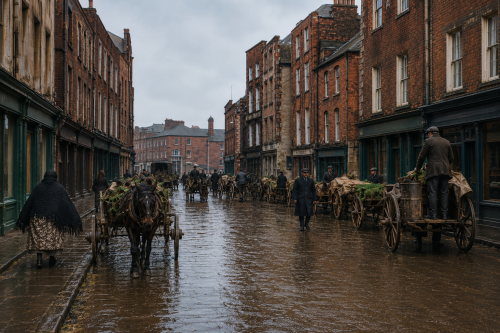
This photograph, dated 1 March 1937, captures a busy market day in Limerick city. Horse-drawn carts, traders, shoppers, and farmers crowd the wet street, creating a vivid picture of everyday commercial life. On the right, a man drives a horse and trap, a form of transport commonly associated with more prosperous Irish farmers. Market goods are displayed on carts and stalls, while pedestrians move between the buildings lining the street. The scene records the importance of markets to Limerick’s economy, bringing rural producers and urban customers together during a period when horses remained central to transport and trade throughout Ireland.

Limerick Boat Club

Limerick Boat Club, founded in 1870, ranks among Ireland’s oldest and most distinguished sporting institutions. For generations, it has introduced people to the pleasures and disciplines of rowing on the River Shannon, encouraging fitness, teamwork and a lasting appreciation of the water. The club’s striking red-brick Victorian clubhouse, standing directly beside the river, has become a familiar landmark on Limerick’s waterfront. Although rooted in a proud competitive tradition, the club places strong emphasis on recreational rowing and community participation. Its enduring presence reflects both the city’s deep connection with the Shannon and Limerick’s long, celebrated sporting heritage and civic identity.

Treaty Stone

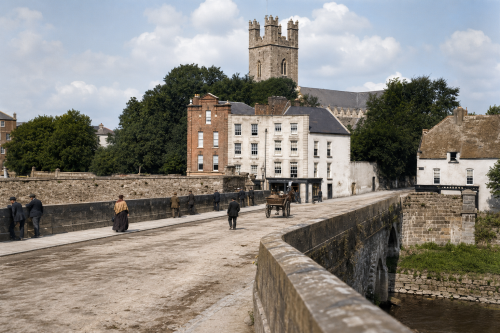
AI-assisted archival reconstruction showing the Treaty Stone on Thomond Bridge, Limerick, with the riverside castle buildings and historic bridge approach in the background. The scene presents the monument, cobbled roadway, bridge parapet, pedestrians, and horse-drawn traffic in a restored early twentieth-century setting, preserving the atmosphere of the original historical source image.

Glenduff Castle Restored

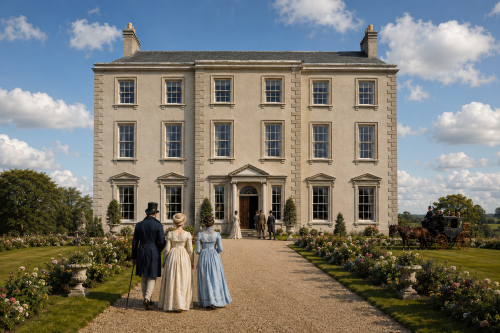
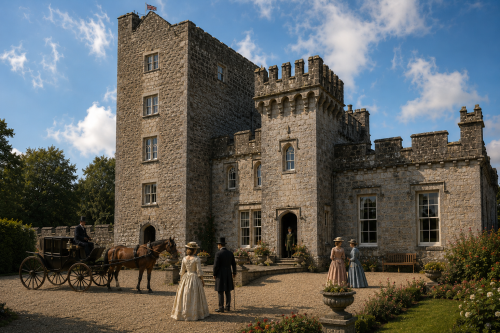
Glenduff Castle is shown restored to its former splendour, standing proudly amid landscaped gardens in rural County Limerick. Built around 1840 for the Ievers family, the castellated country house incorporated an earlier tower house dating from about 1600. Its battlements, flanking towers, arched entrance and long stone façade created a striking Gothic Revival residence. The scene imagines the estate before its destruction, with residents, visitors and a horse-drawn carriage bringing the grounds to life. Glenduff Castle was burned during the Irish Civil War on 29 June 1922, leaving the picturesque ivy-covered ruin that survives on private farmland near Broadford today.

Children Gather

A vast children’s celebration has been held in Phoenix Park as part of Queen Victoria’s final visit to Ireland, bringing together school pupils from Dublin and numerous districts beyond the capital. Special trains, organised parties and local escorts carried children towards the park, where extensive arrangements had been made for their reception. Contemporary estimates of attendance vary, but all describe a gathering numbering many tens of thousands. News of the spectacle has reached Limerick, where families, teachers, clergy and political organisers are considering both the scale of the occasion and the use of schoolchildren within an explicitly royal ceremony.

Fatal Confusion

Cappamore and the surrounding district lost a medical practitioner in early February 1900 when Dr Charles Philip Tennant died after accidentally swallowing carbolic acid during an evening visit to a family at Rath. Tennant served patients across the Cappamore and Murroe area, where a country doctor might travel considerable distances to reach sick people in their homes. The surviving reports describe no deliberate act and no dispute over the cause. An ordinary medical call ended in tragedy because two liquids carried to the house were confused, turning a customary gesture of hospitality into a fatal emergency.

Glenduff Castle Restored

This reconstructed view presents Glenduff Castle in County Limerick as it may have appeared before its destruction in 1922. The imposing residence combines the fortified character of an earlier seventeenth-century tower house with the Gothic Revival additions created for the Ievers family around 1840. Tall crenellated towers, pointed windows, battlements and a formal central entrance give the building a commanding presence. Set within carefully maintained lawns and mature woodland, the castle reflects the scale and confidence of a nineteenth-century Irish country estate. The image offers a plausible visual impression rather than a definitive record of its original appearance or grandeur.

Limerick Market Day, 1937

This photograph, dated 1 March 1937, captures a busy market day in Limerick city. Horse-drawn carts, traders, shoppers, and farmers crowd the wet street, creating a vivid picture of everyday commercial life. On the right, a man drives a horse and trap, a form of transport commonly associated with more prosperous Irish farmers. Market goods are displayed on carts and stalls, while pedestrians move between the buildings lining the street. The scene records the importance of markets to Limerick’s economy, bringing rural producers and urban customers together during a period when horses remained central to transport and trade throughout Ireland.

George Street, Limerick

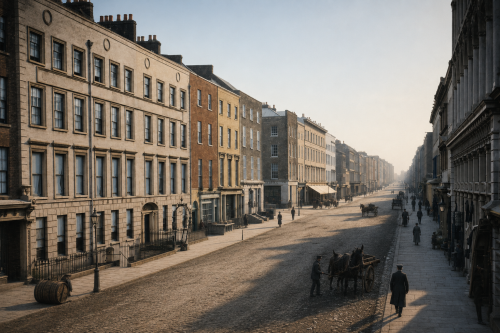
In 1900, George Street, now O’Connell Street, formed the commercial heart of Edwardian Limerick. Its broad thoroughfare was lined with elegant Georgian buildings, busy shops, hotels and offices, while horse-drawn carts, carriages and pedestrians filled the roadway. Street traders added colour and activity to the city’s principal avenue. Among its notable establishments were the Cruises Royal Hotel, MacMahon’s Temperance Hotel and respected merchants such as O’Mahony & Company. The street reflected Limerick’s growing prosperity at the opening of the twentieth century, combining refined architecture with energetic daily commerce and serving as a central meeting place for residents, visitors and travellers alike.