-
Dairy Expansion
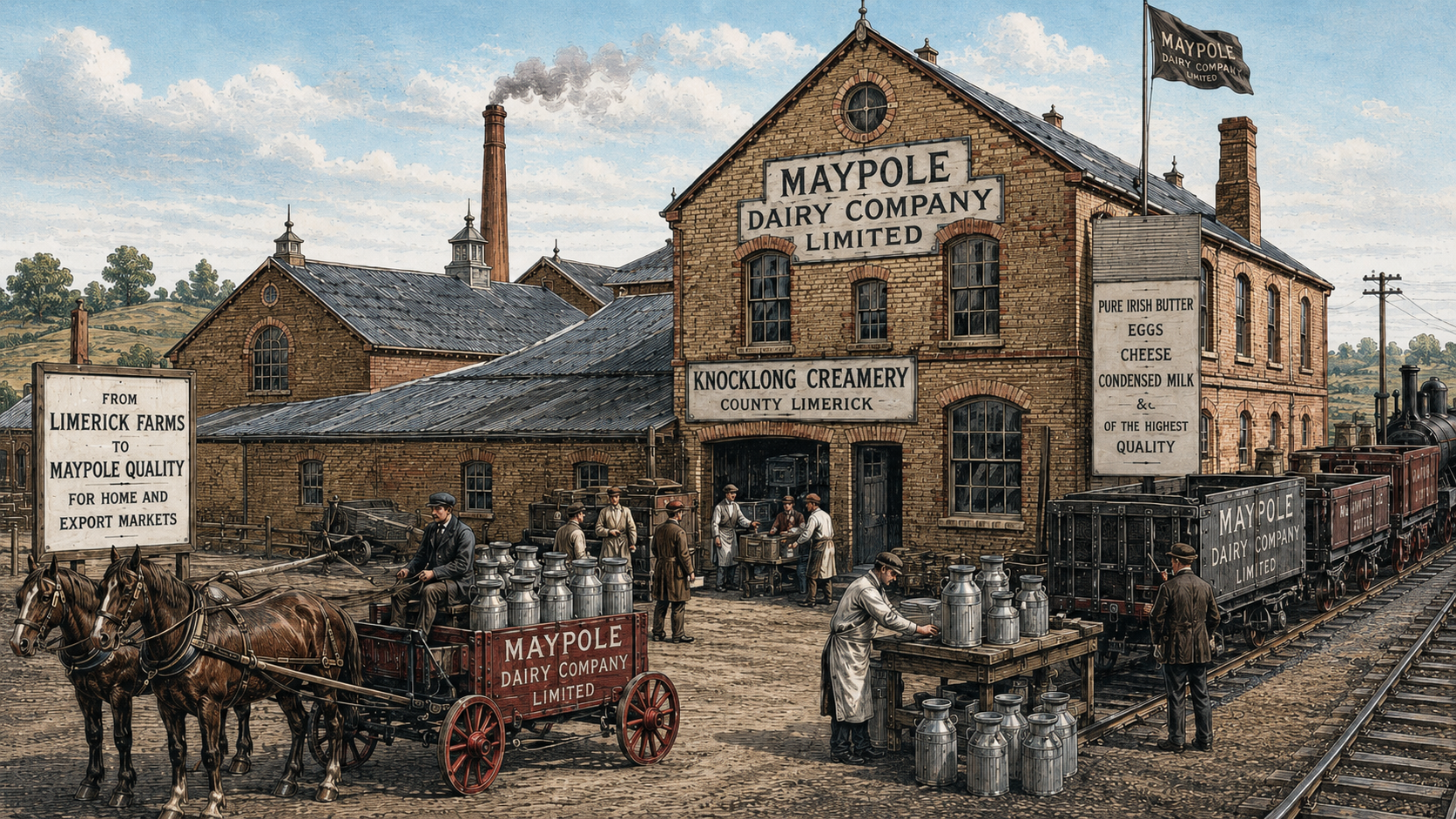
Read Article: Dairy ExpansionCounty Limerick’s dairy economy was changing rapidly around 1900 as the Maypole Dairy Company strengthened the connection between rural milk production and large-scale commercial retailing. At Knocklong, where the company had built a creamery during the mid-1890s, farmers delivered milk for mechanical separation and butter-making rather than producing every finished article within their own homes. The operation linked surrounding farms with a business selling provisions across Britain. For local suppliers, the creamery offered regular access to a wider market, while the company gained a dependable source of Irish butter for an expanding network of urban shops.
The Maypole enterprise had grown from the Watson family’s provision trade and became closely associated with affordable butter, margarine, tea, eggs and condensed milk. In 1898, the Maypole and Medova businesses were combined within a public company under the chairmanship of William George Watson. At that stage, the enlarged concern controlled 185 shops and seventeen creameries or butter factories in Britain and Ireland. County Limerick therefore formed part of a substantial commercial system in which rural production, central management and multiple-shop retailing were organised together to supply large numbers of working-class customers.
Knocklong’s creamery depended upon the daily labour of farmers, carters and factory employees. Milk had to reach the premises promptly, be tested and separated, and then be churned under controlled conditions before the butter was packed for transport. Creamery production encouraged greater uniformity than traditional household methods because milk from numerous farms could be processed with common machinery and supervision. Rail and road connections then allowed the finished produce to move beyond the district. A County Limerick farming community was consequently drawn into a chain extending from the cowshed and milk cart to provision counters in British towns.
Cleanliness and consistency became central to the Maypole company’s public identity. Its commercial success depended upon persuading customers that produce sold through hundreds of branches would possess a dependable standard regardless of where it had been made or purchased. This reputation required orderly factories, careful handling, suitable storage and disciplined retail service. Such claims should not be mistaken for proof that every creamery always achieved ideal conditions, but they reveal the standards the company wished customers and suppliers to associate with its name. Quality became both a practical requirement and a powerful form of advertising.
The growth of Maypole’s Limerick operations also reflected a wider contest over the organisation of Irish dairying. Proprietary companies purchased milk and controlled processing facilities, while emerging co-operative creameries sought to place ownership and profits in the hands of supplying farmers. Knocklong’s Maypole creamery belonged to the private corporate model and connected local agriculture to decisions made beyond the county. Its presence nevertheless provided employment, encouraged industrial butter production and demonstrated the increasing importance of machinery, transport and distant markets. By 1900, dairy farming in Limerick was becoming inseparable from the expanding commercial networks that carried Irish produce abroad.
- Mary O’Riordan, Butter: The Cream of County Limerick, Limerick City and County Council, p. 26; records that the Maypole Dairy Company built Knocklong Creamery around 1894–95 and that Cleeve’s purchased it in 1908.
- British Newspaper Archive, indexed contemporary report headed “Meeting at Knocklong,” concerning farmers supplying the Maypole Dairy Company’s factories; newspaper title and exact publication date remain unconfirmed in the available index.
- The Times, 12 June 1918, p. 8, Maypole Dairy Company advertisement emphasising shop cleanliness, coolness and service.
- Eoin McLaughlin and Paul Sharp, “Competition Between Organisational Forms in Danish and Irish Dairying Around the Turn of the Twentieth Century,” Business History, vol. 63, no. 2, 2021, pp. 314–341.
- Kathryn A. Morrison, “‘Shop-Coolness and Counter-Cleanliness’: The Legacy of the Maypole Dairy Co,” Building Our Past, 25 March 2016.
-
Route Endorsed
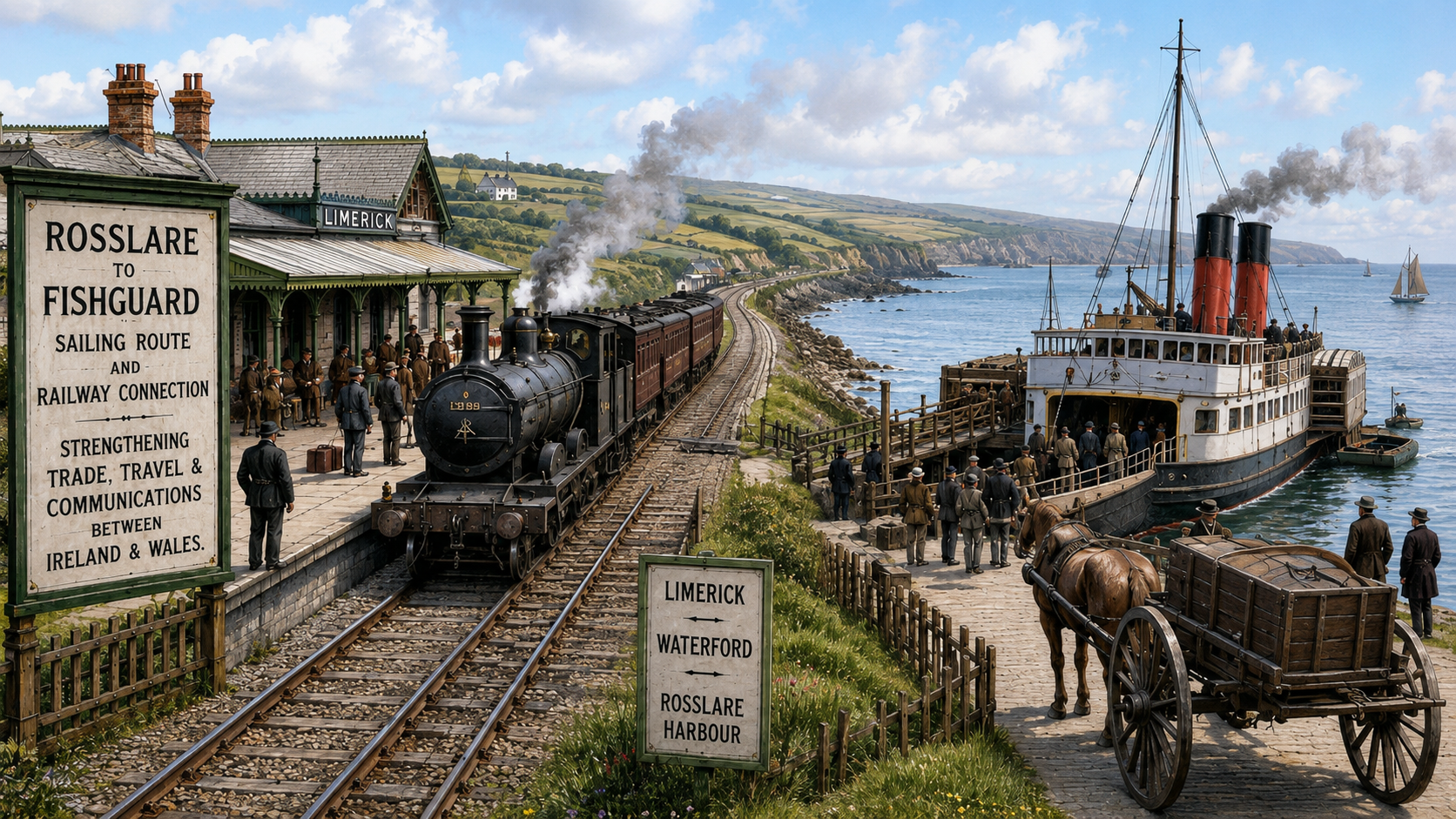
Read Article: Route EndorsedLimerick County Council looked towards the Irish Sea in 1900 when it supported proposals for the developing railway and steamship connection between Rosslare in County Wexford and Fishguard in Wales. The surviving account mistakenly calls the Irish port “Roeselare,” the name of a Belgian city, but the intended destination was Rosslare. Although both harbours lay far from County Limerick, councillors recognised that a through route from the Shannon region towards Waterford and the south-eastern coast might improve passenger travel, commercial communication and access to markets in Britain.
The Fishguard and Rosslare Railways and Harbours Company had emerged from plans advanced during the late 1890s by interests associated with the Great Western Railway and the Great Southern and Western Railway. Parliament authorised the undertaking through the Fishguard and Rosslare Railways and Harbours Act of 1898. The project required considerably more than the introduction of a ferry. New harbour works, railway approaches and connecting lines were needed on both sides of the Irish Sea before trains and steamships could operate as parts of one coordinated transport system.
Further parliamentary powers followed in 1900, permitting additional harbour construction at Rosslare and alterations to portions of the authorised railway. Limerick already possessed a rail connection towards Waterford through the former Waterford and Limerick Railway, known by then as the Waterford, Limerick and Western Railway. Supporters could therefore envisage passengers and agricultural consignments travelling eastward from Limerick through Clonmel and Waterford before continuing towards Rosslare. The route promised an alternative link with Britain, though substantial engineering, financial and administrative difficulties still stood between parliamentary approval and regular operation.
The council’s support reflected the economic ambitions of a county dependent upon agriculture, trade and reliable transport. A more direct south-eastern crossing offered the possibility of shorter journeys, improved mail communication and more efficient movement of produce towards British towns. Yet the benefits remained prospective in 1900. The company’s obligations and proposed railway works became subjects of continuing parliamentary scrutiny, while disputes arose over connecting lines and the fulfilment of earlier undertakings. Local enthusiasm could encourage the project, but Limerick County Council did not control the construction timetable, the harbour engineering or the companies responsible for completing the route.
Regular passenger operations between Rosslare and Fishguard did not begin until 1906, six years after the Limerick discussion. The eventual opening nevertheless fulfilled much of the vision that had attracted support: a linked railway and sea passage joining southern Ireland with Wales and the Great Western route towards London. For Limerick, the episode demonstrated that transport policy extended beyond roads and railways lying within the county boundary. Decisions concerning distant harbours could influence local commerce by reshaping the routes through which people, letters, livestock and goods travelled between western Ireland and Britain.
- Limerick Archives, “Revolutionising Maritime Transportation Between Ireland and England: The Roeselare-Fishguard Sailing Route,” 20 May 2023.
- Fishguard and Rosslare Railways and Harbours Act 1898, 61 & 62 Victoria, chapter cclii.
- Fishguard and Rosslare Railways and Harbours Act 1900, 63 & 64 Victoria, chapter cvi, 30 July 1900.
- CIÉ Group Archives, CIE/FRR/2, Legal and Property Records, Fishguard and Rosslare Railways and Harbours Company, 1897–1925.
- CIÉ Group Archives, CIE/FRR/2/2, Fishguard and Rosslare Railways and Harbours Company Bill 1897: Brief on Opposition from the Dublin, Wicklow and Wexford Railway Company.
- Great Southern and Western and Waterford, Limerick and Western Railway Companies Amalgamation Act 1900, 63 & 64 Victoria, chapter ccxlvii.
- House of Commons Debates, 21 June 1901, vol. 95, “Fermoy and Cork Direct Railway.”
-
Militia Mobilised
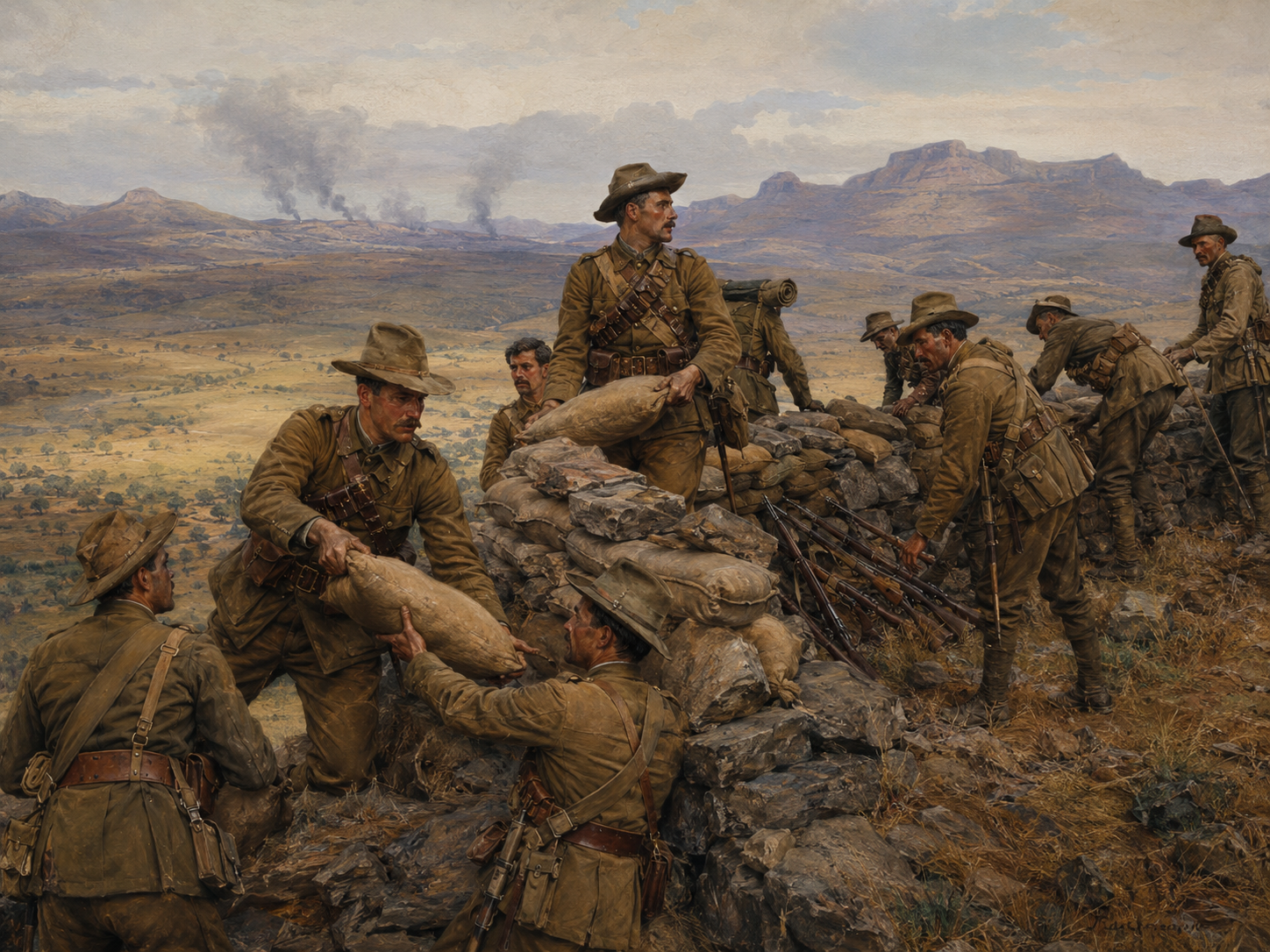
Read Article: Militia MobilisedThe South African War entered everyday life in Limerick during 1900 when the Royal Limerick County Militia was embodied for extended military service. Since the army reforms of 1881, the historic county force had formed the 5th Battalion of the Royal Munster Fusiliers and maintained its local headquarters at Strand Barracks. Its mobilisation connected families throughout Limerick city and county with the wider demands of an imperial conflict. Although the battalion did not campaign against the Boers as a complete unit, its men undertook duties that released regular soldiers for service elsewhere.
The Childers reforms had combined the 101st and 104th Regiments of Foot with three Munster militia units to create the Royal Munster Fusiliers. The South Cork Militia became the 3rd Battalion, the Kerry Militia the 4th, and the Royal Limerick County Militia the 5th. This arrangement preserved local recruiting identities while placing part-time soldiers within the organisation of a regular infantry regiment. The Limerick battalion therefore possessed both a county character and a defined place within the British Army, drawing its officers and men from communities where military service remained an important source of employment and family tradition.
Following mobilisation, the 5th Battalion left Strand Barracks in April 1900 under Lieutenant-Colonel John Massy-Westropp. Contemporary expectations were shaped by the emergency in South Africa, but the battalion’s own course led first to garrison service in England rather than direct deployment to the battlefield. This work was central to the mobilisation system. By guarding military installations and performing routine duties at home, militia battalions allowed regular formations to be concentrated for overseas operations. The contribution was less dramatic than combat, yet it formed an essential part of the army’s effort to sustain a prolonged war thousands of miles from Ireland.
The battalion subsequently reached Malta in February 1901 and assumed Mediterranean garrison duties. Its presence there again released regular troops for more urgent service while extending the separation of Limerick soldiers from their homes. Records of the return journey show the scale of the military community involved. On 29 September 1901, the battalion embarked for Queenstown aboard the transport Assaye with headquarters and eight companies, including 18 officers, 415 rank and file, soldiers’ wives and children. The party disembarked in Ireland on 8 October, bringing an extended period of overseas duty towards its conclusion.
The episode demonstrated how the South African War depended upon forces far beyond those fighting on the veld. The Royal Limerick County Militia helped maintain Britain’s military system through mobilisation, movement and garrison service in England and Malta. For Limerick, the consequences were measured through absence, interrupted employment and the uncertainty experienced by households awaiting the battalion’s next orders. The unit’s history also complicates simple accounts of Irish participation in the war: its men served within the British Army at a time when strong nationalist sympathy for the Boer republics made imperial military service a deeply contested subject at home.
- War Office, Monthly Army List, May 1900, distribution of militia battalions; entry for the 5th Battalion, Royal Munster Fusiliers, Royal Limerick County Militia.
- John S. Farmer, The Regimental Records of the British Army: A Historical Résumé Chronologically Arranged of Titles, Campaigns, Honours, Uniforms, Facings, Badges, Nicknames, etc., London: Grant Richards, 1901, entry for the Royal Munster Fusiliers.
- Limerick Museum, The Royal Munster Fusiliers, exhibition booklet, Limerick City and County Council, 2023.
- National Army Museum, “The Royal Munster Fusiliers,” regimental history and collection guide.
- Malta Royal Army Medical Corps, “The 1st/101st Royal Bengal Fusiliers,” section recording the 5th Battalion, Royal Munster Fusiliers, in Malta during 1901.
- Limerick Archives, “The Royal Limerick County Militia: Mobilisation and Deployment in the Context of the South African War,” 20 May 2023.
-
Commons Uproar
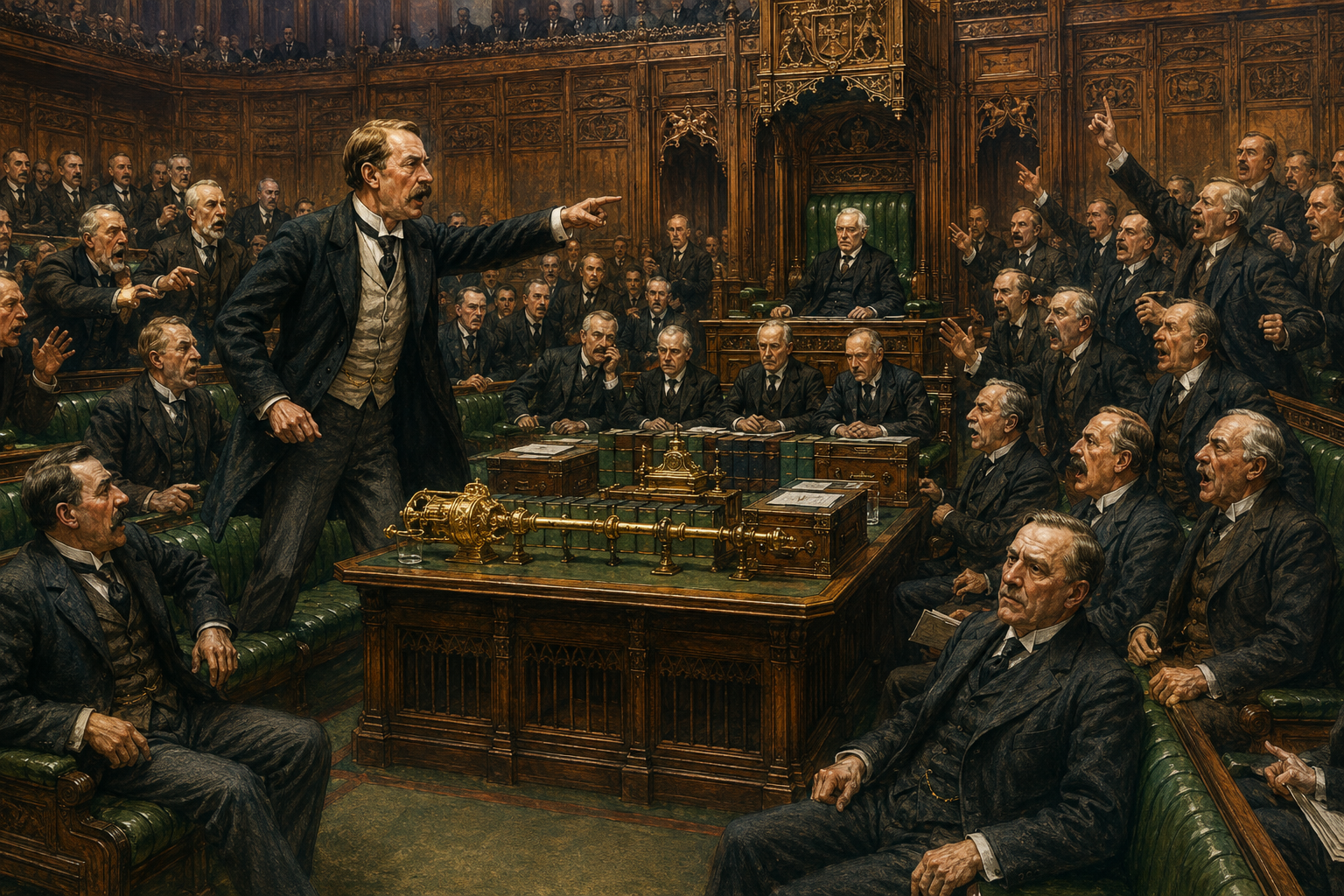
Read Article: Commons UproarThe House of Commons descended into uproar on 2 February 1900 after Colonel Edward Saunderson invoked remarks attributed to John Daly, the Mayor of Limerick, during a fierce attack upon Irish Nationalists. Speaking in a debate on the Government’s conduct of the South African War, the North Armagh Unionist argued that a ministry dependent upon Nationalist votes could not be trusted to prosecute the conflict. Limerick’s political voice therefore entered Westminster at a moment of imperial crisis, exposing the gulf between Irish opposition to the war and Unionist demands for victory and loyalty to the Crown.
Saunderson quoted Daly as declaring that British soldiers were falling before the Boers and that, once the Boers had taken the “stuffing” out of them, the men of Cork and the rest of Ireland would lend a hand. The words were presented in Parliament as evidence of Nationalist hostility towards Britain, although Hansard records them only through Saunderson’s attribution and does not establish the original occasion or full context. Daly, a veteran Fenian and serving mayor, represented a separatist tradition that regarded British reverses in South Africa as weakening imperial authority and creating opportunities for Ireland’s national cause.
The confrontation became disorderly when Saunderson added that British troops might be attacked from behind because Nationalists “never attacked in the front.” Timothy Healy demanded to know why Saunderson was not serving with the Cavan Militia, while John Dillon and William Redmond protested that the remark insulted Irish courage. Members shouted demands for withdrawal, Speaker William Gully repeatedly called for order, and John Redmond formally questioned whether the words exceeded parliamentary usage. Saunderson initially attempted to explain the observation through what he called Irish historical records, an explanation that Nationalist members considered more offensive than the original insult.
Arthur Balfour appealed for the dispute to end, and the Speaker eventually pressed Saunderson to withdraw the observation after Nationalist MPs made clear that they regarded it as a personal reflection. The argument later returned to military service when William Redmond asked why Saunderson did not go to South Africa himself. Saunderson replied that age prevented him from volunteering, describing “Anno Domini” as an incurable condition. He then challenged Redmond to join the Boers, prompting Redmond to answer that he could serve their cause and liberty more effectively within the House of Commons.
The episode captured the bitterness created by Irish participation in an imperial war many Irish Nationalists condemned. Irish soldiers were fighting and dying in British uniform while politicians such as Daly and Redmond expressed sympathy for the Boer republics. Saunderson used those sympathies to question Nationalist loyalty, while his opponents insisted that opposition to the war did not justify insulting Irish valour. Horace Plunkett privately recorded that Saunderson’s attack damaged relations between Nationalists and English members. For Limerick, the confrontation showed how its mayor’s reported words could become ammunition in a Westminster struggle over empire, patriotism and Ireland’s political future.
- House of Commons Debates, 2 February 1900, fourth series, vol. 78, cols. 451–548, especially cols. 531–542, “Fourth Day’s Debate.”
- House of Commons Debates, 15 February 1900, fourth series, vol. 79, “Irish Militia—Alleged Coercion to Volunteer,” concerning Irish militia service in South Africa.
- Sir Horace Curzon Plunkett, Diary, entry for 2 February 1900, National Library of Ireland digital edition.
- Lawrence William White, “Daly, John,” Dictionary of Irish Biography, Royal Irish Academy.
- Patrick Maume, “Saunderson, Edward James,” Dictionary of Irish Biography, Royal Irish Academy.
-
Fatal Confusion
Read Article: Fatal ConfusionCappamore and the surrounding district lost a medical practitioner in early February 1900 when Dr Charles Philip Tennant died after accidentally swallowing carbolic acid during an evening visit to a family at Rath. Tennant served patients across the Cappamore and Murroe area, where a country doctor might travel considerable distances to reach sick people in their homes. The surviving reports describe no deliberate act and no dispute over the cause. An ordinary medical call ended in tragedy because two liquids carried to the house were confused, turning a customary gesture of hospitality into a fatal emergency.
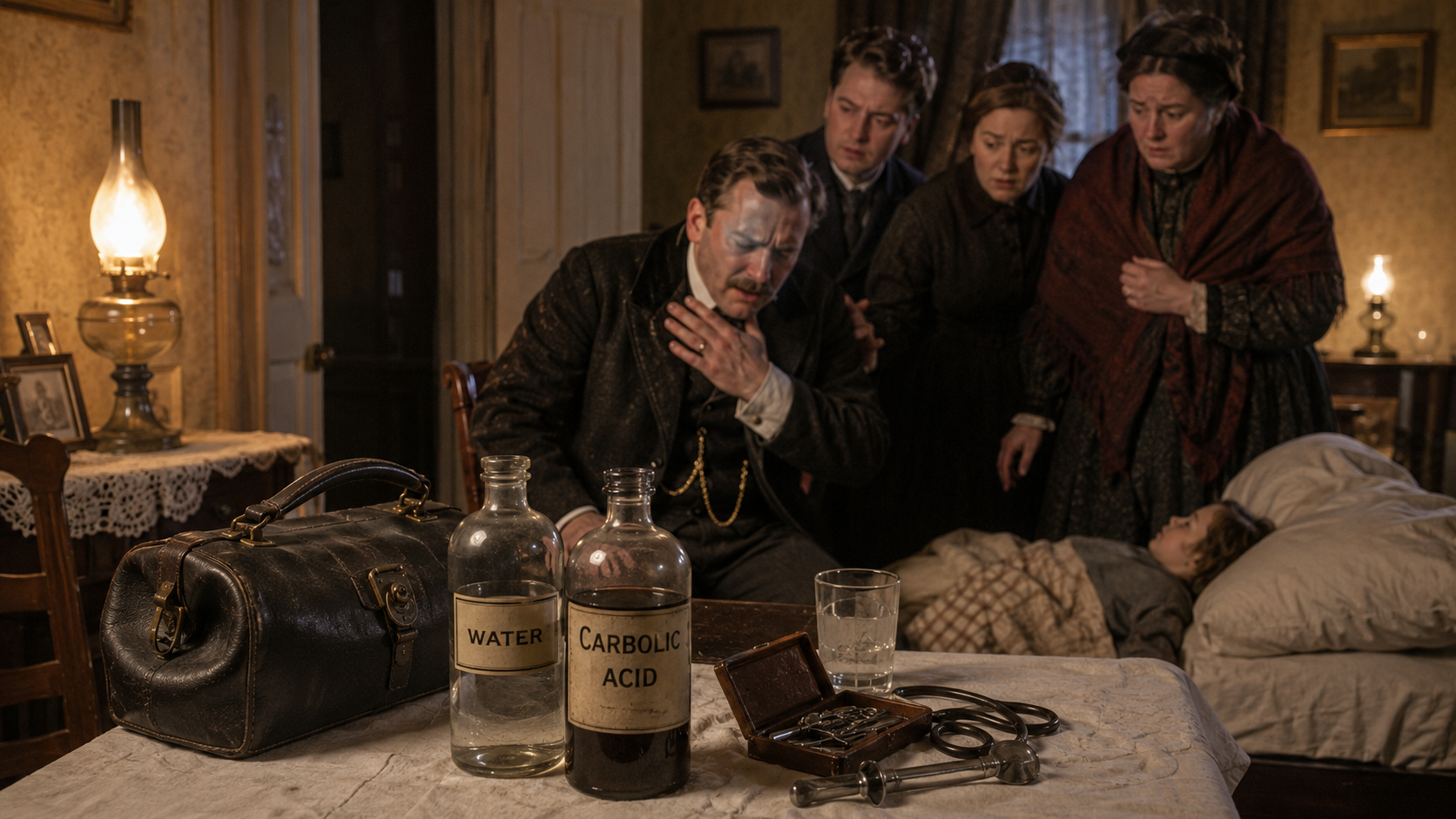
According to the reported sequence, a man named Mulcahy had travelled to obtain Tennant’s assistance for four sick children. On returning to the family home, Mulcahy carried two bottles: one containing whiskey and another holding carbolic acid intended for disinfecting purposes. Both were handed to Mrs Mulcahy while Tennant attended the children in a small bedroom. Carbolic acid was then widely employed as an antiseptic and disinfectant, but it was also a powerful poison. Its presence beside an ordinary drink created a danger that became greater within a poorly illuminated rural interior.
When Tennant had finished treating the children and prepared to leave, Mrs Mulcahy offered him whiskey to warm him before his journey home. Through a mistaken selection of the bottles, carbolic acid was poured instead. The doctor swallowed some of the liquid and immediately understood what had happened. He called for mustard and hot water, then commonly used to induce vomiting, while assistance was sought from Dr O’Callaghan. Despite the efforts made to save him, Tennant died shortly after the second doctor arrived. The contemporary report consistently characterised the poisoning as accidental.
The tragedy demonstrated the dangerous closeness between medicine and poison at the beginning of the twentieth century. Carbolic acid, also known as phenol, had become important in antiseptic practice and domestic disinfection, yet concentrated quantities could severely burn tissue and rapidly poison the body. The Cappamore incident arose not from an unfamiliar substance but from one carried for a useful purpose during an ordinary medical visit. When drinkable and poisonous liquids travelled together in similar containers, poor lighting, hurried handling and a momentary mistake could have irreversible consequences.
Tennant’s death removed a doctor from a rural district in which individual practitioners provided essential care across scattered communities. The story was reported in the Limerick press and later travelled far beyond Ireland, appearing in the New Zealand Tablet in April 1900 for readers among the Irish diaspora. Surviving records do not establish every detail of Tennant’s practice or the precise quantity swallowed, and later accounts differ over the exact date. They agree, however, that Charles Philip Tennant died through an unintended confusion between whiskey and carbolic acid while carrying out his professional duties.
- Limerick Chronicle, 8 February 1900, news report concerning the accidental poisoning of Charles Philip Tennant at Cappamore; death notice published 13 February 1900, as identified in the Limerick Local Studies obituary index.
- New Zealand Tablet, vol. XXVIII, no. 17, 26 April 1900, report from Cappamore concerning Dr Charles Tennant, the Mulcahy family at Rath and the accidental swallowing of carbolic acid.
- “The Death of Doctor Tennant by Poisoning in Murroe, Limerick, Ireland,” Limerick Life, 30 January 2013, later reconstruction of the incident from historical reporting.
-
Mortgage Fetter
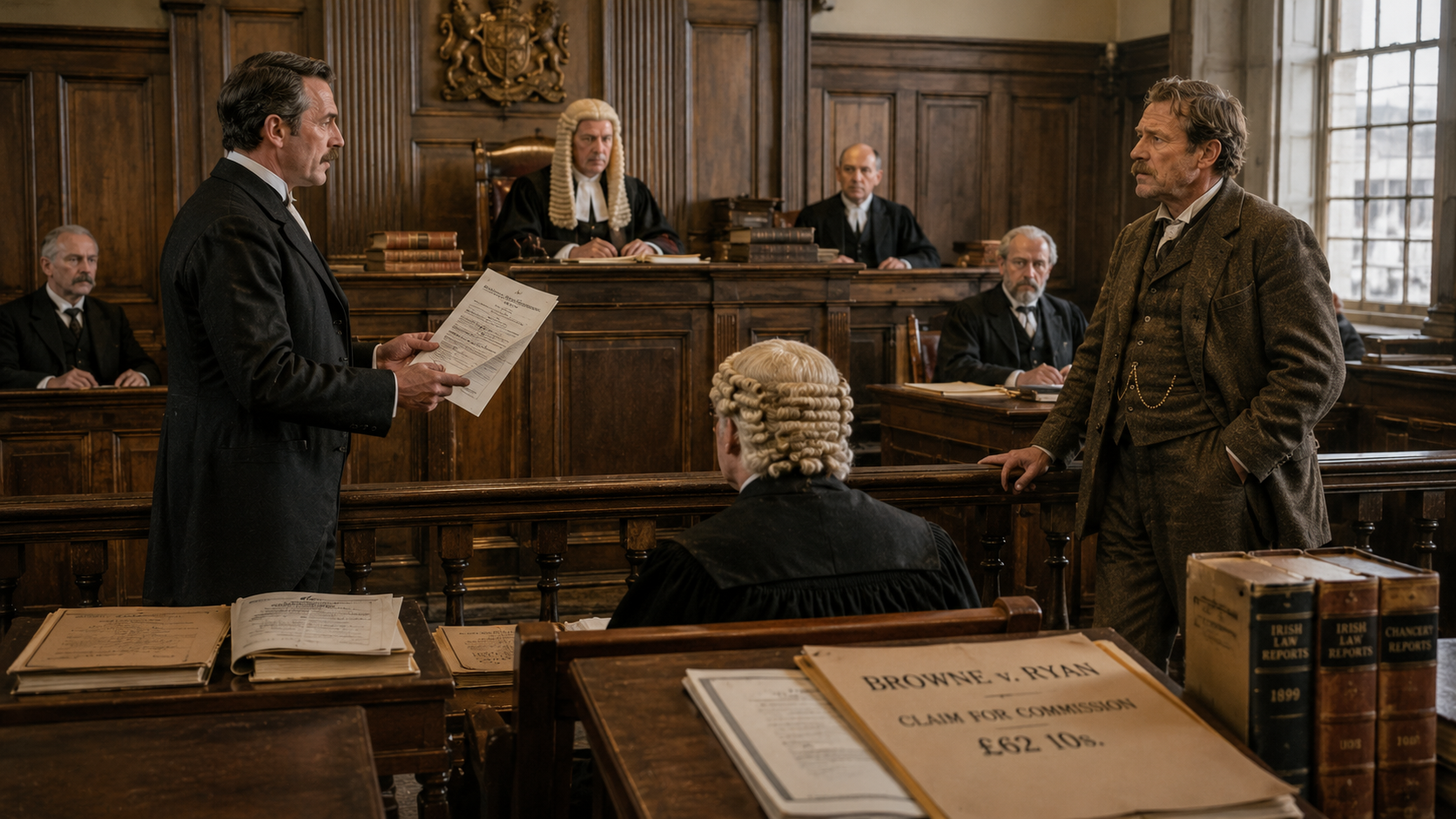
Read Article: Mortgage FetterA mortgage dispute involving County Limerick auctioneer John Browne and Patrick Ryan, a farmer of Ryaninch in County Tipperary, reached the Irish courts in 1900 after Browne sought £62 10s in commission from the sale of Ryan’s property. What appeared to be an ordinary contractual claim raised a larger question about the limits placed upon mortgage lenders. Browne relied upon a separate agreement connected with a £200 loan, but Ryan argued that its terms improperly burdened his right to redeem the mortgaged land and recover complete control once the debt had been repaid.
Ryan had mortgaged lands at Curragh Feakle in County Clare to Browne on 16 June 1898 as security for £200, with interest. Five days later, the parties executed another deed requiring Ryan to sell the property within twelve months through Browne, who was an auctioneer, and to pay him commission of five per cent upon the purchase price. The agreement added that Browne would receive the same commission even if another auctioneer conducted the sale. Both documents formed part of the same financial transaction, although they were contained in separate deeds.
The lands were subsequently sold to a purchaser named Purcell for £1,250 through another auctioneer. Ryan repaid the £200 loan and interest, and Browne reconveyed the property free from the mortgage in November 1898. Browne nevertheless demanded five per cent of the purchase price under the collateral agreement, producing the claim for £62 10s. Ryan resisted payment on the ground that the promise could not be separated from the mortgage. Although the principal debt had been discharged, the commission clause attempted to preserve a further benefit for the lender arising directly from the mortgaged property.
The original trial judge found for Ryan, holding that the agreement constituted an improper clog upon the equity of redemption. A majority in the Queen’s Bench Division later favoured Browne, but the Court of Appeal reversed that decision in November 1900. The appeal judges concluded that a borrower who repaid the mortgage money must regain the land free from an enduring condition created as part of the mortgage transaction. Browne could recover his principal and interest, but he could not enforce an additional advantage that continued to restrict Ryan’s freedom in dealing with the redeemed property.
The ruling reaffirmed the principle commonly expressed in the words “once a mortgage, always a mortgage.” A mortgage could provide lawful security for repayment, but it could not be transformed into a means of obtaining a permanent or oppressive collateral benefit. The case linked a Limerick auctioneer’s commission claim with a doctrine of lasting importance in Irish property law. It also demonstrated how farmers seeking temporary credit might accept complex conditions whose consequences extended beyond repayment. The court’s intervention ensured that redemption restored not merely legal title, but the borrower’s practical freedom to sell and manage the land.
- Browne v Ryan [1901] 2 Irish Reports 653, Court of Appeal in Ireland; argued 6 and 7 November 1900, judgment delivered 23 November 1900.
- The New Irish Jurist, “Browne v Ryan,” report of proceedings on 6, 7 and 23 November 1900, 1 N.I.J.R. 25.
- Law Reform Commission, Consultation Paper on Limitation of Actions, LRC CP 54-2009, Dublin: Law Reform Commission, 2009, paragraph 2.138, note 277.
-
Stud Dispersal
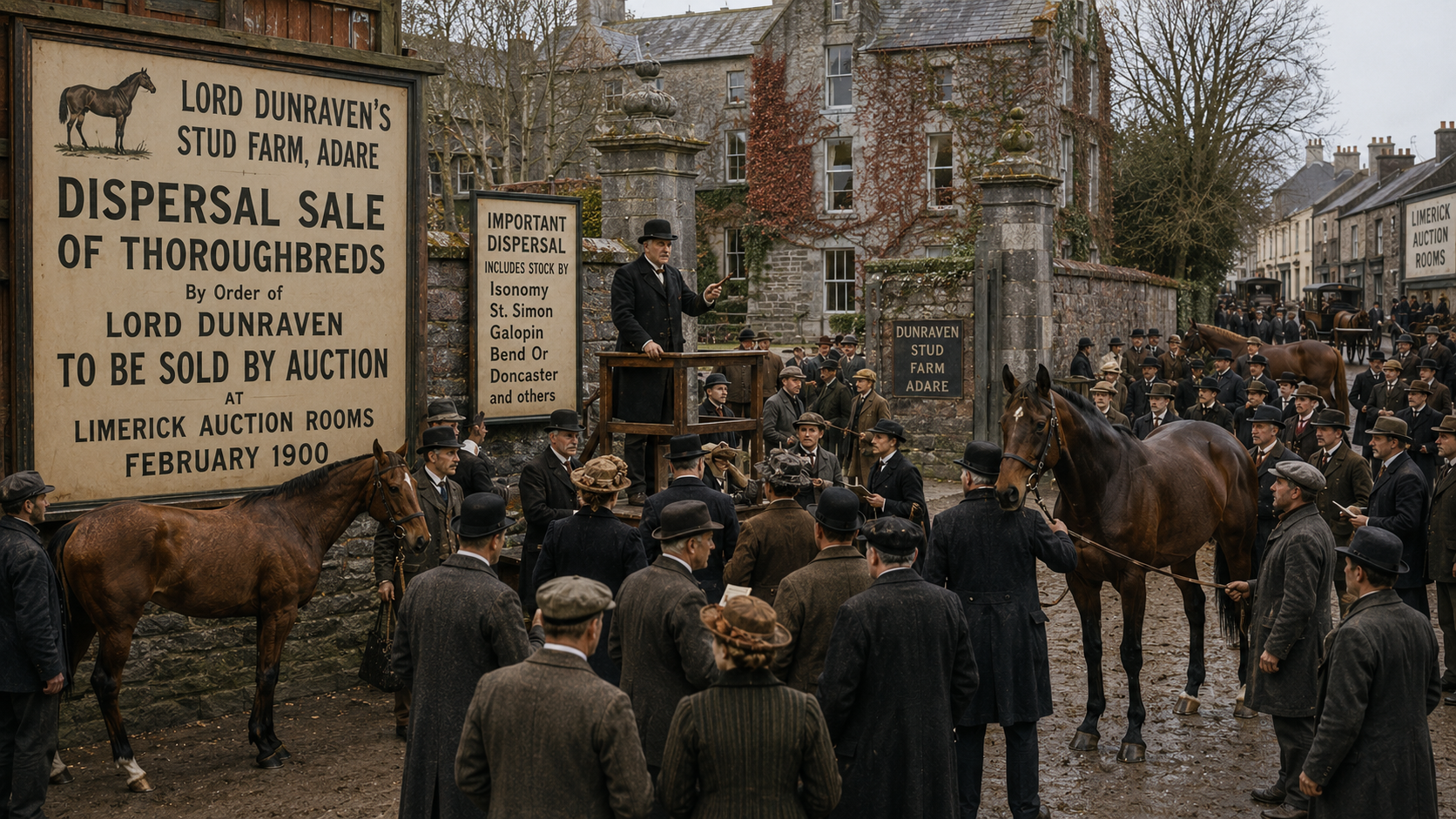
Read Article: Stud DispersalThe Irish racing world received unexpected news in January 1900 when reports announced that Lord Dunraven intended to break up his stud farm at Adare and offer a number of its thoroughbreds by public auction in Limerick the following month. The decision immediately concerned County Limerick, where the Dunraven estate had long influenced employment, social life and sporting prestige. The stud was not merely a private collection of horses. It formed part of Adare’s landed economy and connected the village with breeders, trainers, buyers and racecourses throughout Ireland and Britain.
The fourth Earl of Dunraven, Windham Thomas Wyndham-Quin, had established the Fort Union Stud at Adare in 1876. His interest in racing extended over several decades, encompassing ownership, breeding and earlier experience as a steeplechase rider. The enterprise developed a reputation well beyond the estate, while Dunraven’s horses carried the Adare association into prominent sporting circles. A dispersal therefore represented more than the sale of valuable animals. It suggested a substantial alteration to an undertaking through which aristocratic wealth, agricultural skill and the competitive culture of the turf had been brought together.
The surviving announcement stated that a number of thoroughbreds would be sold publicly in Limerick, but it did not provide a complete catalogue, identify the auction premises or explain why Dunraven had taken the decision. Buyers would have judged each animal through pedigree, age, condition, racing performance and breeding promise, while the sale itself offered local horsemen an unusual opportunity to acquire stock associated with a recognised establishment. For stud employees and others dependent upon the estate’s equestrian activity, however, dispersal also raised practical questions about future work, management and the continuing scale of horse breeding at Adare.
Later evidence shows that the announcement should not be interpreted as proof that every breeding operation at Adare ended permanently. In June 1900, a racing report recorded that the stallion Kirkham was still performing stud duty on the estate. The same report noted the victory of Dunraven’s filly Moanerla, a daughter of Kirkham and Gold Wave, and referred to her full sister Kirschwasser as a multiple handicap winner. These details suggest either that the January plan concerned only part of the stock, that selected horses were retained, or that the proposed dissolution was subsequently modified.
Whatever the final extent of the sale, the announcement revealed the importance of bloodstock to Limerick’s rural and commercial life. Thoroughbreds represented accumulated investment, family pedigrees and years of skilled care, making their movement from one owner to another a matter of sporting as well as financial interest. In Adare, the prospect of dispersal marked a moment of uncertainty around one of the county’s best-known private studs. It also demonstrated how decisions taken within a great estate could reach far beyond its stable yards, affecting workers, traders, breeders and the wider reputation of Limerick horse racing.
- Limerick Archives, “Lord Dunraven’s Stud Farm Dissolution: Impact and Speculation in the Horse Racing Community,” 20 May 2023.
- Milo V. Spillane, “The 4th Earl of Dunraven, 1841–1926,” PhD thesis, Mary Immaculate College, University of Limerick, 2003, p. 113.
- The Queenslander, “Racing Notes,” Brisbane, 30 June 1900, p. 1216.
-
Materials Wanted
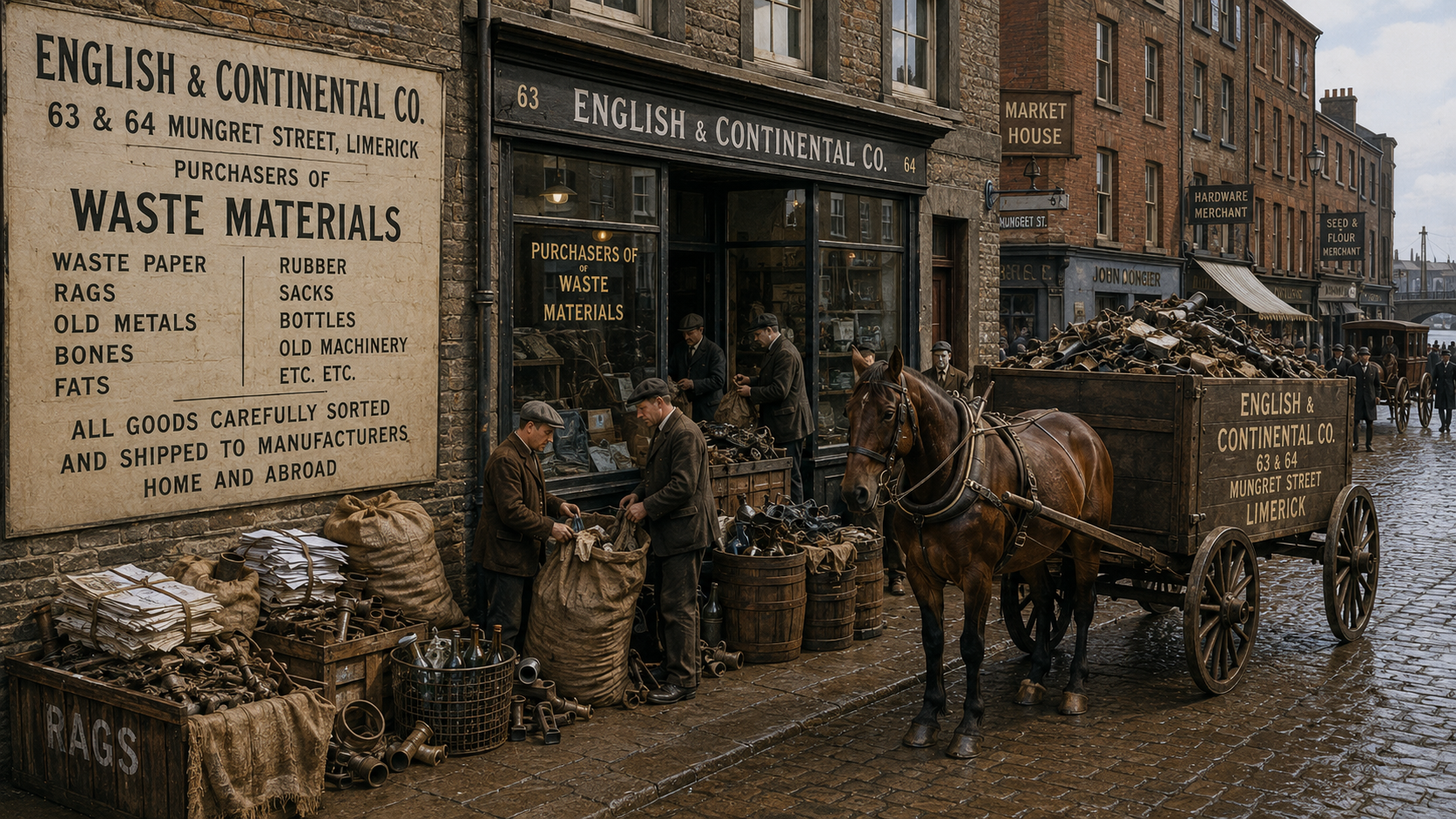
Read Article: Materials WantedLong before recycling became a familiar part of everyday life, the English and Continental Company invited Limerick residents to recognise the commercial value hidden in unwanted materials. Operating from 63 and 64 Mungret Street in 1900, the firm advertised for discarded goods that could be purchased, sorted and returned to productive use. Its premises stood within a busy commercial district close to the city’s markets, workshops and riverside trade. The advertisement reveals an organised local business in recovered materials, connecting household remnants and industrial offcuts with merchants prepared to sell them into wider manufacturing and export networks.
The language of environmental protection did not shape the company’s appeal. Its purpose was commercial: materials commonly regarded as worn out or useless still possessed a price when gathered in sufficient quantities. Dealers could separate, grade and sell recoverable goods to manufacturers requiring cheaper secondary raw materials. For Limerick households, craftspeople and workshops, the arrangement offered a modest payment for articles that might otherwise occupy storage space or be discarded. For the company, profit depended upon recognising potential value where others saw only refuse and upon assembling small individual quantities into marketable consignments.
Mungret Street provided an appropriate base for such an enterprise. The street formed part of Limerick’s Irishtown commercial landscape and lay beside the Milk Market, where agricultural produce, foodstuffs and manufactured goods circulated through the city. Nearby stores, yards and workshops generated residues that could support a trade in reusable material. The English and Continental Company’s double premises suggest that collection required space for receiving, sorting and holding goods before resale. The surviving advertisement does not establish the size of its workforce or the destinations of every consignment, and these details should not be inferred without further records.
Recovery trades formed an established part of nineteenth-century urban economies. Rags could supply paper manufacture, metals could be melted and recast, containers could be reused, while other discarded substances retained value in industrial processing. Dealers occupied an essential but often overlooked position between consumption and manufacture. Their activity reduced the amount of potentially useful material lost from the economy, though it was motivated primarily by demand, scarcity and price rather than modern ecological ideals. The Mungret Street advertisement shows Limerick participating in this practical trade, with reuse governed by the everyday calculations of buyers, sellers and manufacturers.
Viewed from the present, the company’s methods resemble what is now called a circular economy, in which materials remain in circulation rather than passing directly from use to disposal. That modern description must not obscure the harsher circumstances of 1900, when thrift was often a necessity and many people sold unwanted possessions because even a small return mattered. Nevertheless, the advertisement records resourcefulness within Limerick’s commercial life. At 63 and 64 Mungret Street, discarded goods became commodities again, linking ordinary residents and local workplaces to a trade that recovered value through collection, sorting, resale and transformation.
- Freeman’s Journal, 1900, classified advertisement for the English and Continental Company, 64 Mungret Street, Limerick; exact publication date not confirmed in the available index.
- Thom’s Irish Almanac and Official Directory for the Year 1900, Dublin: Alexander Thom and Company, 1900, Limerick city street and commercial listings.
- Charles E. Goad, Insurance Plan of Limerick, 1897, sheets covering Mungret Street and the adjoining commercial district; Leonard Collection, University of Limerick.
-
Excursion Riot
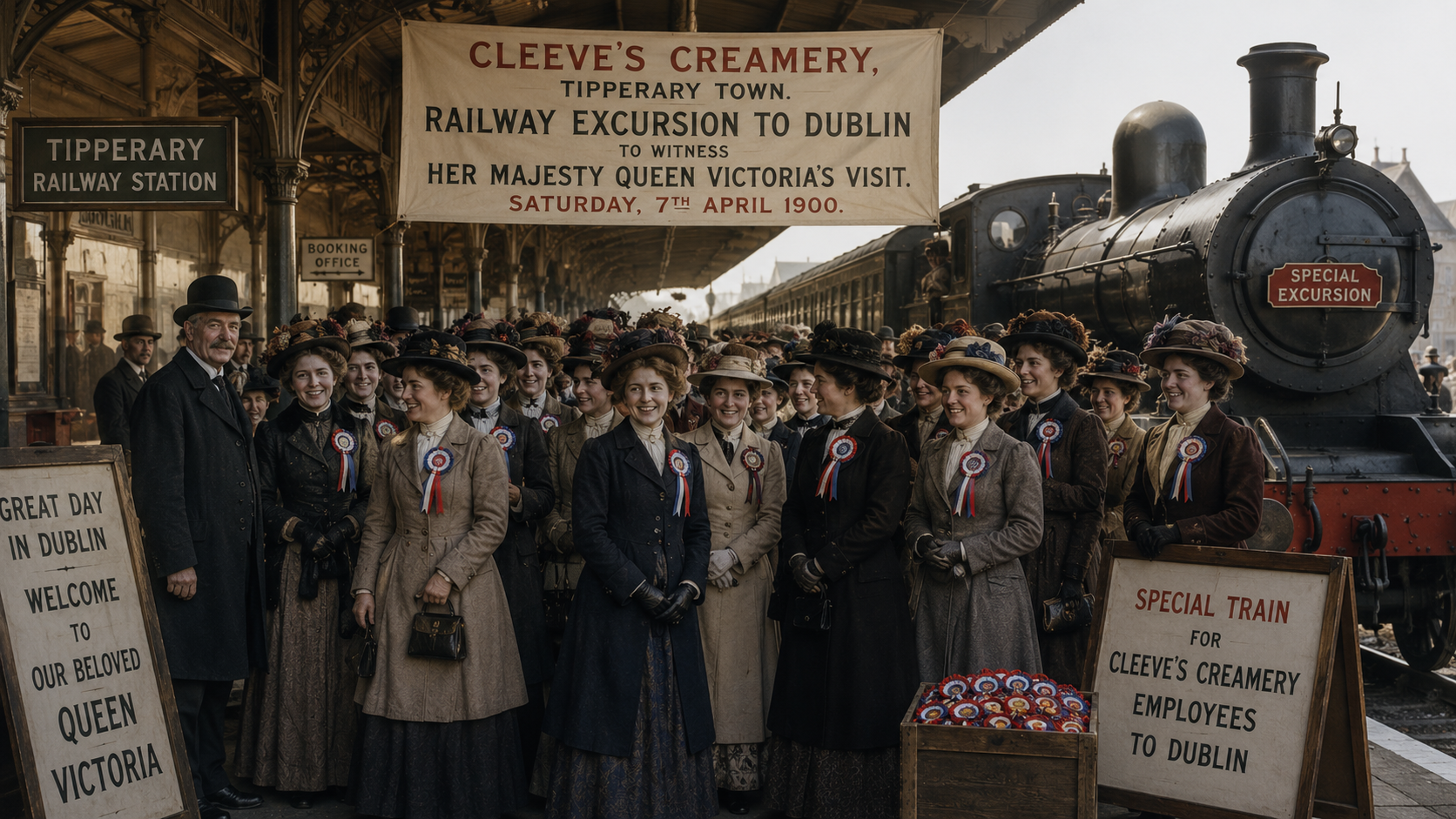
Read Article: Excursion RiotA railway excursion organised by Cleeve’s Creamery in Tipperary town drew the Limerick-based company into public controversy on Saturday, 7 April 1900. The creamery, then the town’s largest employer, arranged a special train to Dublin for its mainly female workforce during Queen Victoria’s final visit to Ireland. Each employee received a rosette in red, white and blue, and the journey was intended as a visible demonstration of loyalty as the royal procession passed through the capital. Because Cleeve’s had its headquarters and industrial identity in Limerick, the episode immediately touched the reputation of one of the city’s most prominent commercial enterprises.
The outing belonged to a wider programme of royal celebration, but it also exposed divisions sharpened by the South African War. Victoria’s visit was presented partly as an acknowledgement of Irish soldiers serving in British forces, while many nationalists regarded the campaign against the Boer republics with hostility. Cleeve’s decision to transport its workers to Dublin therefore carried political meaning beyond an ordinary day away from the creamery. The rosettes, special train and organised attendance identified the employees publicly with the royal occasion, whether every woman shared that enthusiasm or simply accepted an excursion provided by her employer.
When the train returned to Tipperary at about 11.20 that night, a hostile crowd gathered and disorder broke out around the station. Contemporary reports described angry opposition to the excursion and clashes between demonstrators and people whose relatives were serving in South Africa. The disturbance extended beyond shouting and jostling. Approximately forty tons of hay belonging to the creamery were set on fire, creating a large protest bonfire. One reported remark suggested that if Cleeve could pay for an excursion, he could also pay for the blaze, linking the destruction directly with resentment of the company’s sponsorship.
The surviving evidence points principally to political and communal antagonism, rather than establishing that overcrowding, drink or inadequate supervision caused the trouble. Bonfires already formed part of the town’s radical protest culture, and the attack upon company property gave the evening a deliberate symbolic character. The crowd’s hostility was directed not merely towards railway passengers returning from an outing, but towards what the excursion appeared to represent: loyalty to the Crown, support for an imperial war and the authority of a powerful employer. Workers caught in the confrontation occupied an uncomfortable position between company discipline, personal belief and local pressure.
For Cleeve’s, the episode demonstrated how closely commercial reputation could become entangled with politics. The company linked Limerick’s industrial economy to creameries, farmers and employees across Munster, so events at its Tipperary works could reverberate at headquarters on the Shannon. The damaged hay imposed a material loss, while reports of the riot associated the organised excursion with coercion and division. More broadly, the incident revealed that organised leisure was not politically neutral in 1900. A special train intended to reward workers became a public test of loyalty during a royal visit conducted beneath the shadow of war.
- Tipperary People, Friday, 13 April 1900, report concerning the Cleeve’s Creamery excursion and the disturbance following the train’s return.
- Tipperary People, Friday, 20 April 1900, further reporting concerning the excursion and subsequent disorder.
- Clonmel Chronicle, Wednesday, 11 April 1900, contemporary Unionist account of the disturbance at Tipperary.
- Clonmel Chronicle, Saturday, 21 April 1900, subsequent coverage of the Cleeve’s excursion controversy.
- Denis G. Marnane, “Tipperary Town One Hundred Years Ago: Issues of Identity,” Tipperary Historical Journal, 2022, pp. 169–170, 191.
- Shaun Boylan, “Cleeve, Sir Thomas Henry,” Dictionary of Irish Biography, Royal Irish Academy, Dublin.
- David Lee, “The Munster Soviets and the Fall of the House of Cleeve,” in Made in Limerick, Limerick Civic Trust.
-

Election Violence
Read Article: Election ViolenceThe South Mayo by-election of February 1900 drew Limerick directly into a bitter struggle over the direction of Irish nationalism. John Daly, the veteran Fenian then serving as Mayor of Limerick, travelled to County Mayo to support Major John MacBride, whose candidature was promoted while he fought beside the Boers in South Africa. Daly’s intervention carried symbolic importance: a former political prisoner and leading republican, he represented a separatist tradition sharply critical of parliamentary dependence upon Westminster. Reports that he was attacked during the campaign showed how readily political argument could pass into physical intimidation.
The vacancy had arisen when Michael Davitt resigned his parliamentary seat in protest against the South African War. The United Irish League selected John O’Donnell, its organiser in Mayo, while the Irish Transvaal Committee supported MacBride as an independent nationalist candidate. Neither man participated personally in the contest. MacBride remained in South Africa commanding the Irish Transvaal Brigade, and O’Donnell was confined in Castlebar Gaol following a coercion prosecution. Their absence transformed the election into a contest between rival organisations, newspapers and prominent campaigners who claimed to represent Ireland’s authentic national will.
MacBride’s supporters presented his candidature as a declaration against British imperial rule and an expression of solidarity with the Boer republics. O’Donnell’s advocates argued that the United Irish League offered a disciplined political organisation capable of restoring nationalist unity and advancing land reform. Michael Davitt and William O’Brien supported O’Donnell, while John Daly and the veteran Fenian John O’Leary campaigned for MacBride. The quarrel therefore crossed older divisions between parliamentarians, Fenians and emerging advanced nationalists. Agreement in opposing the war did not produce agreement over leadership, organisation or the usefulness of representation in the British Parliament.
The most disturbing episode associated with Daly’s intervention occurred at Ballinrobe, where a contemporary account reported that the Mayor of Limerick was attacked during a political meeting. The available evidence does not securely identify every assailant or establish the extent of any injury, but the report indicates an atmosphere in which rival crowds could subject visiting speakers to threats and physical pressure. Daly’s prominence made the incident especially serious. An assault upon a city’s mayor, while he supported a nationalist candidate in another county, demonstrated how factional loyalty could overwhelm the public dignity normally attached to civic office.
The result announced on 28 February was decisive. O’Donnell received 2,401 votes against MacBride’s 427, giving the United Irish League an overwhelming victory despite a turnout of only 31.2 per cent. The defeat exposed the limited electoral strength of the Irish Transvaal Committee and showed that admiration for MacBride’s service with the Boers did not necessarily translate into votes. For Limerick, Daly’s involvement and the reported attack linked local republican politics with a national contest over unity, constitutional action and resistance to empire. The campaign revealed a movement seeking reunion while remaining capable of profound internal hostility.
- The Times, “Election Intelligence,” no. 36077, London, Wednesday, 28 February 1900, p. 9.
- The Times, “Election Intelligence,” no. 36078, London, Thursday, 1 March 1900, p. 6.
- The United Irishman, Saturday, 3 March 1900, coverage and commentary concerning the South Mayo by-election result.
- The United Irishman, Saturday, 10 March 1900, post-election commentary concerning John O’Donnell and John MacBride.
- Brian M. Walker, ed., Parliamentary Election Results in Ireland, 1801–1922, Dublin: Royal Irish Academy, 1978, pp. 367, 394.
- John Drumm, “Divided Loyalties: The Effect the Boer War and its Aftermath had on how Irish Nationalists Interpreted the Irish Soldier Serving in the British Army,” British Journal for Military History, vol. 1, no. 1, October 2014, pp. 88–89.
- Ciarán Ó Gríofa, “John Daly, the Fenian Mayor of Limerick,” in David Lee, ed., Remembering Limerick: Historical Essays Celebrating the 800th Anniversary of Limerick’s First Charter Granted in 1197, Limerick: Limerick Civic Trust in association with FÁS, 1997, pp. 197–204.