Now Sharing: Articles (154) | Images (445) | Total Items Archived (599)
Our Mission: 100,000 Items | Total Percentage Achieved (0.60%)

Unity Fractures

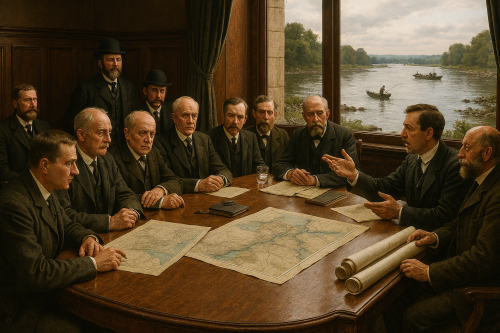
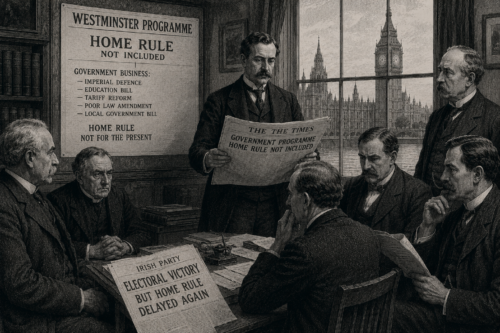
The completion of the general election has shown that the reunion of Irish parliamentary nationalism remains incomplete. Although John Redmond’s Irish Parliamentary Party has secured the overwhelming majority of nationalist seats, six supporters of Timothy Michael Healy have been returned outside the disciplined party organisation. The result will attract close attention among nationalists in Limerick city and county, where unity has been presented as essential to advancing Home Rule and land reform. Healy’s surviving parliamentary following demonstrates that the personal, clerical and local rivalries created during the bitter divisions of the 1890s have not been entirely overcome.

Teampall Nua in Ruins

The old church near Holycross, County Limerick, was recorded as a ruin by 1642. In 1679, Rachael Bourchier, Countess of Bath, restored the building, just one year before her death. Thereafter it became known as the New Church, or Teampall Nua in Irish, and served local Church of Ireland parishioners. A belfry was added during the restoration, giving the structure a distinctive profile. Although the church later fell out of use and returned to ruin, its surviving walls, arched openings and graveyard remain important reminders of seventeenth-century religious life and the long history of worship at this historic site today.

Royal Farewell

Queen Victoria arrived at Kingstown today for what would prove to be her final visit to Ireland, beginning a three-week residence centred largely upon Dublin and the Vice-Regal Lodge in Phoenix Park. Although the royal party will not travel to Limerick, accounts of the landing, the ceremonial procession and the extensive public decorations are already attracting attention throughout the city and county. Unionist residents may regard the visit as an affirmation of loyalty to the Crown, while nationalists are likely to judge it against continuing demands for Home Rule, land reform and recognition of Ireland’s political grievances.

Glenduff Castle Restored

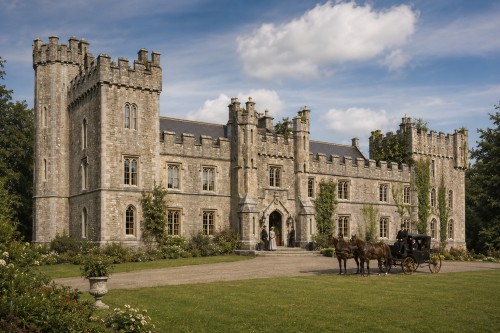
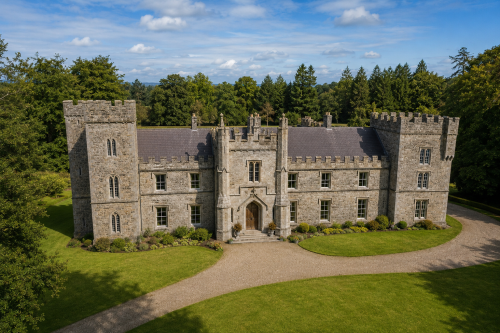
This reconstructed view presents Glenduff Castle in County Limerick as it may have appeared before its destruction in 1922. The imposing residence combines the fortified character of an earlier seventeenth-century tower house with the Gothic Revival additions created for the Ievers family around 1840. Tall crenellated towers, pointed windows, battlements and a formal central entrance give the building a commanding presence. Set within carefully maintained lawns and mature woodland, the castle reflects the scale and confidence of a nineteenth-century Irish country estate. The image offers a plausible visual impression rather than a definitive record of its original appearance or grandeur.

Inside Gurranmore Police Cabin

Around 1880, the interior of a police cabin at Gurranmore, near Pallas in County Limerick, reveals the modest conditions in which rural constables lived and worked. The small room is sparsely furnished, with simple wooden fittings, basic household utensils and few comforts. Uniformed officers occupy the cramped space, suggesting that the cabin served as both workplace and living quarters. Published in The Graphic in 1880, the image offers a rare glimpse of everyday policing in nineteenth-century Ireland. It preserves not only the appearance of the station, but also the disciplined, isolated life experienced by men posted in rural communities nearby.

Limerick from the Shannon, c. 1850s

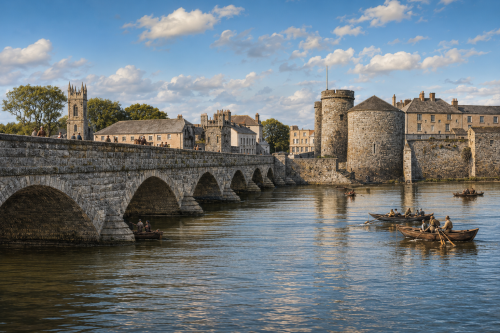
By the mid-nineteenth century, Limerick remained one of Ireland's most strategically significant river cities, its fortunes long tied to the Shannon as a route for trade, defence, and settlement. The medieval walls and towers still visible in this period recalled centuries of contested history, from Norman fortification to the sieges of the seventeenth century that shaped the city's identity. Alphonse Dousseau's romanticised depiction reflects a wider mid-Victorian fascination among European artists with Ireland's older townscapes, capturing Limerick at a moment when its historic core coexisted with the pressures of modernisation, emigration, and post-Famine recovery reshaping much of the country during this era.

Blossom Gate, Kilmallock

Blossom Gate is the last surviving medieval gateway of Kilmallock, County Limerick, once one of Ireland’s most strongly fortified towns. Originally one of five entrances through the defensive walls, it alone remains; St John’s, Water, Ivy and Friary gates have disappeared. Standing on Emmet Street, the three-storey stone tower spans the roadway above a pointed arched vault, marking where the town walls formerly joined it. The name may derive from “Blae Gate” or from the Irish word blá, meaning flower or blossom, combined with the French porte, meaning gate. Today, it is a prominent reminder of Kilmallock’s medieval importance and heritage.

1916 Memorial, c.1940s

On Sarsfield Bridge in 1940s Limerick, the 1916 Memorial rises proudly beside the roadway, enclosed by green iron railings and watched over by elegant lamps. Its pale stone pedestal supports bronze figures commemorating the Rising, their solemn poses lending dignity to the riverside setting. Trees line the background, softening the urban scene and framing the monument against a bright open sky. Pedestrians in period dress walk along the bridge, suggesting ordinary city life continuing around a place of remembrance. The image captures civic pride, republican memory, and the enduring presence of national history within Limerick’s daily landscape and local identity.

St Mary’s Church

St Mary’s Church stands on Athlunkard Street in Limerick, occupying a site associated with Catholic worship since the eighteenth century. The present church opened in 1932, replacing an earlier chapel where Mass was first celebrated on December 10, 1749. Designed by Ashlin and Coleman of Dublin, the building reflects the scale and ambition of parish church architecture in early twentieth-century Limerick. Its tower, façade, railings and street setting mark an important local landmark, while the surviving holy water font from the former chapel links the modern church with the long religious history of St Mary’s parish community today.