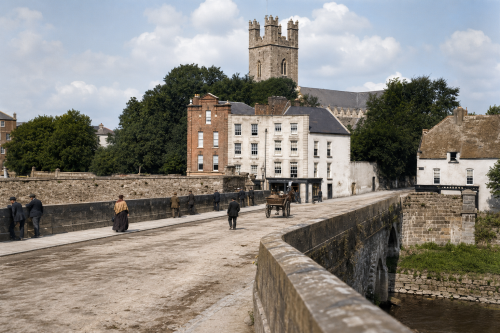
Mathew Bridge, Limerick

Mathew Bridge, completed between 1844 and 1846, forms an important crossing over the Abbey River in Limerick City. Designed by William Henshaw Owen, the triple-span ashlar limestone structure features segmental arches, rounded breakwaters and a broad flat roadway. It linked Rutland Street and Bank Place with Bridge Street and Merchant’s Quay, connecting the Georgian commercial quarter of Newtown Pery with medieval Englishtown. The bridge replaced the inadequate New Bridge of 1762 and accommodated the city’s growing Victorian traffic. Named for Father Theobald Mathew, the celebrated temperance reformer, it remains a notable example of nineteenth-century Irish civic engineering and urban development.
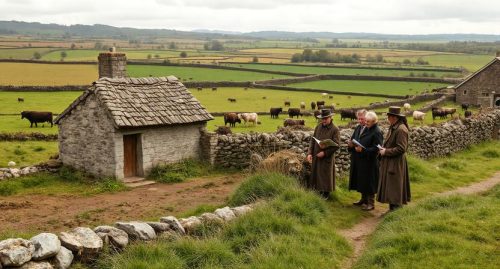
Holdings Enlarged

Campaigners are demanding that uneconomic smallholdings be enlarged through the redistribution of extensive grazing land. The United Irish League argues that thousands of rural families remain confined to farms too small or too poor to provide a secure livelihood while nearby grasslands support cattle but comparatively few people. Its organisers want owners and large occupiers to release untenanted land so that neighbouring holdings may be expanded. In County Limerick, where the size and quality of a farm often determine whether a family can remain at home, the proposal will be judged as both an agricultural reform and a defence against emigration.

Baker Place, Limerick c.1900

At Baker Place in early twentieth-century Limerick, Saint Saviour’s Dominican Church stands at the centre of a broad cobbled streetscape, its Gothic stone façade, rose window, pointed arches, and carved doorways giving the scene a strong ecclesiastical presence. To the right, Tait’s Clock rises above the roadway as a civic landmark, balanced by red-brick industrial buildings and smoking chimneys behind it. Period pedestrians, a horse-drawn cart, street lamps, and a small wooden kiosk add everyday activity. The view captures a city shaped by faith, industry, commerce, public memory, and the architectural confidence of Edwardian urban life in Limerick’s historic core.

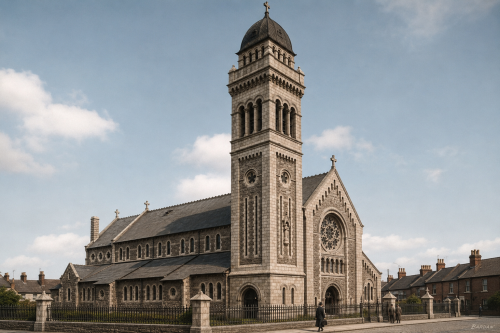
St Mary’s Church

St Mary’s Church stands on Athlunkard Street in Limerick, occupying a site associated with Catholic worship since the eighteenth century. The present church opened in 1932, replacing an earlier chapel where Mass was first celebrated on December 10, 1749. Designed by Ashlin and Coleman of Dublin, the building reflects the scale and ambition of parish church architecture in early twentieth-century Limerick. Its tower, façade, railings and street setting mark an important local landmark, while the surviving holy water font from the former chapel links the modern church with the long religious history of St Mary’s parish community today.

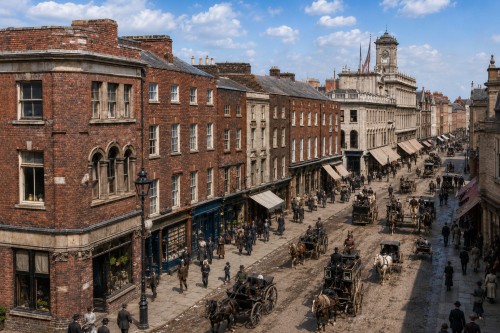
The Heart of Edwardian Limerick

At the beginning of the twentieth century, George Street stood at the centre of commercial life in Limerick. Today known as O’Connell Street, it was bordered by impressive Georgian buildings housing hotels, shops, offices and established local businesses. Horse-drawn carts, private carriages and crowds of pedestrians moved constantly along the busy thoroughfare, while traders brought additional noise and colour to the scene. Landmarks included the Royal Hotel, MacMahon’s Temperance Hotel and firms such as O’Mahony & Company. The street’s elegant architecture and lively commerce made it one of Edwardian Limerick’s most important and recognisable urban spaces for residents and visitors.

Now Sharing: Articles (182) Images (603) Total Items Archived (785)
Our Mission: 100,000 Items Total Percentage Achieved (0.78%)